Making Sense of Space Weather: Q&A with Physicist Robyn Millan
Feature Story
Last update February 4, 2025
Robyn Millan is a physicist and Margaret Anne and Edward Leede ’49 Distinguished Professor at Dartmouth College. She co-chaired the study committee that produced the recent National Academies report The Next Decade of Discovery in Solar and Space Physics. Millan chatted with writer Sara Frueh about space weather, how it affects humans, and how scientists can get better at forecasting it.
For starters, what is space weather?
Millan: I consider space weather to be any of the aspects of the space environment — whether it’s activity on the sun or in the space environment more generally — that has an impact on humans and our technological systems.
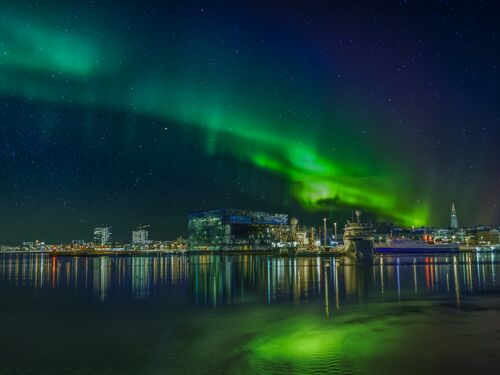
One form of space weather many people are familiar with are the aurora — the northern and southern lights. They’ve been visible in more places than usual recently. What’s driving that uptick in activity?
Millan: It’s been known for hundreds, maybe thousands, of years that the sun has a cycle that periodically results in more solar flares. We now know that this happens because every 11 years, the sun’s magnetic field flips direction. During that transition, the magnetic field goes from being orderly to being kind of twisted up.
You can think of magnetic field lines as being like rubber bands, where, when you stretch them, they store energy, and then that energy can be released. When the sun’s magnetic field lines are getting twisted and stretched, and then that’s released — that’s when we get a solar flare.
So, every 11 years, we reach a “solar maximum” where we get more of this activity. We’re moving into solar maximum this year, and that’s why we’re seeing this increased activity. We’ve already seen some big solar storms — one in May, and another one in October.
During solar storms, there are more solar flares and more coronal mass ejections. The flare is like the bright flash that we see. A coronal mass ejection is when a huge chunk of the sun — millions of tons of solar material, an ionized gas called plasma — is ejected into space. If it happens to be coming towards the Earth, it can hit our magnetic field and cause major disturbances, including the aurora.
What other kinds of disturbances do solar flares and storms cause? How do they affect us here on Earth?
Millan: One system that can be affected is aviation. When there’s a large event on the sun, solar energetic particles — mostly protons — can come toward the Earth. Protons can cause damage to human tissue; it’s radiation exposure — basically like getting a lot of X-rays. Now, down here on Earth, we’re mostly protected by our atmosphere, but when you’re on an airplane, you’re higher and you’re more exposed to that radiation coming from the sun.
If we want to go to Europe from here in the U.S., we usually fly over the pole because it’s faster.
But because of the way Earth’s own magnetic field works, it’s very easy for solar particles to access the polar regions. And during a solar storm, the number of particles is elevated, so it becomes a dangerous radiation environment for airplanes to fly through. That’s when the airlines will divert their airplanes so that they’re not flying over the poles. That’s definitely one of the big potential impacts of space weather.
Another sector that solar storms can affect is the power industry. When a coronal mass ejection hits Earth’s magnetic field and disturbs it, it can cause large currents to flow in the ground and in power lines and in pipelines … this is what led to a massive power outage in Quebec in 1989. They had really large currents that the system wasn’t designed for, and some transformers blew out.
Today, power companies have ways to mitigate that and make sure it doesn’t blow up their infrastructure, but they need a little advance warning. If they know a coronal mass ejection is on the way, they can take action to protect that infrastructure.
The other big impact is on communications. Your GPS uses radio communications that travel from satellites in space to the ground. Pilots and others in aviation use high-frequency radio to communicate. All of those go through the ionosphere, which is part of our atmosphere. When we have a large solar event, the ionosphere can get disturbed, and that can cause errors in GPS, and it can cause blackouts where radio communications can’t get through.
Those are the major impacts for us here on Earth. Space weather will also affect humans as we potentially venture further out to other planets. There are impacts on human health, spacecraft, and electronics that we’ll need to consider.
How far in advance can scientists predict solar storms or flares? How much warning are they able to give power grid operators and others who might be affected?
Millan: NOAA has satellites that are looking at the sun, and we can see a flare or coronal mass ejection go off. And typically, we have something like two to three days before a CME reaches Earth. So, we have a decent amount of advance information. We have satellites that can tell us the speed of the solar wind, so they can usually do a pretty good job at predicting if a CME is headed our way and when it is going to arrive.
But we’re not as good at predicting a flare in the first place. It’s also hard to predict how likely a flare is to cause a major storm. So, there can be false alarms, similar to how things used to be 10 years ago with hurricane prediction — there were a lot of cases where people get upset because they evacuate, and then nothing happens. The same thing can happen with space weather. Scientists make predictions about whether there’s a chance of a G5 solar storm — kind of like a Category 5 hurricane — but the quality of our predictions about the size of a storm is not very good right now.
Did your report recommend ways to improve forecasting for space weather?
Millan: We identify some goals for space weather, and most of those are related to increasing the lead time with more accurate predictions — like greater than 12 hours’ notice prior to a solar flare or coronal mass ejection, for example.
So, we identified goals, and then some focus areas — or themes — for research to achieve them. For example, one of the themes is better understanding the drivers of space weather — solar flares and things happening in the sun. And another theme for research is better understanding the impacts on technological systems and on human health.
Some of the recommendations are targeted to helping the federal agencies coordinate their efforts to make progress on those research areas. The agencies have different roles, but it’s really critical that they’re working together toward the same outcomes.
Space weather is an applied science, and it needs to be driven by the user community. NOAA understands the user community — they interact a lot with commercial providers and the power industry and others. They do surveys to ask, what kinds of predictions do you need? So, we want to make sure that the results of those user surveys are feeding into the goals that NASA and NSF are prioritizing for their space weather research programs. We also recommend that NASA's Space Weather program be expanded.
One last question, going back to the aurora. As a scientist, when you see the northern or southern lights, how do you experience that? In the same way everyone else does, or does your brain immediately go to a scientific place?
Millan: I think if you see the aurora enough times — and I haven’t seen it enough times to get to this stage — maybe you see it and think, “Wow, look at all of those curtains rolling around — what’s causing all that structure?” And when I see images of the aurora, I ask those kinds of scientific questions.
But when I’ve seen it in person — I was up in Churchill, Manitoba, for a balloon launch a number of years ago, that’s where I’ve seen the best aurora — it’s still just wonder and awe, right? It’s just an amazing thing.
And it’s the most visible manifestation of our connection to the space environment. The aurora is so dynamic — it’s changing so much, and it comes and goes — that I think it connects us to our place in space a bit more quickly than anything else.
Featured Publication
The Next Decade of Discovery in Solar and Space Physics: Exploring and Safeguarding Humanity's Home in Space
Consensus Study Report
·2025
Groundbreaking advances in solar and space physics have provided key insights into the dynamic physical processes on the Sun and its influence on Earth, the near-Earth space environment, other planets in our solar system, and beyond. As we look to the next decade, future discoveries in the field wil...
View details