Climate Security in Central America: Proceedings of a Workshop (2024)
Chapter: 3 Climate Security Indicators
3
Climate Security Indicators
To advance the workshop’s goal of developing an integrative systems understanding of climate security risk, the Indicators section of the workshop considered key metrics for climate-related security risks in Central America, beginning with a panel discussion featuring three invited experts. Dr. Fernando Riosmena, of The University of Texas at San Antonio, explored the relationships between climate change and human mobility in the region. Dr. Iliana Monterroso, of the Climate and Land Use Alliance, described the complex links between natural resource governance, climate vulnerability, and migration across northern Central America. Dr. Horacio Riojas, of the National Institute of Public Health of Mexico, presented on the health and food security risks driven by climate change impacts in the region. Dr. Maureen Lichtveld, of the University of Pittsburgh and a member of the workshop planning committee, moderated the panel discussion. The Indicators section of the workshop also included a series of structured discussions, in smaller groups, to develop ideas for indicators for climate-related security risks in the region. The section concluded with a discussion in plenary led by Dr. Brian O’Neill, of the Pacific Northwest National Laboratory and chair of the workshop planning committee.
LIKELY IMPACTS OF CLIMATE CHANGE ON (IM)MOBILITY
In his remarks, Riosmena provided an in-depth examination of the state of research on the nuanced relationships between climate change and human mobility in Central America. He noted that this is an issue of great interest across academia, journalism, and the policy community given concerns that climate impacts may drive substantial future migration flows. However, Riosmena
emphasized that the links between climate factors and mobility remain complex and ambiguous, requiring more rigorous empirical analysis. Experts suspect that, thus far, climate change has not caused mass displacement in the region. While some climate-related mobility occurs, especially surrounding extreme weather disasters, climate factors have also reduced migration in some instances. Riosmena stressed that these effects in either direction tend to be relatively small in magnitude based on the available data.
According to Riosmena, climate change intersects with numerous other forces to shape human mobility in fluid, highly contextual ways across time and place (see Figure 3-1). Exposure to a climate hazard or environmental stressor constitutes just one variable within an interconnected system. Critically, the sensitivity of local populations and their adaptive capacities fundamentally mediate how climate impacts translate into mobility outcomes. Where vulnerability is higher, the same climate stimulus may immobilize populations who lack the resources to move to safety. But with greater resilience, mobility may increase as an adaptive strategy. Riosmena cautioned that the empirical record thus far does not reveal clear threshold conditions or criteria that universally result in heightened versus reduced mobility under climate change. Both outcomes occur, sometimes in close proximity, illustrating the pivotal roles of local institutions, capacities, and response interventions in filtering climate signals into mobility impacts. This complexity highlights the benefits of more interdisciplinary data collection and analysis to develop a sophisticated, context-specific understanding.
Regarding evidence, Riosmena noted that Central America has experienced climate displacement concentrated around major natural disasters, such as hurricanes. For example, Hurricane Mitch in 1998 displaced hundreds of thousands of people in the short term. However, research also indicates that extreme events frequently reduce migration over the longer term, especially in highly vulnerable populations, as people struggle to rebuild in place. In contrast, disasters can spark greater mobility out of less vulnerable areas with robust migrant networks, since remittances finance recovery. In this way, supported mobility can serve as a climate coping mechanism with mixed societal effects.
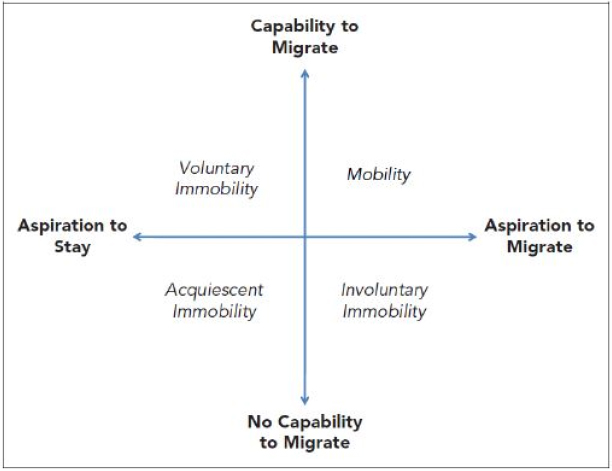
SOURCE: Schewel (2020).
Riosmena cited specifics from migration studies following disasters. For instance, research shows hurricanes increase U.S.-bound international mobility out of countries with more established U.S. migrant communities (Mahajan and Yang, 2020). Within countries, extreme events tend to first spur internal rural–urban mobility. Cross-national studies reveal negative relationships between disasters and migration in poorer countries, likely from immobilization (Cattaneo and Peri, 2016). Riosmena’s work in Mexico found higher U.S. migration from moderately vulnerable areas compared with extremely high or low vulnerability communities. He argued that this aligns with his notion that the most vulnerable people are also the most lacking in mobility options during crises.
In terms of indicators, Riosmena contended that it will be critical to monitor how climate extremes interact with local institutional and socioeconomic conditions to enable different mobility responses. Since the pathways remain uncertain, he emphasized that ensuring the availability of supported, voluntary mobility options could provide lifesaving flexibility during climate shocks. However, evaluating areas facing heightened risk of involuntary immobility also matters given their need for in situ adaptation assistance. As climate impacts accelerate, Riosmena noted, policymakers will face intensifying and divisive migration dilemmas that involve evidence-based indicators and policies centered on human security.
NATURAL RESOURCE GOVERNANCE TO STRENGTHEN RESILIENCE IN THE NORTHERN TRIANGLE
Monterroso presented on the complex links between natural resource governance, climate vulnerability, and migration across Guatemala, Honduras, and El Salvador. She explained that Mesoamerica contains incredible ecological and cultural richness because of traditional governance systems of indigenous communities. However, she said that these ecosystems face threats in that they are politically controlled by local elites, which worsen migration pressures. For context, Monterroso observed that the three countries have around 40% rural populations and high youth shares. Although Guatemala and El Salvador have recently made progress in reducing inequality, poverty remains deeply entrenched. Mobility has long served as an adaptation strategy for marginalized groups. Key migrant spikes occurred around political-economic crises and disasters such as Hurricane Mitch in 1998. Although men migrate predominately, women’s mobility has risen since 2010. The three nations now comprise the world’s top sources of unaccompanied child migrants to the United States. Despite risks, deportations continue to increase (Peri and Zaiour, 2023).
Monterroso explained that remittances are now pivotal to these economies, comprising around 25% of gross domestic product, up from negligible levels historically (Plaza, 2023). While this has not changed the importance of agriculture for livelihoods, remittances have financed shifts in land use, such as forest conversion and cattle ranching. Migration patterns relate to such factors as gender, age, and motivations that shape remittance uses. For example, women’s mobility often increases agricultural workloads at home. Moreover, Monterroso noted that territorial infiltration by criminal groups has driven internal displacement and migration recently through violent land seizures; furthermore, the government’s inability to protect land rights enables illegal claims. Alarmingly, outright land grabbing supports criminal expansion into activities such as drug trafficking and illegal logging, as on Honduras’s Atlantic coast (McSweeney et al., 2018). However, Monterroso argued, opportunities exist to strengthen climate resilience by securing community forest rights. For instance, Guatemala’s creation of community forest concessions enabled sustainable forestry enterprises that provide incomes rivaling remittances (see Figure 3-2). Community monitoring has preserved these forests and bolstered adaptation capacities. Although Honduras also has a history of communal forests, these areas now face threats. Action to recognize indigenous resource rights is important for building resilience and preventing further migration waves.
Monterroso contended climate change interacts with ineffective natural resource governance, inequality, and unaddressed development gaps to drive displacement and migration. However, examples such as Guatemala’s forest concessions illustrate that supporting communal tenure and climate-resilient livelihoods provides concrete alternatives. While daunting challenges remain, strategic partnerships with indigenous and civil society groups committed to defending rights, territories, and climate-vulnerable communities can chart a path toward resilience.
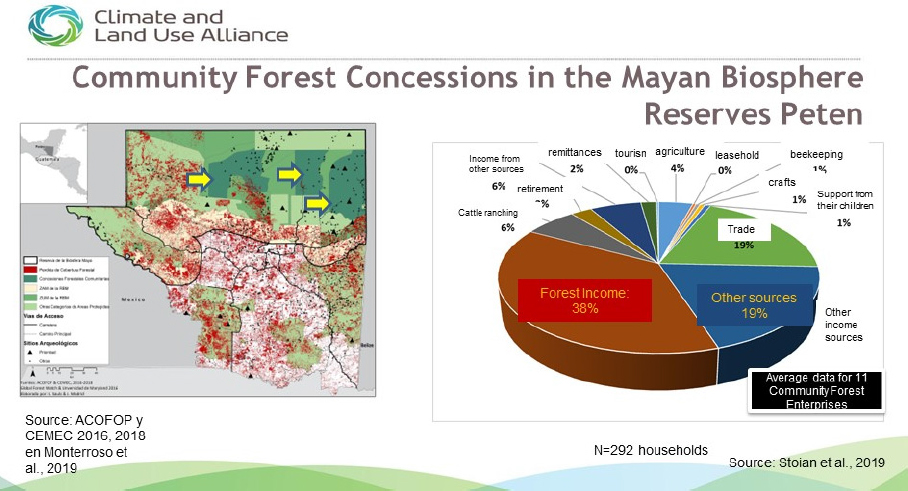
NOTE: Supporting communal tenure and climate-resilient livelihoods are concrete examples of effective resource governance.
SOURCE: Monterroso et al. (2019); Stoian et al. (2019).
FOOD SECURITY IN CENTRAL AMERICA
In his remarks, Riojas described the health and food security risks driven by climate change impacts in Central America, drawing on previous research conducted for the United Nations Economic Commission for Latin America and the Caribbean. This work analyzed the relationships between climate factors and disease incidence to develop mitigation policies (ECLAC, 2021). Riojas explained that they identified escalating risks for diseases such as dengue, which is spread more easily during hotter, wetter conditions that promote mosquito breeding; leptospirosis, which is spread by water contaminated with animal urine and spikes after flooding; as well as asthma, which is influenced by climate-related air pollution and is of potentially rising concern with increased deforestation. Riojas also highlighted leishmaniasis as a useful indicator, as its expansion reflects environmental disturbance. Other diseases such as malaria and chikungunya have declined recently but could resurge given historical climate connections. Tracking child mortality, which can indicate waterborne illness from water insecurity, is another possibility. Overall, understanding these climate-sensitive diseases may benefit from ongoing monitoring to detect increasing risks.
Riojas emphasized that in Central America, climate change exacerbates food insecurity rooted in socioeconomic vulnerabilities. Rising temperatures, shifting precipitation patterns, and extreme weather create agricultural losses and ecological damage that worsen hunger, poverty,
and displacement. The Central American Dry Corridor, containing more than 10.5 million people, faces especially profound challenges. Over 60% of its residents live in poverty and rely on subsistence agriculture (ASB, 2021). Studies estimate that up to 8 million Central Americans currently face food insecurity, with 1.7 million in emergency levels, illustrating the human impacts of compounding climate and development pressures (WFP, 2021). Short-term climate projections can provide insight into future food security. For example, the upcoming dry season could begin early after recent storm losses, with food insecurity spiking for vulnerable populations. Longer-term scenario modeling is also valuable for adaptation planning. Riojas noted that some countries have implemented these methodologies to develop health-focused climate adaptation plans, setting a positive example.
Riojas emphasized that, in the absence of adaptation efforts, climate change health and food security threats represent major human security risks for Central America (see Figure 3-3). He advised incorporating health and food security indicators into climate security monitoring and response frameworks. Riojas also underscored the need for international assistance given intense climate impacts outstripping local capacities across much of the region. Evaluating and expanding existing food security and health adaptation initiatives will be important in light of climate projections.
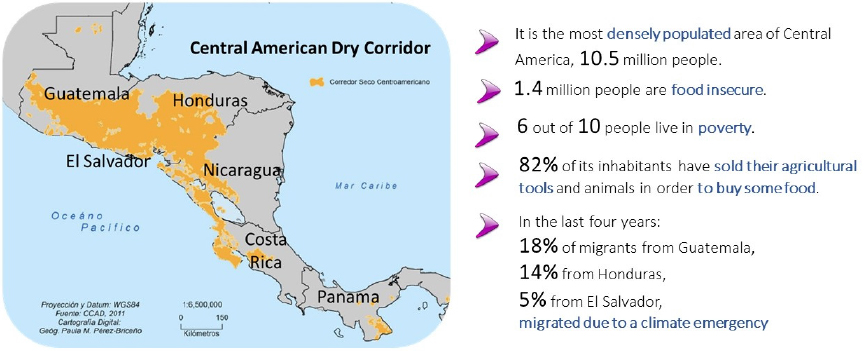
SOURCE: ASB (2021).
INDICATORS PANEL DISCUSSION
Evidence for a climate-migration linkage – A workshop participant noted that there is an active debate in foreign policy circles on whether observed correlations of measures of migration with climate variability in the Central America region imply a causal relationship between the two. In response, Riosmena and Riojas both emphasized that a clear signal has not yet emerged from historical data, but that the future outlook may diverge. Riosmena added that most existing migration data only capture people already displaced, missing those immobilized who might have moved under different conditions. Research based on sending communities is limited but suggests modest effects in both directions—some heightened mobility, some immobilization. Impacts associate more with vulnerability, though not consistently. There is no consensus given the unclear, context-specific evidence. Lichtveld concurred, emphasizing that the climate–migration relationship is complex, involving both domestic and international flows, sometimes voluntary and sometimes forced, depending on systemic vulnerabilities. This makes definitive categorization difficult, suggesting the benefits of a nuanced systems perspective.
Climate, violence, and displacement – A workshop participant inquired about the reversibility of internal climate displacement within countries, and the factors that might determine the extent of reversibility. Riojas responded that annual climate variability and violence are both key drivers. Monterroso also identified violence as a potential driver but noted that the available data from periods of civil conflict are very limited. She added that there is literature linking displacement to natural disasters. Another workshop participant commented that the past two decades of work had not done very much to produce generalizable insights into the climate and migration relationship, largely because of the strong context specificity of individual decisions to move.
Involuntary immobility – A workshop participant referenced the (im)mobility categories suggested by the aspirations–capabilities framework (see Figure 3-1), asking whether the research can offer any insights into the number of people who are “involuntarily immobile” and, in particular, the entrainment of frustrated people into criminal activity and/or political unrest. In response, panelists noted that this is a key area of inquiry and that a better understanding will emerge with more, and more granular, data. Their expectation was that people’s lack of options or control over their lives and livelihoods would certainly engender negative outcomes.
INDICATORS WORK GROUPS
Workshop participants broke out into five smaller, structured discussions intended to develop ideas for climate security indicators for Central America. Each group selected one or more of the risks identified in earlier panel discussions, or agreed to explore a new one, and received some organizing prompts for their discussion:
- Develop a list of indicators that would be useful to assess the seriousness of the risk, or to anticipate the potential for that risk to become serious. That is, what variables or factors would be important to measure and track in order to monitor the status of that risk?
- Be prepared to say why that indicator is important to the status of that risk.
Participants were reminded that the indicators could be direct or indirect. For example, for the risk of damages from tropical cyclones, indicators might include direct measures of economic damages or numbers of people displaced, as well as indirect measures such as the resilience of infrastructure, the capacity of governments to respond to a disaster, or the anticipated frequency and intensity of cyclone landfalls. After the breakout sessions, participants from each group (A–E) reconvened in plenary to report out on their discussions. Following the reports, O’Neill facilitated a plenary discussion.
Group A: In its discussions, Group A focused on the key climate-related risks for Central America previously identified by the assessment process of the Intergovernmental Panel on Climate Change (IPCC) (see Box 2-2), since these risks were each backed by robust scientific consensus. The group proposed that indicators for these risks be targeted to assess the potential implications for each risk on U.S. national security interests. To illustrate this approach, the group developed a set of possible indicators specifically related to the first IPCC key climate risk of worsening food insecurity. The set of sample food security indicators is described in Table 3-1 and include commodity prices and agricultural commodity futures; growth in crop insurance policies; crop monitoring assessments; modeling investments; information access metrics; malnutrition rates; coastal erosion rates; and cold chain infrastructure functionality. Group A participants clarified that these types of indicators aim to systematically assess how climate hazards could undermine regional food security, and in turn, amplify risks to social, political, and economic stability.
TABLE 3-1 Sample Indicators From Work Group A for Food Insecurity
| Indicator | Insight Provided |
| Markets: commodity prices and futures. | Could signal reduced crop productivity if prices begin to rise. |
| Insurance: growth in crop insurance. | Could indicate expectations of greater crop losses. |
| Crop Monitoring: various metrics. | A real-time assessment of production (many tools already available, e.g., GEOGLAM crop monitor a). |
| Modeling: investments in climate modeling. | A country’s ability to predict food production scenarios under climate impacts. |
| Information: various metrics. | Metrics like internet access could capture a country’s ability to access information and act on it. |
| Health: various metrics. | Metrics like acute/chronic malnutrition could capture long-term food availability issues. |
| Livelihoods: various metrics. | Metrics like resource degradation could capture potential disruptions to livelihoods and assets. |
| Infrastructure: various metrics. | Metrics like refrigeration capacity could capture food storage capacity. Road connectivity and disruption could capture the loss of grey infrastructure as a result of storms and other weather extremes. |
a The GEOGLAM crop monitor is a program coordinated by the Group on Earth Observations (GEO) at the request of the G20 Agricultural Market Information System (AMIS). GEOGLAM uses satellite data and ground observations to provide timely information on global crop conditions and production forecasts, in order to improve market transparency and food security (see https://cropmonitor.org/).
SOURCE: Presentation by Work Group A.
Group B: In its discussions, Group B examined potential indicators related to biophysical climate variables, such as rainfall levels, flood risks, and soil moisture. These tangible, measurable factors have clear links to physical climate change impacts, allowing straightforward identification of indicators to monitor those risks. However, the group had greater difficulty conceptualizing socioeconomic indicators and articulating their relevance for climate security analysis. Group participants explained that many social and economic variables—such as poverty rates, youth unemployment, income levels, and debt burdens—do not have directly attributable causal relationships to climate change. Yet in some contexts, these nonclimatic pressures can interact with climate shocks and stresses in ways that amplify overall insecurity. However, the group questioned how proximate or distal an indicator needs to be to climate in order to provide useful insights on climate-related security risks. Participants expressed uncertainty about how to determine whether a socioeconomic indicator is too distant from climate change impacts to warrant inclusion in climate risk monitoring systems. For instance, factors such as high youth unemployment and economic indebtedness are useful social vulnerability indicators across many contexts. The group’s members debated how to assess if those generic development indicators become relevant climate security indicators when considered in relation to climate hazards present in a specific location. The group suggested looking at threshold levels where socioeconomic stressors coincide with climate shocks to produce intolerable systemic risks. However, it noted substantial analytical difficulties in demonstrating these types of clearly defined connections and thresholds.
Group C: In its discussions, Group C began by identifying six risk areas that may be critical for monitoring climate security in Central America: flooding, deforestation, land degradation, urbanization, infectious disease, and extreme heat impacts. The group then highlighted categories
of indirect indicators that could shed light on socioeconomic, governance, and infrastructure factors mediating resilience across those climate risks. Indirect indicator domains cited included economics, demographics, governance measures, community cohesion metrics, and physical infrastructure coverage and condition. The group examined indicators related to three specific, interconnected issue areas: migration, food security, and remittances. Regarding migration, it emphasized the importance of clearly delineating terminology for distinct forms of human movement: internal or international migration, displacement, and general mobility. With respect to migration indicators, the group noted substantial gaps and inconsistencies in existing migration data collection, sharing, and accessibility across the region. It noted the potential benefits of investing in improved availability, transparency, and standardization of migration metrics. With respect to food security indicators, the group stressed the critical role of data availability, access, and effective utilization. It cautioned that national-level data can conceal local food insecurity seen at the community scale. With respect to indicators of remittances, the group discussed how restricted mobility due to tighter border controls has disrupted traditional cyclical, seasonal migration tied to agriculture. This complicates remittance flows and availability of household labor for rural food production.
Group D: In its discussions, Group D focused on the specific case of how climate-driven food insecurity might catalyze migration flows and lead to political instability. It highlighted sample indicators corresponding to key areas of this risk cascade. These included indicators for climate hazards, such as precipitation, drought conditions, and seasonal timing; assistance and development parameters such as humanitarian aid flows, bilateral political relations, preexisting development conditions, and remittances; governance characteristics, including corruption, inclusion, and government effectiveness; and underlying vulnerability factors, such as dependence on subsistence agriculture and economic diversity. The group’s conversation centered on the process for developing these types of climate security indicators, rather than compiling an exhaustive list for its case. For instance, it discussed clearly defining at the outset how exactly the indicator set would be used to guide decision-making, at either the strategic or operational levels. This decision could in turn shape the appropriate indicator selection, prioritization, and aggregation methodologies. The group also noted that the indicator set could find the appropriate balance between capturing low-probability but high-impact risks versus more likely but moderate-impact risk that can collectively become concerning.
Group E: In its discussion, Group E focused on describing six important domains: (1) food, water, and energy security; (2) sustainable development and energy transitions; (3) urban–rural interactions; (4) public health and disease; (5) extreme events and losses; and (6) impacts on primary sectors, such as agriculture and fisheries. Group participants noted that, in all cases, useful indicators could meet basic criteria such as observability, uniqueness, and having robust correlations with the risk factors of interest. The group also emphasized the importance of linking indicators to plausible causal pathways to demonstrate their relevance. The group also examined differences between proactive, risk-oriented indicators focused on resilience, versus reactive indicators of climate impacts and damages. It emphasized the merit in tracking both types, with proactive indicators enabling early action and reactive indicators highlighting when risks become manifest. The group also reflected on the value of attribution—for instance, precisely tying food insecurity or migration to climate versus other socioeconomic factors. It noted that attribution may be less critical from a public perception or policy intervention perspective compared with the perspective of academic research. Additionally, the group stressed tailoring indicators to the appropriate spatial, governance, economic, or social scale required to monitor distinct risks and inform decisions. For example, food security assessments could benefit from specific household-level metrics, while economic assessments could benefit more from community- and national-level metrics.


