Climate Security in Central America: Proceedings of a Workshop (2024)
Chapter: 4 Climate Security Pathways
4
Climate Security Pathways
To advance the workshop’s goal of developing an integrative systems understanding of climate security risk, the Pathways section of the workshop considered the potential future of climate-related security risk in Central America, beginning with two panel discussions featuring four invited experts. Dr. Edwin Castellanos, of The Nature Conservancy, explored plausible change impacts and risks in the region. Dr. Sarah Gammage, also of The Nature Conservancy, considered future scenarios for governance and human mobility. Dr. Jonathan Moyer, of the University of Denver, described integrated assessment modeling approaches to climate-related security risk pathways. Ms. Marieke Veeger, of CGIAR (Consultative Group on International Agricultural Research), explored potential pathways toward climate resilience, equity, and justice. The panel discussions were moderated by members of the workshop planning committee, Dr. Anjuli Bamzai of the National Science Foundation (NSF) and Dr. Ana Barros of the University of Illinois Urbana-Champaign. The Pathways section of the workshop also included a series of structured discussions, in smaller groups, to explore ideas for indicators for climate-related security risks in the
region. The section concluded with a discussion in plenary led by Dr. Brian O’Neill, of the Pacific Northwest National Laboratory and chair of the workshop planning committee.
PLAUSIBLE CLIMATE FUTURES IN CENTRAL AMERICA
Castellanos examined potential climate change impacts, risks, and opportunities for Central America, grounded in the latest assessment from the Intergovernmental Panel on Climate Change (IPCC) (see Figure 4-1). He prefaced his remarks by underscoring the fundamental uncertainty inherent in modeling future climate trajectories, which are contingent on global emissions pathways ranging from the optimistic low-emissions futures in line with rapid decarbonization and a 1.5 °C warming, to more pessimistic high-emissions futures (IPCC, 2022). He emphasized that, irrespective of global mitigation policy measures, some degree of additional regional warming beyond today’s levels is inevitable because of lags in the climate system response to past emissions (IPCC, 2022). Even under an ambitious emissions reduction scenario limiting global temperature rise to 1.5 °C above preindustrial levels, Central America would experience at minimum 0.5 °C of warming relative to the present day (IPCC, 2022). He also cautioned that stated warming levels reflect global land–ocean averages, obscuring likely greater temperature increases over terrestrial areas. Under currently modeled scenarios, terrestrial warming in the Central America region could realistically be 2 °C or more through 2100, even if the aspirational 1.5 °C global-average target is attained (IPCC, 2022).
With respect to precipitation, Castellanos highlighted that climate models consistently project overall drying trends for Central America this century, with potential declines in annual rainfall reaching 20% below current levels by 2100. He added the caveat that, because of the inherent seasonal and interannual variability in precipitation, change will not be gradual from year to year but will instead exhibit extremes and fluctuations bounded by a long-term decline. Even periods of severe drought will continue to be punctuated by heavy precipitation. These extremes will be modulated by the influences of the El Niño–Southern Oscillation and fluctuating sea surface temperatures, which can enhance rainfall volatility. Castellanos stressed that the seasonal timing of rainfall will also be critical, because disruptions during sensitive agricultural periods can be disastrous for smallholder farmers. For example, an extreme drought in early May at the start of the rainy season could decimate subsistence crops even if yearly totals are near normal. Therefore, both intense variability and seasonal shifts represent key impending precipitation threats.
In discussing the potential sectoral impacts of climate change, Castellanos highlighted the intensifying risks to food production, infrastructure, and public health identified by the IPCC assessment process (see Figure 4-1). However, he noted that confidence levels in many of these risk projections remain low for Central America relative to other regions in the world. He attributed this to limited capacities for data collection, analysis, and modeling of the complex climate linkages and vulnerabilities that characterize the region. He stated that, in light of clearly escalating climate threats, there is an urgent need to expand research and analytical capabilities to provide an adequate foundation for evidence-based adaptation policymaking. Castellanos cautioned that scientific expertise within Central American countries continues to lag because of the high outward migration of skilled professionals, including climate scientists. He noted that positive examples such as Guatemala’s scientific climate advisory body demonstrate the potential to elevate evidence to inform decision-making, but that these are nascent efforts with limited resource mobilization and political empowerment. Similarly, initiatives are emerging to develop IPCC-style climate risk assessments across Central America; however these face challenges in convening the region’s thin ranks of qualified scientists.
Castellanos recalled the many deeply rooted systemic challenges described in earlier workshop sessions and cautioned that meaningful adaptation and sustainable development in Central America will be constrained fundamentally by persistent poverty, profound inequality, external
debt dependence, corruption, clientelism, and democratic backsliding, as well as high risk tolerance borne out of endemic exposure to repeated hazards. He noted that these structural factors foster vicious cycles that reinforce socioeconomic marginalization and inhibit public investment to build adaptive capacity. Castellanos also remarked on the profound disparity between Central America’s negligible historical contributions to global greenhouse gas emissions and the acuteness of the climate consequences the region faces. Fundamentally, countries across the region bear little responsibility for precipitating anthropogenic global climate change, yet they are experiencing impacts that exemplify the uneven global distribution of climate risk burdens due to stark development disparities. In his view, this imbalance between limited culpability for, but inordinate suffering from, an environmental crisis created largely by other nations, may engender deep resentment and grievance in the coming years.
In conclusion, Castellanos offered that, while Central America undeniably faces profound climatic and environmental threats layered onto systemic vulnerabilities that limit resilience, there are still reasons for cautious optimism (see Box 4-1). Expanding social movements, grassroots resilience initiatives, indigenous resource governance, civic political pressure for climate action, and growing risk awareness all represent potential forces that could collectively drive nations toward improved governance. Even as climate risks clearly escalate, widespread and cross-sectoral efforts centered on climate justice, human security, and ecological integrity could potentially overcome systemic inertia and tip the scales toward transformative change and pathways leading to an equitable and resilient future.
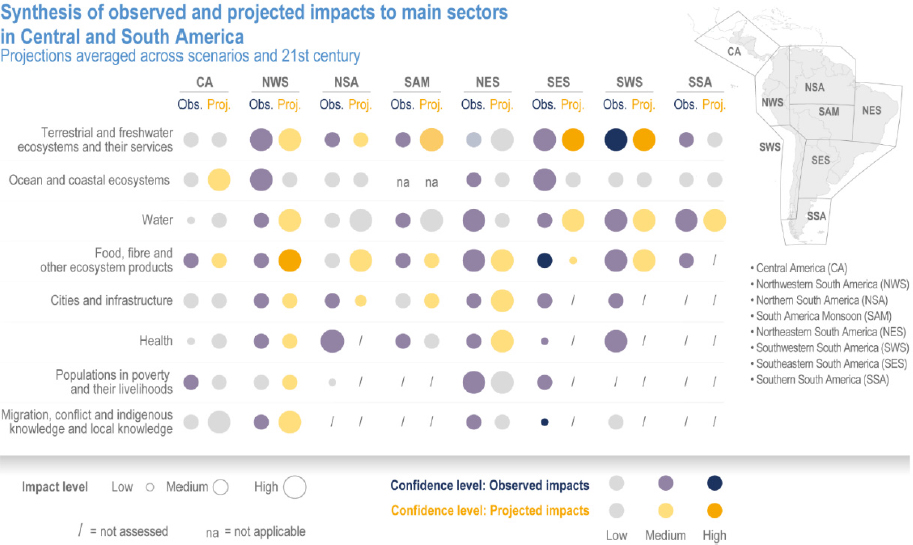
NOTES: The impacts are distinguished for different sectors and each subregion of Central and South America. Observed impacts relate to the last several decades. Projected impacts represent a synthesis across several emission and warming scenarios, indicative of a time period from the middle to end of the 21st century. For each sector (e.g., health) climate change impacts are identified as being low, medium, or high.
SOURCE: Castellanos et al. (2022).
CENTRAL AMERICA SCENARIOS: CLIMATE CHANGE, GOVERNANCE, AND HUMAN MOBILITY
In her remarks, Gammage explored environmental, economic, and governance datasets that can illuminate the natural comovements of key indicators of climate change impacts and
associated drivers of human insecurity in the Central America region. She used these patterns to generate a pair of scenarios, one describing a Central America that implements robust adaptation solutions and one that describes the consequences of not doing so. Echoing remarks by Castellanos, Gammage noted that Central American countries are generally unable to take much action on climate change emissions or to achieve much of a transformation through its own nationally determined contributions.
Gammage briefly reviewed the historical data on climate change in the region, including observed increases in temperature, rising sea levels, and increasing levels of food insecurity, partly due to the impacts of extreme weather. She highlighted a recent finding by the United Nations (UN) Office for Disaster Risk Reduction: of the total natural disasters observed in Latin America and the Caribbean region during 2020–2022, the vast majority were hydrometeorological events. She also noted that the most recent Global Climate Risk Index1 ranks Central American countries among the highest in the world in terms of economic and human losses experienced from climate change impacts (Eckstein et al., 2021). Gammage commented that these examples underscore the value of tracking indicators of climate hazards and exposure across multiple dimensions.
Gammage described some ways in which climate impacts can undermine the rural livelihoods that anchor human well-being and security across the region and, ultimately, U.S. national interests in the region. She called particular attention to studies projecting the future viability of coffee cultivation under warming trends, as an illustrative example of the threats that climate change poses to rural communities. Current projections suggest that warming temperatures will drive coffee production to progressively higher elevations and, among other consequences, leave stranded the existing lower-elevation cultivation that supports hundreds of thousands of vulnerable smallholder producers, as well as impacting millions of people involved in coffee processing, transportation, and other parts of the value chain across Guatemala, Honduras, El Salvador, and Nicaragua (Ovalle-Rivera et al., 2015). If the alternatives for these people lie only in the illicit and informal economies, they will ultimately drift into livelihoods that degrade the resilience and security of the region.
Turning to current economic, political, and social datasets, Gammage offered a few examples of indicators that are not directly, causally connected to climate impacts but may still offer deep insights into the possible policy pathways that can lead to greater climate resilience and security in Central America. Specifically, she demonstrated how correlative relationships between different pairs of metrics describing factors such as poverty, migration, fiscal balance, political stability, and rule of law can help identify opportunities to build resilience (see Figure 4-2). For example, she presented an unsurprising association between more rural countries and stronger dependence of national economies on agriculture. At the same time, these rural countries usually experience greater poverty, and this association suggests that interventions to improve smallholder farms, for example through bench terracing that reduces erosion and retains moisture, could protect rural livelihoods and substantially increase climate resilience at the national scale. Similarly, Gammage demonstrated that fiscal imbalances, anemic public revenues, and poor governance plague many of the Central American countries perceived to have the greatest climate security challenges. For instance, high public debt burdens combined with low domestic tax revenues fundamentally limit investments in human development and climate resilience, suggesting that institutional fragility compounds sensitivity to climate impacts and constrains response capacity.
Synthesizing these risks, Gammage outlined two climate security pathways for Central America that center on whether or not adaptation investments are made. In an optimistic scenario where the region implements major resilience initiatives, she hypothesized that climate change vulnerabilities could be proactively tempered through interventions that build climate-adaptive infrastructures, shore up livelihoods and offer opportunities for diversification, reduce economic losses from climate impacts, reduce poverty and inequality, reduce entrainment of communities
___________________
1 The Global Climate Risk Index is generated by the environment and development nongovernmental organization Germanwatch to analyze countries’ vulnerability and exposure to climate-related extreme weather events (https://www.germanwatch.org/en/cri).
into criminal networks, reduce violence and unrest, and retain people who want to stay in their home communities. She also noted the potential for nature-based solutions, such as scaling mangrove restoration to provide natural coastal buffering against intensifying storms, to complement infrastructural adaptation. Gammage considered various mechanisms to provide initial investments for resilience-building, including climate funding mechanisms as well as commitments of official development assistance. She also noted that technical assistance and regional cooperation are important tools to help improve capacity at local levels. Ultimately, these investments would create greater fiscal space for public-sector growth and improvement of governance and accountability, as well as further investment in human and environmental capital.
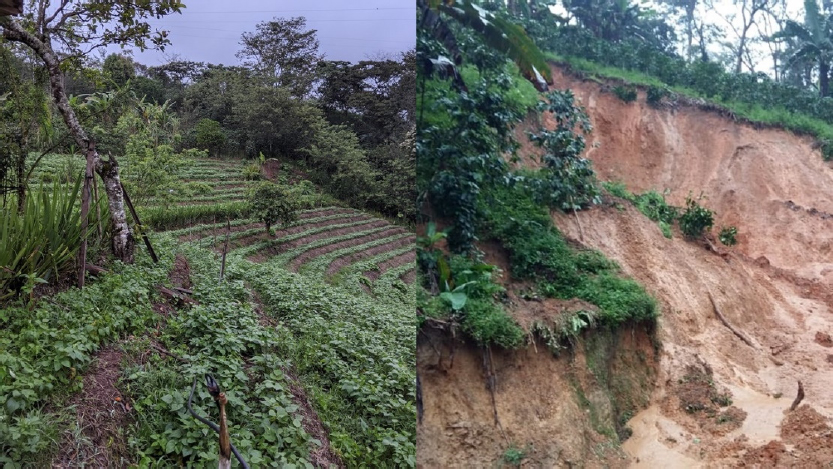
SOURCE: Photographs by Jesse Festa (2021).
PATHWAYS FOR CLIMATE AND SECURITY IN CENTRAL AMERICA
Moyer provided an overview of an integrated assessment modeling approach for developing climate-related security risk pathways, and he shared initial results from an analysis for the Central America region performed using the International Futures modeling tool.2 He remarked at the outset that a systems approach is critical to climate analyses, given that climate outcomes arise from the deep interconnections and interdependencies between natural and human systems across all scales. The assessment of climate-related security risk, in particular, requires a relational understanding of the various social, economic, and political components that contribute to the overall structure of social systems.
Moyer introduced a systems framing for “security” that can be used to define indicators and pathways for security risk. With respect to security indicators, he identified four broad categories,
___________________
2 See https://korbel.du.edu/pardee/international-futures-platform.
ranging from more traditional measures of security, centered on (1) civil war and (2) organized violence, to more expansive notions of human well-being, involving (3) government capacity, and (4) individual resilience. He noted that each of these four indicator categories has an associated set of drivers and causal relationships that have been well studied in the literature. With respect to civil wars, he noted that there is a diversity of predictive tools in the field that integrate, albeit with limited skill, drivers such as anocracy, infant mortality, neighborhood effects, economic interdependence, horizontal inequalities, and the youth bulge.3 For organized violence, which he noted is currently a much more important problem in Central America than civil wars, the established drivers include the youth bulge, government policies, and economic opportunity. For government capacity, accepted metrics may focus on quality, such as effectiveness, corruption, rule of law, or on quantity, such as the total revenues to support public infrastructure, education, and health systems. Finally, for individual resilience, he pointed to well-established metrics for multidimensional development, such as those articulated by the UN Sustainable Development Goals. Turning his attention to security pathways, Moyer offered some high-level examples of how the systems framework could help define pathways linking climate impacts to security outcomes, through some of the indicator relationships described earlier. As an example, temperature change may lead to changes in income distribution, through impacts on agricultural productivity. As another example, sea level rise may lead to capital losses associated with forced migration from coastal areas.
Moyer introduced the International Futures modeling tool (see Figure 4-3), highlighting its core strengths in representing demographics, economics, health, education, governance, and international relations. He explained that the model structures the world as an interconnected network of systems, allowing users to construct different scenarios by perturbing parts of those systems and tracking the cascading impacts over time across the model domain. Moyer elaborated that scenario analysis is a key application of the International Futures tool. It can produce a detailed baseline forecast—for example, a world without climate change—and then develop trajectories based on different assumptions about future development pathways or climate impacts. Comparing different scenarios helps researchers isolate the impacts of policy choices or climate impacts and allows them to test their assumptions of how the world works.
Moyer presented some initial high-level results (see Figure 4-3) from International Futures modeling for a basic climate-related risk pathway, mapping the impacts of climate-driven warming onto socioeconomic development in Central America and moving through a set of damage functions that capture the intensifying marginal economic impacts of increasing temperatures. The model mapped the resulting economic, demographic, and inequality effects onto the four broad categories of security indicators discussed above. The pathway was followed under baseline conditions (i.e., no climate change impacts) and low- and high-impacts scenarios.
Reviewing the modeling results, Moyer noted that, under all scenarios, the model forecasted more secure—or less insecure—outcomes under lower climate impacts scenarios. Examining the more traditional indicators of security (i.e., civil wars and societal violence), Moyer observed that the forecasted risk trajectories did not diverge significantly between low- and high-impacts scenarios. In contrast, for more development-related indicators of security (i.e., government capacity and individual resilience), the risk trajectories diverged substantially. Moyer interpreted these results to mean that climate impacts would be expected to have relatively stronger impacts on regional security through their negative effects on government revenue, poverty, and related factors.
In closing, Moyer argued that while inherently uncertain, thoughtful integrated assessment modeling can significantly advance a systematic analysis of complex climate security risks. The International Futures modeling tool shows that different pathways will have different implications
___________________
3 A youth bulge is a demographic pattern in which a high proportion of the population consists of young adults and children, increasing the number of working-age individuals. If they can be fully engaged in society and employed, the youth bulge will produce a demographic dividend. If not, the youth bulge could produce a demographic bomb, with large numbers of young people frustrated by the lack of socioeconomic opportunity, potentially becoming a source of social and political instability (Hafeez and Faseeh, 2018).
for different measures of security. Some pathways will have very acute effects on the human dimension, while other pathways will have other effects on factors related to political instability and conflict.
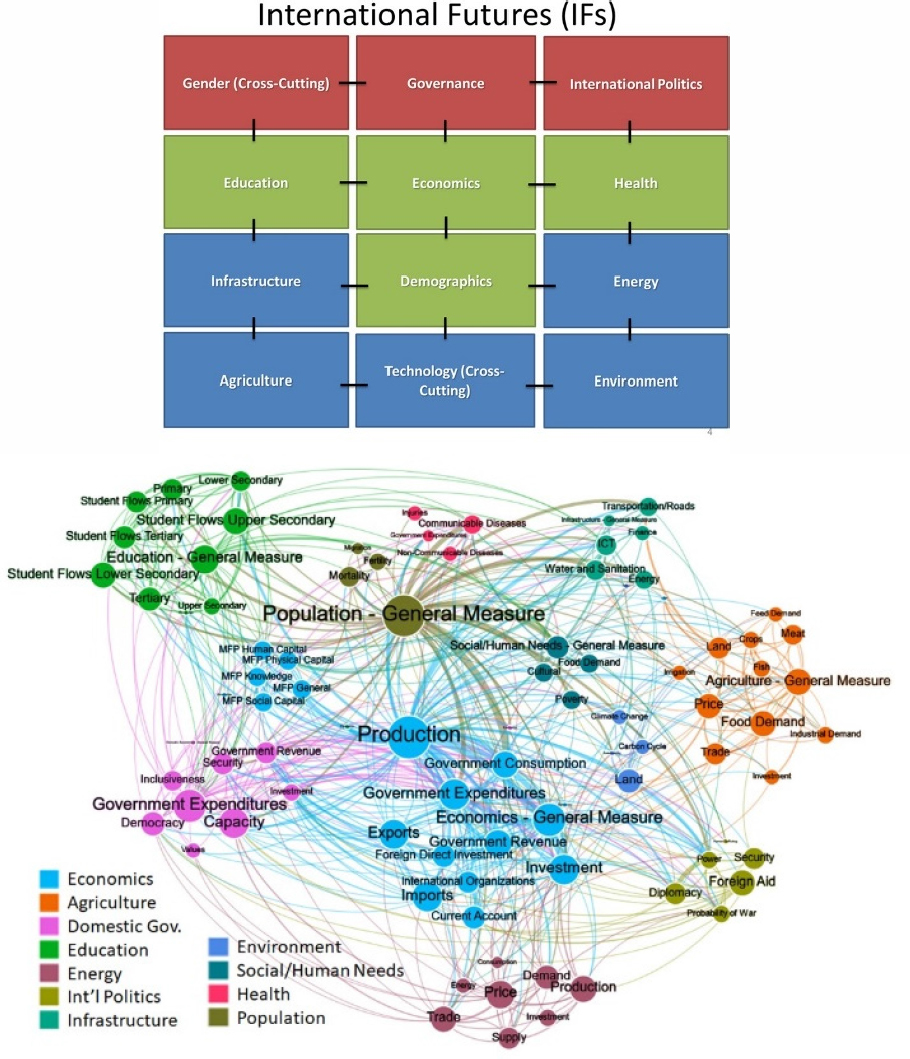
SOURCE: University of Denver, Pardee Center for International Futures.
DISRUPTIVE SEEDS TO ENVISION BRIGHT FUTURES FOR CLIMATE SECURITY
Veeger provided a detailed overview of her work to develop pathways toward climate security by identifying and leveraging so-called disruptive seed initiatives. These are innovative, grassroots-level initiatives that fundamentally challenge and offer alternatives to mainstream, unjust, unsustainable systems and practices, with the goal of envisioning brighter, more just, and sustainable futures for climate security. Veeger noted that the project extends from her previous work developing integrated socioeconomic scenarios linked to climate scenarios across multiple global regions, including Central America, to inform long-term climate policy and investment strategies.
Veeger noted that the most common approach to analyzing climate security risks and developing climate security pathways focuses heavily on identifying risks and potential negative impacts, particularly analyzing how climate change impacts could cascade into security risks. However, she emphasized that there is increasing recognition that these risks are fundamentally driven by underlying socioeconomic, political, and environmental vulnerabilities, and she argued that who and what adaptation actions are directed toward are critical considerations, since the underlying structural vulnerabilities of societies will largely determine their existing adaptive capacity and resilience to climate impacts.
To illustrate the systemic challenges that disruptive seed initiatives are meant to address, Veeger elaborated on the key vulnerabilities driving climate insecurity in Central America, many of which were highlighted in earlier sessions of the workshop. These involve access to land and natural resources; low government capacities; food insecurity; and poor infrastructure and public services. With respect to land and resources, she noted that legal frameworks for land tenure often disfavor marginalized populations, meaning that, absent state restitution, indigenous and traditional smallholder producers lack capital for purchasing lands. In addition, short-term land leasing arrangements are common, inhibiting farmer investments in sustainable soil, water, and agroforestry management practices that require longer horizons and greater certainty of returns. With respect to government capacities, Veeger explained that weak governance and inability to effectively manage land and natural resources allow access and benefits to accrue disproportionately to wealthy elites. For example, land use is dictated by powerful agroindustry interests rather than community needs or ecological limits. She observed that this concentration is enabled by legacies of violent displacement that have fragmented communal tenure, which remains unredressed by states unwilling to confront dominant actors. With respect to food insecurity, she noted that impacts from climate variability and extreme weather events can decimate crop yields in settings where endemic poverty already limits coping capacity. Finally, with respect to infrastructure and basic services, Veeger noted that unreliable infrastructure, inadequate health care, and lack of quality education fundamentally constrain community climate adaptation and foster marginalization. These gaps result from low public investment due to anemic tax revenues, high public debt loads, and the aforementioned capture of political systems by powerful interests.
Veeger explained that the common approach is to analyze how these vulnerabilities can interact with and exacerbate climate change impacts and then spill over into security risks. While this risk analysis remains very relevant, she proposed it could also be a starting point for a different approach focused on mapping out pathways to positive scenarios of climate security. She noted that, within climate governance circles, there is growing evidence that pessimistic scenarios often fail to motivate action on climate change and more hopeful visions tend to inspire change. Veeger’s colleague Elena Bennett has introduced the concept of disruptive seeds as an alternative focus that challenges existing unsustainable, unjust systems and helps develop nuanced, empowering scenarios for transformative change.
Given the urgency of the climate crisis, Veeger emphasized that systemic, rather than incremental, changes are essential. She introduced the concept of disruptive innovation—creating new processes, technologies, or social initiatives that actively make existing approaches, systems, and power structures obsolete.
Veeger provided examples of disruptive seeds identified in Guatemala—including community forest concessions; small, community-owned hydropower initiatives; youth leadership programs; indigenous communities practicing “concrete wealth” approaches to resource management; and social enterprises helping indigenous female farmers access organic food markets. The two main objectives of the project are to (1) develop transformation policy pathways for the food system based on disruptive seeds in the face of accelerating climate change and (2) use these pathways to guide planning and investments by governmental, nongovernmental, and other organizations to strengthen the resilience of Guatemala’s food system. She emphasized that the project seeks to facilitate, not prescribe, these transformation pathways through a participatory process with diverse Guatemalan stakeholders. This involves imagining how disruptive seeds could become the dominant model over time and analyzing necessary enabling conditions, potential transition conflicts, and risks. The pathways will then be stress tested across a range of socioeconomic scenarios to identify robust strategies.
In conclusion, Veeger argued that transformative power shifts are critical to addressing climate insecurity shaped by historical development failures and enduring patterns of social, economic, and political exclusion. The disruptive seeds project focuses on creating a shared vision of what a secure and just climate future could look like for the region, rather than only focusing on risks. As with all foresight initiatives, the aim is to link future visions to present decisions.
PATHWAYS PANEL DISCUSSIONS
Predictive skill in International Futures – In response to a question regarding the time frame over which climate change impacts become noticeable in the IFs projections, Moyer responded that timing is variable depending on the indicator, but that many diverge around 20 years out. He noted that near-term projections are challenging since socioeconomic baseline trends dominate over climate change effects in the short term. He noted that the tool is better suited for medium-to long-term systemic impact analysis rather than precise attribution over 1-to-10-year timescales.
In response to a question about how uncertainty is handled in IFs projections, Moyer explained that the primary approach uses alternative scenarios to bound uncertainty by varying key inputs along accepted high and low outcomes (e.g., different emissions pathways or development conditions). This aims to capture broad uncertainties versus advanced statistical uncertainty propagation, which remains challenging in large integrated assessment models.
A workshop participant noted that climate risk assessments must also consider inherent model uncertainty and natural climate variability, especially over near-term time frames where variability dominates over climate change signals. Moyer agreed that variability is a key omitted component and International Futures climate risk projections are most applicable over longer terms. He reiterated that the tool needs to complement other perspectives for a comprehensive analysis.
Driving resilient transformations – In response to a question about how to incentivize major systemic transformations needed for climate resilience, Veeger responded that doing so is highly context specific but requires rethinking foreign assistance. Supporting disruptive seeds entails embracing new modes of decentralization, participation, and community empowerment versus status quo practices. Demonstrating these alternative models can motivate traditional institutions toward reform.
In response to a follow-up question on how foreign assistance could better create enabling conditions for disruptive seeds and systems transformations, Veeger responded that fostering new participatory governance of natural resources has great potential based on initiatives observed in Guatemala. Supporting communal resource management disrupts concentrated control and builds climate resilience.
In response to a question about the appropriate timescales for achieving climate security, given worsening short-term projections, Veeger responded that her team’s pathways envision long-term transformations by 2050, but focus must begin immediately with investments to spur
change. Bending emissions curves is imperative, but simultaneously pursuing radical adaptations centered on equity and justice can help temper impacts in the interim.
In response to a question on how transformational scenarios account for the contemporary authoritarian governance trends that are constraining civic space in Central America, Veeger acknowledged this challenge but noted that grassroots innovations are sprouting even in unfavorable contexts by working around obstacles creatively. External actors can help by encouraging rights-based adaptation approaches with governments to demonstrate their value, not just critiquing them.
A workshop participant critiqued the concept of disruptive seeds, arguing that agrarian systems resist external pressures, including those to reform, in order to avoid disruption. The participant argued that attempted interventions can thus spur harmful unintended outcomes, such as domestic violence from stress; the participant asked how seeds can potentially become risks. Veeger clarified that seeds are self-organized grassroots responses to untenable conditions, not introduced externally. They can cause managed disruption to force accountability but generally aim to open alternative pathways aligned with community priorities and values.
PATHWAYS WORK GROUPS
Workshop participants broke out into five smaller, structured discussions intended to develop ideas for climate security pathways for Central America. Each group selected one or more of the risks identified in earlier panel discussions, or agreed to explore a new one, and received some organizing prompts for their discussion:
- Explain why you think the pathway and outcome are plausible.
- Explain how the pathway and outcome relate to the indicators of risk discussed in previous sessions. (They may or may not—they may suggest additional indicators.)
After the breakout sessions, participants from each group (A–E) reconvened in plenary to report out on their discussions. Following the reports, O’Neill facilitated a discussion.
Group A: In its discussions, Group A considered various incremental impact scenarios, such as climate-exacerbated inflation and migration crises that overwhelm weak regional governance capacities. However, the group discussed how these pathways essentially just expose ambient, chronic institutional deficiencies that are present already. Therefore, Group A focused its discussion on evaluating a low-probability but high-impact climate shock that would create enough instability for China to dramatically expand its permanent military, economic, and political influence in Central America. The group emphasized that any climate event severe enough to open this door would reveal the intrinsic vulnerabilities arising from deficient regional governance systems. Given the backdrop of already intensifying great-power competition globally and in Central America, such a destabilizing climate disruption could enable adversaries such as China to solidify multidomain regional control and fundamentally degrade U.S. security interests.
Group B: In its discussions, Group B oriented its analysis around a severe 5–10 year drought in Central America and traced impacts on agriculture, nutrition, public health, migration, crime, inequality, and social cohesion (see Figure 4-4). The group recognized the complex, interconnected nature of how these systems would interact under such an extreme climate stressor. However, the discussion focused on illustratively outlining select transmission pathways by which protracted drought could concretely destabilize food, health, migration, and violence dynamics in turn. Group B’s pathway incorporated linear causal relationships into a more integrated framework of interacting climate stressors and development challenges.
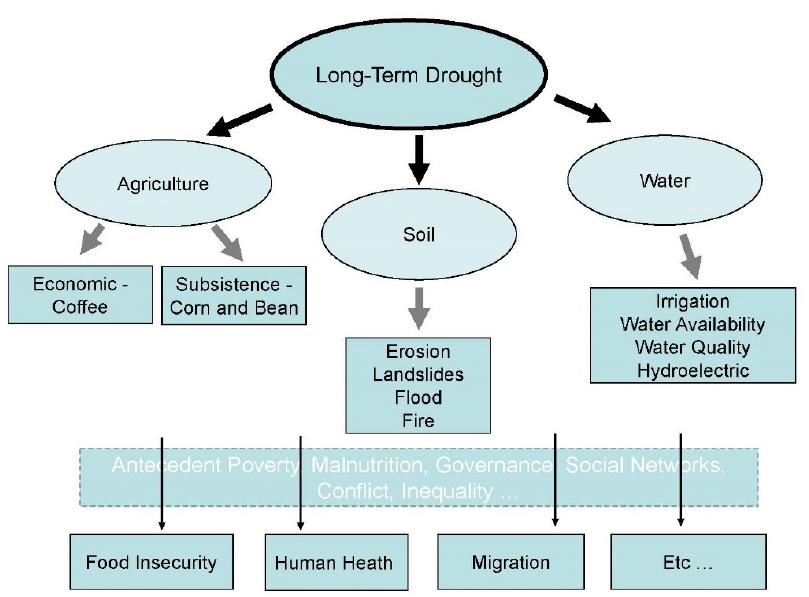
SOURCE: Generated by workshop participants (Group B).
Group C: Group C focused its discussion thematically on priority governance vulnerabilities across Central America that could transmit climate disruptions into security risks. The group critiqued tendencies to silo foreign aid spending into isolated programs rather than mainstreaming climate risk reduction throughout initiatives. It also discussed strengthening institutions through localized coproduction of adaptation projects and investments in civic society networks. Group C also touched on opportunities to learn from positive Central American governance models, such as those of Costa Rica and Panama. The group concluded by weighing migration pathway restrictions as potentially increasing in-country tensions and instability if outlets are constrained.
Group D: After extensive discussion regarding how to analytically approach climate security risk pathways, including whether to work forward from climate stressors or backward from existing security risks, Group D ultimately chose a forward narrative that envisions a multiyear drought in Guatemala’s Dry Corridor, which would exacerbate existing stresses on agriculture and smallholder farmers, and lead to crop losses, lost livelihoods, internal migration, and increased inequality and instability. Within this causal flow, China could take advantage of poor governance capacity and perceptions of U.S. disengagement to expand its infrastructure investments and strengthen its regional influence. This could ultimately culminate in an uncontrolled migration crisis and erosion of the Monroe Doctrine as extra-regional actors threaten long-standing U.S. regional hegemony in the region.
Group E: In its discussions, Group E explored a risk pathway initiated by worsening drought conditions leading to heightened water, food, and energy insecurity throughout Central America. They explained that increasing scarcities across these interlinked systems would spur major new infrastructure investment initiatives by China aimed at shoring up access to water, power, food, and internet connectivity to fill rising deficits. However, the group envisioned that these Chinese
infrastructure expansion efforts would be enabled by increasingly authoritarian governing regimes coming to power across Central America. They outlined a cascade of adverse societal impacts resulting in loss of livelihoods, youth recruitment into gangs and black markets, decreasing popular support for democracy, increasing outward migration, and potential threats to the Panama Canal. The group also discussed complex dynamics and areas of uncertainty where infrastructure upgrades and governance changes could cut both ways in terms of climate adaptation effectiveness and resilience. Finally, it summarized key potential risks to U.S. national security interests related to flows of remittances, migrant community ties, regional economic integration, and direct migration pathway controls.


