Committee on Human Rights: Annual Report 2023 (2024)
Chapter: Advocacy Updates
Advocacy Updates
Since its inception in 1976, the CHR has advocated for justice in 1126 cases spanning 85 countries.
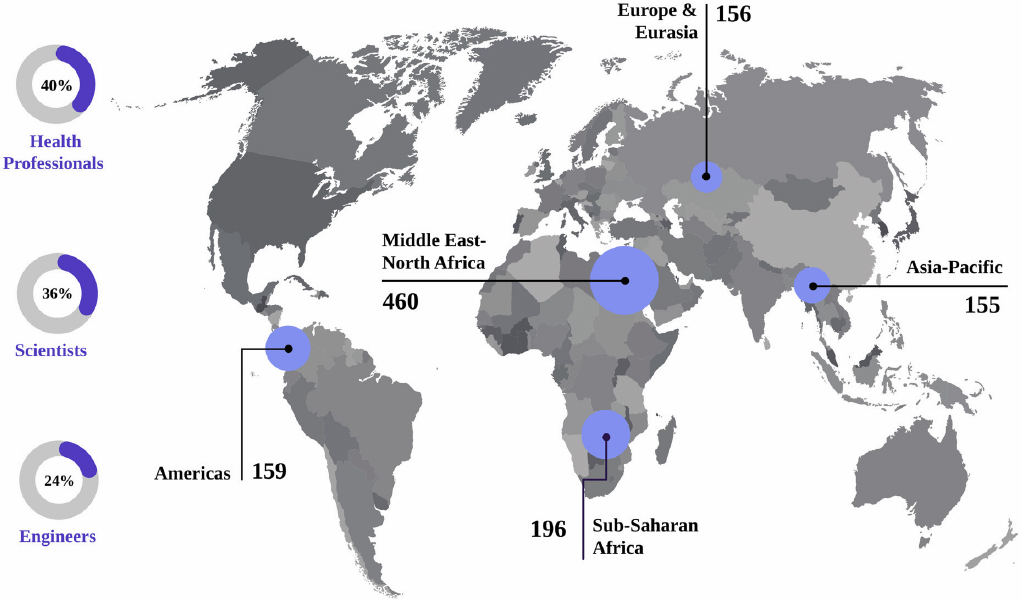
2023 CASES
In 2023, the CHR followed 127 cases involving colleagues throughout the world. Efforts to support these colleagues included action alerts to Academy members and academies participating in the IHRN, trial observations, the submission of case briefs to UNESCO and UN human rights mechanisms, and outreach to U.S. and other government officials.
By Region
Americas: 40 Europe & Eurasia: 39 Middle East-North Africa: 38 Asia-Pacific: 10
By Status
Ongoing Judicial Proceedings: 25
Imprisoned: 24
Under Investigation: 18
Released/Resolved: 17
Convicted (not jailed): 13
Dismissed: 10
Detained: 5
Stateless/Deported/in Exile: 4
Disappeared: 4
Kidnapped/Abducted: 2
Travel/Work Ban: 2
Threatened/Harassed: 2
Released Conditionally: 1
POSITIVE CASE DEVELOPMENTS
In 2023 the CHR, together with CHR Correspondents and national academies participating in the IHRN, took hundreds of actions in support of colleagues under threat. During the course of the year, many colleagues saw significant positive developments in their cases—to include release from prison and dismissal of criminal charges.
Iranian-French Anthropologist Fariba Adelkhah Released from Prison
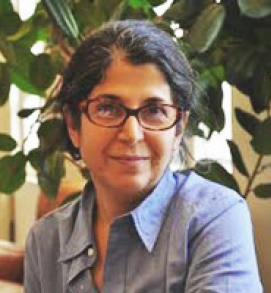
Dr. Fariba Adelkhah was released from Evin Prison in Tehran on the evening of February 10, 2023, more than three and a half years after her arrest. Forced to apply for new identity documents and then a new passport, she was finally able to return to her home in France in mid-October.
Dr. Adelkhah is director of research at the Institute of Political Studies’ (Sciences Po) Center for International Studies in Paris, where she is renowned for her scientific work on post-revolutionary Iranian society. A dual French and Iranian citizen, Dr. Adelkhah resides in France but has traveled to Iran often for her scholarly research as well as to visit her family. At the time of her arrest in early June 2019, she had been conducting field research for several months in Iran and Afghanistan. Her partner, Dr. Roland Marchal, also a senior social science researcher at Sciences Po and a scholar of conflict and state formation in sub-Saharan Africa, was taken into custody alongside Dr. Adelkhah, while visiting her in Iran. Both researchers were subsequently charged with alleged national security-related crimes. Dr. Adelkhah was additionally charged with espionage, for which she faced a possible death sentence; this charge was subsequently dropped. Iranian authorities have never provided a reasonable basis for these charges. Dr. Marchal was released from prison in March 2020, after France released an Iranian engineer from detention in an apparent prisoner exchange. Dr. Adelkhah was brought to trial the following month before a Revolutionary Court. One month later, she was convicted and received a five-year sentence for “assembly and collusion against national security” and a one-year sentence for “propaganda against the state,” which were ordered to be served concurrently. Her conviction was subsequently upheld on appeal.
Dr. Adelkhah was held under harsh conditions of confinement, leading her to undertake a 49-day hunger strike in late 2019 that resulted in severe kidney damage. In late 2020, she was temporarily transferred to house arrest for approximately a year, reportedly for health reasons. Throughout her imprisonment, Dr. Adelkhah was denied French consular assistance, as Iran does not recognize dual citizenship.
Criminal Charges against Mexican Colleagues Dismissed
On May 11, the Second Collegiate Court of Appeal confirmed the dismissal of all charges brought against five Mexican scientists—José Franco López, Julia Tagüeña Parga, Gabriela Dutrénit, Teresa de León, and Marcial Bonilla. They were among 31 scientists and scientific administrators who have faced allegations of serious financial crimes since 2021 in proceedings that raised due process concerns and prompted an outcry from the international scientific community. The cases of three other Mexican colleagues in this group were dismissed on January 13, 2023. The remaining 23 colleagues are awaiting the final dismissal of their cases.
Mexico’s Attorney General, Alejandro Gertz Manero, had alleged the involvement of these 31 individuals in a number of offences—including organized crime and money laundering—that carried possible decades-long
prison sentences and had filed multiple arrest warrants seeking their detention in a maximum-security prison. Although a federal judge did not find credible evidence of wrongdoing and refused to grant the arrest warrants on September 21, 2021, the Attorney General continued to seek their detention.
The CHR has closely followed these cases throughout the complex judicial process, in consultation with a number of relevant actors. In separate initiatives in fall 2021, the Executive Committee of the International Human Rights Network of Academies and Scholarly Societies and the three International Secretaries of the U.S. National Academies of Sciences, Engineering, and Medicine publicly expressed concern to the Mexican authorities that their colleagues were being subjected to harassment and intimidation and called for any further investigatory actions to accord with Mexico’s commitments under international human rights law.
Turkish Forensic Physician Released from Detention Pending Appeal
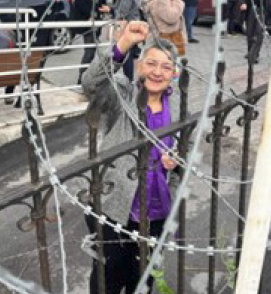
Following her conviction in January 2023 on spurious charges of “making terrorist propaganda,” Dr. Şebnem Korur Finçancı—an internationally recognized forensic physician, president of the Turkish Medical Association, and longtime human rights defender—was released from detention pending appeal. This case is only one of a number of legal proceedings that have been brought against her in recent years as a consequence of her peaceful exercise of internationally protected rights and freedoms.
Dr. Korur Finçancı was arrested at her home in Istanbul in late October 2022 a week after commenting in a German television interview that allegations of the use of chemical gases involving the Turkish military should be investigated in accordance with international standards. The following month five independent UN human rights experts publicly called for her release, noting that her arrest “appear[ed] part of a deliberate pattern of applying counter-terrorism legislation to discredit human rights defenders and organisations and interrupt their vital human rights and medical work.” Following proceedings that did not meet international fair trial standards, the Istanbul High Criminal Court sentenced her to 2 years, 8 months, and 15 days in prison. Dr. Korur Finçancı has appealed her conviction and sentence and is awaiting a court date.
Turkish Medical Doctor Reinstated to University Six Years after Her Arbitrary Dismissal
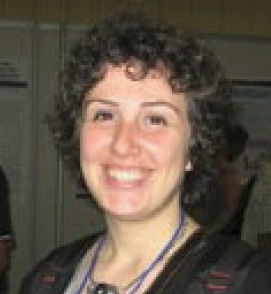
Six years after she was arbitrarily dismissed from her position as Associate Professor of Public Health at Ege University, Dr. Hediye Aslı Davas was recently notified that her appeal for reinstatement has been successful. Although a counterclaim seeking to sever her ties with the university has been filed, she is optimistic about the outcome. Dr. Davas was among hundreds of Turkish academics who were summarily dismissed from their universities in 2016 and 2017, prevented from traveling outside of the country, and who faced criminal investigation/prosecution for signing a petition in 2015, where 1,128 academics called for peace amidst escalating political violence. Following significant international pressure, the Turkish government created an inquiry commission in 2017 requiring those who were dismissed from their universities to apply in order to have recourse to a judicial remedy.
From 2019-2023, Dr. Davas was a “Distance Fellow” in a remote fellowship program—established by the CHR in collaboration with Carnegie Mellon University (CMU)—for at-risk scholars unable to pursue their teaching and/or research. The program connected her with a CMU scholar in her field and provided her with CMU affiliate status and full access to the University’s online library for two two-year terms, helping make it possible for her to continue research and scholarly work in her field.
“[T]he access to CMU’s extensive library resources has been instrumental in shaping my research and academic pursuits, contributing significantly to my growth as a scholar… The fellowship has not only opened doors to academic opportunities but has also served as a beacon of encouragement during challenging times.” — Dr. Hediye Aslı Davas
Economist and Engineer among 222 Nicaraguan Political Prisoners Released to the United States
Scholars Juan Sebastián Chamorro García and Félix Alejandro Maradiaga Blandón were among the more than 200 Nicaraguans released from jail in February 2023 and flown to the United States as part of a diplomatic arrangement between the two countries with the detainees’ consent. Those released include academics, opposition leaders, civil society representatives, journalists, and university students, who are widely considered to have been detained for exercising their fundamental human rights. Many had been held under terrible conditions of confinement without access to needed medical care. Following their release, the individuals were deported and banned from returning to Nicaragua. Immediately after their release, the country’s National Assembly voted to revoke their citizenship—in violation of international human rights norms—after passing a hasty reform to Nicaragua’s Political Constitution. The U.S. government granted them humanitarian parole on arrival, a two-year process that allows individuals to enter the country and apply for asylum. The Spanish government offered all of them citizenship.
Dr. Chamorro, an economist and former vice minister of finance, has taught at several Nicaraguan universities and led an economics think tank. Mr. Maradiaga, a renewable energy engineer, has dedicated his professional life to public service and civil society work in support of human rights, nonviolence, and disarmament. Following the government’s violent crackdown on the 2018 mass popular protests, both men became active in the opposition movement and, in early 2021, announced their plans to run in the November 2021 presidential election. Several months later, Dr. Chamorro and Mr. Maradiaga were arrested; they were among seven opposition presidential candidates and several dozen other civil society advocates taken into government custody in the run-up to the general election. In proceedings that failed to meet international fair trial standards, both men were convicted on spurious national security-related charges and sentenced to 13 years in prison in early 2022.
Dr. Chamorro and Mr. Maradiaga were held under abusive conditions of confinement including being forcibly disappeared for nearly three months, subjected to isolation, forced to sleep on a concrete slab, and given inadequate amounts of food, resulting in significant weight loss. Both men were refused access to needed medical care and permitted only two brief telephone calls with their wives and children, who reside outside of the country due to safety concerns. The CHR remains concerned about the blatant abuses of international human rights law associated with their imprisonment, expulsion, and arbitrary deprivation of citizenship.


