Committee on Human Rights: Annual Report 2023 (2024)
Chapter: International Human Rights Network
International Human Rights Network
The CHR serves as the Secretariat of the International Human Rights Network of Academies and Scholarly Societies (IHRN), an international consortium of honorary societies in the sciences, engineering, and medicine with a shared interest in human rights. The IHRN was founded in 1993 to alert national academies to human rights abuses involving fellow scientists and scholars and to equip academies with the tools to provide support in such cases. Today the IHRN advocates in support of professional colleagues suffering human rights abuses, promotes the free exchange of ideas and opinions among scientists and scholars, and supports the independence and autonomy of national academies and scholarly societies worldwide. The IHRN also raises global awareness of the connections between human rights and science, engineering, and medicine.
Executive Committee Members
ZOHRA BEN LAKHDAR AKROUT, Tunisia
ÉDOUARD BRÉZIN, France
MARTIN CHALFIE, U.S.
CAROL CORILLON, U.S.
ABDALLAH S. DAAR, Oman/Canada
ROSEEMMA MAMAA ENTSUA-MENSAH, Ghana
EDWARD K. KIRUMIRA, Uganda
BELITA KOILLER, Brazil
PEDRO LEÓN AZOFEIFA, Costa Rica
SATYAJIT ‘JITU’ MAYOR, India
IDA NICOLAISEN, Denmark
JOHN POLANYI, Canada
OVID TZENG, Taiwan
Staff
Rebecca Everly, Executive Director
Tracy Sahay, Project Manager
BIENNIAL MEETINGS
More than 90 academies have participated in the IHRN, including by sending a representative to one or more of the IHRN’s biennial meetings. To date, 14 such meetings have been hosted by IHRN-affiliated academies around the world. These events provide an opportunity for academy members to explore topical science and human rights themes and to share information and strategies on cases/issues of human rights concern.
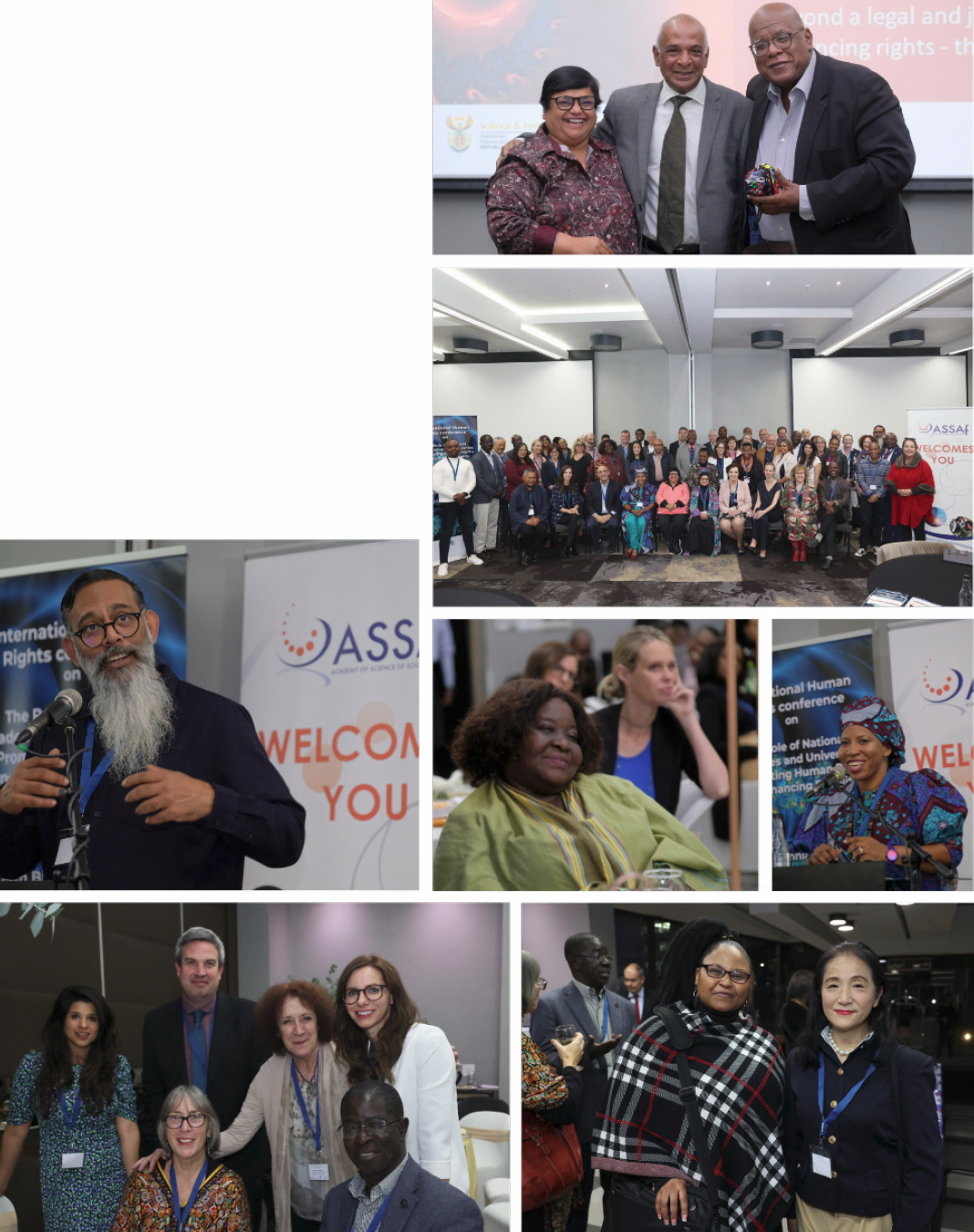
The most recent biennial meeting of the IHRN was held from June 6-8, 2023, in Pretoria, South Africa and was co-hosted with the Academy of Science of South Africa (ASSAf).
The 3-day meeting featured:
- A panel discussion of early career scholars highlighting pressing challenges related to human rights and social justice, as well as ways in which academies and universities can help to address these challenges.
- A full day symposium with expert speakers from around the globe discussing:
- Equity in Global Collaborations
- Gender Equality and Gender-Based Violence
- Addressing Stigma and Discrimination
- Safeguarding Academic Freedom
- Advancing Social Justice through Promotion of Access to Health Care
- A private workshop for 33 participants, representing 25 national academies, during which participants outlined long-term goals and potential activities for the IHRN.
During the meeting, participating academy representatives identified several follow-up activities to explore with their academies and the IHRN Secretariat. Among others, initiatives included:
-
Support for Sudanese Colleagues
Through private appeals and other mechanisms, national academies expressed grave concern regarding the ongoing conflict in Sudan and its devastating impact on access to health care in the country and on the state of science and research, as well as the displacement of students and scholars. The IHRN Secretariat also shared an appeal from Mohamed H.A. Hassan, President of the Sudanese National Academy of Sciences, urging academies of science, universities, and funding agencies to take note and do what they can to host displaced researchers and students.
-
Establishment of the Mexican Academy of Sciences’ Human Rights Body
In October 2023, the Mexican Academy of Sciences (Academia Mexicana de Ciencias) created a Human Rights Commission made up of 8 members, including lawyers, political scientists, and economists. Its main function is the promotion of human rights, the gender perspective, inclusion, diversity, and non-discrimination.
-
Launch of the IHRN Bulletin
In response to calls for greater information sharing among national academies at the 14th biennial meeting, the IHRN Secretariat has introduced a new biannual human rights bulletin containing updates on the IHRN Secretariat’s activities and human rights resources, along with highlights of IHRN participating academies’ human rights-related events, publications, and announcements. Read the first edition of the bulletin.
To receive future editions of this bulletin and other news from the IHRN, subscribe to the IHRN listserv.
Visit the IHRN website to learn more about the 14th biennial meeting and view video recordings from these events.
It was tremendously exciting that…our excellent speakers…all agreed to place their passions and scholarly interests into the public domain in conversation with their global peers...
I was so happy to meet and speak with delegates from Japan, Ghana, Nigeria, South Korea, Zambia, France, Bolivia, Mexico, Brazil, Egypt, DRC [Democratic Republic of the Congo], Botswana, Namibia, and Kenya... What an event!
— Prof. Catherine Burns,
University of the Witwatersrand