A Research Strategy for Environmental, Health, and Safety Aspects of Engineered Nanomaterials (2012)
Chapter: 2 A Conceptual Framework for Considering Environmental, Health, and Safety Risks of Nanomaterials
2
A Conceptual Framework for Considering Environmental, Health, and Safety Risks of Nanomaterials
The rapid emergence of engineered nanomaterials (ENMs) and their use in diverse products imply their eventual and inevitable appearance in the biosphere. As discussed in Chapter 1, the environmental and human health risks posed by these novel materials remain largely unknown, but the materials’ widespread use provides a strong motivation for investment in research directed at potential adverse effects. The vast variety of nanomaterials and their novel properties provide a strong basis for systematic, coordinated, and integrated research efforts to understand what properties of the materials influence their hazard and exposure potential and what applications present the greatest likelihood of exposure and adverse effects on human health and the environment.
ENMs are a subset of the broader field of nanotechnology, which is defined by the National Nanotechnology Initiative (NNI) as “the understanding and control of matter at dimensions between approximately 1 and 100 nanometers, where unique phenomena enable novel applications. Encompassing nanoscale science, engineering, and technology, nanotechnology involves imaging, measuring, modeling, and manipulating matter at this length scale” (NSET 2010a).
Scale-specific properties and phenomena are at the heart of current interest and investment in ENMs. A substance can be designed and engineered at the nanoscale to behave in a particular and useful way, thereby potentially adding value to an existing product or becoming the basis of a completely new product. Scale-specific properties of nanomaterials expand the possibilities for making new products. But the same scale-specific properties are at the center of concerns about possible new risks: if a new material behaves in novel ways, what are the chances that this behavior will lead to harm to people and the environment?
The multiplicity of ENM variants makes material-by-material assessment impractical. That heterogeneity in nanomaterials, characterized by distributions of properties, has spurred efforts to generalize about exposure and hazard potential in relation to these properties, rather than considering risks for specific types of materials. Initial attempts point to complexities in understanding risks of ENMs (Dreher 2004). For example, the size range used to describe ENMs—1-100 nm— has relatively little bearing itself in determining the risk to people or the environment (see, for example, Auffan et al. 2009; Drezek and Tour 2010). Risk “problems” associated with ENMs have been formulated in terms of established “technologic” characteristics of ENMs (such as particle size) that do not appropriately reflect the potential for harm.
Framing risks associated with an ENM in terms of established definitions provides some insight into emergent risks. For example, exposure potential may be enhanced as particle size decreases to the point where novel physicochemical properties begin to dominate behavior. At the same time, a focus on particle size may highlight issues that are not relevant while shifting attention from such properties as reactivity that may be more relevant to determining risks (for example, Maynard 2011; Maynard et al. 2011a). Consequently, there is substantial uncertainty in understanding of the risks associated with the products of nanotechnology, leading to confusion on prioritizing, and addressing these risks— a confusion that is illustrated in many reports on risk. (See discussion in Chapter 1.)
In making risk-based decisions—whether translating an innovative idea into a new product, crafting new regulations, or developing a risk-research strategy—effective problem formulation is essential (NRC 2009). Formulating the environmental, health, and safety (EHS) “problems” presented by ENMs has proved challenging, as documented by research efforts over the last decade.
DEVELOPING A STRATEGY AND A CONCEPTUAL FRAMEWORK
In addressing the challenges presented by ENMs, the committee notes that there is a distinction between a research strategy and a research agenda. The committee has developed a strategy that provides a principle-based approach to sustaining an agenda for EHS research that will be accountable and adaptive as ENMs change, diversify, and expand in use. In this chapter, the committee describes the research framework for its strategy; later chapters identify data gaps to be addressed by the research strategy. The generation of findings for risk assessment is considered here as an evolving process based on the integration of various research efforts rather than as a static “deliverable.” There will be an ongoing need to inform decision-making in advance of product development and to consider uncertainty coming from incomplete information on future production quantities, ENM properties, and uses of nanomaterials. An evolving and iterative process provides feedback for adjusting research priorities and provides
the information needed to implement risk-management strategies aimed at reducing the potential for harm to human health and the environment. That feedback also informs the design, manufacture, and use of future ENMs.
The conceptual framework, described later in this chapter, reflects a coordinated, strategic research effort that is characterized by three key features:
• A reliance on principles that help to identify emergent, plausible, and severe risks resulting from designing and engineering materials at the nanoscale, rather than an adherence to rigid definitions of ENMs.
• A value-chain and life-cycle perspective that considers the potential harm originating in the production and use of nanomaterials, nanomaterial-containing products, and the wastes generated.
• A focus on determining how nanomaterial properties affect key biologic processes that are relevant to predicting both hazard and exposure; for example, nanomaterial-macromolecular interactions that govern processes ranging from protein folding (a basis for toxicity) to the adsorption of humic substances (that may influence mobility or bioavailability of the materials).
Environmental and human health risk assessment of nanomaterials is severely limited by lack of information on exposure to these materials (for example, information on fate, transport, and transformations) and on the hazards that they present. In contrast with previous research strategies that took a sequential approach to evaluating exposure and hazard for assessing nanomaterial-related risks, the committee’s framework considers evaluations of hazards and exposure as processes that occur in tandem, and it accounts for the wide variety of matrices and transformations of nanomaterials along the value chain and across the life cycle (discussed in more detail later in this chapter).
The framework is to be implemented through a research agenda that begins with understanding how nanomaterial properties may affect fundamental processes—processes that are common in determining both exposures and hazards. By focusing on these processes, the goal of advancing exposure and hazard assessment under conditions of uncertainty can be addressed in a predictive and generalizable fashion that helps to inform decision-making on current and future nanomaterials. Knowledge of these processes has immediate applicability in comparing risks among materials and providing criteria for establishing priorities for research on nanomaterials that are on the market, for providing feedback on research needs and priorities, and for providing evidence needed to reduce the risks posed by nanomaterials that are on the market or are under development.
The sections below address the utility of risk assessment in framing a research strategy for the EHS aspects of nanomaterials, the conceptual framework that is informed by risk assessment, and the principles for setting priorities among research needs on the basis of the properties of nanomaterials.
RISK-ASSESSMENT CONSIDERATIONS REGARDING NANOMATERIALS
In developing this chapter, the committee found useful guidance in Science and Decisions: Advancing Risk Assessment (NRC 2009), which offers recommendations for addressing risks in the modern world. The report examines near-term (2-5 y) and longer-term (10-20 y) solutions focusing on human health risk assessment, but it also considers the implications for ecologic risk assessment. The report focused on two broad goals in its evaluation: improving the technical analysis that supports risk assessment and improving the utility of risk assessment. Although that committee concluded that technical improvements are necessary, it suggested retaining the four basic elements of risk assessment— hazard identification, exposure assessment, dose-response assessment, and risk characterization—originally articulated in Risk Assessment in the Federal Government: Managing the Process (NRC 1983). Technical improvements are needed in approaches to uncertainty and variability analysis and in dose-response analysis. With regard to improving the utility of risk assessment, the committee authoring that report focused on improvements in scoping the problem at hand and understanding a broad set of risk-management options so that the ensuing risk assessment would be more relevant to the questions that decision-makers might ask of the scientific-knowledge base. An important conclusion of the committee’s work was that risk assessment, rather than being viewed as an end in itself, should be considered as a method for informing research and commercialization efforts and for evaluating the relative merits of various risk-management options.
In the context of the development of an EHS risk-research strategy for ENMs, NRC (2009) has much to offer in framing a research agenda. The problem is not equivalent to assessing a well-defined chemical substance for which abundant data are available. An effective risk-research strategy for ENMs will require the identification of data and models to assess risks as the sparse data available are augmented. Careful planning, problem formulation, and consideration of options for managing the risks, including application of green-chemistry principles (see Box 2-1), can improve the utility of assessment for decision-making (NRC 2009).
In Table 2-1, the committee applies the framework of NRC (2009) to potential risks of ENMs. The general considerations of NRC (2009) are translated into specific considerations related to ENMs.
Challenges of Defining Potential Risks
The diverse properties of nanomaterials present a challenge to addressing potential EHS risks of ENMs. First, it is difficult to specify the composition of ENMs, because of the variety of material types and variation within types.
BOX 2-1 Incorporating Green-Chemistry Principles Into Nanomaterial Development and Application
An evolving risk-assessment process provides the best available information needed to inform regulatory decision-making and future research while providing a basis for precautionary actions that might otherwise be ruled out because of data limitations. The limitations include
• Lack of data and adequate models (for example, structure-activity and other predictive models) for nanomaterials, which results in major uncertainties in describing and quantifying nanomaterial hazard and exposure potential.
• Lack of understanding and of ability to track and keep abreast of the rapid change, already evident and expected to increase, in the array of nanomaterials and their applications.
• The diversity of nanomaterial types and variants and the poor ability to group materials for assessment purposes on the basis of known risk characteristics that can be related to specific physical properties.
• Difficulties in distinguishing between exposures and risks associated with nanoscale and conventional forms of the same substances and between naturally occurring and incidentally produced nanoscale materials and ENMs.
Nanomaterial development, informed by an evolving risk assessment, presents the opportunity to identify and reduce, at the design stage, the inherent potential for exposure to and the hazards of nanomaterials. Application of green-chemistry principles and design practices to nanomaterial development can help to ensure that nanomaterials are designed to minimize risk whatever their application.
ENMs seem ideally suited to such approaches, given the ability to exert precise control over composition and structure. Such atomic-scale manipulation is the defining essence of nanotechnology and is what makes it possible to impart such materials with specific properties related to function and performance. In principle, the same ability should extend to identifying and exerting control over the factors determining a nanomaterial’s potential for exposure, such as persistence, mobility, or bioavailability. Similarly, it may be possible to reduce risk by reducing the inherent hazard of a nanomaterial by altering such factors as composition and reactivity. The potential to precisely define and control nanomaterial composition and structure are directly relevant to a number of Green Chemistry principles (ACS 2011) such as those addressing atom economy; use of less hazardous substances in processes; and designing for reduced toxicity, increased energy efficiency, enhanced degradation, and inherent safety.
An evolving risk-assessment process enables the identification and development of predictive tools and methods for screening nanomaterials at early stages in the development process for inherent properties that are associated with high exposure or potentially damaging biologic activity.
TABLE 2-1 Risk-Related Concerns from NRC (2009) as Applied to Nanomaterials
| Topic from NRC (2009) | Consideration for nanomaterials |
| Emphasis should be placed on “planning and scoping” and “problem formulation” in the early phases of risk assessment to ensure that the right questions are being asked of the assessment. | Emphasis on “planning and scoping” and “problem formulation” will allow scientists and research managers to triage a wide array of materials to focus on the ones that present the greatest probability of a risk to health or the environment. For example, understanding the hierarchy of information needs from physical characteristics to potential for release to fate in the environment should allow critical early decisions in the assessment process. There may be a minimum set of information needed to address these determinants of hazard or risk for all nanomaterials, but in the near term the committee’s research agenda might best focus on accumulating information on materials that appear to be reactive, likely to be released, likely to interact with other toxic materials and serve as delivery mechanisms, and likely to persist under typical environmental conditions. This somewhat simplistic example shows the importance of developing some early decision rules for implementation of the EHS research agenda. As is the nature of risk assessments, these early rules would probably be refined as experience in assessing ENMs accrues. |
| Refined approaches to addressing uncertainty and variability in all phases of the risk assessment from characterizing potential release through potential exposure to hazard and risk will be a critical component of information needs in this risk-research strategy. | In designing the research strategy for ENMs, a premium should be placed on a “value of information” analysis that underscores how the information gleaned from the research will be used to reduce uncertainty or to refine an appreciation of variability in exposure or risk. Methods for doing that are available and are continuing to evolve (NRC 2009). |
| Providing a perspective on the role of “default” values and scenarios in risk assessments will be critical. | For nanomaterials, research is needed to determine whether the traditional bases of default assumptions (for example, high to low dose, animal to human, and individual human variability in response) will apply; these issues will need to be addressed in considering approaches that lead to predicting releases or exposures that are unlikely to result in deleterious effects to humans and the environment. |
| Cumulative (multiple agents, same route) and aggregate (single agents, different routes) exposures need to be addressed. | For nanomaterials, research on releases of nanomaterials from multiple processes for different applications must be conducted to account for the potential for total release to the environment. Individual assessments of process-release scenarios have the potential to underestimate environmental and human exposures. Potential interactions of different nanomaterials in common disease processes should also be considered. |
Countless assemblages of atoms and structures and a plethora of inorganic and organic macromolecular coatings affect their surface chemistry and therefore their behavior in the environment and their potential for biologic impact.
Second, nanoscale structures include both materials (for example, particles, fibers, or sheets) and macromolecules (for example, proteins or DNA). Many nanomaterials are particles or designed structures, not molecules. The heterogeneity of the materials profoundly affects efforts to detect or to measure the ENMs or to assess their potential to cause harm. Large biomolecules that are labeled as ENMs may be detected with high specificity using molecular recognition elements. Spectroscopic approaches may provide certifiable identification for some large molecular ENMs. Such approaches will frequently fail with the more complex structures. These materials may have highly uniform properties, while many of the more complex structures will lead to a range of possible interactions. However, the magnitude of forces and the resulting bond strengths induced by interactions with ENMs may be different from those for molecules. In addition to forces that show size dependence (for example, van der Waals interactions), the presence of a separate phase introduces surface energies and boundary effects (for example, discontinuity of crystal lattices at a particle surface and resultant surface charge) that are not present with molecules in solution.
Also, the relative impacts of kinetic compared with thermodynamic factors in controlling the environmental behavior of nanoparticles may be expected to differ from conventional chemical species for which there has been success in predicting phenomena, such as bioaccumulation or transport from, for example, use of structure-function relationships to calculate fugacity.
Third, like many “conventional” contaminants, chemical transformations of the nanomaterials and their coatings will occur in the environment and in organisms, and such transformations are not well characterized or readily predictable.
Fourth, the surface properties of nanomaterials are defined in part by the media in which they are dispersed; for example, surface water, lung fluid, salt water, and air may affect these properties differently. Because the behavior of nanomaterials may be controlled largely by surface properties, general predictions about environmental behavior and effects cannot be readily made. Overall, the lack of a clear and stable material identity makes it difficult to group materials or classes of materials that may behave similarly with respect to fate, transport, toxicity, and risk. Moreover, because most nanomaterials can be thought of not only as chemical entities but as having separate phases, there is considerable doubt regarding the appropriateness of applying or interpreting some of the conventional parameters used in exposure assessment, such as octanol-water partition coefficients and volatility.
A CONCEPTUAL FRAMEWORK LINKED TO RISK ASSESSMENT
The committee developed Figure 2-1, which establishes a conceptual framework for informing its research agenda in Chapter 5. The figure, which is
not intended to portray a linear, sequential process, begins with a value-chain and lifecycle perspective. It depicts sources of nanomaterials originating throughout the lifecycle and value chain, and therefore the environmental or physiologic context that these materials are embedded in, and the processes that they affect. The circle, identified as “critical elements of nanomaterial interactions,” represents the physical, chemical, and biologic properties or processes that are considered to be the most critical for assessing exposure and hazards and hence risk. Those elements exist on many levels of biologic organization, including molecular, cellular, tissue, organism, population, and ecosystem. The committee asks, What are the most important elements that one would examine to determine whether a nanomaterial is harmful? and has placed these elements at the center of the proposed research framework. The critical elements in the circle are not ordered, and the dynamic interactions among them are implied. For example, factors that affect surface affinity may also affect persistence and bioaccumulation and would not be appropriately reflected in any linear sequencing of the elements. Research needs relating to such critical elements are discussed in Chapter 3. Research priorities for addressing the critical elements are summarized in Chapter 5.

FIGURE 2-1 Conceptual framework for informing the committee’s research agenda.
The lower half of the figure depicts tools needed to support an informative research agenda on critical elements of nanomaterial interactions. Improved tools will be integral products of the research agenda. The tools are materials (standardized materials that embody a variety of characteristics of interest), methods (standardized approaches for characterizing, measuring, and testing materials), models (for example, for assessing availability, concentration, exposure, and dose), and informatics (methods and systems for systematically capturing, annotating, archiving, and sharing the research results). The vertical arrows between the tools and the circle acknowledge the interplay between what is learned through research about the processes that influence exposure and hazards and the continuing evolution of the tools for carrying out research.
Inputs of nanomaterials depicted in Figure 2-1 represent releases of ENMs along the entire value chain and life cycle. Activities along the value chain imply inputs of energy and materials at each stage and the creation of waste streams. Each nanomaterial or product containing nanomaterials along the steps of the value chain has an associated life cycle of production, distribution, use, and end-of-life releases that may affect human health and the environment. The principle of including a value-chain and life-cycle perspective in the committee’s conceptual framework is fundamental for assessing the risks posed by nanomaterials and is discussed in greater detail below. Understanding release mechanisms in manufacturing, transport, and product use (for example, abrasion) is implicit in this value-chain and life-cycle perspective.
A LIFE-CYCLE AND VALUE-CHAIN PERSPECTIVE WITHIN THE CONCEPTUAL FRAMEWORK
In developing the conceptual framework, the committee recognized the importance of considering aspects of the life cycle of ENMs throughout the value chain to understand the potential for exposure of humans and ecologic receptors. (See Figure 2-2, an input into the conceptual framework, Figure 2-1). The value chain extends beyond production of nanomaterials into primary and secondary products based on the parent nanomaterials. Releases can come from byproducts and wastes in addition to intended and unintended releases of the parent nanomaterials that extend throughout each step of the value chain of products that contain these materials and their life cycles. Examples of potential releases include
• Fugitive emissions of parent material.
• Process releases of nanomaterials during production and finishing of a product (for example, sawing or sanding).
• Releases during transportation or accidents.
• Releases during product or material use, recycling, recovery, or disposal.
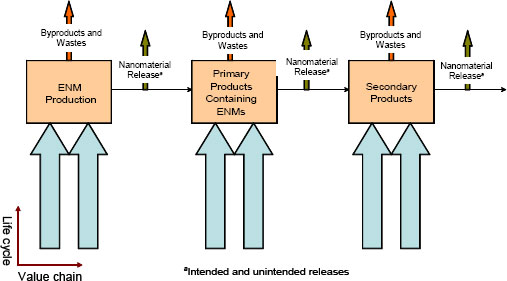
How nanomaterials are produced, used, reused, and disposed of largely determines the risks that they may present to human health and the environment. The risks are in two categories: risks stemming directly from exposure to nanomaterials and nanomaterial-containing products and risks produced by the “collateral damage” associated with energy consumption, material use, and wastes generated as nanomaterials are made, transported, processed, and treated for disposal.
Risks Stemming Directly from Potential Exposure to Nanomaterials
The first category of risks is derived from the potential for exposure to nanomaterials at any stage of fabrication, transport, processing, use, and end of life—activities that make up what is referred to as the life cycle of nanomaterials. The nanomaterial value chain (represented along the horizontal axis in Figure 2-2) involves the production of basic building blocks of nanomaterials and their incorporation (in later stages) into products of increasing complexity (Wiesner and Bottero 2011). For example, such ENMs as quantum dots (Qds) and single-walled carbon nanotubes (SWCNTs) might be combined as QD-SWCNT composites in primary products, such as thin films. Thin films might then be incorporated into solar cells (secondary products), which are then used in housing materials (tertiary products). Each of those products has its own life cycle associated with its fabrication, transport, processing, use, and end of life. Table 2-2 illustrates potential releases of and exposures to carbon nanotubes across the value chain and life cycle of a textile application.
| Raw material | Manufacture 1: Materials Manufacture |
Manufacture |
Manufacture 3: Filling/ Packaging |
Distribution | Use | Recycle | Disposal | |
| CNT | Production of CNT polymers and master batches. Potential for exposure during synthesis, which may differ for each synthesis method. |
Textile manufacture (next row). | Textile fabrication (next row). | Preparing CNTs for shipment to textile manufacturer. Potential for exposure during filling/packing and unpacking. | Transport of CNTs to manufacturer. Potential for release during transfer or from spills. | Use in textiles (next row); also includes epoxy resin, batteries, adhesives, and coatings. | “Recycling” of CNT raw materials may entail release during collection and re-use of remaining materials in subsequent manufacturing. | Potential for release and exposure during transport and waste management (for example, landfills, incinerators). |
| Product 1 (Integrating CNT into Textile) | Potential for exposure during incorporation depending on physical form and handling. | Potential for exposure during processing to make and apply a uniform material; depends on degree of automation and whether CNTs are dry, in suspension, or in masterbatch; coating of textile with CNTs could lead to | Activities include melting, spinning, weaving, sizing, knitting; bleaching, dyeing, printing, washing, drying/fixing, cutting, sewing, shaping, washing; fibre production; finishing (inspection, cleaning, | Sending CNT-treated textile to garment manufacturer. | Transport of secondary product (the garment) with CNT already incorporated into the fabric. | Use in garments (next row). | Recycling of fabric: shredding/cutting and screening, cleaning to reuse materials in new blends; release is possible from intensive treatments (for example, heat, pressure, chemical) and exposure may result from breakdown or from | Disposal of unused or waste CNTs, textile scraps. |
| release or exposure. | washing and packing); fibers carrying CNTs may be shed during these processes. | incorporation of CNTs into a new fabric (cross-contamination). | ||||||
|
|
||||||||
| Product 2 (Article of Clothing) | [N/A: CNT row]. | [N/A: Product 1 row - primary product]. | Pressure, chemicals, and heat of tailoring and finishing the textile may lead to release of CNTs and resulting exposure due to abrasion of fibers. | Filling/packing of secondary product (the garment). | Transport of secondary product (the garment). | Degradation of product during normal wear and tear of garment or from UV, chemicals, water, oxidation (for example, washing, ironing, heat, sweat); direct dermal exposure possible; form of released material a question: single, agglomerated ENPs or nano-or micro- scale textile containing ENP. | Textiles sent to Landfills or second-hand stores incinerators. or developing countries; release and exposure through wear and tear described above; recycling of fabric (previous row). | Landfills incinerators. |
|
|
||||||||
Abbreviation: ENPs, engineered nanoparticles.
Sources: Chaudhry et al. 2009; EDF/DuPont 2007; Som et al. 2009.
Because of the potential for nanomaterial releases and exposures of humans or ecosystems at each stage of the value chain and life cycle, factors to consider in assessing exposure include the nanomaterial form that will be present in commercial products, the potential for the material to be released to the environment, and the transformations of the material that may affect exposure (Wiesner 2009). Analysis based on the value chain and the life cycle is rooted in an assessment of which nanomaterials are being and are expected to be produced and used.
An estimated “reservoir” of nanomaterial production can be used to obtain first-order exposure estimates that are based on explicit, easily understood assumptions regarding the quantities of nanomaterials that enter the environment integrated over the life cycle of production through disposal (Robichaud et al. 2009; Wiesner 2009; Wiesner and Bottero 2011). Understanding the fate and transport of these materials in the environment will lead to an understanding of their ability to interact with biologic systems and help in assessing risk.
Potential Risks Associated with “Collateral Damages”
The second category of risks also extends across the life cycle of nanomaterial production, use, and disposal. At each stage of the value chain (and at the links between stages of the value chain), there is consumption of energy and materials, production of wastes, and the potential for disposal, reuse, and recycling of the materials or products. Those life-cycle factors of nanomaterial production and use throughout the value chain are depicted along the vertical axis (and corresponding vertical arrows) in Figure 2-2 and may result in effects on human health and ecosystems that are independent of the nanomaterials themselves and yet are directly connected to the production of nanomaterials and the products that contain nanomaterials.
For example, the entropic penalties associated with creating order on the atomic scale indicate that energy-intensive processes will commonly be needed to produce nanomaterials (Wiesner 2009). The environmental effects of upstream energy production and use may include hazards to workers in mines, air pollution, global warming, and so on. Material use may introduce risks associated with solvent handling and disposal (Robichaud et al. 2005). It has been shown that the production of non-nanomaterial wastes from the production of carbon nanotubes (Plata et al. 2008) may pose substantial hazards. Those “collateral” risks to human health and the environment are as integral to an assessment of risks associated with nanomaterials as is the potential for exposure to and toxicity of the nanomaterials themselves. However, these factors have been largely unexamined.
An assessment of the repercussions of activities and products throughout the life cycle of production, use, disposal, and reuse of nanomaterials is needed for sustainability planning and decision-making. For any given industrial product, the life-cycle stages of resource extraction, raw-material production, product
manufacturing, transportation, use, and end of life can all be associated with substantial costs and benefits to manufacturers, customers, and the environment. (See Box 2-2 for a discussion of life-cycle assessment, life-cycle inventory, and data needs.)
Although the committee recognizes that indirect collateral effects associated with the life cycle of materials and energy use in nanomaterial production may in some cases be the dominant effects on human health and the environment, the committee’s research framework is focused on identifying EHS issues resulting directly from contact with nanomaterials released along the value chain and life cycle. Notably absent from the proposed framework is a consideration of important issues relating to nanomaterial fabrication, complex nanostructures and devices, and comprehensive life-cycle considerations concerning energy and materials use, reflecting a deliberate focus of this committee on nanomaterials rather than nanotechnology and a heavy emphasis on toxicologic research. However, the framework and strategy proposed by this committee address several key points raised in the NNI Signature Initiative of Sustainable Nanomanufacturing (NSET 2010b). In particular, the focus in this report on methodologic tools supports the call for novel measurement techniques. Like the NNI Initiative, the conceptual approach proposed here and the focus on nanomaterial transformations occurring after release along the value chain aligns with the NNI call for “Development of methodologies that enable accurate measurement of nanomaterial evolution and transport during product manufacturing and use, and across the material lifecycle (NSET 2010b, p. 4).”
One premise of the committee’s framework for research is that EHS research priorities can be established on the basis of judgments regarding the relationships between nanomaterial properties and the processes that govern their interactions with organisms and ecosystems. The nature of the interactions will ultimately define the risk posed by the materials. The following section outlines principles that the committee considered for setting research priorities for the potential human health and environmental risks of ENMs. In many of the committee’s discussions, these principles were applied implicitly as the critical research needs were considered.
Principles for Setting Priorities for Nanomaterial-EHS Research
In the paper “Towards a Definition of Inorganic Nanoparticles from an Environmental, Health and Safety Perspective,” Auffan et al. (2009) illustrate how principles can be used to identify materials that are of interest from a risk
BOX 2-2 Life-Cycle Assessment, Life-Cycle Inventory, and Data Needs
Life-cycle assessment (LCA) provides a formal framework for identifying and evaluating the life-cycle effects of a product, process, or activity. Typically, effects on human health and ecosystem health and effects of pollutant deposition in all environmental media are evaluated for each stage of the life cycle, and an LCA may be performed on products at each stage of the value chain. There are many variations in LCA methods, but arguably the most broadly accepted is one formalized in the ISO-14040 series of standards (ISO 1997; Guinee et al. 2010). Often referred to as formal LCA or full LCA, the ISO method guides the quantitative assessment of environmental effects throughout a product’s life cycle.
A major challenge in conducting formal LCA is to obtain reliable and available data for a life-cycle inventory (LCI). The challenge is amplified for the evolving nanomaterial industry in which production methods, markets, and patterns of product use may be unknown and confidential. Efforts have also been made to integrate consideration of social effects into LCA. The ecoefficiency assessment of BASF corporation has recently been extended to include social effects (Schmidt et al. 2005). Individual indicators of a product’s effects on human health and safety, nutrition, living conditions, education, workplace conditions, and other social factors are assessed and scored relative to a reference (usually the product being replaced).
Although LCA based on a robust LCI may prove to be a useful tool in assessing EHS risks posed by manufactured nanomaterials, it must be remembered that releases to the environment, representing an upper bound on potential for exposure, will not equate to actual exposure of humans or ecologic receptors. Fate, transport, and transformation processes of nanomaterials in the environment need to be considered. Data needs include
• Characterizing commonly used nanomaterials.
• Understanding the potential for release of nanomaterials throughout the life cycle of the material and the value chain leading to products.
• Placing potential releases into an exposure context.
• Providing bases for assessing risk to human health and the environment.
In addition, a broader framework that combines life-cycle assessment and risk analysis may help to inform our understanding of potential risks and environmental impacts of ENMs (Evans et al. 2002; Matthews et al. 2002; Shatkin 2008).
Current knowledge needs to be assessed and a gap analysis performed to understand critical research and data needs for addressing the EHS aspects of nanomaterials (see Chapter 3). Addressing the issues of modeling vs monitoring— for example, releases, fate and transport, exposure, dose, and potential effects— will be critical for the success of this effort (see discussion in Chapter 4).
perspective. Regarding important risk-related characteristics of ENMs, Auffan et al. considered developing a risk-based definition of inorganic nanoparticles that is founded on novel size-dependent properties. Contrary to the title of their paper, Auffan et al. pose a set of principles for identifying materials of interest rather than a rigid definition for classifying ENMs. The science-based approach that they adopted allows materials presenting new or unusual risks to be distinguished from materials that present more conventional risks. Their approach establishes criteria for determining the probability that a material measuring 1100 nm will exhibit novel properties that might lead to new or unusual risks.
Building on that idea, the present committee focuses on a set of principles in lieu of definitions to help identify nanomaterials and associated processes on which research is needed to ensure the responsible development and use of the materials. The principles were adopted in part because of concern about the use of rigid definitions of ENMs that drive EHS research and risk-based decisions (Maynard 2011; Maynard et al. 2011a). The principles are technology-independent and can therefore be used as a long-term driver of nanomaterial risk research. They help in identifying materials that require closer scrutiny regarding risk irrespective of whether they are established, emerging, or experimental ENMs. The principles are built on three concepts: emergent risk, plausibility, and severity; the principles are based on proposals articulated by Maynard et al. (2011b).
Emergent risk, as described here, refers to the likelihood that a new material will cause harm in ways that are not apparent, assessable, or manageable with current risk-assessment and risk-management approaches. Examples of emergent risk include the ability of some nanoscale particles to penetrate to biologically relevant areas that are inaccessible to larger particles, the failure of some established toxicity assays to indicate accurately the hazard posed by some nanomaterials, scalable behavior that is not captured by conventional hazard assessments (such as behavior that scales with surface area, not mass), and the possibility of abrupt changes in the nature of material-biologic interactions associated with specific length scales. Identifying emergent risk depends on new research that assesses a novel material’s behavior and potential to cause harm.
Emergent risk is defined in terms of the potential of a material to cause harm in unanticipated or poorly understood ways rather than being based solely on its physical structure or physicochemical properties. Thus, it is not bound by rigid definitions of nanotechnology or nanomaterials. Instead, the principle of emergence enables ENMs that present unanticipated risks to human health and the environment to be distinguished from materials that probably do not. It also removes considerable confusion over how nanoscale atoms, molecules, and internal material structures should be considered from a risk perspective, by focusing on behavior rather than size.
Many of the ENMs of concern in recent years have shown a potential to lead to emergent risks and would be tagged under this principle and thus require further investigation. But the concept also allows more complex nanomaterials
to be considered—those in the early stages of development or yet to be developed. These include active and self-assembling nanomaterials. The principle does raise the question of how “emergence” is identified, being by definition something that did not exist previously. However the committee recognized that in many cases it is possible to combine and to interpret existing data in ways that indicate the possible emergence of new risks. For example, some research has suggested that surface area is an important factor that affects the toxic potency of some ENMs; ENMs that have high specific surface area and are poorly soluble might pose an emergent risk.
Plausibility refers in qualitative terms to the science-based likelihood that a new material, product, or process will present a risk to humans or the environment. It combines the possible hazard associated with a material and the potential for exposure or release to occur. Plausibility also refers to the likelihood that a particular technology will be developed and commercialized and thus lead to emergent risks. For example, the self-replicating nanobots envisaged by some writers in the field of nanotechnology might legitimately be considered an emergent risk; if it occurs, the risk would lie outside the bounds of conventional risk assessment. But this scenario is not plausible, clearly lying more appropriately in the realm of science fiction than in science. The principle of plausibility can act as a crude but important filter to distinguish between speculative risks and credible risks.
The principle of severity refers to the extent and magnitude of harm that might result from a poorly managed nanomaterial. It also helps to capture the reduction in harm that may result from research on the identification, assessment, and management of emergent risk. The principle offers a qualitative reality check that helps to guard against extensive research efforts that are unlikely to have a substantial effect on human health or environmental protection. It also helps to ensure that research that has the potential to make an important difference is identified and supported.
Together, those three broad principles provide a basis for developing an informed strategy for selecting materials that have the greatest potential to present risks. They can be used to separate new materials that raise safety concerns from materials that, although they may be novel from an application perspective, do not present undetected, unexpected, or enhanced risks. They contribute to providing a framework for guiding a prioritized risk-research agenda. In this respect, the principles were used by the committee as it considered the pressing risk challenges presented by ENMs.
When the principles are applied to existing and emerging ENMs, various groups of materials that may warrant further study are evident. Those groups, identified below, are not intended to be comprehensive, but they are the basis for beginning to map out material properties that need to be addressed in a risk-research strategy (Maynard et al. 2011b).
• Materials that demonstrate abrupt scale-specific changes in biologic or environmental behavior. Materials that undergo rapid size-dependent changes in
physical and chemical properties that affect their biologic or environmental behavior may pose a hazard that is not predictable based on what is known about larger-scale materials of the same composition.
• Materials capable of penetrating to normally inaccessible places. Materials that, on the basis of their size or surface chemistry or both, are able to persist in or penetrate to places in the environment or body that are not accessible to larger particles of the same chemistry may present emergent risks. If there is a credible scenario for accumulation of, exposure to, or an organ-specific dose of a nanomaterial that is not expected according to the behavior of the dissolved material or larger particles of the same material, a plausible and emergent risk is possible.
• Active materials. Materials that change their biologic behavior in response to their local environment or a signal present dynamic risks that are not well understood. Active materials might include materials whose surface charge leads to association with other materials in the environment, which allows the nanomaterial to function as an efficient delivery system for potentially toxic materials, such as metals and polyaromatic hydrocarbons. Active materials might also include materials whose enzymatic or catalytic processes pose a potential hazard in biologic systems. In addition, it is plausible that nanomaterials that have a three-dimensional structure, similar to natural ligands, could activate receptor-mediated processes in humans and the environment.
• Self-assembling materials. Materials that are designed to assemble into new structures in the body or the environment on release pose issues that may not be captured by current risk-assessment approaches.
• Materials exhibiting a scalable hazard that is not captured by conventional dose metrics. When hazard scales according to parameters that are not typically used in risk assessment, emergent risks may arise because dose-response relationships may be inappropriately quantified. For example, the hazard presented by an inhaled material may scale with the surface area of the material, but if risk assessment is based on mass, the true hazard may not be identified; the material has the possibility of causing unexpected harm.
Applying the Principles to the Value Chain and Life Cycle of Nanomaterials and Products
The principles can be applied to both the value chain of materials and products and their life cycle to identify context-specific risks that may arise and require further research to assess and manage them. The concepts of plausibility, emergence, and severity can help to differentiate between what may be considered more and less important risks. For example, generating and handling multiwalled carbon nanotubes in a workplace— materials that have demonstrated novel properties that include, for example, strength and electric conductivity— may present a plausible and emergent risk. It is only recently that production of these materials has started commercially; there are indications that some forms
of carbon nanotubes are more harmful than their carbon base might indicate; and there is a potential for human exposure (Maynard et al. 2004; Han et al. 2008; Evans et al. 2010). However, riding a bicycle that incorporates multiwalled nanotubes in the frame or using a cellular telephone with a battery containing small quantities of nanotubes is unlikely to lead to important exposure. In those cases, although the emergent risk might remain, the plausible risk is much reduced; nevertheless, when the products are disposed of or prepared for recycling, a plausible and possibly severe risk may re-emerge as the material again becomes potentially dispersible and biologically available.
Those examples demonstrate how the principles of plausibility, emergent risk, and severity allow important risks or “hot spots” to be identified over the value chain and life cycle of the material. The principles provide a systematic basis for identifying and setting priorities among properties of nanomaterials as research subjects in addressing risks.1
Criteria for Selecting Research Priorities
Each of the above types of materials (they are not exclusive), illustrates key research questions that need to be addressed if emergent and plausible risks are to be identified, characterized, assessed, and managed. The principles described above can be applied to set priorities for the study of ENMs. However, a comprehensive research strategy also will address both near-term and long-term issues regarding the EHS aspects of nanomaterials, including identifying the properties of ENMs that make them potentially hazardous; determining how to harmonize collection and storage of pertinent but diverse data types to enable risk-assessment modeling and risk management; developing new tools to measure ENMs in complex environmental and biologic matrices and to model exposure and hazard pathways; and identifying justifiable simplifications that can reduce the level of complexity to enable comprehensive risk assessment of ENMs. And it should outline a path to address complex mixtures of ENMs, to understand their transformations and interactions with existing environmental contaminants, and to assess how the transformations and interactions affect their behavior and effects.
In addition to the issues of life-cycle and value-chain perspective discussed earlier, the committee identified the following criteria as a basis of setting priorities for research:
• Research that advances knowledge of both exposure and hazard wherever possible.
_________________
1A similar definition-independent approach to addressing potential risks arising from ENMs has previously been proposed in the Nano Risk Framework developed by the Environmental Defense Fund and DuPont (Environmental Defense/DuPont 2007).
• Research that leads to the production of risk information needed to inform decision-making on nanomaterials in the market place.
• Research efforts to address short-term needs that serve as a foundation for moving beyond case-by-case evaluations of nanomaterials and allows longer-term forecasting of risks posed by newer materials expected to enter commerce.
• Research that promotes the development of critical supporting tools, such as measurement methods, limitations of which hinder the conduct of research in processes that control hazards and exposure.
• Research on ecosystem-level effects that addresses exposure or hazard scenarios that are underrepresented in the current portfolio of nanotechnology-related EHS research; for example, impacts on ecosystem processes and on organisms representing different phyla and environments.
ACS (American Chemical Society). 2011. The Twelve Principles of Green Chemistry. ACS Green Chemistry Institute [online]. Available: http://portal.acs.org/portal/acs/corg/content?_nfpb=true&_pageLabel=PP_ARTICLEMAIN&node_id=1415&content_id=WPCP_007504&use_sec=true&sec_url_var=region1&__uuid=b0b83343-c387-486e-8d4a-d30de190775e [accessed Oct. 25, 2011].
Auffan, M., J. Rose, J.Y. Bottero, G.V. Lowry, J.P. Jolivet, and M.R. Wiesner. 2009. Towards a definition of inorganic nanoparticles from an environmental, health and safety perspective. Nat. Nanotechnol. 4(10):634-641.
Chaudhry, Q., R. Aitken, S. Hankin, K. Donaldson, S. Olsen, A. Boxall, I. Kinloch, and S. Friedrichs. 2009. Nanolifecycle: A Lifecycle Assessment Study of the Route and Extent of Human Exposure via Inhalation for Commercially Available Products and Applications Containing Carbon Nanotubes. Final Report. The Food and Environmental Research Agency (FERA), York, UK [online]. Available: http://www.man.dtu.dk/English/About/personer.aspx?lg=showcommon&id=265562 [accessed Mar. 18, 2011].
Dreher, K.L. 2004. Health and environmental impact of nanotechnology: Toxicological assessment of manufactured nanoparticles. Toxicol. Sci. 77(1):3-5.
Drezek, R.A., and J.M. Tour. 2010. Is nanotechnology too broad to practise? Nat. Nanotechnol. 5(3):168-169.
EDF/DuPont (Environmental Defense Fund and DuPont). 2007. Nano Risk Framework. Environmental Defense Fund, Washington, DC, and DuPont, Wilmington, DE. June 2007 [online]. Available: http://nanoriskframework.com/page.cfm?tagID=1081 [accessed Mar. 17, 2010].
Evans, J.S., P. Hofstetter, T.E. McKone, J.K. Hammitt, and R. Lofstedt. 2002. Introduction to special issue on life cycle assessment and risk analysis. Risk Anal. 22(5):819-820.
Evans, D.E., B.K. Ku, M.E. Birch, and K.H. Dunn. 2010. Aerosol monitoring during carbon nanofiber production: Mobile direct-reading sampling. Ann. Occup. Hyg. 54(5):514-531.
Guinee, J.B., R. Heijungs, G. Huppes, A. Zamagni, P. Masoni, R. Buonamici, T. Ekvall, and T. Rydberg. 2010. Life cycle assessment: Past, present, future. Environ. Sci. Technol. 45(1):90-96.
Han, J.H., E.J. Lee, J.H. Lee, K.P. So, Y.H. Lee, G.N. Bae, S.B. Lee, J.H. Ji, M.H. Cho, and I.J. Yu. 2008. Monitoring multiwalled carbon nanotube exposure in carbon nanotube research facility. Inhal. Toxicol. 20(8):741-749.
ISO (International Organization for Standardization). 1997. Environmental Management-Life Assessment-Principles and Framework. ISO 14040. International Organization for Standardization, Switzerland.
Matthews, H.S., L. Lave, and H. MacLean. 2002. Life cycle impact assessment: A challenge for risk analysis. Risk Anal. 22(5):853-859.
Maynard, A.D. 2011. Don’t define nanomaterials. Nature. 475(7354):31.
Maynard, A.D., P.A. Baron, M. Foley, A.A. Shvedova, E.R. Kisin and V. Castranova. 2004. Exposure to carbon nanotube material: Aerosol release during the handling of unrefined single-walled carbon nanotube material. J. Toxicol. Environ. Health 67(1):87-107.
Maynard, A.D., D. Bowman, and G. Hodge. 2011a. The problem of regulating sophisticated materials. Nat. Mater. 10(8):554-557.
Maynard, A.D., D.B. Warheit, and M.A. Philbert. 2011b. The new toxicology of sophisticated materials: Nanotoxicology and beyond. Toxicol. Sci. 120(Suppl. 1):S109-S129.
NRC (National Research Council). 1983. Risk Assessment in the Federal Government: Managing the Process. Washington, DC: National Academy Press.
NRC (National Research Council). 2009. Science and Decisions: Advancing Risk Assessment. Washington, DC: National Academies Press.
NSET (Nanoscale Science, Engineering, and Technology Subcommittee). 2010a. FAQs: Nanotechnology. National Nanotechnology Initiative. Nanoscale Science, Engineering, and Technology Subcommittee [online]. Available: http://www.nano.gov/nanotech-101/nanotechnology-facts [accessed July 13, 2011].
NSET (Nanoscale Science, Engineering, and Technology Subcommittee). 2010b. Sustainable Nanomanufacturing-Creating the Industries of the Future, Final Draft, July 2010. NSTC Committee on Technology. Subcommittee on Nanoscale Science, Engineering, and Technology [online]. Available: http://www.nano.gov/sites/default/files/pub_resource/nni_siginit_sustainable_mfr_revised_nov_2011.pdf [accessed Nov. 3, 2011].
Plata, D.L., P.M. Gschwend, and C.M. Reddy. 2008. Industrially synthesized single-walled carbon nanotubes: Compositional data for users, environmental risk assessments, and source apportionment. Nanotechnology. 19(18):185706.
Robichaud, C.O., D. Tanzil, U. Weilenmann, and M.R. Wiesner. 2005. Relative risk analysis of several manufactured nanomaterials: An insurance industry context. Environ. Sci. Technol. 39(22):8985-8994.
Robichaud, C.O., A.E. Uyar, M.R. Darby, L.G. Zucker, and M.R. Wiesner. 2009. Estimates of upper bounds and trends in nano-TiO2 production as a basis for exposure assessment. Environ. Sci. Technol. 43(12):4227-4233.
Schmidt, I., M. Meurer, P. Saling, A. Kicherer, W. Reuter, and C.O. Gensch. 2005. SEE- balance®: Managing sustainability products and processes with the Socio-Eco-Efficiency Analysis by BASF. Greener Management International. 45(July):79-94.
Shatkin, J.A. 2008. Informing environmental decision making by combining life cycle assessment and risk analysis. J. Ind. Ecol. 12(3):278-281.
Som, C., M. Halbeisen, and A. Kohler. 2009. Integration of Nanoparticles in Textiles [in German]. Textile Federation of Switzerland and EMPA, Switzerland. January. 5, 2009 [online]. Available: http://www.empa.ch/plugin/template/empa/*/78231 [accessed Mar. 18, 2011].
Wiesner, M.R. 2009. Life Cycle of Nanoproducts. Nanostructured Materials and Nonmanufacturing Definitions: Data Gaps and Research Needs. Presentation at Nanotechnology and Life Cycle Analysis Workshop, November 5-6, 2009, Chicago, IL [online]. Available: http://www.uic.edu/orgs/nanolcaworkshop/wiesner.html [accessed July 26, 2011].
Wiesner, M.R. and J.Y. Bottero. 2011. A risk forecasting process for nanostructured materials, and nanomanufacturing. Comptes Rendus Physique. 12(7):659-669.


