Civic Engagement and Civic Infrastructure to Advance Health Equity: Proceedings of a Workshop (2023)
Chapter: 5 Democratic Deliberation and Closing Reflections
5
Democratic Deliberation and Closing Reflections
The workshop concluded with an opportunity for pre-registered event attendees to participate in a short democratic deliberation exercise designed to encourage reflection on and discussion of ideas explored during the workshop. Roundtable co-chair Ray Baxter followed that discussion with a series of closing remarks.
DEMOCRATIC DELIBERATION EXERCISE
Erika Blacksher of the Center for Practical Bioethics provided an introductory overview of democratic deliberation as a tool for civic engagement (see Appendix D for Blacksher’s summary about the activity). Democratic deliberation has been used around the world to bring together diverse people in substantive discussions about shared challenges and to help identify collective solutions. Democratic deliberation has been used to address complex questions across sectors ranging from education to the environment, transportation and city planning, health and health care, and research. The length of deliberations may be days, weeks, even sometimes months, Blacksher said, before adding that these deliberations would be allotted an hour and a half.
The exercise asked participants to consider what civic infrastructures are most important for advancing health equity. Each breakout group would role-play, serving as the city council of Ourlandia, with the “council members” called on to engage in a deliberative process of allocating $10 million in federal funding among four categories of civic infrastructure (see Figure 5-1 and Table 5-1).
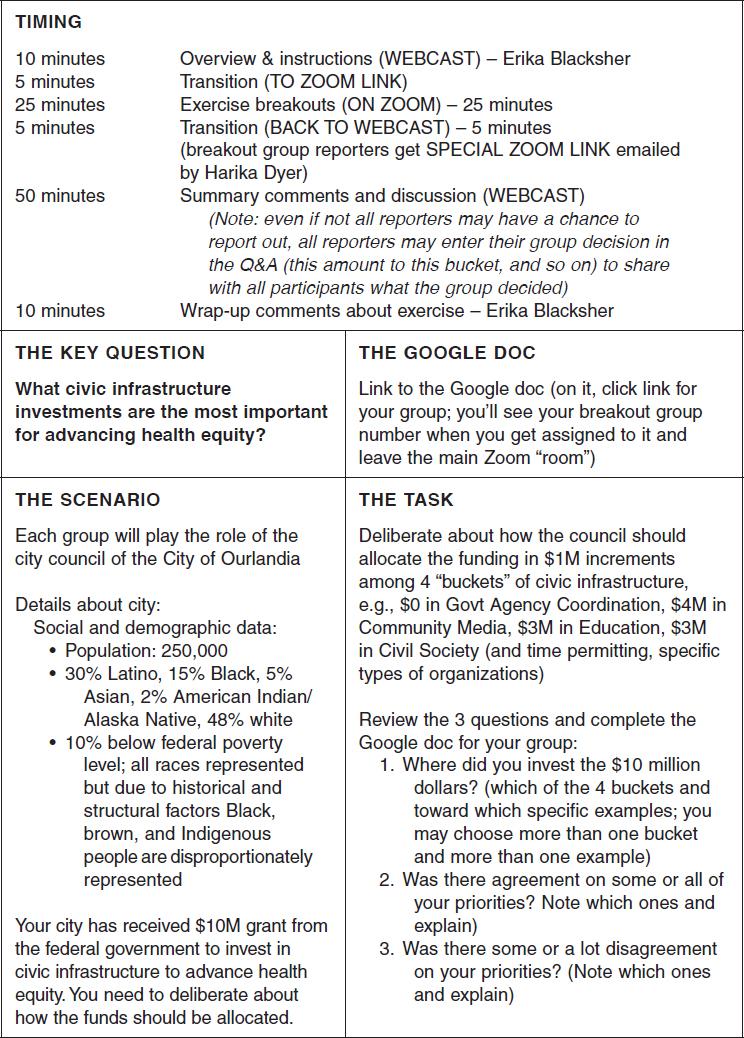
NOTE: Pre-registered participants were asked to have the handout available either in printed form or open on their computers in order to refer to it during the discussion.
SOURCE: Prepared by staff with planning committee input for use by participants in the practical exercise on June 17, 2021.
TABLE 5-1 Notetaking Sheet, Completed by Participants in a Shared Google Doc
| Broad topic | Bucket 1 Government agency Coordination |
Bucket 2 Community media (local knowledge expertise in serving historically marginalized communities of color and other underserved communities) |
Bucket 3 Education (K-12 and higher education) |
Bucket 4 Civil society (non-profit, faith, for-profit) |
|---|---|---|---|---|
| Amount allocation in $1M increments (could be $0) | $_ million | $_ million | $_ million | $_ million |
| Specific types of organizations or entities to invest in/with (add more as needed, highlight all that apply to your allocation decision) |
Such as:
|
Such as:
|
Such as:
|
Such as:
|
| Broad topic | Bucket 1 Government agency Coordination |
Bucket 2 Community media (local knowledge expertise in serving historically marginalized communities of color and other underserved communities) |
Bucket 3 Education (K-12 and higher education) |
Bucket 4 Civil society (non-profit, faith, for-profit) |
|---|---|---|---|---|
| Real-life examples (provided to illustrate only) | Such as: Health in All Policies group CA’s Strategic Growth Council; Vision Zero initiatives in Seattle and Minneapolis |
Name local papers serving specific ethnic community etc.; Facebook and Next Door groups/pages | Coalition for Community Schools; Michigan Educational Justice Coalition; Community-Campus Partnership for Health | Such as: ISAIAH (state coalition of faith communities); Greater Cleveland Congregations; Memphis Congregational Health Network; Grantmakers in Health; Health Anchor Network |
| Agreement | ||||
| Disagreement | ||||
| Other notes |
SOURCE: Prepared by staff with planning committee input for use by participants in the practical exercise on June 17, 2021.
More than 50 pre-registered attendees joined a video conference and were split into five small groups. After entering their Zoom breakout rooms, each group referred to the handout and completed the worksheet. A self-selected rapporteur from each group reported back in the following plenary session. The five rapporteurs were Zo Mpofu, Sophia McWilliams, Madeleine Swanagan, Sally Cohen, and Anna Creegan. All groups identified education as the top priority for investing in civic infrastructure. Further highlights and discussion are provided in Appendix D, authored by Erika Blacksher.
CLOSING REFLECTIONS
Ray Baxter offered brief closing remarks, reflecting on themes that arose over the 2 days of the workshop. These included the following:
- The breadth of community engagement from voting to youth councils to information campaigns;
- The vote as just one (important) dimension of civic engagement; others include setting the agenda and asking the question in the first place, and then shaping the implementation of policies, programs, and investments;
- The critical role of information: where does it come from, and who is the messenger (e.g., the importance of community media)?;
- The power of modelling; the power of institutions when they themselves model how things should be done rather than simply teaching or preaching;
- What are the trusted vehicles for civic engagement? E.g., neither unions nor faith institutions were mentioned much during the workshop; what does that indicate?; and
- Finally, does civic engagement itself improve health equity, or is the goal to enact good policy that reverses entrenched racist and exploitative structures?
Workshop panels highlighted how facts and data do not stand on their own, but are used to fill in a narrative with a story line that can encourage or discourage civic engagement, Baxter said. Finally, he noted that this final session had given workshop participants the opportunity to experience an example of democratic deliberation in a process characterized by the sharing of evidence, reasoned argument, honest personal testimony, empathy, and careful consideration. This practical activity exemplified the themes of the workshop such as the participation of diverse voices, frank and thoughtful dialogue about data and information, and careful consideration of needs for building and sustaining civic infrastructure.
This page intentionally left blank.


