Tipping Points, Cascading Impacts, and Interacting Risks in the Earth System: Proceedings of a Workshop (2024)
Chapter: 2 Historical Analysis of Past Biogeophysical and Social Tipping Points
2
Historical Analysis of Past Biogeophysical and Social Tipping Points
Following the introductory remarks and overview of tipping points, the first topical session of the workshop highlighted examples of historical analysis of past biogeophysical and social tipping points from a range of perspectives and approaches. Workshop participants first gathered in plenary to hear presentations on these examples and then joined breakout group discussions to dive deeper into biogeophysical and social tipping points that occur over different timescales.
ECONOMIC PERSPECTIVE ON SOCIAL TIPPING POINTS RELATING TO CLIMATE CHANGE
Dr. Ilan Noy, Victoria University of Wellington, focused on the economic perspective of tipping points associated with climate change. He shared highlights from Newman and Noy (2023) that considered extreme weather events, such as heat waves, floods, and extreme cold, as significant impacts of climate change on the economy. He explained that the study analyzed around 250 attribution studies on extreme events around the world and matched the economic costs of these events, when available, to estimate the current cost of climate change. In doing so, Noy emphasized that the study revealed the increasing likelihood and economic costs of heatwaves and floods due to climate change. By matching the fractions of attributable risk to economic costs, Noy explained that the study also showed that over the past 20 years, global gross domestic production was affected by almost 1 percent, with impacts to the United States costing around US$150 billion per year. Therefore, Noy stressed that extreme weather events, often considered low-likelihood high-impact events, are already significantly impacting the global economy.
Next, Noy focused on the damages from extreme events, such as mortality or asset damage, that result in declines in economic activity with longer-lasting effects on the impacted communities. Noy identified this space as where tipping points start to matter. Noy provided two examples of potential scenarios following a disaster: recovery to pre-event conditions or a permanent decline in economic growth (Figure 2-1). He emphasized that tipping points play a role when an extreme event can lead to institutional changes that result in a different economic trajectory, which can be beneficial or catastrophic. Noy used a historical example of the 1978 earthquake in Iran, which triggered the Islamic Revolution and subsequent economic decline, to illustrate how a single disaster event can initiate a cascade of dynamics that leads to long-term economic consequences.
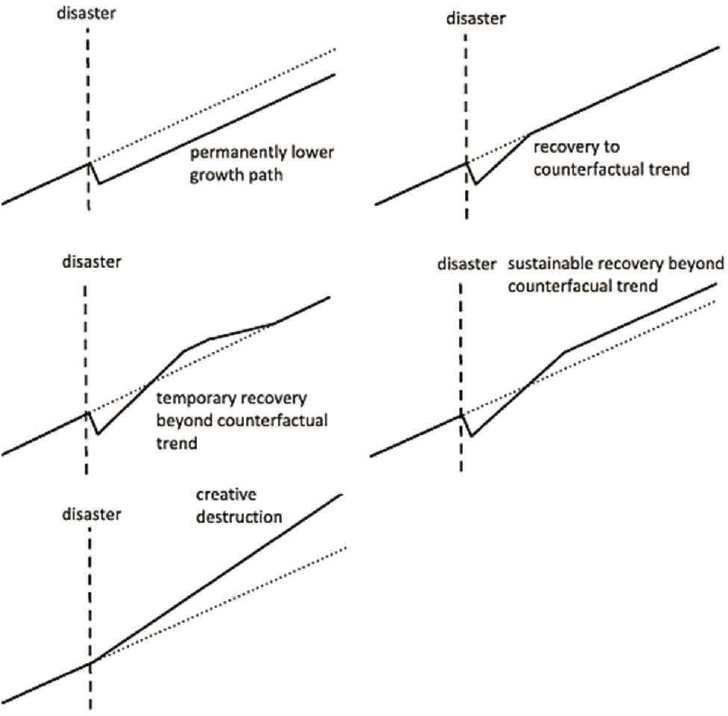
SOURCE: Heger and Neumayer (2019).
Noy provided three more historical examples of past extreme events or disasters to demonstrate the complexity and broader impact of social tipping points triggered by these events and the wide range of resulting possible socioeconomic trajectories. Noy described the lasting economic and social impacts of the Dust Bowl in the United States; the beneficial, though not long-lived, political regime changes triggered by tropical cyclone Nargis in Myanmar; and the drought in the Levant, which may have led to the Syrian civil war and the migration crisis across Europe. Noy concluded by emphasizing a key point—following perturbations related to extreme events caused by climate change, social systems might not necessarily revert to a settled equilibrium, and therefore have the potential for prolonged and unpredictable impacts on economic and social systems.
HISTORICAL EXAMPLE OF A TIPPING POINT: THE DUST BOWL 1930S—THE PERFECT DISASTER
Dr. Benjamin Cook, National Aeronautics and Space Administration Goddard Institute for Space Studies, spoke in more detail about the Dust Bowl drought in the United States and its profound agricultural and societal impacts during the 1930s and beyond. Cook opined that the Dust Bowl was most likely the most severe disaster in U.S. history, causing widespread crop failures, land abandonment, and human migration. Cook also noted that although droughts and dust storms in the Central Plains were not uncommon
before or after the Dust Bowl, the unique severity and scale of the impacts of the Dust Bowl were due to a combination of “bad luck and bad choices,” with contributing factors ranging from the physical climate system, the regional ecology, and the choices people made.
Cook shared contributing factors in the century leading up to the Dust Bowl (1800s and 1900s). He noted that prior to the Civil War in the late 1800s, most agriculture in the United States was located east of the Mississippi River. Following the Civil War, the U.S. government undertook a campaign to remove and displace Native peoples across the Central United States, which opened the Central Plains for settlement and shifted agriculture from the eastern United States to the central plains. To cope with the relatively drier conditions of the Central Plains, agriculture moved toward crop types and practices that preserved water and drew up water from deep below the surface, relying on shallow-rooted, drought-sensitive crops such as wheat and corn. Cook discussed a shift toward the Campbell Method, where subsurface soil was tightly packed to draw up moisture from deep below the surface and covered by a looser surface soil mulch layer, covered by leaves and loose soil to reduce evaporation. With the advent of mechanization, the use of one-way disk plows became widespread to loosen up surface soil, which inadvertently contributed to soil erosion and left the Central Plains vulnerable to wind erosion. Shallower-rooted crops and looser soil surfaces replaced native, wild-adapted, deep-rooted crops of the Central Plains, further propelling the replacement of native resilient ecosystems with erosion- and drought-prone crops.
Cook explained that because these shifts coincidentally occurred during an extremely wet period, negative consequences were not immediate. However, a shift in ocean patterns, which typically drive droughts in western North America, triggered a cascade of events that led to prolonged and intense drought in the Central Plains. He noted that the resulting large-scale crop failures coincided with an economic depression, which led to widespread abandonment of farmland and further drying of the lands and providing the conditions to generate devastating dust storms.
Cook presented a discussion of feedbacks between dust and land degradation in agriculture. He explained that during drought, as vegetation is being removed from the land surface, evaporation of moisture into the atmosphere is reduced. Devegetated dry surfaces allow for loose surface dirt to be picked up by the wind, where the dust aerosols stabilize the atmosphere and suppress precipitation. This process leads to further loss of vegetation and to further surface drying.
Cook then shifted focus to the end of the Dust Bowl, including reevaluation and increased involvement of various government agencies to prevent reoccurrences. Cook shared two important efforts to mitigate the Dust Bowl’s effects: soil conservation measures and increased irrigation. These interventional methods helped prevent similar disasters in the future and increased drought resilience in the Central Plains.
Cook emphasized that the Dust Bowl represented a tipping point resulting from a unique combination of natural and human factors and decisions. He stressed that lessons learned from this event highlight the important role that improved management practices play in reducing the likelihood of similar events occurring in the future.
A SIMPLIFIED MODEL OF BIOGEOPHYSICAL TIPPING POINTS: LOVELOCK’S DAISYWORLD
Next, Dr. Tim Lenton, University of Exeter, presented prepared remarks of Dr. Lee Kump, Pennsylvania State University. Lenton noted that Kump’s presentation would focus on the concept of biogeophysical tipping points, particularly on how tipping point dynamics may arise from certain biological responses to environmental variables. Lenton explained that Kump’s remarks would review the work of Jim Lovelock and Lynn Margulis and their Gaia hypothesis (Lovelock, 1972; Margulis and Lovelock, 1973), which proposes that life and the nonliving parts of the planet are coupled together in such a way that the Earth’s environment is self-regulating over geological timescales. Lenton elaborated that Lovelock interpreted the Earth’s history as long intervals of stability interspersed with rapid tipping-point transitions. Lovelock noticed that biological systems tend to exhibit parabolic responses to environmental variables, as opposed to purely physical and chemical processes that tend to respond monotonically. Lenton noted that this response has important implications for feedback dynamics.
Lenton used Lovelock’s Daisyworld model to elaborate on this concept. He explained that this model simulates a fictional planet and the interactions between its only two lifeforms—black daisies and white daisies. In Daisyworld, the color of the daisies affects the planet’s temperature, with black daisies absorbing sunlight and warming the environment, while white daises reflect sunlight and cool the environment. He noted that the daisies’ effect on temperature starts locally, but as the daisies spread far enough, the effect can scale up to affect the global environment. Lovelock modeled the daisies’ growth response function to temperature parabolically to simulate an optimal temperature for growth. Lovelock seeded the planet with black and white daisies and let the model run forward with time, slowly increasing the solar luminosity to mimic the life cycle of a star and letting the daisy growth and temperature interact. Through such a simulation, Lovelock was able to simulate how the population dynamics of the two types of daisies in response to their coupled temperature responses can lead to tipping points, where he observed rapid system transitions between stable states (as demonstrated by the rapid transitions in areal coverage percentage of the black and white daisies in Figure 2-2a).
Lenton discussed Lovelock and Kump’s joint work to extend the simplified Daisyworld concept to various real-world ecosystems on Earth, such as plants and algae, which also have parabolic responses to environmental variables such as temperature. Lenton pointed out that both plants and algae have the potential to play an important role in regulating the Earth’s climate through their coupling to other environmental processes, such as carbon removal and cloud formation, which can lead to potential tipping points. Lenton explained that Lovelock noted that although these organisms have cooling effects for the Earth and contribute to climate stability, they can only do so up to a certain extent (Kump and Lovelock, 1995). If pushed past certain thresholds (e.g., if sea surface temperatures were to rise above 12°C), algae populations would collapse, and as a result, a tipping point would occur with the abrupt termination of their cooling effect on the climate and a rapid rise in temperature. Lenton also noted that although Lovelock’s Daisyworld model allowed
the daisies to spread globally, spatial heterogeneity in the real world may increase or dampen the risk of large-scale tipping dynamics, and therefore more research is needed to improve understanding of this topic.
Lenton concluded by highlighting the usefulness of simplified models to understand the complexity of and interconnectedness among physical, chemical, and biological systems in determining the stability, and therein tipping points, of the Earth’s climate system. To this point, Lenton added that Kump concluded his prepared remarks by stating that because life both affects and can be affected by the environment, it is an integral part of the global-scale regulation of climate. Because of their parabolic response nature, the sign of the related feedbacks may change past certain thresholds, leading to tipping points.

SOURCE: Kump and Lovelock (1995).
BREAKOUT GROUP DISCUSSIONS ON BIOGEOPHYSICAL AND SOCIAL TIPPING POINTS
Following these presentations, workshop attendees participated in short breakout discussions. The participants were divided into three groups by timescale: (1) Larger-Longer Scale, (2) Cascading Risks Last 1,000 Years, and (3) Last 100 Years. Each group was asked two questions pertaining to their timescale focus:
- What are the key outstanding research questions on biogeophysical and social tipping points, the interacting risks of these tipping points, and their cascading impacts?
- What are the major barriers and opportunities to accelerate progress to advance these areas of research?
Following each breakout session, designated rapporteurs and participants from each group shared the groups’ key takeaways.
Larger-Longer Scale
Dr. Simon Dietz, London School of Economics and Political Science, shared his group’s key takeaways from its discussion on the larger-longer scale risks of tipping points. Dietz emphasized that the larger-deeper timescale perspective of tipping points is important for understanding the stability of the Earth system when subjected to various forcings. He noted that many open key research questions regarding the stability of the coupled natural and physical systems remain. Dietz shared that the breakout discussion focused on the social aspect of tipping points and the importance of gaining a better understanding of the pertinence of the deep-time perspective for social systems and social science questions. He closed his remarks with one opportunity and one barrier regarding the larger-longer scale. The opportunity was the potential that higher-resolution data may offer to improve modeling and understanding, while lack of incentives for transdisciplinary research concerning such long timescales relative to those of other social science disciplines was a barrier. Lenton added that another recurring theme of the group’s discussion centered on how social dynamics may cause tipping in natural systems and vice versa. He highlighted that the group was drawn toward improving understanding of the longer-term perspective of humans in the Earth system and clarifying the importance of new social theories to address fundamental questions around modern growth regimes and the role of societal dynamics.
Cascading Risks Last 1,000 Years
Dr. Michael Schoon, Arizona State University, shared this group’s key takeaways about tipping points in the most recent millennium. On understanding social tipping points, Schoon emphasized that his group discussed that these are not well understood, partly due to lack of fundamental understanding and partly from the challenge of reconciling various timescales across biogeophysical records from millennia ago to human’s day-to-day lives and generational perspectives. He mentioned that the group discussed how further work may be needed to study the intersection of social and biogeophysical tipping points and that tools such as integrated assessment models may need to reexamine how well social processes are represented. Schoon pointed out that a barrier to this work is the discrepancy between how well-defined tipping points in biogeophysical systems are compared to those in social contexts.
Dr. Kristen St. John, James Madison University, added that the group discussed the usefulness of conceptual models to facilitate transdisciplinary team building and communication with stakeholders, particularly in helping to illustrate cause-and-impact relationships between human and natural systems. She also noted that the group discussed the importance of more research on phase changes in the physical system and their feedbacks onto both biogeochemical and human systems. St. John stressed the importance of understanding both the positive and negative impacts of tipping points and their role in providing information for decision-making that considers environmental, social, and climate justice issues.
Finally, Dr. Jeffrey Rubin offered two key takeaways: (1) the importance of considering political cycles when identifying barriers and opportunities for cascading risks research at the millennia scale and (2) the importance of clearly communicating the distinction between inevitability and imminence when considering short-term actions on a human scale using insights from millennia-scale tipping points.
Cascading Risks Last 100 Years
Margo Corum, staff member with the National Academies of Sciences, Engineering, and Medicine, summarized the takeaways of the group discussion on tipping points and risk within the most recent 100 years. She shared that this group elevated the importance of understanding societal amplification dynamics, which may allow natural disasters to scale up to human disasters. Corum noted opportunities for observing this dynamic in the evolution of societal changes from the Middle Ages to the Renaissance. Corum shared the group’s discussion on understanding how societal systems respond to and enforce rates of change to inform policy decisions and risk assessment. Regarding opportunities, Corum highlighted the potential for new technologies and tools, such as improved sensor technology, modeling, and risk forecasting, to improve communication. Corum added that the group’s discussion on risk management also involved contrasting historical examples of unmanaged abandonment, such as the Dust Bowl, to the modern concept of managed retreat. This discussion, Corum noted, highlighted the importance of planning and proactively strategizing to mitigate risks and adapt to environmental change.
Altogether, key recurring themes across the breakout groups’ discussions centered on the complexity of cascading risks and tipping points across disciplines and timescales, the importance of improved communication and transdisciplinary collaborations, and the number of remaining fundamental questions that may involve integrated approaches to account for the complexity of the natural and human systems.


