Sharing Exemplary Admissions Practices That Promote Diversity in Engineering: Proceedings of a Workshop (2023)
Chapter: 2 Higher Education Admissions Systems
2
Higher Education Admissions Systems
The workshop’s first panel session, featuring four presentations from both researchers and practitioners in higher education admissions, addressed how the institutions can change their admissions systems to increase diversity, inclusion, and equity in their engineering programs. The four speakers were OiYan Poon (Colorado State University10), Joseph Montgomery (Tuskegee University), Andrew B. Palumbo (Worcester Polytechnic Institute), and Han Mi Yoon-Wu (University of California). Following the short presentations, Beth Holloway (Purdue University) moderated a discussion among the speakers.
“RACE-CONSCIOUS” HOLISTIC ADMISSIONS
OiYan Poon began her presentation with some background information on affirmative action. She noted that the Supreme Court had recently asked the Biden administration to weigh in on whether the court should hear the lawsuit between Students for Fair Admissions and Harvard University, in which the former contend that Harvard discriminates against Asian students by considering race as a factor in undergraduate admissions, or let stand a lower court ruling that Harvard’s admissions program is constitutional. She pointed out that race-conscious admissions policies had shifted their emphasis over the years from remediation, redressing historic harms, and advancing racial equity to an emphasis on diversity, a position first articulated by Justice Lewis Powell Jr. in the 1978 Supreme Court ruling that upheld the use of race as one factor in choosing among qualified applicants for admission to achieve diversity while also ruling that the practice of reserving a set number of admissions slots for racial minority students (e.g., quotas) was unconstitutional.
The court also upheld the use of race among other factors in admissions policies in the 2003 Grutter v. Bollinger ruling on the University of Michigan’s law school admissions policies, Poon continued, because the program furthered a compelling interest in obtaining “an educational benefit that flows from student body diversity.” That same year in the Gratz v. Bollinger case, the court rejected the approach of the undergraduate admissions program at University of Michigan’s College of Literature, Science, and the Arts, which granted points based on race and ethnicity, because such programs were too rigid and not individualized. In 2016 Justice Anthony Kennedy authored the majority opinion upholding the University of Texas at Austin’s right to consider race as one of many factors in admissions when done holistically and with concrete and precise diversity-related goals that are clearly articulated.
Poon’s research has examined how race-conscious holistic review at selective institutions works within current affirmative action legal parameters established by the Supreme Court rulings, as determined through interviews of admissions officers across the United States. Based
___________________
10 Here and throughout, affiliations indicated are those at the time of the workshop.
on semi-structured individual interviews in 2019 with over 50 admissions professionals familiar with race-conscious holistic review systems at colleges and universities that admit fewer than 35 percent of applicants (i.e., highly selective institutions), she and her colleagues developed a Möbius strip–based model for the admissions cycle as it takes place over five seasons in a calendar year (Figure 2-1).
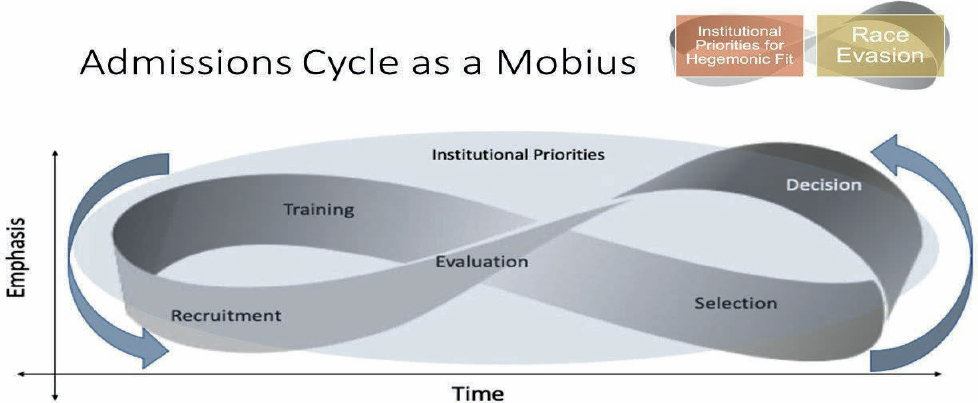
SOURCE: Presented by OiYan Poon on May 24, 2021.
The admissions timeline is relatively the same across institutions, she explained, and includes five “seasons” of training, recruitment, evaluation, selection, and decision. Throughout the cycle, institutional priorities reinforce what the university values. The Möbius model shows that as time progresses different seasons are emphasized or deemphasized.
Changes to the Möbius strip often appear dramatic at first, Poon explained, but the shape itself does not change. In admissions, decisions such as going test-optional or test-free can bring much media coverage to an institution, but the actual transformation of the system and therefore of long-term outcomes is minimal. For example, research shows that policy changes offer marginal but not substantive changes to admissions outcomes and enrollment demographics, because as long as the institutional priorities that encompass and guide the admissions cycle do not change, structures and outcomes will remain generally unchanged.
Poon’s research found a range of institutional priorities, such as financial wellbeing, brand management and prestige cultivation, necessary adaptations to policy contexts like Title IX, and diversity. However, the most clearly articulated priorities were academic quality of the cohort as measured by narrow metrics and financial priorities, such as financial aid budget limitations and projected tuition revenue. When these priorities compete with each other, racial diversity can become less and less of a priority. This process does not center students’ interests or the educational process, said Poon.
In an attempt to change the Möbius structure of the admissions process, Poon partnered with the Admissions Community Cultivating Equity and Peace Today11 advocacy group to create Hack the Gates, an initiative to radically reimagine admissions by facilitating honest conversations among admissions professionals about their role as gatekeepers to opportunity, perpetrators of race and class inequities, and transformative leaders in designing equitable
___________________
college access and enrollment processes. Their efforts generated a series of policy papers making the case that reimagining college admissions to move away from racialized organizational practice will necessitate doing more than tinkering around the edges.
A PANDEMIC-INDUCED ASSESSMENT OF ADMISSIONS PRACTICES
The COVID-19 pandemic caused Tuskegee University to look deeply and differently at how it assessed who was a qualified applicant and who was not, which Joseph Montgomery said was a difficult process for an institution steeped in a legacy of equity and inclusion. Historically, he explained, the admissions process had relied heavily on grade point average (GPA) and the types of classes students had taken in high school, with test scores serving as an absolute cutoff. “We were hard-ruled on that and it made it difficult for us to make a decision for any students that may have shown some promise or who had adversity,” he said. The pandemic allowed the university to fully understand the constraints of its admissions policies.
The first step the university took toward reimagining its admissions procedures and policies, Montgomery explained, was to look at how its students from different educational backgrounds performed, particularly students admitted under the Tuskegee Scholars program, a high-touch program that admits about 30 students each year who do not meet the admissions requirements but show promise. The students are supported and tracked throughout their time at Tuskegee. Looking at a decade of information about these students provided clarity about the procedures and policies the university would have to put in place for students to have the opportunity to apply in a test-optional manner.
Today, the university has two application modes: the standard application that includes a student’s academic curricula and grades, standardized test scores, and an optional letter of recommendation, or a test-optional application that requires students to show evidence of their academic achievement, submit a letter of recommendation, and write an essay. At the same time, Montgomery continued, the university had to train staff on how to assess applicants’ educational and living environment to determine the likelihood of their success at Tuskegee. Training included having staff reread the applications from the previous three years to see how they would have made different decisions under a test-optional scenario. The institution also adopted a rubric to create some standardization on how to make decisions on test-optional applicants.
The university has put in place instruments that will enable it to see how students are performing on campus in what he called reverse mode. This approach considers the types of courses the students took and whether they were part of Advanced Placement (AP) or International Baccalaureate programs, which may enable the university to better understand what curriculum is working best when students come to Tuskegee without the aid of a standardized test score. He noted that the university intends to continue its test-optional policies, but “we want to continue with some strong evidence on what’s going to make a student successful.”
Montgomery concluded with a thought-provoking question: “And how do we predict what that success is going to look like?”
TEST-BLIND ADMISSIONS: ELIMINATING THE INEQUITABLE INFLUENCE OF THE SAT AND ACT
Andrew Palumbo opened his presentation by defining how standardized tests are used in admissions decisions (Figure 2-2). Since the COVID-19 pandemic began, most schools have moved to test-optional application policies, but he noted that even before the pandemic over 1,000 colleges and universities had already moved in that direction and many universities have gone to a test-blind process, where SAT or ACT scores are not considered at all, even if a student submits them with an application.

SOURCE: Presented by Andrew Palumbo on May 24, 2021.
Three main arguments for a test-blind admissions process, Palumbo explained, are that (1) admissions officers can make excellent decisions without test scores; (2) the SAT and ACT both have longstanding problematic correlations with family income, race, ethnicity, and gender; and (3) the tests do not predict actual student success outcomes such as graduation. Given those realities, he likes to ask leaders in higher education who are skeptical of test-blind admissions to think about what they would do if they were redesigning college admissions from scratch knowing that test scores are poor predictors of student success and that they perpetuate power, privilege, and inequities when used in the selection process. “Why would you ever argue for inclusion of these test scores?” he asked, adding that there is little to no risk in eliminating them from the admissions process.
Palumbo noted that the National Association for College Admission Counseling has partnered with test-optional schools to create a campaign to help students understand that SAT and ACT scores are indeed optional and that an increasing number of colleges and universities do not care if they submit their test scores. One problem, he said, is that “students are smart,
they’re savvy, [and] they know that in a zero-sum game, if high scores can help you, not having a test score can hurt you.”
In 2007 Worcester Polytechnic Institute (WPI) became the first nationally ranked STEM university to become test optional by dropping the requirement to submit standardized test scores with an application for admission. “We assumed we would be followed by many others given the data and the evidence against using these test scores, but that did not happen until around March or April 2020,” said Palumbo. During that interval, WPI’s leadership realized that standardized test scores also influenced determinations of who would receive financial aid. As a result, in 2016 WPI stopped participating in any scholarship program that used standardized test scores as a sorting mechanism, including the National Merit Scholarship program, which eliminated 99 percent of students using test scores alone. In 2019 the Institute eliminated test scores from any aid consideration, whether need based or not, and in March 2021 WPI instituted an eight-year pilot of test-blind admissions.
Palumbo noted that 85 percent of WPI’s faculty voted in favor of this pilot program, which will include an annual review of admissions and student success data. The case made to faculty included three studies examining how well test scores predicted student success in their undergraduate studies. A 2014 study of more than 120,000 students from 33 institutions suggested that high school grades predict college performance better than standardized test scores, specifically that college GPAs tend to mirror high school GPAs despite wide variability in test scores. The same study also found that student performance did not differ between those who submitted test scores for admission and those who did not, but that those who did not submit test scores were more likely to be first-generation college students, students of color, Pell Grant recipients, and/or women (Hiss and Franks 2014).
Although not specific to engineering, a 2019 study conducted by the College Board (Westrick et al. 2019) also showed that high school GPA is the best predictor of first-year college GPA and that adding SAT scores to the model does not add much predictive value. Finally, a 2021 ACT study of admissions and enrollment officers suggests that many institutions are moving to test-optional or test-blind policies in the wake of the pandemic (ACT 2021).
In closing, Palumbo said that WPI’s review of its students’ data showed that academic quality increased during its test-optional admissions process and that graduation rates did not differ depending on test score submission. “We have acknowledged we are not going back, that test-optional is going to stay,” he said, adding that “thirteen months ago, there was one school that was test-blind. Now there are dozens of universities that are test-blind, and hundreds are likely to follow over the next three to five years.”
UNDERGRADUATE ADMISSIONS POLICIES IN THE UNIVERSITY OF CALIFORNIA SYSTEM
Han Mi Yoon-Wu explained that the University of California (UC) system has nine undergraduate campuses that serve the top 12.5 percent of California’s high school graduates, while the 23 schools in the California State University system serve the top one-third of the state’s high school students, and the California Community College system provides open access to all students interested in pursuing postsecondary education. She quoted the UC Regents Policy on Undergraduate Admissions, which states that “the University seeks to enroll, on each of its campuses, a student body that, beyond meeting the University’s eligibility requirements, demonstrates high academic achievement or exceptional personal talent, and that encompasses
the broad diversity of cultural, racial, geographic, and socioeconomic backgrounds characteristic of California,” adding that “a diverse UC community broadens and deepens the educational experience and scholarly environment for students and faculty alike while furthering the university’s mission as a public institution that can strengthen California’s social fabric.”
While the Supreme Court ruled that schools may use race as one aspect of their admissions criteria, in 1996 California voters passed Proposition 209 amending the state’s constitution to specifically prohibit universities from granting preferential treatment to or discriminating against any individual or group on the basis of race, sex, color, ethnicity, or national origin. As a result, the UC system has developed two admissions policies that enable it to increase the diversity of incoming classes through race-neutral means, including consideration of a student’s local context. The “local path” approach offers eligibility to the top 9 percent of students in every high school in the state based on grades earned in college preparatory classes, and it recognizes outstanding performances given the context of opportunities available at each high school. This policy supports geographic diversity and provides opportunities for students throughout the state, said Yoon-Wu.
In addition, UC has established a comprehensive review process that incorporates traditional quantitative measures of academic achievement along with indicators that reflect a deeper and more nuanced evaluation of an applicant’s readiness to attend UC. “Rather than relying exclusively on high school course completion, grade point average, and test scores, comprehensive review provides campuses with the latitude to conduct a more thorough review of every application and employ broader indicators of an applicant’s readiness for higher education,” said Yoon-Wu. Merit, she explained, is assessed in terms of the full range of an applicant’s academic and personal achievements and likely contribution to the campus community, viewed in the context of the opportunities and challenges the applicant has faced.
The most recent development in the UC admissions policy has been the switch to a test-optional policy for students applying for fall 2021 admissions. The UC Board of Regents allowed UC campuses to adopt either a test-optional or test-blind approach to new student admission through the fall of 2022 and decided that the university system would be test-blind for the fall 2023 entering class. But in September 2020 a court issued a temporary injunction prohibiting UC from using SAT and ACT scores in its admissions decision, so the UC admissions system was effectively test-blind for the fall 2021 entering class.
Test-blind admissions aside, UC continues to assess applications in the same fundamental way under the comprehensive review and local path processes. Yoon-Wu noted that all students apply through a common UC application developed and managed by the UC Office of the President. Students self-report grades and provide information on activities and awards. They also answer four questions designed to mimic an interview.
While every UC campus places the highest importance on academic achievement, this process allows each campus to give specific weight to the various comprehensive review factors. Each campus can also use a holistic review process that accounts for the totality of a student’s qualifications and experiences. These reviews, Yoon-Wu explained, are evaluated by trained admissions readers and no single criterion is given a fixed weight. She said that many UC STEM programs consider a student’s performance specifically in math and science, but always in the context of what might have been available to the student at their high school. She noted, too, that while her presentation was on first-year student admissions, UC has a goal of enrolling one transfer student for every two first-year students, another strategy for increasing diversity in the UC system.
DISCUSSION
An audience member asked the speakers for their ideas on the best way to evaluate applications without using standardized test scores and whether that best practice is efficient and sustainable for schools that receive tens of thousands of applications. Poon replied that what is important is for institutions to start with their mission and values statements and develop admissions policies that support them. She noted that the UC system processes tens of thousands, if not hundreds of thousands, of applications per year, so there is a way to do holistic review efficiently.
Palumbo characterized this as a design problem, to continually assess whether policies and admissions standards support the mission and values of the institution. “I think higher education has shown over the past year that we can be resourceful when we focus on a new problem and do so with a new mindset,” he said. WPI, for example, decided to eliminate its application fee when it realized that it was a barrier for some qualified students.
An audience member asked the panelists to discuss the training provided to application reviewers so they can conduct a holistic review that supports their institution’s mission. Montgomery replied that training is constant and calls for reviewers to think deeply about where students are applying from and what challenges they may have faced in their communities. He noted that his small institution, with 3,000 students, receives only 1,200 or so applications a year, making it a doable process to learn about each student and match them to the predictors for success at his institution.
Yoon-Wu added that UC’s application readers are certified annually, and part of the certification process includes implicit bias training. The process also helps the readers stay focused on serving the goals, objectives, and priorities for each campus. Palumbo agreed that annual implicit bias training was “a must,” and that his institution uses evidence-based research to improve its processes and help avoid implicit bias. He added that staff frequently ask “what can we do to improve this cycle, because…every time you lean in and do more work you find even more work that your team can be doing in future cycles.” Poon noted the importance of auditing the data generated by the admissions process.
Taking an audience question, Holloway asked the speakers how they address the issue of students who feel strongly that their high standardized test scores are a good reflection of their potential, despite those scores being “more correlated with family income and other certain demographics than student success.” Palumbo said that because students might have “put a lot of time and often money into the preparation for these test scores, it comes back to institutional values.” At his institution the view is that the inequitable outcomes reinforced by standardized test scores have created unnecessary barriers for qualified students and “allow an advantage to people who very often are already advantaged by those test scores,” which can “introduce that power and that privilege into your process.” He noted, too, that eliminating the need for test scores eliminates the stress that so many students face regarding those tests.
In a follow-up question, Holloway asked if any of the speakers had tips for engaging and convincing reluctant faculty that test-optional or test-blind admissions policies better serve the needs of the institution. Montgomery responded that it was difficult for him to start a conversation with the deans on campus about introducing a test-optional policy because they were set in their opinion about what student characteristics they wanted to see in order to feel comfortable admitting a particular student. What helped him was the data from the Tuskegee
Scholars program showing that students who “on the surface were not prepared” succeeded in their majors and graduated at the same rate as their peers.
Palumbo said that convincing faculty is critical to the success of going to a test-optional admissions process, based on the several schools he has worked with on making that transition. He echoed Montgomery’s point that providing data and case studies from institutions that have successfully gone this route is key to convincing faculty and assuaging their doubts. Yoon-Wu cited the importance of using the argument that test scores are most highly correlated with family income and so do not support the values of equity and access, which are particularly important for public universities.
Asked what types of characteristics reviewers can use when evaluating students from underprivileged backgrounds, Yoon-Wu said that, with the new local context approach, the UC system is “looking at all the students within the same high school so that we know the kinds of opportunities and challenges that all the students in that high school would have been facing, and not necessarily comparing students from a public high school, maybe from an urban area, with a private high school in a suburban area.” Palumbo added that “very few people get into admissions who want to perpetuate the inequities of K-12 education and in our society at large,” and while there is a lot of work left to do to make college admissions more equitable, “professionals in this field are leaning into these difficult challenges.”
As a final question, Holloway asked if there are particular barriers to address regarding transfer students and the role they play in diversifying engineering. Montgomery said that that issue involves what he calls academic sovereignty and “that the faculty has to trust that the preparation from another institution is at the same level that they believe that they’re teaching.” He talks with individual faculty to get them to a common ground on which everyone can agree about whether transfer students are up to the task of succeeding at Tuskegee.


