Progress Toward Restoring the Everglades: The Tenth Biennial Review - 2024 (2024)
Chapter: Summary
Summary
The Everglades, one of the world’s treasured ecosystems, once encompassed about 3 million acres of slow-moving water, which supported an array of wetland and estuarine habitats from Lake Okeechobee in the north to the Florida Keys in the south. During the past century, the Everglades has been dramatically altered by drainage and water management infrastructure to improve flood management, urban water supply, and agricultural production. The remnants of the original Everglades now compete for water with urban and agricultural interests and are impaired by contaminated runoff from these two sectors. The Comprehensive Everglades Restoration Plan (CERP), a joint effort launched by the state and federal governments in 2000, seeks to reverse the decline of the ecosystem. This multibillion-dollar project was originally envisioned as a 30- to 40-year effort with 68 individual projects including water storage reservoirs, water quality treatment using constructed wetlands, seepage management, and removal of barriers to sheet flow (e.g., canals, levees). Collectively these CERP projects aim to achieve ecological restoration by reestablishing the natural hydrologic characteristics of the Everglades—quality, quantity, timing, distribution, and flow—where feasible and by creating a water system that serves the needs of both the natural and the human systems of South Florida.
The National Academies of Sciences, Engineering, and Medicine established the Committee on Independent Scientific Review of Everglades Restoration Progress in 2004 in response to a request from the U.S. Army Corps of Engineers (USACE), with support from the South Florida Water Management District (SFWMD) and the U.S. Department of the Interior, based on Congress’s mandate in the Water Resources Development Act of 2000. The committee is charged to submit biennial reports that review the CERP’s progress in restoring the natural ecosystem. This is the committee’s tenth report. Each report provides an update on progress toward natural system restoration during the previous 2 years, describes substantive accomplishments, and reviews developments in
research, monitoring, and assessment that inform restoration decision making. The committee also identifies issues for in-depth evaluation stemming from new CERP program developments, policy initiatives, or improvements in scientific knowledge that have implications for restoration progress (see Chapter 1 for the committee’s full statement of task). For the 2024 report, the committee evaluated the use of Indigenous Knowledge, application of tools for understanding climate change, and progress in application of adaptive management and incorporation of new information in the CERP.
During 2023–2024, Everglades restoration progress has continued at a remarkable pace, supported by record-high levels of federal and state funding. CERP projects are under construction or have been completed in nearly every region of the Everglades (Figure S-1), and important early benefits are evident. Notably, the recent completion of seepage management, combined with non-CERP projects, has enabled increased flows to Northeast Shark River Slough, a long-time restoration goal. With restoration of flows, however, concerns about new or increasing phosphorus impacts have arisen and warrant further study. With many projects coming online and evidence of both restoration benefits and unanticipated outcomes, there is a need for timely use of the best available information to improve the CERP. In this context, the committee presents opportunities to further boost restoration gains in three specific areas focused on (1) best practices for including Indigenous Knowledge in project planning, monitoring, and management; (2) application of climate change information and tools; and (3) improvements in adaptive management and more nimble incorporation of new information into restoration decision making. Each of these areas offers substantial potential to enhance restoration outcomes but requires new investment of CERP resources to achieve them, including increased staff, a more robust science enterprise, and leadership to build agency cultures that support these objectives.
RESTORATION PROGRESS
In Chapter 2, the committee outlines the major accomplishments of restoration, with an emphasis on natural system restoration progress from the CERP in the past 2 years.
The pace of restoration implementation has reached historic levels, based on record state and federal investments in fiscal year (FY) 2022 and FY 2023. Six CERP projects are under construction, one CERP project and two major project components have been completed, and one additional project is essentially complete. The Central Everglades Planning Project (CEPP) continues to progress rapidly, as befits the project that is the keystone to restoring the central heart of the Everglades. Maintaining this pace of progress requires both
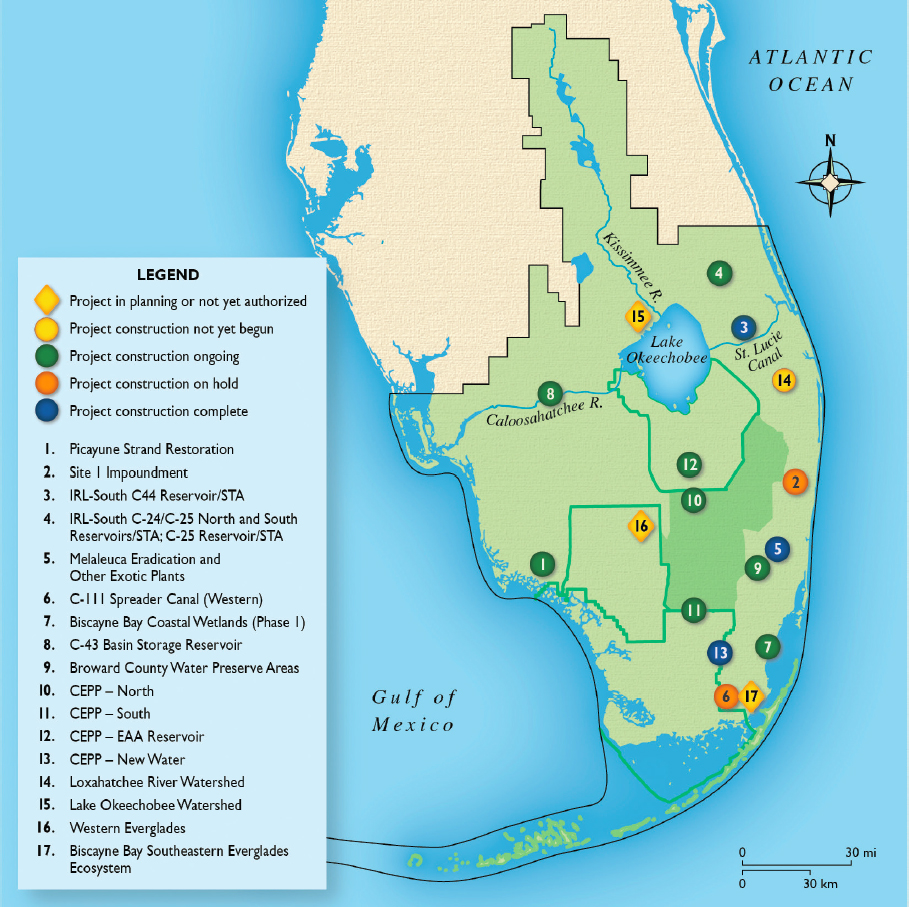
SOURCE: Map by International Mapping.
continued construction funding and support for other agencies responsible for facilitating restoration implementation (e.g., permitting, monitoring). With so many projects under construction, if future funding levels fall short of those used for planning, difficult decisions will need to be made as to whether to delay all projects equally or, preferably, to expedite those with the greatest near-term benefits.
Sizable restoration benefits are evident from recent progress on CEPP New Water, Picayune Strand, and the Melaleuca Eradication projects. The recent completion of CEPP New Water is a restoration milestone. It is already evident that the combined effect of the recently constructed seepage barriers will greatly reduce, and perhaps even eliminate, flood control constraints imposed by the 8.5 Square Mile Area within the CEPP footprint. Prior to the Combined Operational Plan (COP), these constraints completely stymied every attempt over decades to restore the historic distribution of flow between Northeastern and Western Shark River Slough. However, with the addition of these new seepage barriers, no such constraints have affected operations since water year 2022. Restoration of hydrology in Picayune Strand appears to be generating benefits to the local flora and fauna, with vegetation and macroinvertebrate communities responding favorably. Additional longitudinal monitoring will be needed to continue documentation of recovery, especially given the magnitude of seasonal and inter-annual variation. CERP investments in invasive species biological control efforts have contributed to a 75 percent reduction in area dominated by Melaleuca and have largely controlled air potato reproduction to the extent that air potato is no longer a priority invasive species.
Initial monitoring results indicate that the COP has been a restoration success, generally meeting expectations in achieving hydrological and ecological restoration objectives and improving conditions in the central Everglades relative to previous water management. The rehydration of Northeast Shark River Slough in Everglades National Park represents the largest step yet toward restoring the hydrology and ecology of the central Everglades. However, achieving complex objectives that involve creating fairly precise hydrologic conditions over extended periods of time—for example, optimal recession rates and water levels during the nesting season for threatened and endangered species—has been more challenging. Like any system operations plan, the COP likely lacks the capacity to adjust sufficiently to meet the restoration targets under all rainfall regimes. Thus, the COP is proving to be what it was intended to be, not a complete solution but rather the first major step toward restoring the central heart of the Everglades. The changes wrought by the COP have revealed some issues with water quality and have confirmed anticipated adverse effects on endangered Cape Sable seaside sparrows. This latter issue requires creative solutions, sooner rather than later.
Information on natural system restoration progress relative to expectations and project objectives remains difficult to find and interpret. The CERP lacks a mechanism for centralized multi-agency reporting of project-level restoration outcomes. Data, when available, are often presented in permit reports produced by a single agency or in monitoring reports produced by contractors. Increased attention to multi-agency data synthesis and interpretation is needed to support assessment and learning. The COP Biennial Report is an example of effective multi-agency analysis of extensive monitoring data on hydrologic, water quality, and ecological conditions in support of learning and adaptive management. Simplified and straightforward analyses of key metrics will provide increased transparency of restoration outcomes to the public and Congress.
The Western Everglades Restoration Project (WERP) as proposed offers important benefits to the western Everglades, but implementation progress largely depends on non-CERP source control implemented by private landowners, which could lead to large delays without implementation and performance requirements. In general, WERP features, if implemented as planned, should improve hydration, hydrologic and ecological connectivity, and water quality, which have been longstanding concerns in the WERP study area. Yet, issues regarding flood risk of the Looneyville community still need to be addressed to meet Savings Clause requirements.
Downward trends in total phosphorus (TP) concentrations in stormwater treatment area (STA) outflow reflect extensive recent Restoration Strategies efforts, but timely attainment of the stringent water quality–based effluent limit (WQBEL) will depend on how effectively the STAs respond to these efforts and the extent to which data collection (including cell-by-cell monitoring), data analysis, modeling, and synthesis are rigorously applied to inform adaptive management decisions. As noted in NASEM (2023), CERP progress and the timely delivery of restoration benefits, particularly for CEPP North and the Everglades Agricultural Area Reservoir, depend on meeting the WQBEL in all STAs. High TP concentrations in Lake Okeechobee further the challenge of STA performance given the future plans to move more lake water south. The cumulative performance of STAs during the recent 5-year period is impressive and generally trending in the right direction, but only STA-3/4 currently meets the WQBEL. Maintaining low phosphorus and hydraulic loading rates should improve STA treatment efficiency, but high inflow concentrations in the Western and Eastern Flow Paths could pose particular challenges for WQBEL attainment.
Additional research is recommended to explore the potential biogeochemical effects from the CERP through increased flows, flow velocities, canal-to-marsh interactions, and other factors that may mobilize legacy phosphorus and impact periphyton and plant communities. The S-333 Working Group identified sediment mobilization in the L-29 Canal as a key driver of
increasing concentrations and loads into Everglades National Park with recent increased flows during the dry season, and agencies are implementing strategies to reduce sediment mobilization. Research has also illuminated potential connections between increased flows and increased phosphorus loading and/or vegetation impacts, although discrepancies between the SFWMD and Long-Term Ecological Research data need to be resolved. The potential of ecological effects from increased CERP flows also merits further study. Specifically, research should examine the dominant TP sources (e.g., sediment, floc, suspended), determine the mechanisms by which these concentrations and loads may be exacerbated under the CERP through increased flows and/or canal-to-marsh interactions, and, if necessary, identify approaches to mitigate phosphorus impacts.
USE OF INDIGENOUS KNOWLEDGE IN THE CERP
The lands and waters of the Everglades are the geographic and spiritual home of the Miccosukee and Seminole peoples. The health and well-being of the Everglades is synonymous with that of the Miccosukee Tribe of Indians of Florida (hereafter the Miccosukee Tribe) and the Seminole Tribe of Florida (hereafter the Seminole Tribe). Therefore, the Tribes have a wealth of knowledge about the South Florida ecosystem based on their intimate reciprocal relationship with the biophysical environment that has been developed through lived experience and passed down through generations. The following conclusions and recommendations are provided in response to a request from CERP agencies for advice on how Indigenous Knowledge could be better included in CERP planning and management, which was prompted by recent Executive Office requirements to include Indigenous Knowledge in federal scientific and policy decision making.
Indigenous Knowledge, like western science, is a “body of observations, oral and written knowledge, innovations, practices, and beliefs” about the natural world that has much to offer Everglades restoration (EOP, 2022a). For example, the Miccosukee and Seminole Tribes’ extensive personal and Tribal knowledge of tree islands, if applied to restoration efforts, would benefit both the ecosystem and the Tribes. Indigenous Knowledge spans much longer time frames than western scientific studies and can therefore enhance understanding of historical ecological conditions and modern deviations from baseline conditions. Indigenous Knowledge should also be considered and applied in efforts to refine the RECOVER monitoring plan and conceptual models to better develop and incorporate performance measures and metrics that are relevant to biocultural restoration.
Consistent and meaningful engagement between CERP agencies and Tribal Nations is necessary to ensure a partnership in which Indigenous Knowledge is recognized, considered, and applied in restoration decision making, and
notable progress has recently been made to improve the quality of Tribal engagement and cooperation in the CERP. The Everglades has offered refuge and sustenance to the Miccosukee and Seminole peoples for generations. Historically, the U.S. and state governments attempted to remove all Tribal people from the southern Florida landscape through coercive and violent means. This painful history is part of the living memory of Miccosukee and Seminole Tribal elders and remains an under-current in all consultation, engagement, and coordination with the Tribes. The lack of meaningful engagement with the Tribes historically heightens the importance today of building trustful relationships, based on integrity and with careful adherence to laws, regulations, and guidance in consultation and cooperation with the Tribes. Over the past decade, consultation has become less proforma and more meaningful, as exemplified by the application of Indigenous Knowledge to inform decision making in WERP and in a 2023 temporary deviation from the seasonal closures of the S-12A and S-12B structures. The work required to shift agency cultures to further elevate meaningful Tribal engagement will be labor- and resource-intensive for both agencies and Tribes but will reap rewards for Everglades restoration.
The recently developed Miccosukee internal peer-review process is an important step toward facilitating consideration of Indigenous Knowledge in Everglades restoration processes and provides a potential model for others throughout the nation. This process results from extensive effort on the part of the Miccosukee Tribe to speak to western scientific norms on data quality and transparency in culturally appropriate ways. The Miccosukee Tribe developed the process considering federal government requirements for data quality to ensure that the Indigenous Knowledge cannot be rejected because of quality assurance/quality control concerns, while protecting Indigenous data sovereignty and governance. The onus is now upon the agencies to meet the Tribes “where they are” and develop protocols that effectively consider and apply Indigenous Knowledge even when it does not conform to western scientific norms and presentation.
RECOVER and other CERP staff should implement best practices in their efforts to engage Tribes and apply Indigenous Knowledge in Everglades restoration planning, operations, monitoring, and adaptive management. Staff should consult with the Miccosukee and Seminole Tribes to determine their desired timing and level of engagement for specific projects. Some best practices include the following:
- Recognize that Tribes are autonomous nations and interact with Indigenous partners as such, not as stakeholder groups.
- Involve Tribal members in planning, research, and monitoring efforts, with funding where necessary, to foster co-stewardship and co-production of knowledge to support restoration and priorities of value to the Tribes.
- This may require new contracting mechanisms that should be informed by a review of other federal-state-Tribal efforts to improve capacity building and enhance partnerships.
- Provide opportunities for the Miccosukee and Seminole Tribes to engage in CERP processes and share knowledge in meaningful and culturally sensitive ways, recognizing that independent internal discussions among Tribal members may be necessary to provide input to the decision-making process.
- Include Tribal members in meetings in thoughtful ways that avoid unintentional tokenism and encourage participation by Tribal members in planning meeting agendas.
- Create data-sharing agreements that center Indigenous data sovereignty and governance and support the culturally sensitive integration of Indigenous Knowledge into reports and agency actions while protecting sensitive Tribal cultural information from public disclosure.
- Build, support, and maintain an inclusive agency and CERP culture that establishes high expectations for meaningful engagement and incorporation of Indigenous Knowledge throughout agency hierarchy and operations.
To continue to improve the quality of Tribal engagement and inclusion of Indigenous Knowledge, training should be developed, in consultation with the Miccosukee and Seminole Tribes, and required on a recurring basis for all agency staff who interact with Tribal members. The integration of Indigenous Knowledge in Everglades restoration planning, operations, and adaptive management is in its infancy, and the acceptance of its application in long-established federal and state restoration processes varies within the CERP community. The CERP is not alone—restoration programs throughout the United States are grappling with how to meaningfully engage with Indigenous Knowledge at various scales. Formal training should be provided for CERP agency personnel who interact with the Tribes, including leadership, scientists, engineers, and field staff, to strengthen a culture of meaningful engagement by all restoration practitioners. This training could cover the history and governance of the Miccosukee and Seminole Tribes of Florida; Indigenous Knowledge; laws, regulations, and guidance; case studies that highlight the complementarity of Indigenous Knowledge and western science; and best practices for consultation, cooperation, and meaningful engagement. Also valuable would be education on the appropriate protection of sensitive Indigenous Knowledge to build a relationship of trust and cooperation.
Attention is needed to ensure that Tribal input and opportunities for meaningful collaboration and inclusion of Indigenous Knowledge are not lost because of staffing resource constraints. The pace of Everglades restoration planning,
operations, and adaptive management and the associated requirements for effective engagement may exceed the existing staff resources of both the CERP agencies and the Tribal Nations. CERP agencies’ dependence on a single staff member to coordinate Tribal relations creates vulnerabilities. CERP agencies could improve their capacity through increased agency training and staffing to ensure a breadth of expertise and uninterrupted relations in the event of personnel turnover. Other restoration programs have provided grants to Tribes, when needed, to increase Tribal staff availability for consultation and engagement.
CLIMATE CHANGE
Attempting to include climate change information in CERP planning could overwhelm even the most intrepid project planner, and CERP planners have been cautious in their attempts to do so. The amount of climate change information, the unknown credibility of the information, the number and complexity of models used in CERP planning, and the complications of incorporating climate information into models not designed for that purpose add up to a very challenging endeavor. Although there is danger in using climate projections without a carefully considered plan that is consistent across the diverse set of analysis and models involved in the CERP, the greatest danger is making no attempt to plan for climate change. The committee offers the following recommendations to advance the use of climate change information in CERP planning and operations.
A strategy to understand the impacts of climate change should be developed with a curated set of scenarios that are used consistently across all components of planning and restoration implementation. This set of climate change scenarios should represent the range of plausible changes based on review of the scientific literature and available climate projections and be used to assess project and system vulnerability to changes in temperature, precipitation, and sea-level rise. Validated methods for the use of climate scenarios, of which there are several in the scientific literature, should be used to stress test restoration plans. These planning scenarios should be applied through existing hydrologic and ecological models to provide insights on the potential vulnerability of flora, fauna, and infrastructure to these plausible changes. This strategy can be implemented now, and the results can lead to better estimation of benefits of planning and ultimately better outcomes in the long run.
A dynamic model that predicts coastal wetland elevations through time informed by empirical data is needed to provide more accurate predictions of coastal restoration outcomes and guide investment decisions. Sediment accretion models are currently being used to compare alternative restoration plans for the Biscayne Bay and Southeastern Everglades Ecosystem Restoration (BBSEER) project in the context of sea-level rise. Because the models are based
on approximated relationships between flooding, salinity, and accretion, the predicted and even relative outcomes for each alternative may not reflect reality. A dynamic predictive model of accretion and wetland elevations over time will be more accurate and could provide helpful confirmation of the potential ecological return on the large, expected infrastructure investments in BBSEER while also informing future planning of the Southern Everglades project.
Existing ecological models should be used to a greater extent and further developed to anticipate the effects of climate change, including temperature, on the wildlife indicators of Everglades restoration success. Because wildlife species and habitats are the ecological endpoints of Everglades restoration, the output of ecological models should be considered early in the process when evaluating restoration plans. Ecological models should be developed and applied to evaluate the effects of projected changes in precipitation and temperature on biotic indicators of restoration success. Because confidence in temperature projections is greater than that for precipitation, attention should be paid to the effects of increased temperature on life history, phenology, and physiology of wildlife species using tools such as mechanistic niche models. Furthermore, a more thorough accounting of uncertainty in ecological models with respect to climate change impacts should be undertaken. How changing climate is incorporated into models based on historical data that are unlikely to hold in the future, as well as the reliability of tools under changing conditions, should be evaluated.
A more cohesive integration of ecological and physical modeling and monitoring that draws together existing data, models, and efforts should be pursued to understand and mitigate the effects of climate change on Everglades restoration to better support restoration decisions. In an integrated framework, management decisions can be informed by physical and ecological models, which in turn can be updated with monitoring and other data to further inform management, monitoring, and model refinement, in an ongoing cycle of learning that can reduce uncertainty in projections. Such an integrated framework that enables updating based on new information, such as in the Everglades Vulnerability Analysis (EVA) modeling framework, can better support decision makers as they weigh risks and benefits of alternatives, manage trade-offs, and prepare for the effects of climate change on Everglades restoration. A long-term commitment and careful coordination and communication among teams overseeing models, monitoring, management, and decision making will be necessary to achieve this objective.
Regular revisions to the System Operating Manuals and other operational plans should incorporate the evolving understanding of climate variability and change, including extreme events, to ensure anticipation of and planning for a wide range of conditions. The System Operating Manuals represent the flexibility inherent in infrastructure operations and can be leveraged for that purpose
if monitoring and periodic updating are systemized and linked to operations. The evolution of the COP to CEPP 1.0 represents a prime opportunity to apply learning from several years of COP operations and consider a subset of future climate scenarios to test the response of operations to changing climate conditions.
ADAPTIVE MANAGEMENT AND USE OF NEW INFORMATION IN DECISION MAKING
When the CERP was authorized in 2000, Congress directed the use of adaptive management to ensure continued restoration progress amid uncertainties and to improve restoration outcomes through the incorporation of new information. After 24 years of CERP program development and implementation, the committee evaluates the effectiveness of the incorporation of new information into the CERP at four stages: (1) project-level adaptation during design and construction, (2) project-level adaptive management after operations begin, (3) adaptation of operations at regional scales, and (4) program-level adaptive management. Adaptive management itself is not a stationary process. Increasing input from the Tribes, experience with restoration, and the challenges associated with climate change all demand that the adaptive management program evolve to meet the needs of agency decision makers and stakeholders.
The CERP has developed thorough project-level adaptive management guidance, but the process to incorporate new information is often time-consuming and burdensome, which limits its application and effectiveness at the full scale of the CERP. RECOVER’s adaptive management guidance is sound conceptually and sufficiently detailed to be effective and has informed the development of well-crafted project-level adaptive management plans. The guidance promotes a collaborative relationship between RECOVER and Project Delivery Teams that spans design and operation to support adaptive management. However, effective adaptation of authorized designs and operational plans for implemented projects has often been a very lengthy process. The USACE approval processes required to modify a congressionally authorized project contribute to the delays. Modifications can be made more quickly when some flexibility is built into the Project Implementation Reports (PIRs) or when uncertainties are anticipated in project adaptive management plans. As many more projects come online, more timely responses and processes are needed that facilitate adaptation to new information.
Adaptation of operations to new information is a particular strength of water management for restoration, and the USACE and the SFWMD should continue their increased use of conditions-based operations to better adapt to changing conditions. Adaptive approaches have been used effectively to provide and improve operational flexibility, in large part because of regu-
lar and transparent communication between scientists and decision makers. Many regional operations, such as the Lake Okeechobee System Operating Manual and the COP, rely on conditions-based operations to provide maximum flexibility and responsiveness to changing conditions, but other parts of the system (e.g., S-12A-D along Tamiami Trail) continue to rely on specific calendar-based operations. Conditions-based operations, where feasible, would enable optimization of water management in light of prior hydrologic and ecological conditions. However, such actions would require modification of existing operational plans and likely require additional resources for staff to review data and make management recommendations or to upgrade control structures to enable remote operations. Structured opportunities for learning from operations, such as the COP Adaptive Management Plan, will further improve future operations.
Program-level adaptive management has not been implemented in detail. The focus of adaptive management to date has instead been at the project level where the objective appears to be to modify projects to achieve the expected outcomes of those projects. At the program level, adaptive management has potential to maximize the benefits of the restoration as a whole. RECOVER identified program-level “mission-critical uncertainties” in 2015, including the implications of climate change and available water storage on restoration outcomes, but no coordinated program-level adaptive management strategy has been implemented. Past System Status Reports have lacked the necessary analysis of how and why the system is changing over time relative to goals and expectations to support program-level decision making. The potential for learning through the long-anticipated Second Periodic CERP Update is substantial and should support renewed attention to program-level adaptive management.
Additional efforts are needed to provide the necessary foundation for successful adaptive management in the CERP. The following three areas are essential to achieve this goal:
- Prioritize building expertise and a culture of adaptive management. Guidance alone is insufficient to support effective implementation of adaptive management. Clear endorsement from leadership of the importance, objectives, and value of adaptive management is essential to promoting a culture of adaptive management. In addition, CERP staff at all levels need additional experience in adaptive management. Building capacity and a culture of adaptive management across agencies and stakeholders can take many years but can be jump-started with strategic hiring of experienced adaptive management practitioners from other restoration programs. Regular workshops have been used in other large-scale restoration efforts across the country to build a culture of adaptive management and should be incorporated into the CERP.
- Develop a robust, integrated science enterprise to support adaptive management, consisting of effective monitoring, modeling, synthesis, and research activities with inclusion of Indigenous Knowledge. This requires adequate staffing of appropriately trained scientists, including a critical mass of expertise in statistics, data analysis, visualization, synthesis, and communication. With the shift from planning to implementation, responsibilities for adaptive management in both RECOVER and in the agencies have expanded substantially; however, staffing levels have not increased to match these needs. The creation of an Environmental Assessment Team within the SFWMD charged with collecting relevant knowledge and providing it to Project Delivery Teams is a positive step toward supporting adaptive management. A CERP Science Plan would facilitate systemwide coordination of science, which is necessary for effective adaptive management.
- Improve communication of restoration performance (relative to expectations and objectives) and implications for decision making. Effective adaptive management relies on the timely sharing of data and knowledge both within and across projects and integration of this information into management decision making. Multi-agency reporting on project outcomes, such as Project Delivery Team biennial reports and/or a CERP dashboard built on key metrics that are collectively developed, would improve tracking of project outcomes and communication to management and the public.
All of these efforts will require strong direction from USACE and SFWMD leadership that adaptive management is a CERP priority that adds value and improves efficiency toward restoration success. Such communication should include not only messaging but also provision of the necessary resources for adaptive management implementation, including staffing to support the rapid increase in the number of CERP projects.
USACE headquarters should review required approval processes associated with incorporating new information into design, construction, and project-level adaptive management processes to ensure timely use of new information. Such an effort would benefit not only the CERP but all USACE restoration projects. Under the current framework many decisions related to effective implementation of adaptive management are cumbersome, slow, and often not timely enough to address current or future challenges. Implementation of existing processes could deter staff from making valuable changes because of the administrative burden necessary to affect that change or the implication of delays on other projects. As a result, new information that could substantially improve restoration outcomes may not be used if it is unrelated to legal drivers such as the Endangered Species Act. Therefore, a more timely and effective administrative
process for incorporating new information into decision making is needed. The USACE has used the 3×3×3 approach in the project planning process to reduce the time associated with review and decision making. The committee encourages USACE headquarters to identify lessons learned from this approach that could be applied to project-level adaptive management and the incorporation of new information. By reviewing when decisions must be elevated to the district, division, or headquarters for action, the USACE can determine whether the effort for these approvals is appropriate to the risks posed, including impacts to ecosystem integrity and Tribal resources associated with lengthy delays. The USACE headquarters review should consider opportunities to incorporate flexibility into the decision-making process and empower decision making at the lowest reasonable level. USACE headquarters should also explore mechanisms to increase post-authorization flexibility within the constraints of existing processes, such as incorporating more flexibility into PIRs and operation manuals.


