Transitioning to Net-Zero Carbon: Engineering Challenges and Opportunities: Proceedings of a Forum (2024)
Chapter: 1 Engineering Challenges and Opportunities
1
Engineering Challenges and Opportunities
“The time is now right when it comes to addressing climate change,” said Deanne Bell, founder and chief executive officer of Future Engineers, in her introduction to the forum of the 2022 annual meeting of the National Academy of Engineering (NAE). “Global leaders have set a goal to reach net-zero carbon by the year 2050. To do that will require significant investment, significant innovation, and significant advocacy—and engineers are at the forefront of that work.”
At the forum, five distinguished and accomplished engineers, with Bell serving as moderator, discussed the prospects for achieving net-zero carbon and the role engineers must play if the world is to meet that ambitious goal.
THE CHALLENGE OF NAVIGATING THE ENERGY TRANSITION
“If the global community does not take action, the world will warm by 3 to 4 degrees Celsius by later in the 21st century,” said Gavin P. Towler, vice president and chief technology officer of Honeywell Performance Materials and Technologies and Honeywell UOP. If governments do everything that they have promised to do, that warming might be around 2.5 degrees. If governments do much more than they have promised and follow the recommendations of the Intergovernmental Panel on Climate Change, the world has a chance to limit warming to 1.5 degrees. But societies have just two or three years to make the changes needed to hit the 1.5-degree target, Towler warned, and they have just eight to ten years to get on the trajectory needed for a 2-degree target.
Most of the technologies needed to decarbonize the energy system are already available, including those for massive electrification of most applications that today use fossil fuels and for greatly expanded use of
low-greenhouse-gas fuels like hydrogen for applications that are difficult to electrify. Even aviation, which has “a lot of very interesting things still to be determined,” as Towler remarked, has alternatives such as electric power, fuels derived from biomass, and hydrogen fuel.
A major challenge to engineers and scientists is to reduce the costs of abatement to make it easier to fund the energy transition.
The challenge, at a societal level, is that relatively few steps pay for themselves or result in net savings, according to Towler. The costs of most forms of abatement mean that “we’re not moving at the pace we need to.” A major challenge to engineers and scientists is therefore to reduce the costs of abatement to make it easier to fund the energy transition.
Towler and his colleagues have developed models of future energy consumption that meet the 1.5-degree target while enabling developing countries to meet their energy needs. In the “golf” scenario, the rest of the world emulates the US pattern of big and distributed houses filled with manufactured possessions. “If this is the way the rest of the world develops, we’ll need a lot more energy”—more than twice as much energy by 2050 as is consumed today. In the “yoga” scenario, people around the world come to consume about as much energy per capita as the average person in Japan, Italy, or the United Kingdom, all of which have similar energy intensities. Even in this scenario, energy consumption would go from today’s 18 terawatts to 28 terawatts. Thus, with either option, “we have to expand the energy supply while at the same time moving away from coal, oil, and gas toward wind, solar, nuclear, and other zero-carbon or low-carbon energy and hydrogen fuels for those applications that are difficult to electrify.”
The world currently spends about half a trillion dollars a year on the energy transition, Towler observed. That amount needs to be approximately $2 trillion a year by the end of this decade and be sustained at that level for the next 30 years, he said. “It’s phenomenally expensive.”
The technical community needs to find ways to make the transition less expensive. “There is no area of the energy economy that cannot be innovated to make it lower cost, whether that’s carbon capture, reducing the cost of solar power—which is one of our Grand Challenges1—or bringing nuclear fusion to commercial-scale applications. There are many, many things that we can do, but all these things need technical advances to lower the price.”
___________________
1 The NAE Grand Challenges for Engineering in the 21st Century: Make solar energy economical (www.engineeringchallenges.org/challenges/solar.aspx).
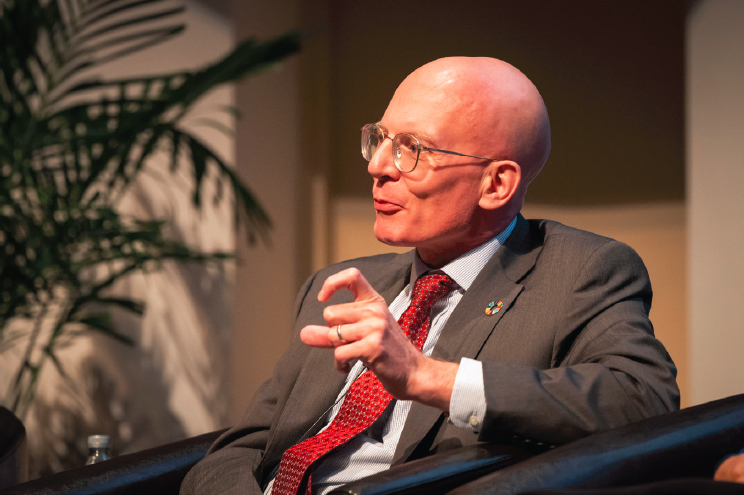
In response to a question from the audience about the viability of the scenarios he described and about the lifecycle carbon footprint of renewable energy technologies, Towler explained that the numbers in the two scenarios are projections but are based “on fairly good models with a lot of thought behind them.” He also said that it is important for engineers, educators, and members of the general public to understand the lifecycle implications of technologies. “They need to be able to look at things on a systemwide basis and understand: What are the inputs and outputs? What is the carbon footprint?”
Responding to another question about the continued use of fossil fuels in the scenarios, Towler pointed out that even the changes required by a 1.5-degree target do not immediately eliminate the use of oil, coal, and natural gas. However, meeting that target requires that no more natural gas or coal-fired power plants be built within a couple of years and that some existing plants be shut down and written off as stranded investments. Electrification will also require massive transformations in the industrial infrastructure.
“People don’t grasp the magnitude of the problem,” he said. “You have to redesign the entire infrastructure. All of the industries that supply transportation equipment, building equipment, mining equipment—they all have to move to different drivetrain technologies. You have to close down the
natural gas and the coal-fired power plants or mitigate them with carbon capture…. There’s a massive investment [needed] to get to 1.5 degrees.”
Towler noted that the countries that need to decarbonize soonest to help achieve the target of 1.5 degrees are the ones with the biggest carbon footprints. They are mostly in the OECD, and although they have already phased out much of their coal consumption, they still consume large amounts of natural gas. These countries need to reduce their natural gas use, while developing countries that need more time to decarbonize will run their existing coal-fired power plants through the 2060s. “Coal will actually be the last hydrocarbon,” Towler concluded.
THE PROSPECTS FOR SOLAR POWER
“Engineers have been very successful in developing technologies that provide renewable energy,” said Sarah Kurtz, professor at the University of California, Merced. “The challenge now is to implement those technologies with equal success.”
Solar power is a prime example. The cost of solar panels has declined by more than a factor of 10 since 2010, to the point that solar energy is now the cheapest source of electricity in history. Kurtz pointed out that it now would cost about the same to paint the walls in the auditorium of the National Academies as it would to buy the equivalent area of solar panels. “It’s phenomenal how the price has come down,” she said. As a result of these steadily dropping prices, the deployment of solar power has skyrocketed. The world has already installed more than a terawatt of solar capacity—equal to the total electricity-generating capacity of the United States.
About 80 percent of new generating capacity comes from renewable sources—and half of this new capacity is from solar power.
Despite this expansion, solar still provides only about 4 percent of the world’s electricity. However, about 80 percent of new generating capacity comes from renewable sources—and half of this new capacity is from solar power.
What needs to happen now is a rapid acceleration in the deployment of solar power, since the current rate of increase will not be enough, in just three or four years, to transform the electricity grid. What would normally take 30 or 40 years needs to happen much more quickly.
One reason solar capacity has grown rapidly is a virtuous feedback loop. Enthusiasm about clean solar energy that people could generate themselves,
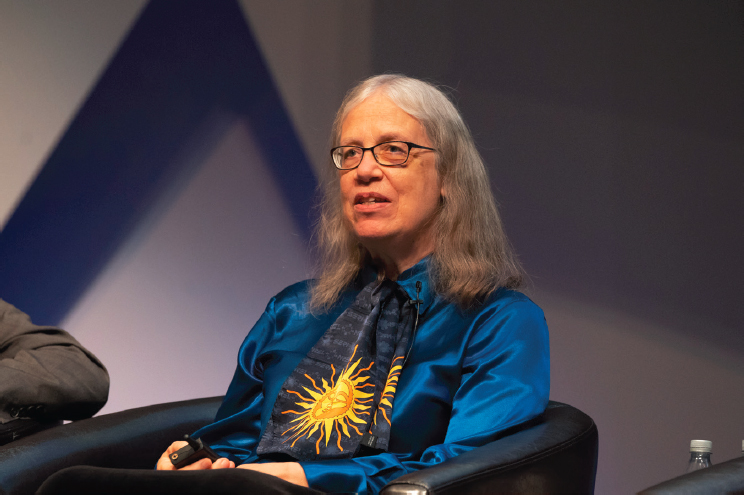
coupled with favorable public policies, led to increased deployment. That brought about lower costs, which further increased enthusiasm. This form of positive feedback “can allow you to grow very quickly.”
Incorporating solar power into the larger energy system is a complex problem, but complexity also means that there are more ways for positive feedback loops to occur, Kurtz explained. As an example, she cited the potential for electric vehicles to be charged during the day and serve as batteries at night.
California has been a leader in the generation of solar power, with 25 percent of its electricity generated by solar. However, much of that electricity is generated during the day—so much so that the supply can exceed the demand at times. If charging equipment were installed in daytime parking lots, people could charge their cars while they’re at work and then drive them home. There they could plug their cars into their home grid and use available excess energy for evening and nighttime needs. This would be a much more cost-effective solution than having everyone stop at a charging station on their way home from work, requiring that large amounts of energy be delivered to vehicles during a short amount of time.
“I suggest that we be smart and invest in the infrastructure that will provide the low-cost solution,” Kurtz concluded.
THE PROSPECTS FOR SMALL MODULAR REACTORS
José N. Reyes Jr., cofounder and chief technology officer of NuScale Power and professor emeritus in the School of Nuclear Science and Engineering at Oregon State University, described another way to generate power without producing carbon dioxide.
Small modular reactors are typically categorized as nuclear reactors that produce less than 300 megawatts-electric. The reactor being developed by NuScale Power, for example, generates just 77 megawatts, “so it’s really small.” The reactor and the containment vessel (a steel structure that can be pressurized to 1,000 pounds per square inch if necessary) are manufactured in a factory rather than being built on site. The reactor’s components can then be shipped by truck, rail, or barge and assembled and installed in the fully constructed reactor building, greatly reducing the time needed to bring a reactor online.
In discussions about small modular reactors that Reyes and his colleagues have held with 28 utilities in the United States and Canada and 12 other countries, three main messages have emerged. First, aging coal-fired plants need to be retired and replaced with clean energy. Second, as the generating capacity of renewables grows, utilities need help stabilizing the grid. Third, countries have an immediate need for energy independence and energy security. “That has come up quite a bit,” said Reyes. “The

Czech Republic, Romania, Estonia, Poland, and Ukraine all have reached out to us to talk about the possibility of small modular reactors in their countries.”
Designing a reactor for the modern grid requires, first and foremost, safety, Reyes said. With the reactor designed by NuScale Power, even under worst-case conditions the reactors will shut themselves down without operator action and without AC or DC power. They also will remain cooled for an unlimited period of time without the need to add water, and they are hardened facilities designed to withstand natural disasters and cyberattacks. “We’re the first commercial nuclear design that’s been approved by the Nuclear Regulatory Commission with this level of safety,” Reyes said. “It’s a game changer.”
The design has also been approved for off-grid operation, which is a first for nuclear power, Reyes noted. The reactors can thus go right next to end users that need power for carbon-free hydrogen production, ammonia production, or a wide range of other applications.
According to one study, eight of the company’s 77-megawatt modules could provide power and steam to a 250,000-barrel-per-day oil refinery and reduce carbon emissions from that facility by 40 percent. Another study, done with the Idaho National Laboratory, found that one module powering high-temperature steam electrolysis could produce almost 50 tons of hydrogen per day. Reyes commented that the major oil companies “are saying ‘we need 200 to 250 metric tons of hydrogen per day, and we need it 24 hours a day and seven days a week.’ That’s our goal. We need to be thinking in much larger scale if we want to make a big change.”
Another potential use for stand-alone modules is desalination. In some parts of the world, Reyes pointed out, the economics of water production outweigh those of electricity production. One module coupled to a reverse osmosis desalination system can produce about 77 million gallons of clean water per day, so four modules would be enough for a city the size of Cape Town, South Africa. “When you start thinking at commercial scales, you realize that the potential is enormous. We can solve the water issue, but it requires will and the ability to deploy these plants relatively quickly.”
A factory that produces three to seven small modular reactors per month could add clean energy to the grid very quickly.
Change needs to happen quickly, and “nuclear is not known for its speed,” Reyes acknowledged. But three things could shorten the time needed to bring small modular reactors online:
- Align for impact. For example, a study in the Pacific Northwest found that adding small modular reactors to renewables, particularly solar with battery, can reduce costs by $8 billion per year by avoiding overbuild. “This is a technology that is great to work with other technologies.”
- Design for impact. The company’s reactor designs are “changing the philosophy of nuclear power,” said Reyes. A factory that can produce three to seven modules per month could add clean energy to the grid very quickly.
- Fund for impact, which has been one result of recent federal legislation. The Inflation Reduction Act of 2022, for example, provides a 30 percent cost incentive for any form of clean energy, plus an additional 10 percent for replacing coal-fired production and a $3-per-kilogram credit for producing hydrogen.
NuScale Power has already made great progress, Reyes reported. The forging dies were being made at the time of the forum, with full-scale components scheduled to be built in the second quarter of 2023 and the first module ready for delivery in 2027. More orders for plants will get manufacturers more engaged, which will further speed up the process.
In response to a question, Reyes addressed the issue of radioactive waste generated by small-scale reactors. The spent fuel from a reactor needs to be stored in a pool for several years, after which it can go into dry cask storage. However, “that fuel really belongs to the Department of Energy,” not to the organization that has used it in a reactor,” Reyes said, adding that “materials making up the reactor also become radioactive but these are low-level wastes for which long-standing disposal practices have been developed.”
THE PROSPECTS FOR FUSION POWER
“Fusion energy as a practical way of generating power still faces many challenges,” said Kathryn A. McCarthy, US ITER project director at Oak Ridge National Laboratory. “But with innovation from people like all of you, I believe that we can get there.”
Fission reactions today produce 20 percent of US electricity, whereas “fusion doesn’t produce any,” McCarthy observed. But fusion has the potential to provide equitable global access to reliable electricity because the fuel for fusion reactions is readily available. Furthermore, because of recent scientific and technological progress, fusion has been attracting considerable attention, with almost $5 billion of private money going into fusion research.
Governments have also been investing in fusion energy. The ITER facility being built in southern France is a collaboration of the European Union, the United States, China, India, Japan, Korea, and Russia. Its goal is to produce what is called a self-heated or burning plasma while providing research results that can augment recent progress in the science and technology of fusion. “We have to have data with which to validate our models,” said McCarthy. The United States is responsible for about 9 percent of the hardware for ITER and is producing various components, including the superconducting magnets for the central solenoid.
Fusion has the potential to provide equitable global access to reliable electricity because the fuel for fusion reactions is readily available.
Earlier in 2022, the Joint European Torus in the United Kingdom produced 59 megajoules of fusion energy over a period of five seconds, which showed that “the physics models were correct,” McCarthy reported. “They accurately predicted that [result], which is a really important piece of data.” Also, the National Ignition Facility at Lawrence Livermore National Laboratory has produced 1.3 megajoules of energy by imploding light isotopes with lasers.
These experiments have demonstrated that fusion energy can be generated, noted McCarthy. “But how do we get from that to practical fusion energy, to something that we can actually use?” She identified three gaps:
- Materials. Fusion reactors have to operate continuously while surviving in extremely harsh environments. Work is being conducted on materials that would meet these demands, with the US government now focusing attention on the technologies needed to achieve commercial operations.
- Cost. Fusion will have to compete economically with other energy sources. For fusion to have an impact on the energy transition, a fusion plant will need to be demonstrated in the 2035–40 period based purely on the timeframe needed by utilities, apart from the science and technology needs, McCarthy pointed out.
- The fuel cycle. The easiest fusion reaction to obtain uses deuterium and tritium as fuels, “easiest because we only have to go to 10 times hotter than the sun.” Tritium can be produced from lithium in nuclear reactors, but this is an additional technological step when using tritium as a fuel.
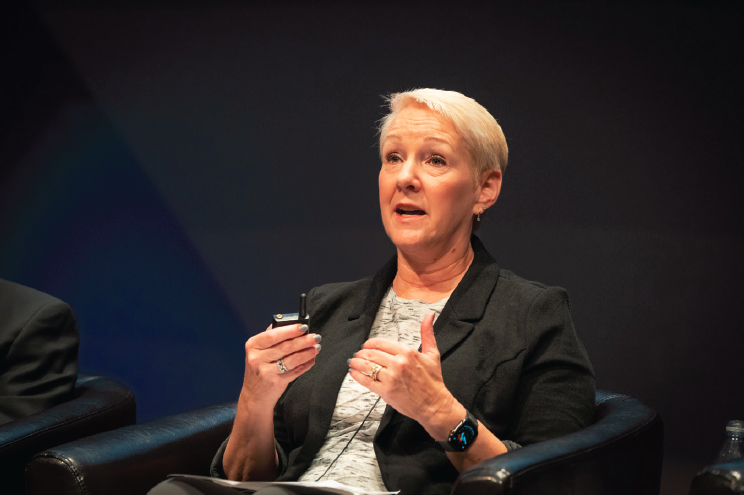
In March 2022 the White House held a Fusion Summit that brought together representatives of the public and private sectors to discuss strategies for getting to practical fusion energy. The Department of Energy has also announced a funding opportunity using public-private partnerships to develop a pathway from preconceptual designs to a fusion pilot plant. “These public-private partnerships are going to be key,” said McCarthy. “The US government is putting a lot of effort into this, and multiple private companies are looking at this because, ultimately, it’s a very worthwhile goal.”
In response to a question about whether the deuterium-tritium fuel cycle is the one that should be used in early demonstration projects, McCarthy noted that many opinions exist about fuel cycles, whether deuterium-deuterium, deuterium-tritium, or deuterium-helium 3. ITER is using deuterium-tritium because “it is the easiest, and the information that you get from it will inform many other options.” The same question could be asked, she observed, of why ITER is using a torus design rather than a different configuration, and again the answer is that the largest database exists for that configuration and the data from the torus-shaped ITER are applicable to many other applications. Tritium does pose safety problems, such as the need to manage tritium so that it does not get into the environment and pose health concerns to humans. But it has been
managed successfully in the past, and it may not be the fuel ultimately used in a commercial fusion reactor. “The jury’s still out on what’s going to end up being better,” she said.
“Is it worthwhile investing in fusion? Absolutely. [But] there are multiple pathways being investigated…. What you want to understand is a self-heating plasma, and dealing with deuterium and tritium will get us there more quickly.”
THE PROSPECTS FOR THE GRID
The technological entity that ties together the components described by the other speakers is the electricity grid, explained Amy Halloran, director of the Nuclear Fuel Cycle and Grid Modernization Program at Sandia National Laboratories. The grid consists of the substations, transformers, power lines, and other equipment that connect electricity generation to consumers. In the United States, “the grid” is actually three grids: the Eastern Interconnection, the Western Interconnection, and ERCOT, which handles most of Texas. Regional balancing authorities within these grids have the complex job of matching energy demand with supply.
Recent examples demonstrate what happens when demand and supply become mismatched. In the winter of 2021, Texas experienced outages that left people without heat, lights, or clean water for days. California experienced power outages in the summer of 2022 because of a stint of record-breaking heat. Winter storms in 2022 caused almost a million outages along the East Coast.
The nation’s energy system was designed and built to handle the temperatures of the last century, not the extremes being experienced now because of climate change, noted Halloran. In addition, the use of renewable energy will continue to increase more rapidly than the overall demand for energy, but renewable energy sources are not always “on,” which means that the grid will have to incorporate massive amounts of energy storage.
This storage can take many forms, from pumped hydropower to batteries to hydrogen systems. Much of the current focus is on batteries, with the US Energy Information Agency predicting that growth of battery storage will parallel the growth in renewable energy generation. But seasonal disconnects between energy demand and energy generation will also require some form of seasonal energy storage, such as pumped hydropower, hydrogen, or reliance on nuclear energy.
These storage resources “will not be inexpensive,” said Halloran. Storage systems include not only the underlying mechanisms such as batteries but
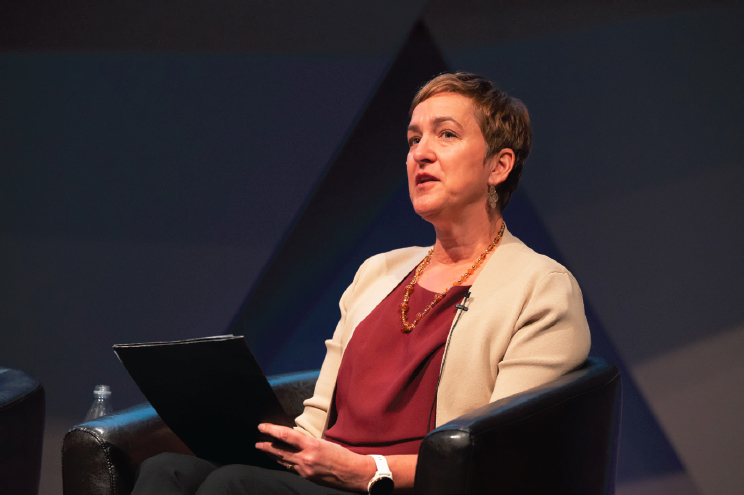
also power conversion systems, energy management systems, and the integration of these and other components.
Also, a very large amount of storage will be needed. As of 2020, the US grid had 32 gigawatts of storage, 93 percent of which was in 43 pumped-hydropower facilities. (Many of these were created to allow nuclear power plants to operate at full capacity when demand is low.) Recent studies by the National Renewable Energy Laboratory and others have shown that anywhere from 5 to 50 times the current amount of storage will be needed on the grid by 2050, Halloran reported.
In addition, land-based wind and solar sites are often located in remote locations far from where the electricity is consumed, so new transmission lines will be needed to transport electricity from where it is generated to where it is used. According to the Transmission Agency of Northern California, it can take on average 10 or more years to plan, permit, and build a high-voltage transmission line. Transmission lines are also expensive, Halloran observed. A Wisconsin utility recently notified its public service commission that the costs for a 100-mile 345-kilovolt transmission line will be more than half a billion dollars, partially due to pandemic-related increases in the costs of steel, insulators, and conductors.
As wind and solar technologies advance, new turbine technologies will allow wind sites to be located in populated areas with lower wind speeds.
Solar photovoltaic costs have already experienced a dramatic cost reduction, making solar systems more economically viable in less sunny areas. For example, Vermont received 16 percent of its energy in 2022 from solar, a much higher percentage than sunnier states like Florida, Texas, and Arizona.
It is worth noting that “past dire predictions of grid collapse with even 20 percent renewable energy have not come true,” said Halloran. In recent months, renewables provided 36 percent of California’s and 34 percent of Texas’s electricity, and they consistently provide the majority of electricity in many other parts of the country, such as Iowa and South Dakota.
Because energy generated by wind and solar can suddenly decline if the wind stops blowing or the sun stops shining, advanced power electronics are needed that can respond almost instantly to manage the flow of electricity between renewable sources and the grid. One specific area of power electronics needed for a modernized grid is solid state transformers, Halloran noted.
Advanced power electronics, such as solid state transformers, are needed to respond almost instantly to manage the flow of electricity between renewable sources and the grid.
Today’s transformers are designed to operate with one directional flow. Solid state transformers, with their much faster response time, would enable higher controllability of the power flow. They would also be able to interface with power electronics converters from renewable energy sources. In these and other areas, major advances are being made in power electronics research and development. For example, Sandia National Laboratories recently applied for a provisional patent on a power electronics base controller that allows optimized control and functionality of storage systems with a variety of storage types.
The federal government is working to address current and future needs. In April 2022 the Federal Energy Regulatory Commission published a Notice of Proposed Rulemaking that proposed requiring public utility transmission providers to conduct long-term regional transmission planning on a sufficiently forward-looking basis to meet transmission needs, driven by changes in the resource mix and demand. The Department of Energy also has many programs working to solve challenges involving the grid, from a new grid deployment office to energy storage. The grid deployment office will invest $17 billion in programs and projects to identify and address national transmission, distribution, and clean generation needs. In addition, the office will manage programs to keep nuclear power plants, which provide the biggest share of the country’s carbon-free electricity, from retiring if they can oper-
ate safely and reliably, and it will support the upgrading and modernizing of hydropower facilities.
“Changes are needed on many fronts to keep the grid delivering electricity on a day-to-day basis, and we’re working on those solutions,” said Halloran. In the future, the grid will look less like the three grids that exist today and more like a collection of smaller grids that are interconnected so that they can be powered up, turned off, and isolated, creating a reliability that does not currently exist. Such a collection of grids will require advanced power electronics so that they can react much faster. “The federal government, the public utility commissions, and the public and private utilities are all thinking about this,” she said. But investments are needed to move in that direction.
In response to a question about how to generate the necessary investments, Halloran observed that investments are necessary but not sufficient, “especially with respect to transmission.” One of the biggest issues involving the grid is NIMBYism—“people don’t want to put high-voltage transmission lines in their backyards.” Permitting is also an issue, when it takes 10 years to get a high-voltage line permitted to even begin construction. In conclusion, Halloran noted, “If we get past the societal issues, then, hopefully, society will be willing to fund these investments moving forward.”


