Full-Depth Reclamation: Current Practices (2025)
Chapter: 2 Literature Review on Practices and Guidelines for Use of Full-Depth Reclamation

CHAPTER 2
Literature Review on Practices and Guidelines for Use of Full-Depth Reclamation
This chapter provides a comprehensive review of details related to practices on the use of FDR as a rehabilitation technique. Discussions on benefits and limitations of FDR, exploration into FDR selection as a preferred rehabilitation alternative, properties and methods of characterization for FDR, stabilization additives and mix design, structural design of pavements incorporating FDR, construction procedures, quality assurance practices, opening to traffic and surfacing requirements, life cycle assessment and life cycle cost assessment, as well as documented performance of FDR-treated projects are explored. The information presented was gathered from published technical papers and reports, as well as DOT documents and NCHRP publications.
2.1 Background and Introduction
Amid financial constraints and escalating construction costs, agencies across all tiers are tasked with restoring and maintaining their aging and deteriorating road infrastructure. With the growing prominence of sustainable construction practices, many agencies are seeking to revitalize their investments in deteriorating road infrastructure through the cost-effective reuse of existing materials (Reeder et al., 2017). The use of recycled materials in asphalt pavement rehabilitation has garnered considerable interest among many agencies in the United States and globally. Recycling technologies are a less impactful approach to rehabilitation, offering both economic and environmental benefits. However, these techniques have not been extensively adopted for a variety of reasons. The reasons include the lack of understanding of the complex material behavior and its long-term durability (Bowers et al., 2020).
FDR, as one recycling technique, is a rehabilitation approach in which the existing asphalt layer, together with a predetermined portion of the underlying layers, is recycled into a new base layer and overlaid with surface treatments or an asphalt overlay, depending on traffic volume or other serviceability needs. The recycling depth may vary between 4 and 12 inches (ARRA, 2015), depending on the existing asphalt layer thickness. Constituent materials used in the FDR process include reclaimed asphalt pavement (RAP), stabilizing agents (which can be asphalt, chemical, mechanical, or a combination), and water for adequate compaction.
The stabilizing agents, which include but are not limited to asphalt emulsion, foamed asphalt, lime, fly ash, kiln dust, calcium chloride, and Portland cement, are incorporated to improve the structural properties of the layer and minimize the negative effects of moisture (Owino et al., 2022). An overview of these constituent materials and their effects has been summarized by Theyse et al. (2004) in a two-dimensional space of rigidity and deformability, depicted in Figure 2.
Numerous agencies have implemented FDR as a rehabilitation technique to varying degrees, primarily because it provides substantial enhancements in structural capacity following construction and during the early service life. Despite the increasing adoption of FDR, concerns persist concerning the long-term performance of stabilized materials when subjected to heavy

Long Description.
The first illustration shows a graphical representation with rigidity (brittle-cracking risk) along the vertical axis (greater rut resistance) with stress dependent at the bottom and linear elastic at the top and deformity (rutting risk) along the horizontal axis (greater flexibility) with stress dependent on the left and time, temperature dependent on the right. The elements marked from the bottom left corner to the right and upward are rutting, unbound crushed stone or gravel, FDR (cemented, granular, visco-elast), HMA, lightly cemented, strongly cemented, cracking brittle, fatigue, less economical mixes. Bituminous binder is at the top, and 6%, 4%, and Cement are on the right. The second illustration shows a graphical representation with greater permanent deformation resistance along the vertical axis and improved flexibility along the horizontal axis. The plot for bituminous binder is divided into four segments from left to right as none, low (0.5 to 2.0 percent), intermediate (2.0 to 4.0 percent), and high (4.0 to 7.0 percent). An up arrow on the right for cement indicates marked strength. A down arrow on the right for cement is marked catalyst. Four segments from bottom to top are none, low (0.5 to 1.5 percent), intermediate (1.5 to 3.0 percent), high (3.0 to 5.0 percent), and very high (8.0 to 10.0 percent). The elements listed in various cross sections are unbound material, high quality crushed stone (stress dependent behavior), moderate quality natural gravel, poor quality natural gravel, foamed-bitumen and emulsion treated material, asphalt concrete (temperature dependent, visco-elastic behavior), cemented foamed bitumen and emulsion treated material (in the middle of the graph), concrete, strongly cemented material C2 to C1 (brittle behavior), lightly cemented material C4 to C3, and presumed economically not viable).
traffic loads. This review aims to organize and discuss the current state of practice in FDR as a rehabilitation technique.
2.2 Project Selection, Benefits, and Limitations for Full-Depth Reclamation
This section provides an in-depth review of the selection criteria used to determine FDR as the preferred rehabilitation alternative, which includes considerations of road conditions, traffic capacity, and environmental impact. Considerable cost savings resulting from the implementation of FDR, including timely construction and decreased material and labor costs, are discussed alongside the constraints associated with quality control and assurance techniques.
2.2.1 Project Selection
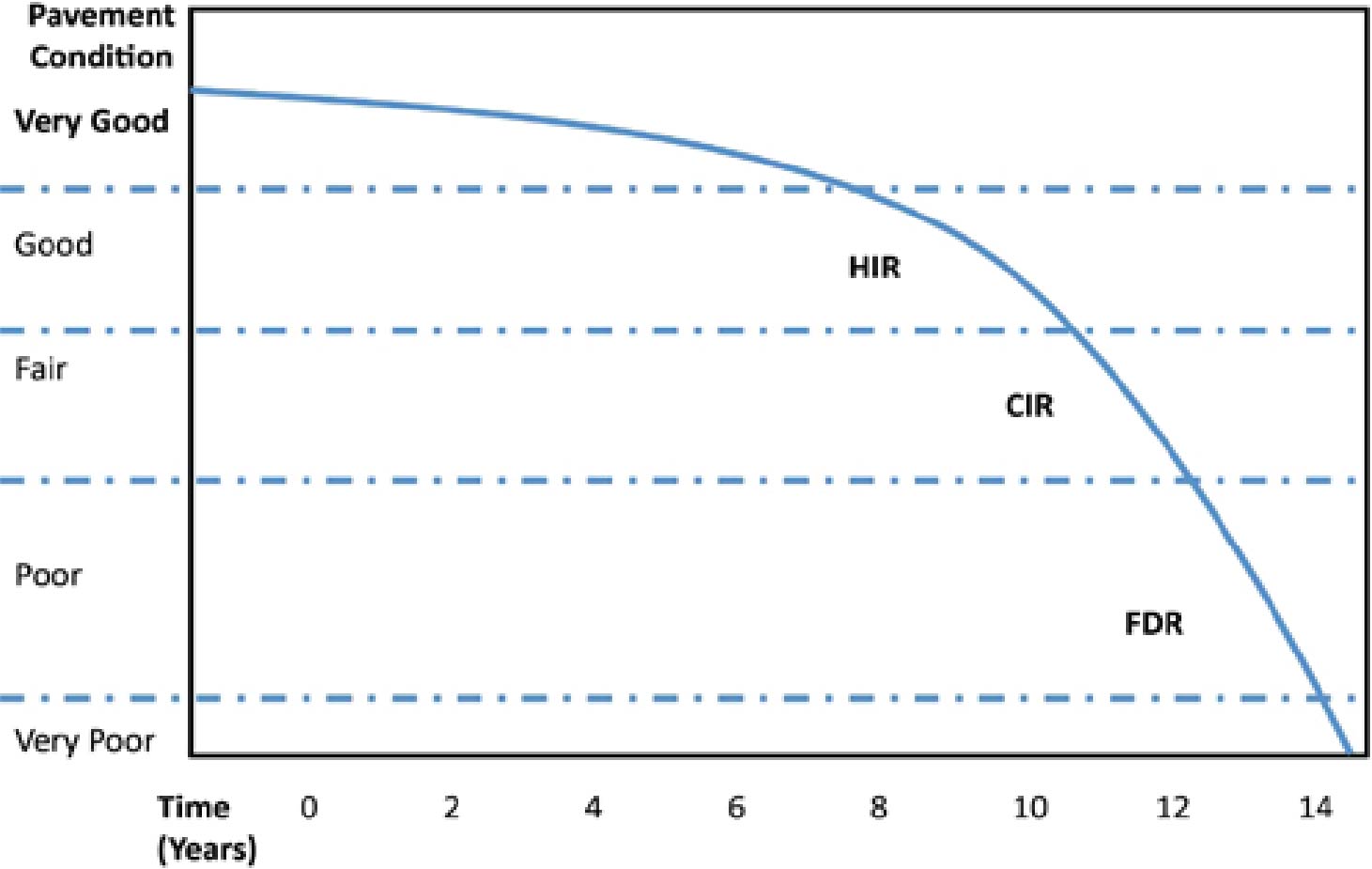
FDR is a widely utilized technique in the restoration of roadways that have experienced substantial deterioration or developed structural defects (Stroup-Gardiner, 2011). Figure 3 illustrates the period during which the FDR application is suitable, alongside other recycling rehabilitation techniques, based on the pavement condition index.
Gathering adequate information about the existing pavement is crucial when evaluating the suitability of FDR as a rehabilitation strategy or when designing a successful FDR project, as with other pavement treatments. The initial evaluation and assessment of the existing pavement necessitates efforts such as surveying the existing pavement condition, determining the existing traffic level, conducting in situ testing, and performing field sampling for laboratory investigations. According to the Pavement Preservation and Recycling Alliance (PPRA, n.d.), the following pavement distresses can be treated with FDR:
- All forms of cracking and rutting.
- Reduced ride quality resulting from uneven road surfaces characterized by swells, bumps, sags, and depressions.
- Raveling, potholes, and bleeding resulting in loss of surface integrity.
Long Description.
The vertical axis for pavement condition has layers from bottom to top marked as very poor, poor, fair, good, and very good. The horizontal axis for time (years) ranges from 0 to 14 in increments of 2. A concave down curve slopes downward from a point in the very good layer for 0 years to the very poor layer by 14 years. The parts of the curve are marked HIR, CIR, and FDR in good layer, fair layer, and poor layer, respectively.
- Excessive shoulder drop-off.
- Inadequate structural capacity.
- Subgrade instability.
Table 1 provides a general overview of the applicability of FDR in addressing various forms of distress.
While some other pavement distresses can be successfully remedied using alternative methods, the criteria used by agencies to determine which distresses are suitable for FDR application vary based on several factors discussed further in this synthesis.
- Material and Environmental Considerations
When the mix design is formulated, the proportions of materials are important. Through the reclamation process, the existing asphalt material may be milled and taken away, while in other situations, additional materials may be required to rectify material deficiencies. Determining suitable candidates thus necessitates consideration of the existing pavement layer depths. The cost and design are also influenced by the material composition, specifically the composition of the subgrade material. Prior to rehabilitation, areas with a weak subgrade may require complete subgrade removal and replacement or stabilization through various cost-effective means (Owino et al., 2022).

Long Description.
The table shows pavement distress in the first column and applicability in the second column, with row entries as follows. Bleeding, slightly more than least appropriate. Block cracking, most appropriate. Bumps, slightly less than most appropriate. Corrugation, slightly more than the least appropriate. Depression, slightly less than most appropriate. Edge cracking, most appropriate. Fatigue cracking, most appropriate. Longitudinal cracking, slightly less than most appropriate. Potholes, slightly more than least appropriate. Reflective cracking, most appropriate. Ride quality, least appropriate. Rutting, most appropriate. Sags, slightly less than most appropriate. Shoulder drop off, least appropriate. Shoving, slightly more than least appropriate. Skid resistance, slightly more than the least appropriate. Slippage cracking, slightly more than the least appropriate. Swells, slightly less than most appropriate. Transverse cracking, most appropriate.
- Expected Traffic
Traffic volume is an additional factor considered in FDR selection. A redesign and reconstruction of the pavement structure will be required in lieu of surface maintenance should pavement failure result from an increased traffic burden, leading to a compromised base layer. FDR, in this regard, may be considered a more suitable technique for the rehabilitation of this roadway due to its ability to enhance the condition of the pavement base (Owino et al., 2022). The required curing time, along with the associated construction time and traffic delays, can deter the adoption of FDR, particularly on higher-volume roadways. However, the appropriate selection of materials and methods can help alleviate this challenge. - Road Geometry
While FDR can rectify minor deficiencies in both the horizontal and vertical profiles, it may be necessary to perform additional operations to ensure uniform treatment depth when substantial modifications are necessary to the existing roadway. Prior to performing FDR, cold planing can be utilized to rectify profile deficiencies in asphalt pavements of sufficient thickness when significant profile adjustments are necessary. When the existing pavement surface is thin, aggregate or RAP from an off-site source may be added to a roadway. During the reclaiming process, the supplementary material must be thoroughly combined with the pulverized asphalt pavement and underlying materials in a uniform manner (Reeder et al., 2017).
2.2.2 FDR Benefits and Limitations
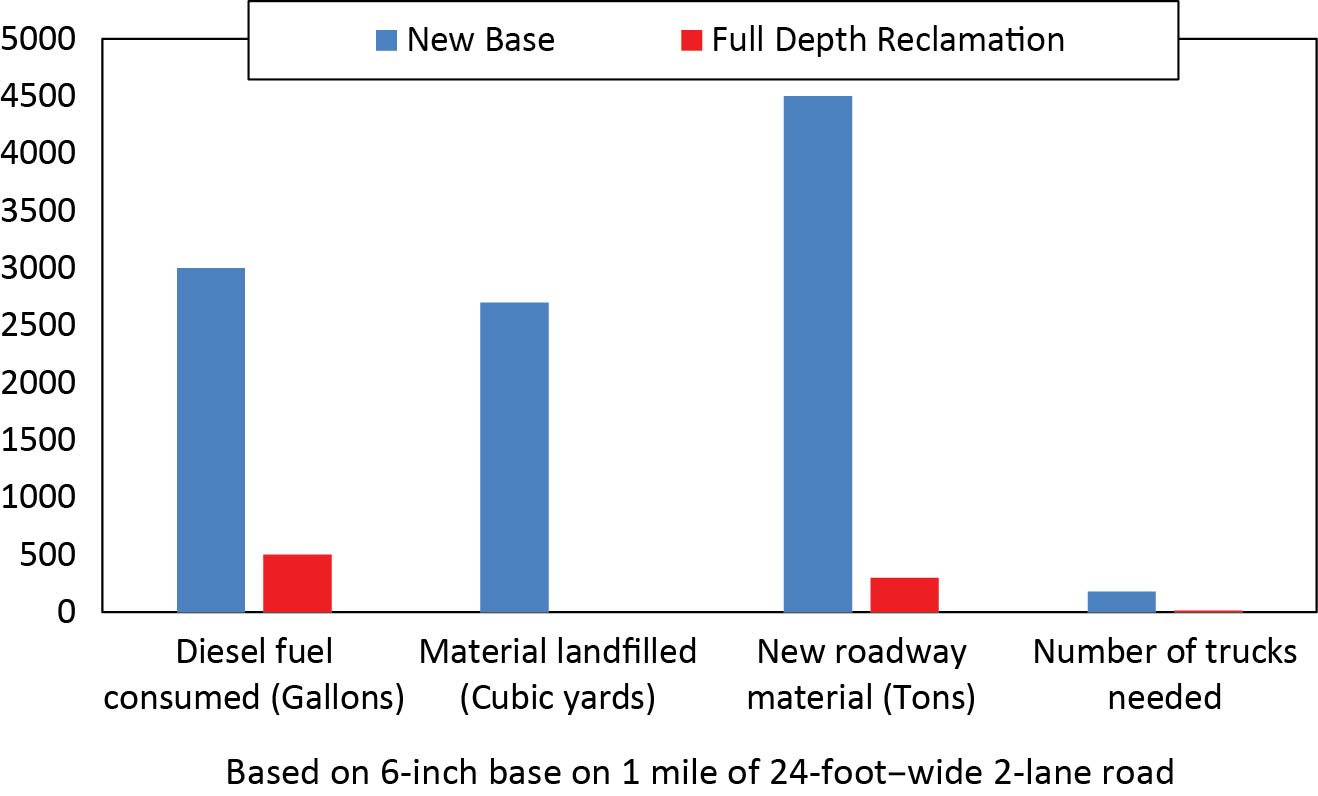
In addition to being an environmentally friendly approach, FDR can also be categorized as a feasible alternative to traditional rehabilitation and reconstruction due to its simplicity of construction, cost-effectiveness, and potential long-term durability. In general, the durability of FDR is determined by the service life of the overlay or wear course rather than the FDR layer itself. Some of the benefits of FDR utilization include its applicability in widening roadways, usually at a fraction of the cost of alternative road construction techniques (Kandhal and Mallick, 1998; Lewis et al., 2006; Reeder et al., 2017; PPRA, n.d.). In addition, FDR effectively reduces the carbon footprint of roadway rehabilitation projects by minimizing the transportation of materials to and from the site and significantly decreases, if not eliminates, the need for quarrying new materials for use in constructing the new base layer. Figure 4 illustrates the benefits of using FDR compared to a traditional base reconstruction project.
Long Description.
The vertical axis ranges from 0 to 5000 in increments of 500. The horizontal axis lists four different categories. The data is as follows.
- Diesel fuel consumed (gallons). New base, 3000. Full depth reclamation, 500.
- Material landfilled (cubic yards). New base, 2500. Full depth reclamation, no data.
- New roadway material (tons). New base, 4500. Full depth reclamation, 250.
- Number of trucks needed. New base, 100. Full depth reclamation, no data. All data are based on 6-inch base on 1 mile of 24-foot-wide 2-lane road.
The absence of a nationally adopted approach for the mix design of FDR and the lack of reliable metrics for engineering properties, necessary for pavement structural design, are among the few constraints associated with its application. Although laboratory investigations, sample preparation procedures, specimen sizes, testing methods, and physical property requirements vary among agencies, FDR mix designs are typically dependent on the designerʼs expertise, which further restricts the implementation of FDR in regions with limited familiarity with the technology (Reeder et al., 2017).
During the construction phase, water is typically required in conjunction with stabilization agents to promote proper compaction. Curing the FDR layer to a moisture content that renders it less vulnerable to moisture damage is a necessary step following the completion of FDR construction and prior to the application of the surface layer. Elevated humidity or precipitation may impede the construction of the surface layer by extending the curing period. Therefore, the construction season for FDR is limited, as it is optimal to carry out construction activities during periods characterized by moderate and dry weather (Ghasemi et al., 2018).
2.3 Properties and Characterization Methods
The overall effectiveness of the FDR material or layer is influenced by its distinct properties. Appropriate evaluation of these properties, individually and/or collectively, ensures that the pavement structureʼs long-term performance and durability are achieved. The most common FDR properties evaluated are the following:
- Density: Due to its effect on particle interactions and void reduction, density through adequate compaction necessitates particular consideration. The effectiveness of FDR depends on the density (Wirtgen, 2012). At the point of maximum density and optimum moisture, maximum strength is attained. Strength and durability may be undermined if the FDR material or layer is compacted at a reduced density (Reeder et al., 2017).
- Stiffness: The stiffness of an FDR layer is an important metric as it is utilized mostly in quality assurance practices and in the design of the FDR pavement. In most cases, the density and type of stabilizer will determine the stiffness of an FDR layer. Understanding the target field density of the FDR layer is crucial for achieving the proper level of compaction. Significantly higher stiffness metrics are attained for an FDR base compared to a base composed of unstabilized granular material. Additionally, the moisture content of the FDR layer plays a crucial role in determining its stiffness. The optimal moisture content for the FDR layer or material is specified in the mix design. The stiffness tends to decrease as the moisture content of the material increases, approaching 100% saturation (Buchanan, 2007; Reeder et al., 2017).
- Strength: The strength characteristics of FDR are contingent on several factors, including the nature and attributes of the constituent materials (e.g., RAP, underlying aggregate, underlying soils), the type and quantity of stabilizer utilized, the materialʼs density, and the rate of curing.
- Permeability: Both the FDR mix proportion and the degree of compaction that occurs during construction are responsible for controlling the permeability of the FDR layer. The FDR layerʼs low permeability will enhance its resilience to damage caused by freeze-thaw cycles and provide improved load support compared to a saturated granular base without stabilization.
2.3.1 Characterization Methods
The fundamental, engineering, or empirical approaches employed to characterize FDR materials for pavement design and performance evaluation generally are still the subject of ongoing research. Methods from the existing literature that are commonly used to assess FDR materials are discussed in this section.
2.3.1.1 Laboratory Characterization Methods
Marshall Stability
The Marshall stability test has been extensively utilized for the mixed design of FDR projects, particularly bituminous-stabilized FDR. The results from this test are also commonly incorporated into the quality control specifications of various agencies. Originally developed for HMA, the test assesses the resistance of the asphalt mixture, both in dry and wet conditions, to plastic deformation by measuring the deflection caused by an applied load at a specified rate until the peak load is reached. This peak load is then used to determine the stability of the mixture, as well as the retained stability, based on the ratio of dry and wet stability (Smith, 2013). This test is usually performed following the ASTM D6927 specifications.
Indirect Tensile Resilient Modulus Test
The indirect tensile resilient modulus (IDT Mr) test has been widely used in various studies on cold recycled (CR) materials, and some include gaining insights into curing mechanisms (Graziani et al., 2016; Ogbo et al., 2022) for mix design purposes and to analyze the influence of temperature (Bocci et al., 2014). The literature often reports excessively high values for the modulus obtained through this test (Kuchiishi, 2019). Specified in ASTM D7369, this test involves the application of a cyclic haversine compressive load on the diametral plane of a cylindrical specimen. The Poissonʼs ratio and Mr are determined by measuring horizontal and vertical deformations. Figure 5 illustrates the test setup in a universal testing machine (UTM).
Triaxial Resilient Modulus Test
The triaxial resilient modulus (TMr) test is able to evaluate the effects of stress conditions on FDR materials that cannot be replicated by the IDT Mr tests. To simulate a range of stress-state

Long Description.
The configuration shows a cylindrical specimen placed horizontally between two vertical loading strips inside the loading frame. The system includes a load frame, loading strips, and deformation measurement devices attached to the specimen to capture the horizontal deformation response.
conditions, different combinations of confining and deviator stresses are applied. The test procedure typically involves applying cyclic haversine loading at a frequency of 1 Hz, with a loading period of 0.1 s and a rest period of 0.9 s, as specified in the AASHTO T 307-99 guidelines under room temperature, temperature conditions of interest, or both. Louw et al. (2019) devised an improved test approach for measuring the resilient modulus of stabilized FDR materials in a triaxial configuration. The motivation for this study stemmed from observations that the commonly utilized approach—AASHTO T 307, originally developed for unbound materials—was not suitable for testing FDR-stabilized materials. Five different test setups, which ranged from top cap to third-point strain measurements, were evaluated. The study suggested third-point on-specimen strain measurements, as they were observed to be minimally influenced by the non-linear strain distribution, and the results closely correlated with back-calculated stiffness from FWD. Readers are referred to the study for more information. The TMr testing apparatus from both approaches (AASHTO T 307 and that from Louw et al., 2019) are illustrated in Figure 6 a and b.
Indirect Tensile Strength Test
The indirect tensile strength (ITS) test is used as an indirect measure of the tensile strength and flexibility of FDR materials (Asphalt Academy, 2020). The index provides a means of assessing engineering properties. It can also be utilized to quantify the materialʼs susceptibility to moisture through the tensile strength ratio. ITS strength measurements can be used to assess the quality of FDR materials, particularly bituminous-stabilized FDR, and predict the potential for rutting or cracking. Multiple studies have utilized the ITS test to assess the performance characteristics of FDR materials, determine mix attribute contributions in terms of active filler usage, and track the strength gains of FDR materials through curing (Cross, 2000; Kim et al., 2011; Diefenderfer et al., 2012; Gandi et al. 2018; Lane and Kazmierowski, 2012; Smith, 2013). The test is performed in accordance with the ASTM D6931 guidelines. It involves applying a defined rate of deformation (50 ± 5 mm/min) and a testing temperature of 25°C (77°F) to at least three cylindrical specimens

Long Description.
The first part shows a cylindrical specimen placed vertically inside a triaxial chamber with top and bottom loading platens supported by porous stone and filter paper. The parts marked are tie rods, steel ball bearing, latex membrane, acrylic chamber, drain outlet, pressure inlet, linear ball bushing, pressure transducer, LVDT, LVDT bracket, load cell, and UTM actuator. The second part shows a vertical specimen inside a transparent triaxial chamber. The additional parts marked include T S 1 through T S 5 with a load at the top.
(either laboratory-prepared or core specimens) along their vertical diametral plane. The peak load at the point of failure is measured and used to determine the strength of the specimensʼ ITS. Figure 7 depicts the test configuration.
Unconfined Compressive Strength Test
The unconfined compressive strength (UCS) test is frequently employed in assessing pavement materials and has been widely utilized by researchers to examine the enhancement of strength. The UCS value is commonly used as an indicator of the quality of a cement-stabilized FDR layer (Ghanizadeh et al., 2018; Kwon et al., 2020; Lewis et al., 2006; Suebsuk et al., 2024). Typically, the determination of this parameter is based on prepared specimens that have undergone a 7-day curing process at 22°C (Ghanizadeh et al., 2018). Previous studies have shown that increasing the proportion of cement in the mixture of RAP and aggregates leads to an increase in the UCS. However, it may also negatively impact cracking performance. The ITS test is more sensitive to stabilizer content than the UCS test, making it increasingly important for assessing long-term durability (Wirtgen, 2012). This test is conducted by loading FDR specimens to failure at a constant loading rate of 140 kPa/s, in accordance with the guidelines outlined in ASTM D1633.
Complex Modulus
Multiple studies have investigated the stiffness of FDR materials through the analysis of complex modulus (E*) results. The NCHRP 09-51 study (Schwartz et al., 2017) has made substantial contributions to the formulation of design inputs by developing the necessary E* and repeated load permanent deformation (RLPD) models using field cores. The utilization of E* in other CR material evaluations has been demonstrated in studies, such as the one conducted by Kim et al. (2011), which examined the impact of curing time and moisture content on the stiffness of cold in-place recycling (CIR) materials. Godenzoni et al. (2015) also investigated the influence of RAP

Long Description.
The setup shows a cylindrical specimen placed between two curved steel loading strips inside a loading frame.
content on the stiffness of cement-bitumen-treated materials using the E* test. In addition, Kim et al. (2009) conducted a comparison between the viscoelastic properties of CIR materials and HMA using the E* test. In an attempt to reduce material quantity requirements for E* characterization, Gatiganti et al. (2023) explored specimen size effects (large-scale and small-scale) on E* determination of FDR mixtures and found a difference of less than 15% between the different specimen sizes at all test temperatures and frequencies evaluated. The test is usually performed in accordance with the guidelines outlined in AASHTO T 342.
Triaxial Shear Strength Test
The triaxial shear strength test has been widely accepted as the standard method for evaluating the shear strength of materials for the past five decades (Kaloush et al., 2010). Stabilization of recycled materials, such as FDR in this case, enhances shear properties by significantly increasing cohesion (c) and slightly reducing the friction angle (φ) (Bierman, 2018). Collings and Jenkins (2011) suggest that CR materials generally resemble conventional unbound granular materials but with enhanced cohesion during the initial stages after construction. The shear strength is a fundamental property of CR materials that is associated with rutting caused by plastic deformations (Asphalt Academy, 2020). Cížková et al. (2016) suggested that the triaxial test could be particularly useful for characterizing the behavior of CR materials with low binder levels. Previous studies (Jenkins et al., 2007; Fu, Steven et al., 2009; Jenkins et al., 2012; Dal Ben and Jenkins, 2014; Guatimosim et al., 2018) have established the suitability of the triaxial test in characterizing the shear and shear properties of common FDR materials.
The simple triaxial test (STT) developed by Mulusa (2009) has enhanced the process of triaxial testing in laboratory settings. The STT apparatus is primarily used for monotonic triaxial testing to determine cohesion and friction angle values. Additionally, the monotonic stiffness of the material, known as the tangent modulus (Etan), can also be measured. This parameter indicates the elastic behavior of a material and can be used to track stiffness trends in various mix compositions (Asphalt Academy, 2020). The specimens used for this type of characterization are typically 300 mm (11.8 in.) in height and are compacted with five equally thick layers. Figure 8 depicts the test components and setup.

Long Description.
The first part shows the components as the triaxial cell, specimen, top and bottom platens, confining fluid, and loading system. The second part shows the triaxial strength test apparatus with a cylindrical specimen under vertical loading within a transparent chamber.
Triaxial testing can also be used to determine and convey the moisture susceptibility of FDR materials, as well as the retained cohesion. FDR materials are generally less susceptible to water than granular materials and have greater cohesion retention. Using monotonic triaxial experiments at a high confining pressure, the retained cohesion is calculated as the ratio of the soaked (submerged in water for 24 hours at 25 °C) to the unsoaked principal stress.
Falling Head Permeability Test
The permeability of recycled materials is primarily influenced by the voids present in the recycled mix and the level of stabilization. The material permeability is typically influenced by both the mix proportion and the level of compaction achieved during construction. Stabilized FDR layers exhibit permeability comparable to that of compacted clay. The materialʼs low permeability enhances resistance to freeze-thaw damage. It provides better load support compared to a saturated, unstabilized granular base. Novel testing procedures are currently being developed to determine the moisture sensitivity of FDR base materials. The falling head permeability test (see Figure 9) and the tube suction test have demonstrated potential as a method for quantifying water movement in a sample of FDR (Mallick et al., 2019; Reeder et al., 2017).
2.3.1.2 Field Characterization Methods
Nuclear Density Gauge
Nuclear density gauge devices (NDGs) have been widely utilized to obtain field density and determine the level and degree of moisture content in FDR projects (Cox et al., 2016; Le et al.,

Long Description.
The illustration shows a vertical stand holding a graduated standpipe connected to the top of a soil specimen contained in a permeameter cylinder. The parts marked include a graduated cylinder with upper timing mark (500 milliliter) and lower timing mark (0 milliliter), clamp assembly, hose clamp, membrane, cap assembly, cap sealing O ring, hose barb fitting, sealing tube, 10 degree taper, Min. ID, pedestal, pressure line, outlet pipe, pressure/vacuum pump, quick connects, pedestal sealing O-ring, quick connect, h1, h2, and pressure gauge.
2016; Sebaaly et al., 2019). The NDG utilizes electromagnetic emissions (gamma rays) to measure field density, employing either the backscatter or direct transmission approach for paving purposes. The backscatter approach measures surface or near-surface density by detecting radiation that scatters back from the material, making it suitable for thin layers. In contrast, the direct transmission approach involves inserting the source rod into the material, allowing for deeper and more extensive density measurements. The choice between the two methods depends on the required depth and accuracy of the density measurement. However, in ideal cases, the backscatter approach is employed for surface assessments, while direct transmission is preferred for deeper, comprehensive density evaluations. The measured material density from this device can thus be adjusted for moisture content and subsequently compared to the specified density requirements. Figure 10 depicts the NDG utilized for field density measurements.
Falling Weight Deflectometer (FWD) and Light Weight Deflectometer (LWD)
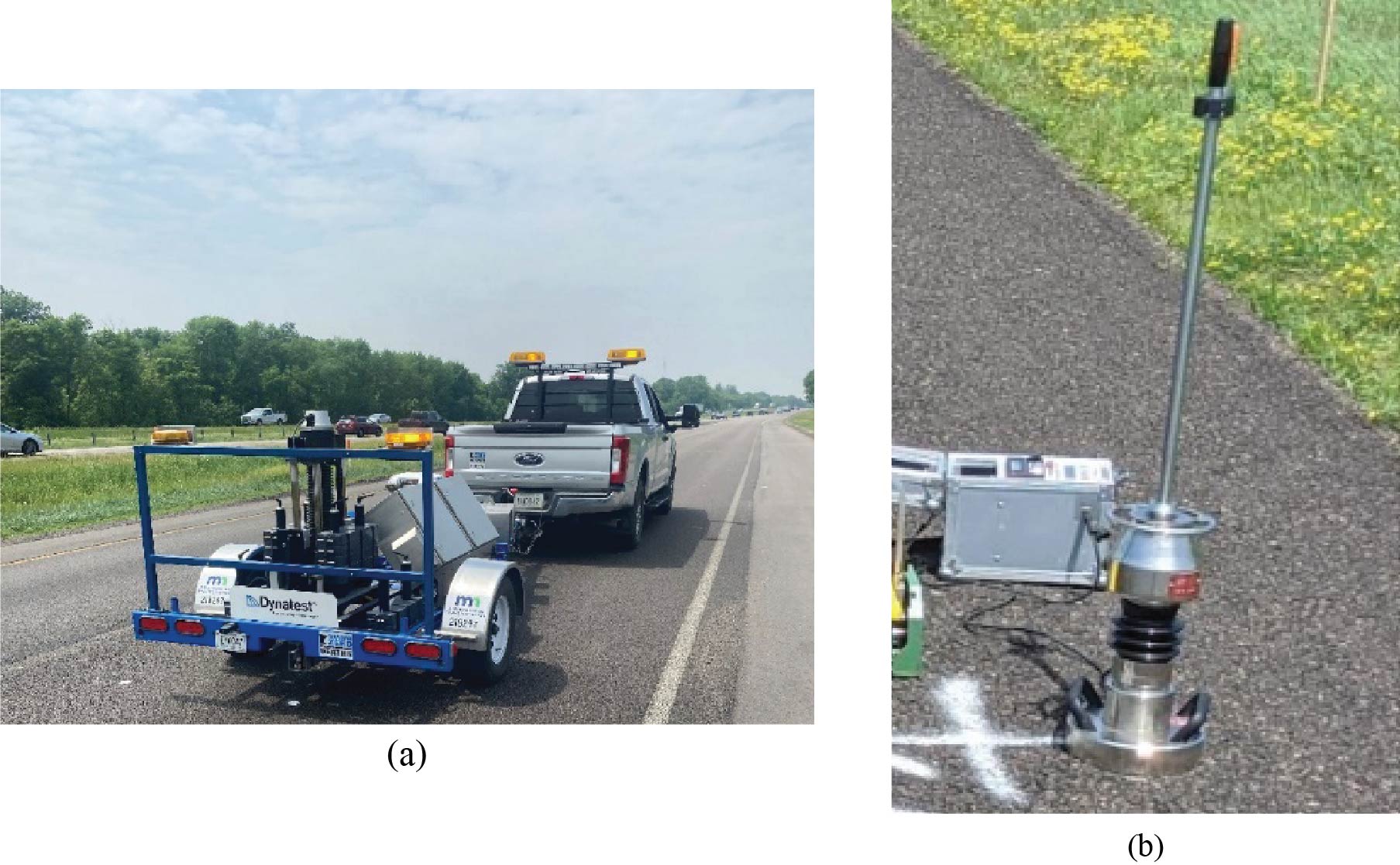
The evaluation of the field performance of new and in-service road pavements has gained significant value in contemporary practice. Engineers require a dependable method to assess the structural condition of pavements, providing appropriate suggestions for rehabilitation and management, as well as quality control and assurance processes (Tebaldi et al., 2014). Several studies have implemented FWD for FDR stiffness characteristics assessments as well as other CR layers (Diefenderfer and Apeagyei, 2011; Mallick, Bonner et al., 2002; Ellis et al., 2015; Al-Ihekwaba et al., 2024; Kroge et al., 2009). Plastic deformation in a recently completed recycled layer can result from the stress magnitudes applied from the FWD equipment, which is why FWD tests are typically conducted several days to weeks after construction. In addition to assessing the stiffness of the FDR layer, the FWD equipment can be used to evaluate the structural conditions of the FDR pavement progressively over time and develop performance models (Xiao et al., 2018). This test is typically performed in accordance with the guidelines outlined in ASTM D4694-09. Figure 11a depicts the configuration of the Falling Weight Deflectometer (FWD).

Long Description.
The device consists of a digital display and a source rod.
Long Description.
(a) The first photo shows a falling weight deflectometer (FWD) setup on a roadway surface. It includes a loading plate and geophones arranged radially to measure deflection. (b) The second photo shows a lightweight deflectometer (LWD) setup. It consists of a portable device with a circular loading plate and drop weight system for measuring the surface modulus of the FDR layer.
On the other hand, LWD tests are conducted to determine the surface modulus, also known as the composite modulus, of a tested surface. This measurement helps assess the structural contribution or short-term bearing capacity of the unstabilized or stabilized FDR material. The LWD is a portable device (Figure 11b) that produces stress pulses similar to the FWD. However, the maximum stress is typically lower, usually not exceeding 200 kPa (29 psi), with a standard loading plate diameter of 300 mm (11.8 in.). The center deflection is the main parameter assessed in this device (refer to Figure 9, right). LWD has been successful in determining the early stiffness of FDR layers and is suggested for use in quality control and assurance processes (Ellis et al., 2015; Kwon et al., 2020; Diefenderfer et al., 2021). The LWD is typically performed in accordance with the guidelines outlined in ASTM E2583-07.
Dynamic Cone Penetrometer
The FDR layer/materials in situ resistance to penetration can be measured using the dynamic cone penetration (DCP) test (Ghasemi et al. 2018). DCPs are well-suited for the comparatively fine-grained materials typically encountered in pavement foundation layers (Asphalt Academy, 2020). The evaluation of the underlying materials can be achieved through coring or drilling of the asphalt pavement layers, which reveals the subgrade and granular base/sub-base materials. Water used in the coring process could evidently influence the DCP values of the upper portion of the underlying materials due to the moisture that ensues. Typically, load-bearing capacity evaluations are carried out in the same areas where asphalt pavement samples are collected for material property analysis. However, additional DCP testing needs to be performed on thin and/or weak pavement structures to more comprehensively evaluate their load-bearing capacity and identify areas of weakness. This evaluation is of utmost importance, as inadequate compaction typically results in a substantial degradation of the FDR materialʼs performance. In addition to sampling operations, the DCP test may be conducted simultaneously at the sampling base before the sample locations are backfilled (Reeder et al., 2017). The DCP results are subject to variation throughout
the year due to fluctuations in the moisture conditions of the base and subgrade. Ideally, the DCP results need to be acquired when the subgrade moisture conditions are comparable to those that existed during FDR construction. In the event that this is not feasible, the DCP evaluation criteria will require modification to accommodate the variations in moisture content that occur between the testing and construction phases (ARRA, 2015). It is imperative to acknowledge that the data acquired from a DCP probe represents, at best, a provisional indication of the characteristics of the substance within a pavement stratum. Nonetheless, statistical analysis can be applied to data gathered from multiple points, as the greater the amount of data analyzed, the more certain one can be of the results (Asphalt Academy, 2020).
2.4 Stabilization Methods
This section presents the various stabilization methods utilized in FDR mixtures, including, but not limited to, aggregate, Portland cement, asphalt emulsion, foamed asphalt, fly ash, lime, calcium chloride, kiln dust, and quarry by-products, and how these additives and their dosage amounts influence the overall performance of FDR. Stabilizing agents are frequently incorporated into FDR materials to improve their strength, durability, and moisture resistance. The selection of a suitable stabilization method and additive for a roadway needs to be based on a thorough evaluation of factors such as traffic volume, pavement structure integrity, and material properties (Ghasemi et al., 2018). There are three categories of stabilizing methods based on the materials used:
- Mechanical
- Chemical
- Bituminous
When mechanical stabilization is impractical from an economic standpoint or is hindered by the roadwayʼs geometry, and further reinforcement is required, chemical or bituminous stabilization may be necessary. There are no strict rules governing the choice of stabilizing method. However, the decision on which stabilizing agents to use depends on certain factors. The thickness of the existing pavement, the characteristics of reclaimed materials, the required reinforcement or alteration, the accessibility of stabilizing agents, the agencyʼs and local contractorsʼ prior experience, and economic considerations are all factors (ARRA, 2015). A flowchart illustrating the stabilization methods and their constituent stabilization materials is shown in Figure 12. Additional details regarding each of these methods are presented in subsequent subsections.

Long Description.
The schematic shows the stabilization methods as mechanical stabilization (granular materials or aggregates), chemical stabilization (Portland cement, lime, fly ash, lime kiln dust, calcium chloride), and bituminous stabilization (asphalt emulsion, foamed asphalt).
2.4.1 Mechanical Stabilization
Mechanical stabilization involves adding granular materials to the recycled FDR layer while it is being pulverized. The requirement for granular material is established through a gradation analysis of the combined materials in the current layers (Morian et al., 2012). Mechanical stabilization is achieved through particle interlock between the pulverized mixture of the existing asphalt and subsurface layers (Reeder et al., 2017). The process enhances the structural integrity of existing materials by improving their gradation, or can be employed to enhance the structural stability of in-place materials with excessive bitumen content. The addition of granular material during mechanical stabilization can enhance vertical curves, increase pavement surface elevation, or achieve roadway widening without reducing layer thickness. Various materials, including crushed aggregate, recycled asphalt pavement, and recycled concrete pavement, can be utilized for mechanical stabilization. These materials can be incorporated into the reclaimed layer either by spreading them before the pulverization process or by blending them in after the initial pulverization and shaping. The stabilization material can be evenly distributed using a motor grader or more consistently using mechanical spreaders or paving equipment (Morian et al., 2012). Mechanical stabilization can be employed independently or in conjunction with additional bituminous or chemical stabilizing additives.
2.4.2 Chemical Stabilization
Chemical stabilization involves combining pulverized asphalt pavement and base layer materials with a chemical stabilizing agent (Reeder et al., 2017). Portland cement, lime, fly ash, kiln dust, calcium chloride, and a combination of these materials are the most common chemical stabilizing additives used for FDR. The use of fly ash and other readily available reactive elements, such as lime kiln dust, has been restricted; however, they may also be utilized as FDR stabilizing agents (Morian et al., 2012). Calcium chloride offers benefits such as improved density, moisture control, increased surface uniformity, and potentially frost protection (Shepard et al., 1991). Chemical stabilization involves the formation of a matrix that binds the aggregate particles, resulting in increased strength (Wegman et al., 2017). The strength improvement achieved by incorporating chemical additives is primarily influenced by the characteristics of the reclaimed material and the specific stabilizers employed, including their type and dosage (Morian et al., 2012). Chemical additives may be used within a specific range to enhance strength and stability while avoiding excessive rigidity that could lead to cracking of the pavement surface. Insufficient stabilizing agents lead to inadequate binding in the matrix, while excessive stabilizing agents can increase base layer rigidity and potentially cause cracking (Wegman et al., 2017). FDR with Portland cement is a well-established engineered alternative that offers a cost-effective solution for agencies looking to improve roadways. Stabilization using Portland cement is typically most effective in areas with significant damage caused by heavy traffic or subgrades that lack sufficient strength. Moreover, pavements that have significantly deteriorated and necessitate complete reconstruction are suitable candidates for the application of cement stabilization (Owino et al., 2022). The Portland Cement Association reports that agencies that employ FDR can achieve cost savings ranging from 30% to 60% compared to alternative reconstruction methods, such as the complete removal and replacement of existing pavement. In addition to its economic advantages, the use of FDR with cement allows for a shorter construction period compared to not using cement, resulting in significant time savings (Reeder et al., 2017).
2.4.3 Proprietary Product Stabilization
The utilization of proprietary products in FDR has been the subject of limited research. In general, it has been recognized that these products lack design procedures or verification tests to identify their contributions to the pavement structure and long-term performance characteristics.
Wegman et al. (2017) assessed the contributions of a chemical proprietary product to an FDR project in Minnesota. The structural design for the FDR section resulted in a Granular Equivalency factor of 1.25 for the proprietary product-treated layer, which also surpassed the 10-ton effective capacity design requirements. Furthermore, the California bearing ratio (CBR) values were found to be lower in the DCP evaluations both prior to and following the injection of this material. In contrast, Ghasemi et al. (2018) conducted an additional study that demonstrated a higher stiffness than other stabilizers that were assessed using DCP analysis.
2.4.4 Bituminous Stabilization
Bituminous stabilization involves the reclamation and combination of pulverized asphalt pavement and base layer materials using either emulsified asphalt or foamed asphalt. Bituminous stabilization achieves strength gain through the coating of aggregate particles and the formation of adhesive bonding. This stabilizing agent is a viscoelastic material that provides waterproofing to aggregates through a coating process. Since it does not typically undergo chemical reactions, its strength properties are influenced by temperature and loading rate. The incorporation of bituminous stabilizing materials into the recycled layer can enhance its stiffness and resistance to water-induced damage. The addition of an appropriate amount is necessary to enhance the waterproofing of the aggregate by increasing the strength of the asphalt without compromising the stability of the matrix (Wegman et al., 2017). This stabilization allows FDR to exhibit greater flexibility compared to other types of FDR. Consequently, depending on the specific design specifications, this product has the potential to enhance resistance to fatigue caused by loading compared to alternative options (Morian et al., 2012).
- Asphalt Emulsion: The binder included in this product is an asphalt binder that is distributed in water in the form of an oil-in-water asphalt emulsion. The charge of the asphalt emulsion is determined by the emulsifying agent, which is responsible for keeping the asphalt suspended. Emulsion breakdown occurs when the asphalt binder separates from the water and adheres to the aggregate materials. Asphalt emulsion does not undergo a heat-based stabilization process, which prevents the asphalt from aging.
- Foamed Asphalt: The infusion of water into a heated binder causes the binder to foam spontaneously. The viscosity of the binder decreases significantly when in contact with the injected water, causing the water to vaporize into numerous bubbles rapidly. Foamed asphalt adheres to fine particles, creating an asphalt-bound filler that serves as mortar, binding the coarse aggregates together. A proportion of approximately 5–20% of the material passing through the 200 sieve is required for the presence of foamed asphalt. Inadequate fines can lead to the formation of “stringers,” which are agglomerations of fines with a high binder content. These stringers act as a lubricant, causing a decrease in the strength and stability of the mixture (Wegman et al., 2017).
Bituminous-stabilized FDR demonstrates effective compatibility with various additives, such as granular material, cement, or lime. Typically, a slurry state is employed for the application of cement or lime in the case of this particular combined product (Morian et al., 2012).
2.5 Mix Design
Similar to other recycling techniques, there is currently no universally accepted approach for conducting mixed designs for FDR. Different agencies have utilized several FDR mix design methods; however, only a limited number of these methods have been documented (ARRA, 2015). Some modified mix design methods have been developed based on traditional mix design
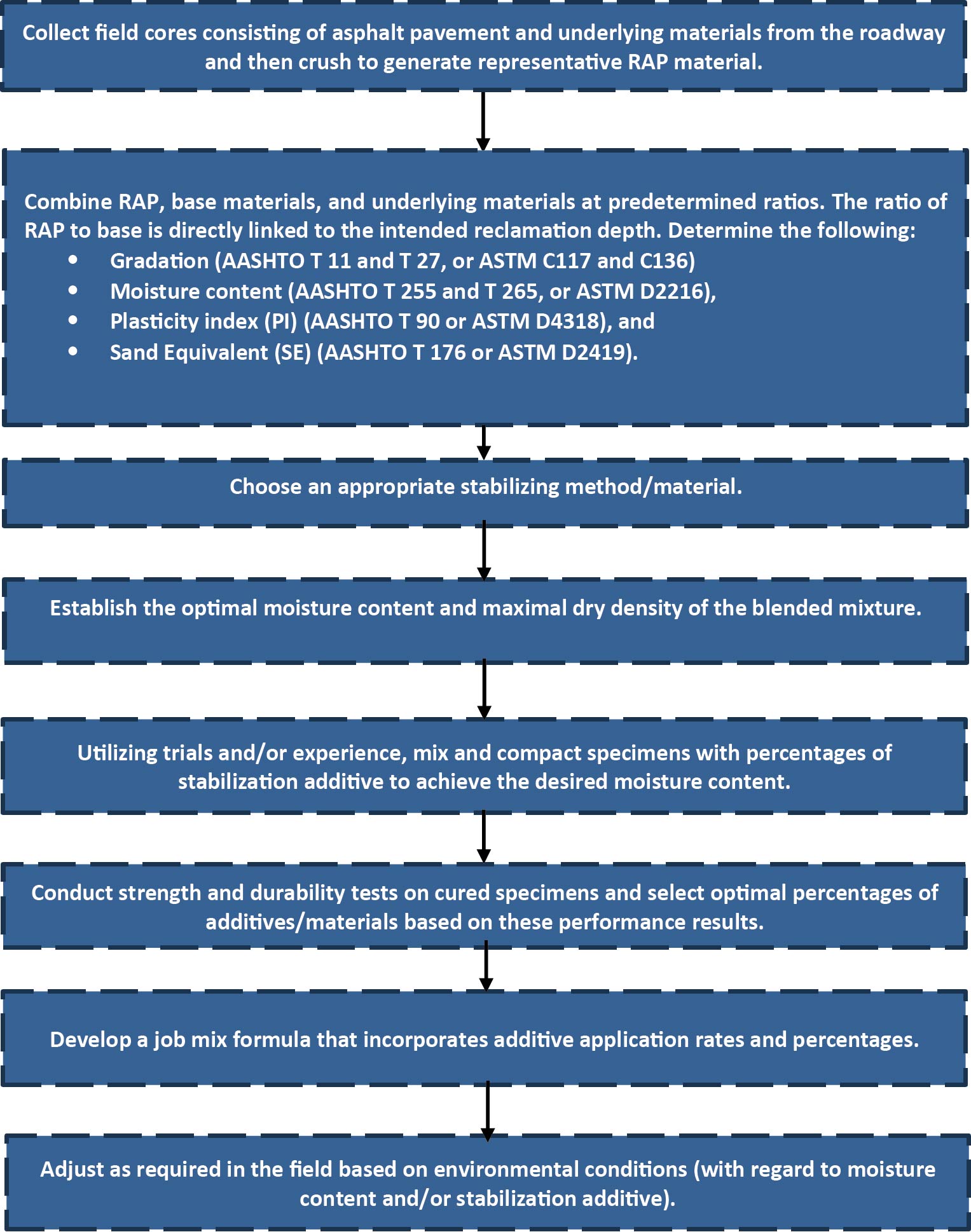
methods for HMA and vary in complexity. Generally, the FDR mixture preparation process involves sampling materials and assessing their physical properties, followed by combining the materials using an appropriate stabilizing approach based on the characteristics of the sampled materials. This process is then followed by establishing the optimal moisture content and density, and finally, compaction of the specimens. The process concludes with curing and durability assessments to establish a job mix formula. The material mixing process involves the use of various equipment, such as blenders, buckets, and pugmills. The mixing is carried out in two stages at specific time intervals under ambient temperatures (Asphalt Academy, 2020; ARRA, 2015; Eller and Olson, 2009). Specimen fabrication and compaction are accomplished using several techniques, as described in multiple research publications and in compliance with AASHTO PP 86 and PP 94. Amongst these include vibratory compaction, Marshall hammer compaction, gyratory compaction, and modified Proctor compaction (Asphalt Academy, 2009; Bairgi et al., 2022; Wirtgen, 2012; ARRA, 2015; Ma, 2018; Kim et al., 2007). Following specimen fabrication, the specimen is cured. Curing is designed to replicate the in situ conditions necessary for generating sufficient strength (Bowers et al., 2023). The field curing procedures utilized by agencies for CR techniques typically involve time-based, moisture content-based, or a combination of both approaches. The curing process lasts between 3 days and 2 weeks for time-based curing, while attainment of moisture content ranging between 1% to 2.5% is considered adequate in terms of moisture-based curing (Dave et al., 2022). In addition, various studies have developed laboratory approaches that are regarded as reflective of actual field conditions (Jenkins and Van de Ven, 1999; Bowering, 1970; Serfass, 2002; Cross, 2003; Lee et al., 2002; Kuchiishi, 2019). Laboratory assessment techniques for durability on these cured specimens involve assessments of stiffness based on resilient modulus and Marshall stability, as well as moisture sensitivity through ITS tests, often under both short-term and long-term cured conditions (Xiao et al., 2018). The Marshall stability testing, along with ITS assessments under both dry and wet conditions, is performed to establish the optimal binder content in terms of bituminous stabilization. The UCS, on the other hand, is employed for chemical and mechanical stabilization of FDR mix property assessment. A typical mix design process using initial field investigations and material collection is shown in Figure 13.
Extensive details on the mix design steps, based on stabilization to achieve the desired properties, are discussed in further detail.
2.5.1 Mechanically Stabilized FDR
In situations in which the reclaimed materials fail to achieve the desired level of structural support through pulverization, blending, and densification, enhancements can be achieved by incorporating granular materials, including virgin aggregates, reclaimed granular materials, or RAP. Adding granular material is contingent on the following factors: the gradation and physical properties of the reclaimed materials, the geometry of the existing carriageway, and the mixing and compaction depths that are feasible (ARRA, 2015). The first step in the mix design process is to determine the quantity and gradation of any granular element. To enhance the strength capabilities of the recovered mix through optimal densification and particle interlock, the mix design involves determining the right moisture content. Common moisture-density test procedures, such as the standard or modified Proctor or comparable test methods, are used to determine the suitable or optimum moisture content (OMC) and related maximum dry density (MDD). Strength testing is necessary on the reclaimed blend that has been compacted at the OMC. Methods for evaluating strength consist of the CBR and DCP, among others. The outcomes of the strength testing are either utilized by the design engineer to ascertain the overall pavement structure that is necessary or to validate the minimum strength properties of the reclaimed mix (ARRA, 2015).
Long Description.
The flow diagram from top to bottom is as follows.
- Collect field cores consisting of asphalt pavement and underlying materials from the roadway and then crush them to generate representative RAP material.
- Combine RAP, base materials, and underlying materials at predetermined ratios. The ratio of RAP to base is directly linked to the intended reclamation depth. Determine the following: Gradation (AASHTO T 11 and T 27, or ASTM C117 and C136), Moisture content (AASHTO T 255 and T 265, or ASTM D2216), Plasticity index (P I) (AASHTO T 90 or ASTM D4318), and Sand Equivalent (SE) (AASHTO T 176 or ASTM D2419).
- Choose an appropriate stabilizing method or material.
- Establish the optimal moisture content and maximal dry density of the blended mixture.
- Utilizing trials and slash or experience, mix and compact specimens with percentages of stabilization additive to achieve the desired moisture content.
- Conduct strength and durability tests on cured specimens and select optimal percentages of additives or materials based on these performance results.
- Develop a job mix formula that incorporates additive application rates and percentages.
- Adjust as required in the field based on environmental conditions (with regard to moisture content and slash or stabilization additive).
2.5.2 Chemically Stabilized FDR
The primary objective of chemically stabilized FDR design is to achieve optimal stabilizer and water contents in the FDR blend (Owino et al., 2022). During the design process, right after the tests to classify and characterize the materials for the mixture have been completed, the trial percentages of multiple chemical stabilization additives for cement, lime, and fly-ash mix designs are evaluated at 2% increments, using the optimum moisture content of the mixture. The optimal moisture content can be determined using AASHTO T 134 or ASTM D558. However, standard Proctor (AASHTO T 99 or ASTM D698) or modified Proctor (AASHTO T 180 or ASTM D1557) methods may also be employed on occasion. A single test, typically conducted at the midpoint of the additive content, is considered sufficient, as small changes in the additive
content do not significantly affect the optimum moisture content. FDR designs that incorporate chemical stabilizers typically rely on the outcomes of the UCS test (Ghasemi et al., 2018). The minimum required 7-day UCS, which is dependent on the level of roadway traffic, is depicted in Table 2. Additionally, maximum compressive strength is typically specified to prevent the formation of premature shrinkage cracking and/or an extremely rigid stabilized base layer (Wegman et al., 2017).
2.5.3 Bituminous-Stabilized FDR
The mix design for bituminous stabilization remains consistent in terms of assessing the appropriateness of the reclaimed material, determining the OMC, establishing the optimal binder content, and verifying the mechanical properties of the stabilized mixture (ARRA, 2015). The design of bituminous stabilization mixes is generally more complex than that of chemical stabilization mixes because bituminous stabilization mixes consider resistance to thermal cracking and both short-term and long-term characteristics to ensure the stabilized layerʼs long-term performance (Wegman et al., 2017). To optimize binder content for foamed asphalt, it is important to maximize the foaming properties of the binder. This process can be achieved by determining the appropriate percentage of water required for a specific asphalt binder temperature, which in turn affects the expansion ratio (time) and half-life (seconds) of the foamed asphalt. The optimal water percentage is typically determined by identifying the point of intersection between the curves representing half-life and expansion ratio. In the process of asphalt emulsion stabilization, specimens are created with varying binder contents to identify the optimal emulsion content, similar to the approach used in foamed asphalt. The water content in asphalt emulsion mixtures is generally between 50% and 75% of the OMC determined through the modified Proctor test. After compaction, the asphalt emulsion specimens are typically cured at a temperature of 60°C for 48 hours. Table 3 lists some agency example laboratory test thresholds to assess the moisture sensitivity and strength of bituminous-stabilized FDR materials.
2.6 Structural Design of Pavements with FDR
The evaluation of the remaining pavement life and the necessary structural adjustments for future traffic are fundamental to the structural design of FDR pavements. Design and construction practices for FDR layers must meet or surpass design assumptions, regardless of whether the proposed overlay is flexible or rigid. Such designs must be able to withstand and compensate for the tensions, strains, and deflections that arise from surface traffic loads and environmental conditions
Average Daily Traffic (ADT) |
Minimum 7-day Unconfined |
|---|---|
< 250 |
200 to 300 psi |
250< ADT < 1,000 |
300 to 350 psi |
> 1,000 |
350 to 400 psi |
Source |
Test Property |
Requirement |
|
|---|---|---|---|
South African Bitumen Association |
ITS at 25°C (psi) |
25 Minimum |
|
Conditioned ITS @ 25°C (psi) |
15 Minimum |
||
Triaxial Shear Strength |
Cohesion (psi) |
33 Minimum |
|
Frictional Angle (°) |
35 Minimum |
||
Retained Cohesion (%) |
75 Minimum |
||
Wirtgen |
ITS at 25°C (psi) |
33 Minimum |
|
Conditioned ITS @ 25°C (psi) |
15 Minimum |
||
Triaxial Shear Strength |
Cohesion (psi) |
36 Minimum |
|
Frictional Angle (°) |
40 Minimum |
||
(Reeder et al., 2017). The primary distresses for consideration in the design of FDR pavements are rutting, fatigue cracking, and moisture susceptibility. Rutting, as the cumulative deformation, results from the repeated application of loads and is influenced by the shear properties and level of densification of the FDR material. The rutting of the FDR layer creates cracking on the overlay by significantly elevating the tensile strain caused by the repeating loading (Wirtgen, 2012). Moisture susceptibility damage from high moisture content exposure to the FDR layer results in a reduction in layer strength and an increased rate of damage under repetitive traffic. In conditions below 4°C, any free water within the layer undergoes expansion during the freezing process, resulting in the generation of hydraulic pressures. The most severe consequences for the FDR layer are frost heave damage, resulting in accelerated deterioration. The desired balance of stiffness, rut resistance, flexibility, and durability in the FDR layer can be achieved by modifying the proportions of aggregate, asphalt binder, and active filler in the FDR mixture (Asphalt Academy, 2020).
The structural design of FDR pavements comprises several user-defined inputs that are either site-related or design-related (Reeder et al., 2017). These include the following:
- The existing pavement condition and, by extension, the underlying support conditions
- The traffic characterization
- The design life and reliability
- The FDR-related properties
Through these inputs, design methods are specified and selected to obtain a resilient FDR pavement structure. Several methods exist for the structural design of FDR, and among these methods are the AASHTO empirical design method; the South African–based Asphalt Academy Technical Guide 2 (Asphalt Academy, 2020); the pavement number (PN) approach, which is an advancement of the structural number employed in the AASHTO empirical design guide; and the mechanistic-empirical (M-E) method. Wirtgen (2012) specifies the structural number (SN) method and the deviator stress ratio (DSR) design method, which are intended for increased traffic volumes exceeding 30 million equivalent single-axle loads (ESALs). Of these specified methods, the two commonly utilized approaches are the AASHTO empirical design approach (SN) and the mechanistic-empirical design approach. These are discussed in the following subsections.
2.6.1 AASHTO Empirical Design Procedure
The predominant empirical design methodology utilized is the AASHTO Design Guide. This approach uses the SN parameter, which estimates drainage capacities and layer-specific structural contributions by multiplying the individual thicknesses of each layer by two empirical coefficients—layer coefficient (ai) and drainage coefficient (mi)—and utilizing empirical correlations between traffic loads and pavement thicknesses to inform the design of the pavement structure. In the context of pavement layers, layer coefficients have been devised for different types of materials. By utilizing the layer coefficient particular to the employed materials, the thickness necessary for each layer to attain an SN, which can be computed, is established. It is important to acknowledge that this design method has considerable constraints, as it primarily relies on the observed performance of a restricted range of materials, climatic conditions, construction practices, and traffic applications (Smith and Braham, 2018; Timm et al., 2014). Layer coefficient values for FDR materials are typically considered to be 50%–100% higher than conventional granular layers. However, an extensive range of layer coefficient values for FDR is found in the literature and is summarized in Table 4.
Reference |
FDR type |
Layer coefficient value |
|---|---|---|
All FDR |
0.15–0.40 |
|
All FDR |
0.18 |
|
Emulsion-stabilized FDR |
0.12–0.29 |
|
Foamed asphalt-stabilized FDR |
0.18–0.33 |
|
Cement-stabilized FDR |
0.24–0.34 |
|
Cement-stabilized FDR |
0.30 |
|
Emulsion-stabilized FDR |
0.24 |
|
All FDR |
0.2 |
|
Foamed asphalt-stabilized FDR |
0.22–0.35 |
|
Cement-stabilized FDR |
0.28 |
|
Emulsion- + lime-stabilized FDR |
0.37 |
|
Emulsion-stabilized FDR |
0.24 |
|
Bituminous stabilization |
0.25–0.3 |
|
Chemical stabilization |
0.3–0.37 |
|
Cement-stabilized FDR and asphalt emulsion- stabilized FDR |
0.41–0.66 |
|
Cement-stabilized FDR |
0.2–0.27 |
|
Foamed asphalt-treated FDR |
0.1 |
|
All FDR types |
0.20–0.38 |
|
|
1Recommendation for practice 2Based on research conducted on varying contents of stabilizers 3Includes other CR applications |
||
2.6.2 Mechanistic-Empirical Design Procedures
The mechanistic-empirical (M-E) design approach differs from traditional empirical pavement design methods. This approach is getting increasing attention and has been used in studies to assess and design CR pavements. M-E methods surpass empirical pavement design approaches in terms of comprehensiveness, as they incorporate a wide range of variables and parameters to characterize materials and forecast pavement performance accurately. The required pavement thickness for a set of design conditions is determined by combining elements of mechanical modeling and performance observations. This approach necessitates inputs for traffic, climate, materials, and the geometry of a pavement structure. The M-E methods are utilized to determine the effects of load on pavements, specifically the stresses and strains. These measurements are then used to assess the damage incurred over time, resulting in the deterioration of the pavementʼs ride quality (Baus and Stires, 2010). The mechanistic design method offers notable benefits in the context of rehabilitation design due to its capability to accurately model non-standard materials in pavement structures. Furthermore, the approach accommodates every rehabilitation option, including the incorporation of dense stabilized layers, which are characteristic of recycled pavements (Wirtgen, 2012). The methodology used for M-E design is depicted in Figure 14.
After selecting the design approach and providing all pertinent information regarding the FDR pavement structure, the M-E computational program evaluates the pavementʼs performance over its design life. Significant pavement distress indicators are computed by the structural response model and transfer functions of the program. The structural response model computes critical pavement responses (Figure 15) by incorporating mechanistic models into the program. Empirical transfer functions transform these critical pavement responses into performance indicators, which are assessed throughout the pavementʼs design life (Baus and Stires, 2010).
Presently, the majority of pavement ME design approaches do not include a transfer function specific to CR (FDR) pavements. As defined by AASHTO (2008), CR layers are considered asphalt layers, which do not take into consideration other FDR types, such as cement-treated FDR or purely pulverized FDR. The transfer function utilized by the California ME Pavement Design Program (CalME) (Ullidtz et al., 2010) for rutting in asphalt layers is also utilized for CR layers. Transfer function models have, however, been researched and developed overseas, including the South African fatigue transfer function, which is based on limited laboratory and heavy vehicle simulator testing (Long and Theyse, 2004) as well as the Stellenbosch rutting transfer function

Long Description.
The input materials characterization (paving materials, subgrade soils), traffic, and climate lead to a structural model which, in sequence from top to bottom, leads to pavement responses (sigma, epsilon, delta), transfer functions, pavement distress or performance, and final design. Also, design reliability leads to pavement distress or performance, which leads back to the structural model. Design iterations is shown on the right.
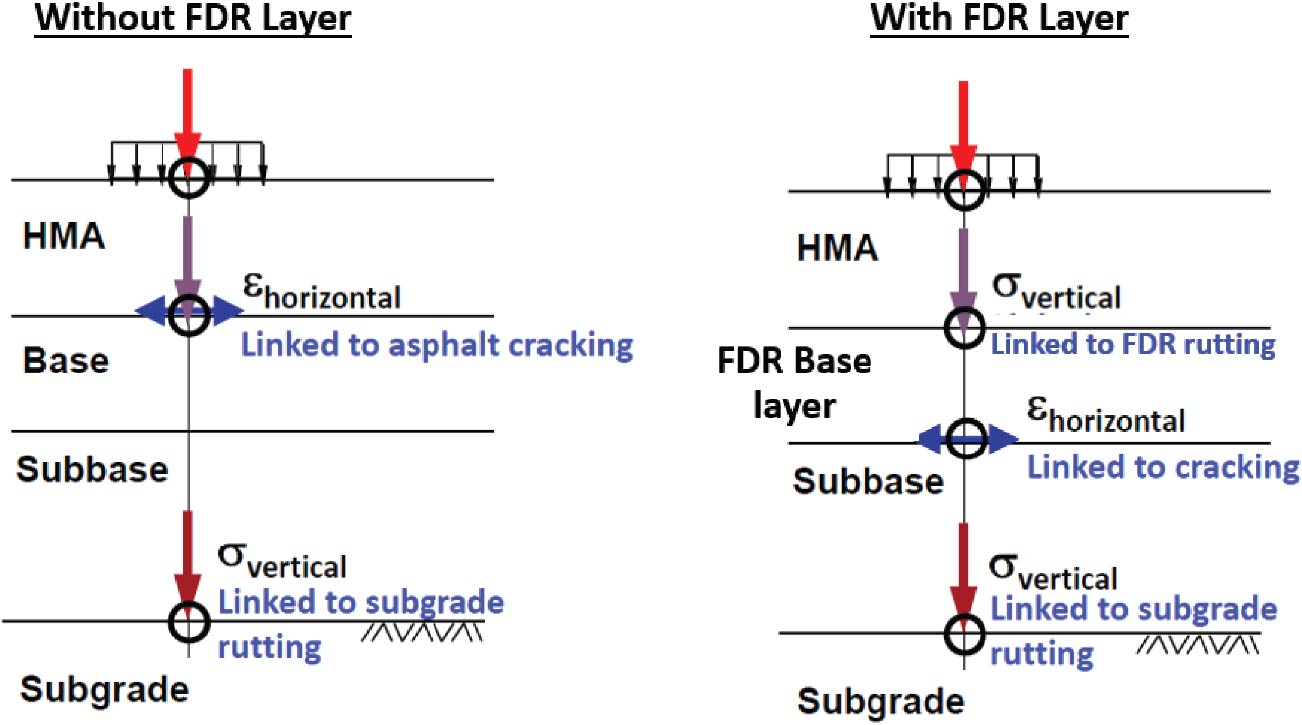
Long Description.
First part. The illustration, marked without FDR layer, shows a pavement cross-section under wheel load marked HMA, which leads to the base marked epsilon subscript horizontal (linked to asphalt cracking). Next to the base is the sub-base, which leads to subgrade marked sigma subscript vertical (linked to subgrade rutting). Second part. The illustration, marked with FDR layer, shows a pavement cross-section under wheel load marked HMA, which leads to the FDR base layer marked sigma subscript vertical (linked to FDR rutting). Next to the base is sub-base marked epsilon subscript horizontal (linked to cracking), which leads to sub-grade marked sigma subscript vertical (linked to sub-grade rutting).
developed solely for bituminous-stabilized materials (Bierman, 2018). By establishing a repeated load permanent deformation (RLPD) model and requisite E* model based on field cores, the NCHRP 09-51 study (Schwartz et al., 2017) has significantly advanced the development of design inputs. Additional investigation is, however, required to construct a comprehensive material property database for FDR materials as well as performance characteristics metrics, given the current absence of a specialized transfer function for FDR layers.
2.7 Construction Processes, Quality Assurance Procedures, and Requirements for Opening to Traffic and Surfacing
This subsection covers the detailed construction procedure for a successful FDR project and the typical equipment used for the construction of these FDR layers. Details related to existing procedures for quality control and assurance are outlined. Environmental considerations related to curing and the opening of the FDR pavement to traffic are also presented.
2.7.1 FDR Construction Process
Cutting the asphalt-bound layer with rippers mounted on motor graders or crawler tractors was a previously used method employed for reclaiming roadways. The asphalt pavement fragments generated during the ripping process were subsequently reduced in size using traversing hammer mills, grid rollers, or comparable machinery (ARRA, 2015). In recent years, numerous reclaimers used in FDR have been equipped with teeth or milling heads that can pulverize pavement materials extending beyond a depth of 12 inches into the road pavement (Owino et al., 2022). During this process, the asphalt-bound layers are pulverized and combined with the underlying granular base, sub-base, or subgrade materials. The decision regarding the proportion of granular base to mix with pulverized asphalt layers depends on several factors. These include the type and condition of the underlying subgrade soils, the use of stabilizing agents, the thickness of the asphalt layers in relation to the thickness of the granular base, subbase, or subgrade, as well as the gradation and physical properties of both the pulverized asphalt and the granular material (ARRA, 2015).
The FDR construction process must prioritize the accurate replication of the mix design established in the laboratory (Wegman et al., 2017). Although many agencies employ specific patterns
in the FDR construction process, the process generally includes pulverization, sizing through gradation, stabilization, shaping, compaction, and application of overlay or surface treatment (Le et al., 2016; Ghasemi et al., 2018). Sizing and stabilization are typically accomplished in two passes with a single-unit reclaimer. The initial pass involves pulverizing and blending the existing asphalt surface layer with the underlying base materials. This pass is followed by a second pass in which new materials or stabilizing agents are added and thoroughly mixed with the pulverized layer before being uniformly spread across the roadway surface. When multiple stabilizers are utilized in the FDR process, they are introduced in a sequential order (Stroup-Gardiner, 2011). Subsequently, the pavement together with the stabilizers is pulverized to a pre-established thickness and mixed with water extracted from a nurse truck to ensure a homogeneous mixture. Following this process, the blended material undergoes a shaping process using a motor grader to achieve the desired surface profile and is compacted to achieve the desired density. It is possible to achieve initial compaction with a sheepʼs foot roller, depending on the stabilizer and additive. Additional water may be required to supply the optimal amount of moisture for achieving the desired density (Stroup-Gardiner, 2011). An alternative construction method is the paver-laid process, enabled by advanced paving technology. Unlike the traditional reclaiming technique, the paver-laid process allows for the entire lane to be paved in a single pass, rather than requiring two passes. Additionally, this method can combine the mixing and pulverizing steps into one pass if desired. Furthermore, instead of leaving the reclaimed pavement material to be graded and compacted by motor graders and rollers, the paver-laid process directly conveys the reclaimed mixture to the paverʼs hopper, where it is precisely placed, graded, and compacted, thus eliminating the need for motor graders and pad-foot rollers (Bland and Johnson, 2021). Figure 16 illustrates the various FDR processes and a typical construction equipment train, respectively.
2.7.2 Quality Assurance Procedures
Similar to other road construction procedures, the successful execution of an FDR project necessitates adherence to two essential phases. Initial and foremost is the formulation of a comprehensive and adequate set of specifications, followed by inspections conducted throughout the construction process to verify that the intended objectives of the specifications have been realized (ARRA, 2015). High-quality materials, adequate compaction, and proper curing are among the many parameters for a successful FDR construction. These constitute the core elements of quality control and assurance procedures (Ghasemi et al. 2018). Several factors can hinder an effective FDR during the construction phase, particularly when chemical treatment or stabilization is employed. Ascertaining whether the correct amount of stabilizer is being applied, identifying environmental conditions that could hinder stabilization, and examining the FDR mixture for heterogeneity, especially with regard to varying RAP percentages, are among these factors (Scullion et al., 2012).
Numerous agencies establish specifications pertaining to the curing criteria, pulverized particle size, in-place density through compaction, and weather conditions. The degree of compaction significantly influences the rate at which strength is gained and the ultimate strength attained, and therefore the long-term effectiveness of the FDR layer. These factors will determine the load-carrying capacities and response to repeated loading of the FDR blend (ARRA, 2015). Generating a homogeneous mixture is also frequently compromised by the existence of sizable RAP particles. Many agencies typically dictate the gradation of the pulverized RAP material. In addition, agencies typically mandate that FDR be constructed during specific seasons and under specified weather conditions. This mandate ensures that construction is carried out during favorable weather conditions, which facilitate adequate curing and prevent the accumulation of excessive moisture (Ghasemi et al., 2018). As prescribed by Morian et al. (2012), it is advisable to construct an initial test section with a minimum length of 300 feet. The test section may be incorporated into
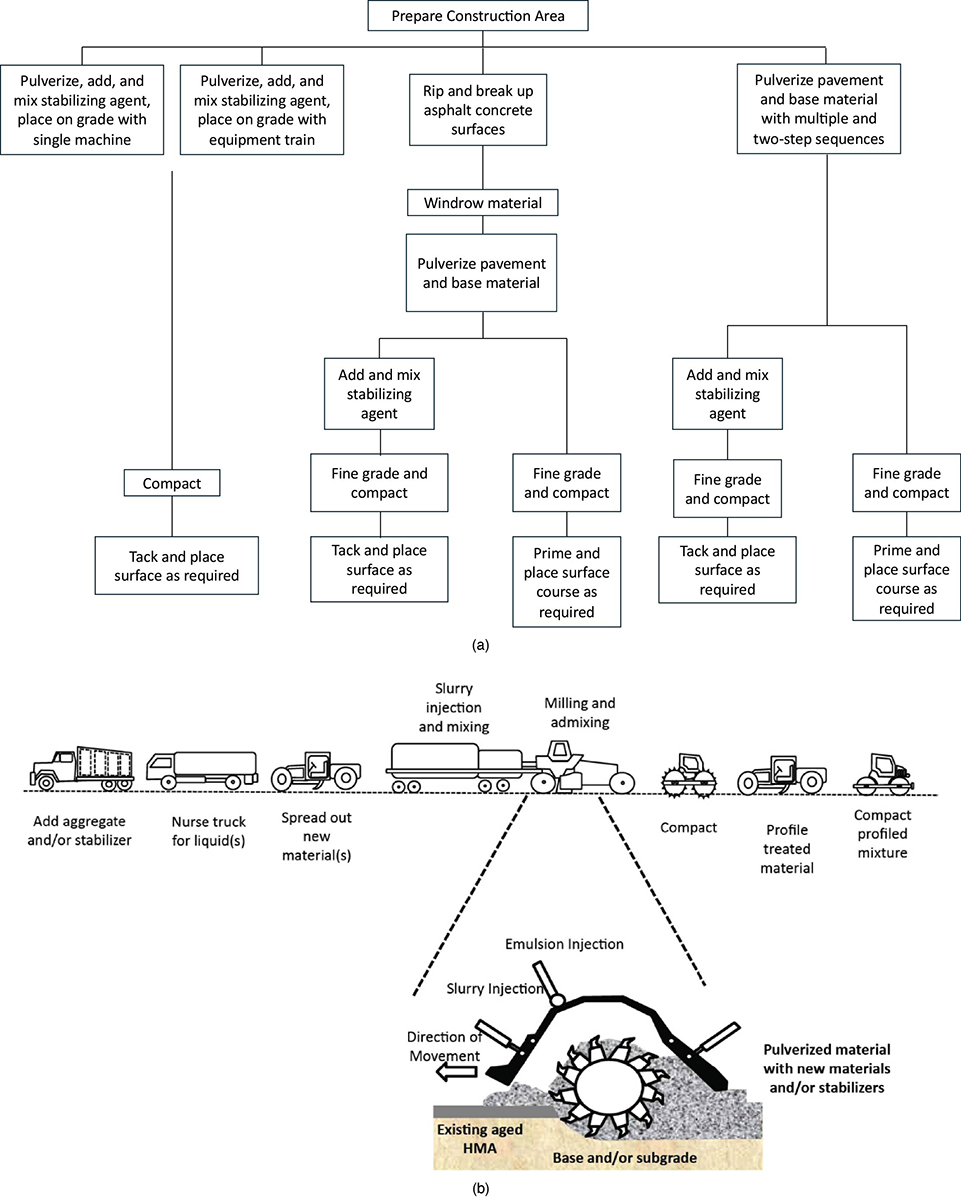
Long Description.
The steps in the process diagram from top to bottom are as follows. The preparation of the construction area leads to pulverize, add, and mix stabilizing agent, place on grade with single machine, pulverize, add, and mix stabilizing agent, place on grade with equipment train, rip and break up asphalt concrete surfaces, and pulverize pavement and base material with multiple and two-step sequences. The rip and break up asphalt concrete surfaces leads to windrow material and pulverize pavement and base material. The next level below these includes add and mix stabilizing agent, fine grade and compact, and tack and place surface course as required on the left, and fine grade and compact, and prime and place surface course as required on the right. The path on the left leads to compact, and tack and place the surface as required. The path on the right leads to add and mix stabilizing agent, fine grade and compact, Tack and place surface course as required on one side, and fine grade and compact, and prime and place surface course as required on the other side.
The illustration shows the steps from left to right as follows. Add aggregate and slash or stabilizer. Nurse truck for liquid(s). Spread out new material(s). Slurry injection and mixing. Milling and admixing. Compact. Profile treated material. Compact profiled mixture. The milling and admixing is enlarged and includes emulsion injection, slurry injection, direction of movement (with arrow), existing aged HMA, base, and slash or subgrade, and pulverized material with new materials and slash or stabilizers.
the project length or placed at a predetermined alternative location. This test section configuration is intended to
- Confirm the rates at which the stabilization material and water are applied,
- Determine an appropriate rolling pattern to compact the FDR layer,
- Validate the density attained through a nuclear density gauge or other density-measuring device,
- Ascertain the in situ moisture content of the reclaimed material, and
- Determine the in situ moisture content of the pulverized material prior to reclamation by obtaining field samples and drying them with a burner to measure and identify any moisture content deviations from the mix design condition. In accordance, the water introduced during reclamation must be modified.
A series of additional quality checks, as specified by Wegman et al. (2017), is also outlined during the construction process:
- Pre-pulverization of additional mix design components, such as aggregates for enhanced strength, onto the roadway is necessary to ensure adherence to the design specifications.
- After the introduction of the additive, the compaction process may involve using a pad-foot roller with sufficient passes, until the pad-foot indicates light contact between the compacted base and the drum.
- To eliminate pad-foot indentations and construct the correct cross-section and crown, pad-foot rolling may be followed by blading.
- Combining steel and pneumatic rollers for control strip quality control is necessary to achieve the optimal density once the cross-section and crown have been determined.
- When the thicknesses of the pavement or base layer vary throughout the project, ground-penetrating radar (GPR) data can be of great assistance in ensuring accurate proportioning by providing direction for pre-milling or modifying the depth of the reclaimer.
- As specified in the design and for the support of construction equipment, it is essential to inspect and adjust the moisture content to an ideal level.
- To ensure the equipment is set up effectively, yield and depth checks may be executed at necessary intervals.
- During the compaction process, water may be applied to the surface to ensure a more uniform cure and enhance the results.
NCHRP Project 9-60 (Diefenderfer et al., 2021) also provides guidance for process control and acceptance of FDR construction processes. The study developed and suggested using shear and raveling tests to quantify the time needed before opening a recycled layer to traffic or surfacing it. Specifically, the long-pin shear test (measuring the number of blows and torque) was suggested for determining the time to surface the layer, while the short-pin raveling test was proposed for determining when traffic can be allowed. Threshold values for these tests were developed based on statistical analysis, with the suggestion that these tests be applied only to recycled layers thicker than 3 inches.
2.7.3 Requirements for Opening to Traffic and Surfacing
For an FDR layer to attain appreciable strength prior to trafficking and or overlay application, proper curing is required (Ghasemi et al., 2018). The FDR rehabilitation process typically involves recycling the roadway in half-widths, while stop-and-go controls are implemented on the adjacent half to facilitate unidirectional traffic (Asphalt Academy, 2020). Asphalt emulsion-treated FDR requires extra time before traffic may be allowed, since the increase in density upon compaction does not provide adequate protection against traffic damage. Resistance to traffic damage necessitates an increase in cohesion and is determined by the time it takes for the bituminous emulsion
to break and cure. Reeder et al. (2017) specify in their study that low-speed local traffic can traverse a completed cement-treated FDR base almost immediately, provided that the base possesses adequate stability to sustain permanent deformation or marring caused by traffic loads. It was also suggested that the FDR layer be allowed to cure for 2 days prior to applying the surface course, as this provides sufficient time for the cement-treated FDR layer to be inspected for isolated soft areas and, if present, rectified before the surface layer is applied. Diefenderfer et al. (2020), based on the NCHRP 9-62 study, devised rapid tests to determine the appropriate level of curing and the time required for traffic opening. These tests include stiffness, penetration, shear, and raveling resistance. These tests are generally able to capture the curing time for the CR mixes, in this case, FDR, as demonstrated in the study. Specifically, the most sensitive tests to the level of curing were the penetration resistance tests, which included the Marshall hammer, DCP, and the number of blows from the long-pin shear and short-pin raveling tests.
2.8 Performance of FDR Projects
The performance differences among various stabilizing techniques for FDR remain a subject of discussion, given the wide adoption of quality construction procedures. To provide context, chemical stabilizers are commonly added to FDR to enhance early strength, increase resistance to moisture damage, and potentially serve other purposes. However, it remains uncertain whether these chemical stabilizers have a positive impact on the long-term performance of FDR pavements (Schwartz et al., 2017). A significant number of agencies have reported positive results from the performance tracking of various stabilized FDR pavements. Details regarding the performance of FDR from various states are discussed in this section.
2.8.1 Mechanically Stabilized and Non-Stabilized FDR
In a study by Jones et al. (2016), two tests were conducted under wet and dry conditions on low-volume roads that were rehabilitated using FDR without the addition of stabilizer. By simulating a worst-case scenario, the wet test highlighted the criticality of drainage in road design. The dry test exhibited better performance in all respects over the wet test, as evidenced by the 13 mm rutting depth observed after 500,000 ESALs as opposed to 165,000 ESALs in the wet test. Rutting in the dry test consisted primarily of downward compression, whereas both compression and displacement were observed in the wet test, indicating base failure. During the dry test, no cracking was detected; however, during the wet test, significant deformation and fatigue cracking were observed. The stiffness measurements in the two studies were comparable. For low-volume distressed roads with a design life of up to 500,000 ESALs, FDR without stabilizer, followed by an appropriate surface treatment, is a viable and potentially cost-effective strategy as suggested by the study. Poor performance in extremely wet conditions, however, emphasizes the importance of adequate drainage.
A study by Bradshaw et al. (2016) investigated the resilient moduli of RAP and virgin aggregate blends from a Rhode Island site, including cold recycled RAP blends prepared off-site and in situ RAP blends from FDR. Cyclic triaxial tests were conducted on reconstituted specimens, compacted at the optimum moisture content (OMC) to at least 95% of the maximum dry density. A three-parameter material model was used to fit the laboratory test data and interpret the Mr, which was then validated using the Mechanistic-Empirical Pavement Design Guide (MEPDG). The Mr values for cold recycled RAP blends (14%–39% RAP content) ranged from 120 to 502 MPa, with minimal shear softening or hardening, while untreated FDR RAP blends (57%–71% RAP content) exhibited higher Mr values (171 to 578 MPa) but with more significant shear softening and permanent strains compared to cold recycled RAP blends.
2.8.2 Chemically Stabilized FDR
FDR with cement has been successfully utilized on pavement projects for over three decades (Reeder et al., 2017). A 10- to 15-year performance evaluation of FDR projects in Nevada indicated positive performance outcomes. The FDR projects utilized 2%–3% Portland cement as a stabilizing agent in cases where a soft subgrade was identified. The cause of longitudinal cracking on one of the projects was attributed to the asphalt surface rather than the FDR treatment. Over the 10- to 15-year span, most projects performed satisfactorily, except for a few instances of transverse or fatigue cracking. Pavements older than 15 years have either undergone rehabilitation or experienced reflective cracking (Bemanian et al., 2006). Wen et al. (2004) conducted a study in which Class C fly ash was employed as a stabilizing agent on an FDR section located in Wisconsin. The performance of the pavement was assessed utilizing the FWD test both after construction and 1 year after construction. Compared to 2001, the corrected deflections of the pavement in 2002 were considerably reduced. The modulus of the fly ash–stabilized FDR base course exhibited a 49% increase from 1.24 GPa to 1.84 GPa in 2002, as compared to the results in 2001. The pavement section yielded a structural coefficient of 0.16 at the time of testing in 2001, which increased to 0.23 in 2002. An increase in the layer coefficient signifies an enhancement in the FDR layerʼs structural capability. The observed increase is hypothesized to be the consequence of a prolonged pozzolanic reaction occurring in the mixtures that incorporate Class C fly ash. The pavement experienced no distress within 2 years of its construction.
According to another study by Jones et al. (2015), the measured and back-calculated stiffness values of a Portland cement–treated FDR section were substantially greater than those of a non-stabilized FDR section. Despite experiencing over 37 million additional ESALs, the recycled layer on the FDR section treated with Portland cement experienced its rigidity degrading significantly after trafficking. Nonetheless, the rigidity remained orders of magnitude greater than that of the non-stabilized FDR section. Additionally, the deflection at the base of the Portland cement–treated FDR section was found to be roughly equivalent to that at the base of the non-stabilized FDR section after 490,000 ESALs, following testing completion (43.3 million ESALs). Conversely, both sections experienced no cracking, and the Portland cement–treated FDR section exhibited a marginally greater rate of change in deflection, which is consistent with the behavior of cement-containing stabilized layers. Howard and Cox (2016) in their study of a cement-stabilized FDR on a heavily trafficked segment of US-49 containing substantial quantities of fines and nominal layer depths of 16 inches, observed that the representative modulus and UCS values were approximately 200,000 and 400 psi, respectively, after 53 months of service (500:1 ratio). The (1,200:1) MEPDG Level 2 ratio is undervalued based on this and may result in improperly designed FDR layers due to an overestimation of the modulus value. The average FDR layer coefficient was 0.36, with a range of 0.28 to 0.43. The layer coefficient value of 0.30 for the 1993 Guide, which the authors suggest, appears reasonable and perhaps slightly conservative in light of the overall range and literature review. Kwon et al. (2021) conducted a mechanistic sensitivity analysis that highlighted the significant impact of the stiffness and thickness of the FDR base layer on pavement performance. Increasing the FDR modulus and thickness reduces tensile strain at the bottom of the asphalt concrete, mitigating fatigue cracking concerns. It was indicated that the high-strength FDR base acts similarly to a non-reinforced concrete slab, suggesting that surface asphalt, together with the FDR base, can be utilized as an asphalt overlay on concrete pavement prone to reflective cracking. Similarly, Diefenderfer et al. (2023) evaluated the structural performance of a pavement section on I-64 in Virginia that consisted of a cement-treated FDR and Cold Central Plant Recycling (CCPR) layer. This work credited the FDR layer with controlling strain in the asphalt layers, yielding a low-strain pavement that would likely demonstrate perpetual behavior. It was also indicated that recycling techniques can be utilized in high-traffic locations by employing a structural design similar to the I-64 segment 2 section.
The performance of a cement-stabilized FDR on US-75 in Kansas, constructed in 2012, was assessed by King and Akakin (2023) as part of a study on nine concrete overlays on FDR sections. It was found to be exceptionally smooth from the outset due to the initial diamond grinding. This smoothness has also persisted with minimal average faulting values, as indicated by automated pavement condition data, and has not experienced any notable distress as of 2022. Shepard et al. (1991) also evaluated the impact of calcium chloride in a low-volume FDR structure compared to a control structure with no additive. FWD deflections revealed an overall increase in pavement strength from 3.4% to 15.1% over the 12-month assessment period.
2.8.3 Bituminous-Stabilized FDR
Three engineered emulsion (EE) FDR sections (Cells 2, 3, and 4) constructed on I-94 in 2008 at the Minnesota Road Research Facility were analyzed by Johanneck and Dai (2013). Each test section was constructed to accommodate 3.5 million ESALs. As of June 30, 2012, approximately 2.2 million ESALs had been subjected to these sections, surpassing 60% of the intended design. Different concentrations of emulsion were used for the FDR layers. Stabilizing agents (EE) of 4%, 3%, and 0.75% were applied to the FDR layers of Cells 2, 3, and 4, respectively. The strain responses of the hot mix asphalt (HMA) and stabilized full-depth reclamation (SFDR) layers at their base were assessed utilizing strain sensors. The obtained data demonstrated that the bottom of both the HMA and FDR layers experienced tensile strain. Notably, the tensile strains under the FDR layers were considerably higher than those beneath the HMA layers. This discrepancy suggests that the stabilized layer effectively transmitted strain to a profound extent within the pavement structure. As indicated by Blumen Stress Analysis in Roads simulations, the horizontal strains encountered beneath the HMA layer were roughly 50% reduced in comparison to an HMA placed over a pavement structure with a granular base. Performance could potentially be enhanced, and service life could be prolonged, due to this decrease in tensile strain. Field measurements of rutting, fracture, and International Roughness Index (IRI) indicated that the performance of test sections was satisfactory. There was no observation of cracking in Cells 2 and 4. Cell 3 featured a single crack, presumably originating from the shoulder. No thermal crack was detected. Cell 4 rutting measurements were 0.3 inches, while those for Cells 2 and 3 were 0.27 inches, following approximately 60% of the design life. Field measurements closely matched the predictions of DARWin-M-E rutting and IRI when project-specific inputs were utilized. In summary, the findings suggest that the implementation of FDR improved pavement performance and reduced tensile strains in HMA, compared to the traditional configuration of HMA supported by a granular base (Vrtis, 2023). As of February 2019, the cumulative number of ESALs for the sections had surpassed 8.5 million, which was a substantial increase compared to their intended ESALs. All cells had a Pavement Condition Index of “Good” (>85) after 7 years of service.
Another study, conducted by Lane and Kazmierowski (2012) in Ontario, Canada, focused on a foamed asphalt FDR project on Highway 17. The project resulted in a smooth, hard, and uniform surface suitable for temporary traffic, providing an excellent base for HMA paving operations. Over a 10-year period, surveys and pavement distress data showed that the foamed asphalt FDR section maintained a smooth surface (IRI < 1) and remained in excellent condition [Pavement Condition Index (PCI) > 85], indicating successful long-term performance. Three mix designs, including two with corrective aggregate and one without, performed similarly over the 10 years. A control section of FDR with an 80 mm HMA overlay initially had similar IRI performance but deteriorated at a faster rate. Comparisons with other projects along the same highway revealed that the foamed asphalt FDR section outperformed both a CIR project with a 50 mm HMA overlay constructed in 1999 and an FDR project with a 120 mm HMA overlay constructed in 1998. In terms of pavement roughness and condition, the foamed asphalt FDR section performed significantly better than the adjacent CIR and mechanically treated FDR sections. Additionally,
it performed similarly to the FDR with 120 mm of HMA, which is a more expensive and less environmentally friendly treatment than the foamed asphalt FDR with an 80 mm hot mix asphalt overlay. The foamed asphalt FDR section also outperformed the average FDR project according to Ontarioʼs ministry-established IRI and PCI performance curves for FDR with HMA overlay. The study concludes that foamed asphalt FDR stabilization provides an effective in-place recycling rehabilitation strategy that conserves natural resources and offers an economical alternative to conventional FDR methods.
2.8.4 Life Cycle Cost Analysis and Life Cycle Assessment of FDR Projects
Agencies are increasingly considering sustainable solutions as they decide on roadway rehabilitation strategies. The overarching objective of these approaches is to proactively incorporate critical environmental and economic factors into the decision-making process. The economic component has been the primary decision factor for many years. However, in recent years, the environmental component has begun to arise more frequently, despite the present limitations associated with its measurement and assessment. An underlying premise of life cycle cost analysis (LCCA) is that the benefits of the alternatives under consideration are equivalent; therefore, only costs (or differential costs) must be taken into account. On the other hand, life cycle assessment (LCA) offers a comprehensive method for assessing the total environmental impact by analyzing all inputs and outputs throughout the life cycle, from construction to the end of life. This systematic approach identifies the most pertinent impacts and the most significant enhancements that can be made while also identifying potential trade-offs (Harvey et al., 2016). A typical life cycle assessment framework is depicted in Figure 17.
FDR, which reuses existing materials, is economically logical given that a century of urbanization and development in the United States has severely depleted aggregate supplies. The problem is further exacerbated as the reconstruction of Americaʼs deteriorating infrastructure coincides with the scarcity of valuable resources. Traditional remove-and-replace roadway construction methods necessitate the transportation of the existing bitumen and base materials off-site, in addition to the extraction of aggregates. In addition to incurring high transportation expenses, the accumulation of materials that could be recycled on-site occupies valuable stockpile space (Reeder et al., 2017).
Long Description.
The elements are as follows.
- Goal Definition and Scope. Key steps include goal and system boundary definition, essentially, what can be left out of the LCA?
- Life Cycle Inventory Assessment. The accounting stage. Where we track all the inputs and outputs from the system.
- Impact Assessment. Where we translate the inventory into meaningful environmental and health indicators.
- Interpretation. Where the results of the impact assessment are related back to the questions asked in the Goal.
The service life of a properly constructed FDR road ranges from 7 to 20 years (Maher et al., 2005; Wu et al., 2010; Ghasemi et al., 2018). FDR material and installation costs are dependent on the FDR thickness and type of stabilization, ranging between $4 and $7 per 15 square meters (Federal Lands Highway Division of the FHWA, 2005).
Diefenderfer and Apeagyei (2011) compared the life cycle costs of stabilized FDR and a conventional mill and overlay method over 50 years. For two hypothetical road sections, a series of 2- or 4-inch overlay treatments was planned using conventional mill and overlay methods, while a stabilized FDR with a 3-inch overlay treatment was intended. The treatment schedule and cost were based on the Virginia Department of Transportationʼs (VDOT) experience. According to the results, the life cycle maintenance cost of a road constructed using FDR is approximately 16% less than that of a road constructed using the conventional overlay method. Specifically, the prospective savings for the primary network and secondary network would be approximately $10 million and $30.5 million, respectively, over the 50-year life cycle. A study conducted by Evers and Torres-Machi (2024) measured the effects that enhanced precision in deterioration modeling has on relevant indicators used in pavement asset management. The research investigated the effectiveness of pavements that underwent FDR. To forecast roughness, rutting, and fatigue cracking, random forest models were developed. A comparison was made between the random forest models and M-E models tailored to the same sites to quantify disparities in long-term performance, useful life, and life cycle costs. In comparison to the proposed random forest model, the M-E design undervalues the value of FDR by 44%, according to the life cycle cost analysis. Additionally, the study suggested that by scheduling treatment applications using random forest predictions, maintenance expenses could be decreased by 6.5%. In another study by Kedarisetty et al. (2023), LCCA was conducted for pavement rehabilitation on State Routes 113 and 84 in California, comparing FDR with cement stabilization (FDR-C) and HMA reconstruction. The study used both deterministic and probabilistic approaches, including Monte Carlo simulations, to evaluate costs. For Route 113, FDR-C was about 22.5% less expensive overall compared to HMA reconstruction, with agency costs 35% lower and road user delay costs similar. The CalME design method further reduced FDR-C costs by about 50% for agency expenses and 10% for road user delays. On Route 84, FDR-C was roughly 18% cheaper overall than HMA, with a 22% reduction in agency costs and one-third less road user delay costs. The impact of construction work zone delays was minimal on Route 84 due to its low traffic volume.
2.9 Summary
A summary of the findings from the literature review conducted regarding the state of the practice and state of the art of FDR is presented in the next sections, organized by the various topics covered.
2.9.1 Project Selection, Benefits, and Limitations
FDR is a valuable technique for rehabilitating deteriorating roadways, offering environmental benefits and cost-effectiveness. Gathering information about the existing pavement condition, traffic levels, and conducting in situ testing is crucial for implementing a successful FDR project. Several factors influence FDR suitability, including material composition, environmental considerations, expected traffic, and road geometry. Pavement distresses suitable for FDR include cracking, rutting, ride quality issues, potholes, shoulder drop-off, inadequate structural capacity, and subgrade instability. In addition, weak subgrades may require removal or stabilization. FDR can also be cost-effective for roads with heavier traffic loads and is suitable for various projects, such as airports, highways, and parking lots. An additional benefit of utilizing FDR is its potential for 25-year durability. FDR effectively expands the life of roadways at a significantly reduced
cost compared to other available rehabilitation approaches. However, limitations include the absence of a standardized mix design, varying laboratory practices, and concerns about durability and subgrade support during construction. Table 5 provides a summary of the benefits and limitations of FDR utilization in relation to other rehabilitation techniques.
2.9.2 Properties and Characterization Methods of FDR
Challenges arise in measuring the structural properties of FDR due to the complexities of replicating field mixing, compaction, and curing conditions in laboratory settings. The effectiveness of FDR is influenced by various properties, including density, which affect particle interactions and void reduction, ultimately impacting strength and durability. Adequate compaction at the point of maximum density and optimum moisture is crucial for optimal FDR performance. In addition, the characterization methods for FDR materials for pavement design and performance evaluation vary, and these methods are still under exploration, with lingering questions regarding their fundamental, engineering, and empirical characteristics. Stiffness metrics are vital in flexible pavement design, as density and stabilizer type significantly influence stiffness magnitudes. Strength characteristics in FDR with stabilizers depend on factors such as stabilizer quantity, constituent material nature, density, and curing rate, with compaction level significantly influencing material strength. Permeability, controlled by the mix proportion and compaction during construction, plays a role in enhancing the FDR layerʼs resilience to damage from freeze-thaw cycles and in providing improved load support compared to an unsaturated granular base without stabilization.
Characterization methods for FDR materials in pavement design and performance evaluation are currently diverse and under exploration, lacking a unified approach. Questions persist about the fundamental, engineering, and empirical characteristics of these materials. Table 6 provides a summary of the current characterization methods for FDR, as reported in the literature and practice.
2.9.3 Stabilization Additives
The initial utilization of FDR can be traced back to the 1910s. Both bituminous and chemical stabilizers are widely used for FDR stabilization. Lime, fly ash, kiln dust, Portland cement, and calcium chloride have also been integrated as effective stabilizers for FDR (Morian et al., 2012),
Benefits |
Limitations |
|---|---|
Materials and energy conservation is achieved, while air quality issues caused by dust, fumes, and smoke are eradicated. |
Additional effort may be necessary to address subgrade issues. |
The process can rectify pavement deterioration by achieving the desired profile, eliminating wheel ruts, restoring crown and slope, and addressing issues such as potholes, irregularities, and rough areas. |
Certain shrinkage cracks may become visible on the bituminous surface. |
For most projects, just a thin overlay or chip seal surfacing is needed, and the production cost is minimal. |
The duration of the curing period necessary before allowing traffic is currently unknown, as premature trafficking can result in the formation of permanent deformation during the early stages of its lifespan. |
The construction cycle is rapid, resulting in minimal traffic disruption. |
The lack of a universally accepted mix design approach is a limiting factor in its implementation. |
Rain has minimal impact on the construction schedule of FDR. Additionally, the FDR process itself creates a base that is resistant to moisture and frost action. |
Due to the effects of rainfall and high humidity on the curing process, construction is preferred during warm and dry weather conditions. |
as well as proprietary products (Ghasemi et al., 2018). In a past survey by Owino et al. (2022), a higher proportion of respondents indicated that Portland cement was their preferred stabilizing agent. While some agencies have limited experience with using Portland cement as a stabilizer for FDR, others prefer it due to its versatility in stabilizing various soil types within their respective states. Additionally, its straightforward application during construction contributes to its popularity. Substandard fly ash has also proved effective in FDR and is considered not to be a hazardous waste when utilized in FDR (Dillon et al., 2015). Calcium chloride, on the other hand, offers reduced freeze-thaw susceptibility in FDR-constructed layers (Shepard et al., 1991).
Agencies generally have differing guidelines regarding the selection of the most suitable stabilizing method. Adhering to these guidelines and laboratory testing protocols to ascertain the appropriateness of the stabilizing agent, given the current state of the road and anticipated future road usage, can optimize resource utilization for FDR. The optimal performance of an FDR layer is highly dependent on the stabilizing agent selected. In addition to influencing the structural capacity of the rehabilitated pavement, the stabilization agent also affects its mechanical properties, expected lifespan, and, most significantly, rehabilitation costs (Owino et al., 2022).
2.9.4 Mix Design Process
Mix designs serve to assess the appropriateness of chosen materials for FDR treatment. These additions may consist of stabilizers, aggregates, or both. These designs are an essential component of the pavement investigation and design process. They are used to determine the most efficient means of treating materials to enhance their engineering properties (Wirtgen, 2012). Currently, a universally recognized laboratory mix design method for FDR and CR does not exist. Recent developments include the AASHTO R 109 for emulsified asphalt FDR mix design and AASHTO M 347 for materials utilized in the emulsified asphalt FDR design. The FDR mixture preparation process typically involves combining materials, followed by compaction and curing, using various equipment and techniques, which include vibratory, Marshall hammer, gyratory, and modified Proctor compaction, adhering to standards such as AASHTO PP 86 and PP 94. The curing process aims to replicate the field conditions necessary for strength development. It can be time-based, moisture content-based, or a combination, typically lasting between 3 days and 2 weeks or achieving a moisture content of 1% to 2.5%. Laboratory simulations are also employed to reflect actual field conditions effectively. Strength gain in a range that provides increased strength and stability without producing a stiff and brittle composite that can cause cracking of the overlying pavement surface is typically evaluated using the unconfined compressive strength of the cured samples for chemical stabilization. To ensure the thermal fracture resistance and long-term performance of the stabilized layer, the mix design procedure for bituminous stabilization must consider both short-term and long-term strength (Wegman et al., 2017).
2.9.5 Structural Design
The integration of the investigation and design phases is crucial, as it enables a comprehensive understanding of the existing pavementʼs behavior. Identifying the most economically viable pavement design that meets expectations in terms of functionality and design life, while also reducing the need for costly maintenance interventions, is also essential. Additionally, the design needs to produce a pavement that can be rehabilitated at a minimal cost at the end of its designated life. The structural design of FDR pavements is crucial in ensuring they can endure traffic loads and environmental conditions over their lifespan. Key distresses, including rutting, fatigue cracking, and moisture susceptibility, must be considered, with rutting being influenced by the materialʼs shear properties and densification. Moisture susceptibility can reduce layer strength and accelerate damage, especially under freezing conditions. The most commonly utilized structural design methods for FDR pavements are the AASHTO empirical design method and the M-E design method. The AASHTO design method, which uses the SN to account for drainage and layer-specific contributions, has limitations due to its reliance on empirical data. In contrast, the M-E approach offers a more comprehensive analysis by integrating mechanical modeling and performance predictions, making it particularly suitable for non-standard materials like those in recycled pavements. However, the development of transfer functions specific to FDR pavements is still limited. Current practices often apply functions designed for conventional asphalt layers, such as those used in the California ME Pavement Design Program. Further research is needed to develop a specialized database and transfer functions tailored to FDR materials, taking cues from developments such as the RLPD and E* database from the NCHRP 09-51 study, as well as transfer functions developed for recycled layers in the South African guides.
2.9.6 Construction Processes, Quality Assurance Procedures, and Requirements for Opening to Traffic and Surfacing
The construction process of FDR comprises specific procedures, including pulverization, sizing and grading, stabilization, shaping, and compaction. Following these, quality assurance inspections become necessary for material quality, compaction, and curing, as well as adherence
to specifications. Complications may arise during chemical stabilization, necessitating careful assessment of stabilizer application, environmental conditions, and mixture homogeneity. The effectiveness of FDR is influenced by variables such as degree of compaction, RAP particle size, and construction season. It is also advisable to establish an initial test section for a range of evaluations, such as moisture content and stabilization rates. Further quality assurance measures implemented during construction include the pre-pulverization of mix components and the use of NDG data to ensure appropriate compaction procedures are followed. The concluding stage pertains to the stipulations concerning allowing traffic and surfacing. Bituminous-stabilized FDR reduces delays and permits immediate traffic in a few cases. Traffic can be permitted on asphalt emulsion-treated FDR only after sufficient curing has been satisfied. Foamed asphalt-treated FDR, on the other hand, instantaneously permits low-speed traffic. For cement-treated FDR, crews are advised to allow the layer to cure for 2 days prior to applying the surface course, in order to inspect and address any areas of weakness.
2.9.7 Performance of FDR
The performance disparities among different stabilizing techniques in FDR continue to be debated, despite the widespread implementation of high-quality construction procedures. Ongoing discussions persist regarding the effectiveness of various stabilization methods in FDR projects. Table 7 summarizes the performance of FDR projects based on the various stabilization techniques.
Agencies are increasingly turning to sustainable solutions for roadway rehabilitation. The primary goal of these solutions is to integrate environmental and economic factors into the decision-making process. Historically, economic considerations have dominated, but environmental aspects are now increasingly considered, despite measurement challenges. LCCA focuses on cost comparisons under the assumption of equivalent benefits, while LCA comprehensively evaluates environmental impacts from construction to end of life, identifying key impacts, improvements, and potential trade-offs. FDR is gaining popularity due to its economic and environmental advantages. FDR, which reuses existing materials, is seen as a logical choice in the face of dwindling aggregate supplies caused by a century of urbanization. Properly constructed FDR roads have a service life ranging from 7 to 20 years, and the material and installation costs for FDR are estimated to be between $4 and $7 per 15 square meters. Life cycle cost analyses comparing FDR to conventional overlay methods indicate a potential 16% reduction in maintenance costs for roads constructed using FDR over 50 years. Recent research also suggests that enhanced precision in deterioration modeling, particularly with random forest models, can undervalue the benefits of FDR by 44%, highlighting the potential for decreased maintenance expenses by 6.5% when treatment applications are scheduled based on random forest predictions.
References |
Stabilization approach |
Major Findings |
|---|---|---|
Non- Stabilized |
Wet and dry tests were conducted to simulate worst-case scenarios on low- volume roads rehabilitated using FDR without stabilizer. The dry test exhibited superior performance with minimal rutting and no cracking, even after 500,000 ESALs, while the wet test showed significant deformation, fatigue cracking, and base failure after 165,000 ESALs. Despite comparable stiffness measurements, the study suggests that FDR without a stabilizer, followed by proper surface treatment, is a viable and potentially cost-effective strategy for distressed low-volume roads, while further emphasizing the critical role of drainage in wet conditions. |
|
Mechanical Stabilization |
The study investigates the resilient moduli of reclaimed asphalt pavement (RAP) and virgin aggregate blends from Route 165 in Rhode Island, comparing off-site cold recycled RAP blends with in situ full-depth reclamation (FDR) RAP blends. Cyclic triaxial tests revealed resilient modulus (Mr) values ranging from 120 to 502 MPa for untreated cold recycled RAP blends and 171 to 578 MPa for untreated FDR RAP blends, with more significant shear softening and permanent strains compared to cold recycled RAP blends. |
|
Chemical Stabilization |
A 10- to 15-year performance assessment of FDR projects in Nevada demonstrated overall positive outcomes, with satisfactory performance observed in the majority of projects utilizing 2%–3% Portland cement as a stabilizing agent for soft subgrades. The occurrence of longitudinal cracking in one project was attributed to the asphalt surface rather than the SFDR treatment, but most projects performed well, with few instances of transverse or fatigue cracking noted over the evaluated period. |
|
The study conducted a mechanistic sensitivity analysis demonstrating that the stiffness and thickness of the FDR base layer significantly influence pavement performance. Increasing the FDR modulus and thickness reduces tensile strain at the bottom of the asphalt concrete, alleviating fatigue cracking concerns. The study suggests that a high-strength FDR base functions similarly to a non-reinforced concrete slab, making the surface asphalt and FDR layer suitable as an overlay on concrete pavement prone to reflective cracks. |
||
The structural performance of a pavement section on I-64 in Virginia, featuring a cement-treated FDR and CCPR layer, highlights that the FDR layer effectively controls strain in the asphalt layers, potentially leading to perpetual pavement behavior. The study suggested that recycling techniques could be used in high-traffic areas by adopting a structural design similar to the I-64 segment 2 section. |
||
Class C fly ash was used as a stabilizing agent on an FDR section in Wisconsin and demonstrated positive performance. The corrected deflections of the pavement were significantly reduced 1 year after construction, and the fly ash-stabilized FDR base course exhibited a 49% increase in modulus, indicating improved structural capability attributed to a prolonged pozzolanic reaction. |
||
The performance evaluation of a cement-stabilized FDR on US-75 in Kansas, constructed in 2012, revealed that the pavement exhibited exceptional smoothness from the time of construction, attributed to the initial diamond grinding. The ongoing assessment, utilizing automated pavement condition data, indicated minimal average faulting values. As of 2022, the pavement has not shown any significant signs of distress. |
||
The impact of calcium chloride in a low-volume FDR structure was evaluated against a control structure with no additives. Falling weight deflectometer (FWD) deflections indicated an overall increase in pavement strength, ranging from 3.4% to 15.1%, over a 12-month assessment period. |
||
Bituminous Stabilization |
Three engineered emulsion (EE) FDR sections on I-94 in Minnesota, constructed in 2008 and designed for 3.5 million ESALs were analyzed with different concentrations of emulsion (4%, 3%, and 0.75%) utilized on the FDR layers. Strain sensor assessments revealed higher tensile strains under the FDR layers compared to HMA layers, suggesting effective strain transmission within the pavement structure. Field measurements over 7 years demonstrated satisfactory performance, with minimal cracking and rutting below design limits, supporting the conclusion that FDR implementation improved pavement performance and reduced tensile strains in HMA layers. |
|
A foamed asphalt FDR on Highway 17 in Ontario, Canada, revealed a smooth and durable surface suitable for temporary traffic and HMA paving operations. Over a 10-year period, the foamed asphalt FDR section exhibited excellent long-term performance, outperforming other treatments, including CIR and FDR with HMA overlay, and offering a cost-effective and environmentally friendly alternative to conventional FDR methods. |


