New Rapid Expert Consultation Offers Strategies for Navigating Disaster Response, Evacuation, and Sheltering Complicated by COVID-19
News Release
By Megan Lowry
Last update February 23, 2021
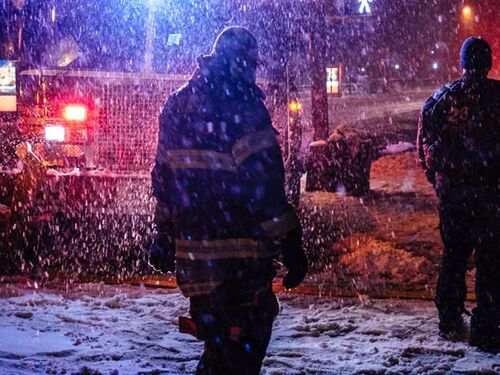
WASHINGTON — A new rapid expert consultation from the National Academies of Sciences, Engineering, and Medicine identifies strategies for emergency planners and decision-makers to consider as they update their disaster plans for evacuation, sheltering, and mass care amid COVID-19.
Even as vaccination programs ramp up, their slow pace means disaster responses will need to continue to take the virus’s spread and impact into account throughout 2021’s snowstorms, flooding, earthquakes, and other emergencies, says Emergency Evacuation and Sheltering During the COVID-19 Pandemic.
Evacuation
The risk of COVID-19 can make traditional evacuation plans unsafe. For example, last-minute mass evacuations because of wildfire can lead to crowding along evacuation routes, increasing the risk of transmission at rest stops or restaurants. The National Academies’ consultation says disaster preparedness planners can start by evaluating the specific support needs of their community, reconfiguring transportation planning to reduce viral transmission, and updating evacuation communications to take the virus and public health guidance into account. For instance, emergency management personnel need to consider explicitly communicating when a disaster such as a hurricane is more immediately life-threatening than possible COVID-19 exposure. Planners also should anticipate delayed evacuation as people weigh their personal risks of COVID-19 exposure against the disaster at hand and factor this delay into their plans.
Sheltering and Mass Care
Sheltering and mass care during disasters will be complicated by the need to physically distance and follow other COVID-19 prevention measures. The consultation says enhancing shelter capacity in vulnerable communities, increasing the number of shelters by using nontraditional spaces such as college dormitories and campgrounds, and increasing personnel and modifying their training are all strategies to consider. Introducing new shelter safety measures consistent with Centers for Disease Control and Prevention and American Red Cross guidelines can also reduce the risk of COVID-19 spread. Working with local organizations can unlock alternate shelter options and in-kind donations, and increase the likelihood that COVID-19 safety protocols will be followed during emergencies.
Risk Communication
The consultation says the public’s willingness to follow evacuation orders and public health guidance simultaneously is critical for both reducing disaster impacts and limiting the spread of COVID-19. Effective risk communication strategies — such as giving as much advance warning as possible or using trusted community messengers — can play a key role in helping people make good choices and remain safe during disasters.
Undertaken by the Societal Experts Action Network (SEAN), Emergency Evacuation and Sheltering During the COVID-19 Pandemic was sponsored by the National Science Foundation and the Alfred P. Sloan Foundation. The Natural Hazards Center at the University of Colorado, Boulder, with support from the Alfred P. Sloan Foundation, substantially contributed to this guidance. SEAN is affiliated with the National Academies’ Standing Committee on Emerging Infectious Diseases and 21st Century Health Threats. The National Academies are private, nonprofit institutions that provide independent, objective analysis and advice to the nation to solve complex problems and inform public policy decisions related to science, technology, and medicine. They operate under an 1863 congressional charter to the National Academy of Sciences, signed by President Lincoln.
Contact:
Megan Lowry, Media Officer
Office of News and Public Information
202-334-2138; e-mail news@nas.edu
Featured Publication
Emergency Evacuation and Sheltering During the COVID-19 Pandemic
Rapid Expert Consultation
·2021
Fundamental shifts in preparedness planning are needed to ensure health, safety, and smooth operations during emergencies in the context of the COVID-19 pandemic. To prepare for emergency events requiring evacuation, it is necessary to revise shelter planning and mass care operations, shelter staffi...
View details