ACRP University Design Competition Winner's Unrelentless Pursuit Leads to Artemis II
Update
Last update June 5, 2026
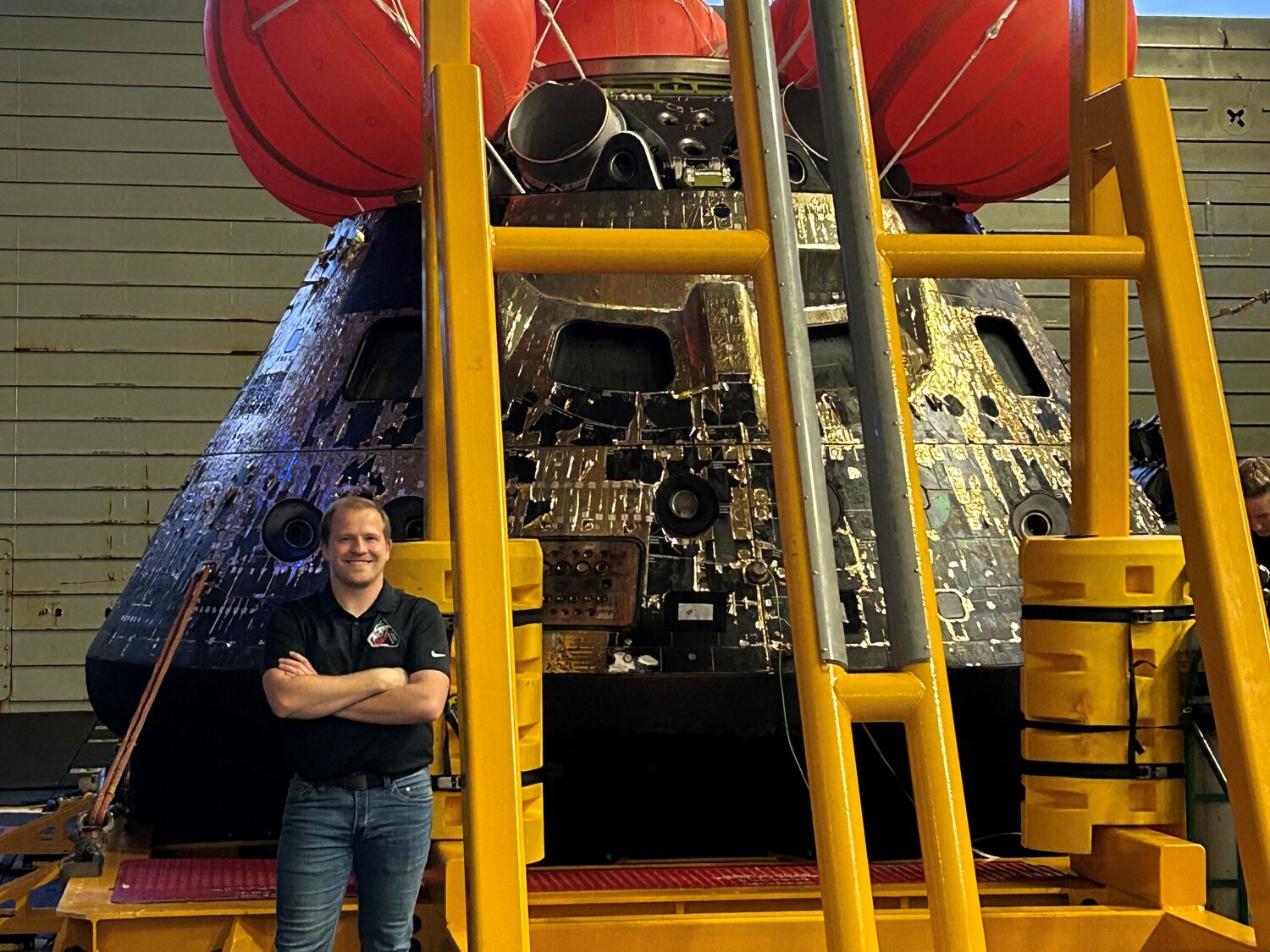
When the Artemis II astronauts splashed down, an enormous team was behind the successful mission. Jason Endsley, a 2020 ACRP University Design Competition winner, was at sea on the recovery vessel as lead instrumentation engineer. Also part of launch operations, he installed sensors used to make real-time decisions based on the state of the sea and other conditions to determine if the module could clear obstacles and safely be brought on board without heat shield damage. Sensors also monitor the ship’s roll, pitch, and yaw to understand how the ship interacted with the water inside that floods the well deck. Even more sensors on the recovery equipment, like the llamas (line load attenuation measurement apparatus), measure line tension. The recovered data led to a successful recovery and will be used in future missions to improve installation procedures and locations to better protect sensors during launch.
Endsley and the recovery team waited on the ship at sea, looking at the sky with no way to watch the livestreams of the mission’s return. “There was a lot of cheering and yelling once that crew module was visually acquired,” recalls Endsley of the quiet breaking on the ship during the recovery experience. “But it really didn't explode until main parachute deployment because— at that point—pretty much all of the thousands of things that had to go right, appeared to have gone right, and we watched it splash down. At that moment, those astronauts were back after orbiting the moon; farther than humans have ever gone.”
A winning design
Less than 10 years earlier, Endsley was a graduate student at Purdue University in Mary Johnson’s class when he learned about TRB’s Airport Cooperative Research Program (ACRP) and the University Design Competition. Johnson encouraged students to submit a proposal and has advised several winning proposals throughout the competition’s history. Together with fellow graduate students Cooper Burleson and Jack Green, they wrote a proposal suggesting that general aviation airports could generate additional revenue by implementing low-cost test cells in medium- to high-need areas for spaceport operations. The concept also suggested benefits for the space industry by expanding locations for activities like rocket engine testing.
“Obviously, I did not have much experience responding to a request for a proposal at that point in school,” says Endsley. While he had some professional exposure in the past, by entering the competition he learned that, “there are all these requirements that, if you want your proposal to be considered, you have to meet them.”
Indiana is not a natural location for the space industry. But the team, looking for local benefits, thought about ground testing and nearby Grissom Air Force Base. “We had a good point of reference because there are aviation engine test cells at the airport. A little different, of course, but that was where we got the groundwork,” notes Endsley. From there they explored requirements for using explosive materials and how they fit within an airport setting. Using public domain data, they determined Grissom checked every box to do it safely.
Held annually, the ACRP University Design Competition is open to individuals and teams of undergraduate and graduate students working with a faculty advisor at U.S. colleges or universities. Competitors are challenged to consider innovative approaches related to airport issues. Students can win cash prizes for winning design solutions. First place winners present their work at a national award ceremony. Submissions are typically due in May each year.
Unrelentless pursuit
“Consider the topic you’re going to write about carefully,” Endsley advises students contemplating the competition. “If there’s a topic that interests you that relates to one of the areas ACRP includes, then there’s absolutely no reason you shouldn’t go for it. You are going to expand your interest and start relating real-world problem-solving to the things you’re passionate about.”
The teammates initially grouped themselves around a love of aerospace. Endsley recalls that working on the project for ACRP “was really where all those potential side paths dissipated, and it was like, ‘alright, NASA is where I’m trying to go.’ During the process of writing this paper, it solidified that air space was the path that I would be unrelentingly pursuing.”
The human connection was an unexpected benefit from the University Design Competition. Endsley’s still in regular contact with another teammate who has also pursued a career in aerospace. They texted each other congratulations on successes in both of their careers recently.
A dream job
Today, Endsley says, “I’m very fortunate to play a role in America’s return to crewed, deep space exploration. After the Artemis II mission, I’m unsure if I could do anything else.”
He stresses the importance that instrumentation plays in every industry. “Some of the same things they're looking for on an aircraft, we use instruments to look for out here: air pressure, pressure differentials, temperatures.” Endsley explains. Because data was needed in building the vehicle, as well as integrating, testing, launching, and recovery of the Artemis II mission, Endsley was part of each of those steps. With the increasing use of data across industries, instrumentation has become a crucial tool.
This dream job didn’t fall in his lap. He recounts a year spent delivering food and applying for jobs. “It was over 500 job applications, but I wasn’t willing to settle. I knew where I wanted to be and the things I wanted to work on. I wasn’t going to take the next best thing.”
Within aerospace, Endsley lists multitude of careers: from sewing to weather forecasting. Naval aviators, supported by NASA crews on board, used helicopters taking off from the recovery vehicle to operate some of the high-powered imaging cameras, including thermal imaging used in the recovery.
“You never know where your expertise may find a niche within your passion.”
Also read: