Elevating Intersections of Air Pollution in India: Climate Crossroads at RamFest 2025
Program News
By Nikita Uberoi
Last update December 16, 2025
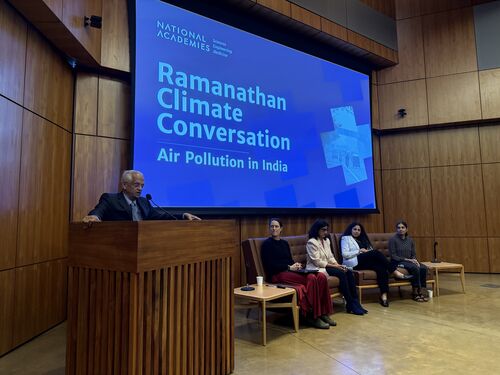
RamFest 2025, a symposium celebrating the illustrious career of Veerabhadran Ramanathan
In September, Climate Crossroads traveled to Scripps Institution of Oceanography for RamFest 2025, a symposium celebrating the illustrious career of Veerabhadran Ramanathan, a visionary in climate science and action and member of the National Academy of Sciences. The 1.5-day event brought together a diverse group of experts, including international scientists, policymakers, students, and artists for inspiring discussions on climate science and actionable solutions.
As part of the broader event, the National Academies led 4th annual Ramanathan Climate Conversation invited new perspectives to the program for a crosscutting discussion on air pollution in India. A topic closely aligned with Ramanathan’s work, "Air Pollution in India" brought the annual Ramanathan Climate Conversations’ vision to life – convening interdisciplinary experts to discuss a critical topic at the intersection of public health and climate resilience in South Asia. Moderated by Jennifer Burney of Stanford University, the panel explored the complex, multi-dimensional nature of the air quality crisis, connecting issues that are often treated in isolation.
This event was part of Climate Crossroads’ regional engagement, an ongoing effort to convene interdisciplinary conversations that advance science-informed decision-making.
“Air Pollution Anywhere is Air Pollution Everywhere”
Poor air quality in India is a pervasive issue with both visible and invisible impacts that are felt every day, by billions of people. As Ramanathan often reminds us, "air pollution anywhere is air pollution everywhere.” Many sectors -- ranging from energy and industry to agriculture and household cooking -- contribute to poor air quality. As a result, solutions to this problem are deeply intertwined with public health, food security, economic development, and climate change, creating a complex web of trade-offs.
Invited experts examined these intersections within the air quality crisis, leaving the audience with important takeaways on how science and policy can translate into effective practice.
Insights from Public Health, Agriculture, and the Political Economy
Exposure to both outdoor and indoor air pollution contributes to millions of annual deaths and chronic diseases, such as heart and lung diseases, cancer, and diabetes, reducing life expectancy by about five years on average in India. Pallavi Pant, an environmental health scientist with the Health Effects Institute, emphasized that the deterioration of population health is negatively impacting national productivity, economic outcomes, and straining the country’s healthcare system. “We need health systems that are better prepared to deal with these problems as they happen,” Pant remarked.
Meha Jain, an associate professor from the University of Michigan, highlighted the contributions of agriculture to the air quality crisis. Agricultural practices like crop residue burning, where farmers quickly clear their fields to prepare for the next crop, can contribute up to 75% of fine particulate matter, also known as PM2.5, during peak season in large urban centers, such as the Delhi National Capital Region, Jain noted. Crop burning is a path for farmers to optimize their yields and ensure food security. However, climate change and rapid groundwater depletion often incentivize more burning, further complicating efforts to reduce agricultural emissions. Jain underscored the need for integrated solutions across the multiple axes of food security -- water availability, climate variability, and air quality -- to find win-win scenarios that align multiple objectives.
As Pant and Jain unpacked the deep interconnectivity between air pollution, public health and food security, Meera Mahadevan, an assistant professor at the University of California, San Diego, explored the political economy of air quality management and decarbonization. Addressing air pollution and climate change simultaneously requires navigating trade-offs, particularly at the nexus of energy and economic policy. Mahadevan stressed that policies designed for decarbonization must be carefully managed to avoid disproportionately impacting vulnerable populations who are striving for electrification. She encouraged an empathetic approach, acknowledging that while science offers solutions, successful implementation requires workforce training, follow-through, and policies that respect the reality of vulnerable groups. “A surmountable problem,” she assured.
Signs of Progress
Despite the scope of challenges brought forward during the conversation, the panelists shared compelling stories of progress through recent technological adoption, improved data availability and monitoring, and community leadership.
A study by Mahadevan revealed a strong causal link between the election of female leaders at the local legislative level and a 13% reduction in crop burning practices, resulting in a 40% fall in particulate matter from burning. “If the right people have the right information, they can bring change themselves,” Mahadevan stated, adding that women leaders reported prioritizing health concerns more than their male counterparts.
Improved real-time air quality monitoring, space-based earth observation systems, and emissions inventories have also led to tremendous progress in emission source tracking. Increased data availability has informed programs like the 2019 National Clean Air Program and surveillance efforts for the National Center for Disease Control. Meanwhile, improved Earth observation satellites are helping evaluate the success of new technologies and strategies in agriculture.
Key Takeaways
The 4th annual Ramanathan Climate Conversation illustrated how air pollution and climate resilience are deeply intertwined with health, agriculture, and policy systems. The panelists examined challenges in air pollution governance, the importance of aligning incentives to support both climate and air quality goals, and the role of community leaders in driving change. As Mahadevan noted, collaboration among stakeholders and diversity in policy are essential to achieving thoughtful, long-term solutions.
In their concluding remarks, the panelists stressed that historically parallel yet siloed conversations on climate change and air quality must converge to address shared sources and the compounding effects that make the joint problem worse than either issue alone. They also underscored the need for researchers to communicate these links more effectively, whether to the general public, a national level decision-maker, or a Panchayat (village council) leader. Ultimately, the discussion made clear the need for holistic solutions that can navigate the complex web of trade-offs across the air pollution and climate change nexus.
Acknowledgments
Ramanathan Climate Conversations are annual discussions in honor of National Academy of Sciences member Veerabhadran “Ram” Ramanathan, and are made possible through generous support provided by Sunanda Basu. Recognizing that climate change is a global challenge that requires global solutions, Ramanathan Climate Conversations focus on climate resilience in South and East Asia, aiming to identify pathways to action relevant to viewers and policymakers around the world.
We are grateful to the event organizers, Yangyang Xu, Kristina Pistone, and Jennifer Burney for inviting Climate Crossroads to be part of the RamFest program, as well as to the event-day support provided by Scripps.