Gulf Research Program Awards Over $2.7 Million to Support Workforce Development for the Energy Transition
News Release
By Pete Nelson
Last update December 4, 2025
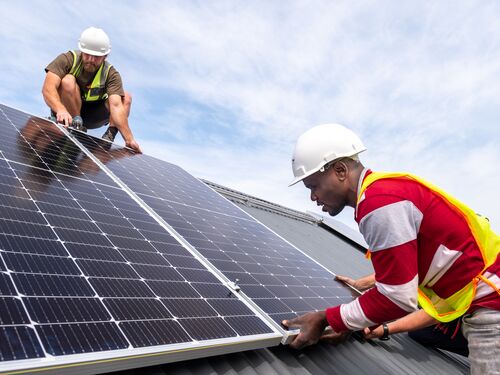
Technicians carefully connect and install solar panels on a residential rooftop. Houses in South Africa installing solar energy solutions due to large scale load shedding.
WASHINGTON — The Gulf Research Program (GRP) of the National Academies of Sciences, Engineering, and Medicine announced today an award of more than $2.7 million to support four projects designed to prepare young adults in the Gulf region for high-quality careers in the energy sector as the nation transitions to cleaner and more resilient energy systems.
The Workforce Development for the Energy Transition funding opportunity was created to help Gulf State residents ages 16-25 acquire the skills, knowledge, and credentials needed to join the future energy workforce. As energy systems evolve to meet rising demand and environmental challenges, the sector projects a shortfall of more than 3 million skilled technical workers required to meet emerging energy technology needs across the U.S.
The awarded projects will expand pathways into high-demand energy careers by combining hands-on training, STEM education, and industry-aligned credentialing, empowering young people to participate in the region’s energy economy while strengthening local resilience and opportunity.
“Creating access to high-quality energy careers is key to building a resilient Gulf workforce equipped for a changing energy landscape,” said Karena Mothershed, director of GRP’s Board on Gulf Education and Engagement. “These projects not only bridge critical workforce gaps but also empower young adults to lead in shaping a more sustainable and prosperous future.”
The awarded projects are:
Project Title: Texas Green Careers Academy: Activating a New Generation of Energy Professionals
Project Director: Brittany Jayroe, EcoRise
Award: $728,000
Project Summary: The Texas Green Careers Academy is a workforce development initiative designed to prepare students in Central and Gulf Coast Texas for clean energy careers. Led by EcoRise in partnership with Austin Energy and Zpryme, the program integrates energy literacy into K-12 classrooms while providing 90 high school students with paid internships, mentorship, and career coaching. Teachers receive training to explore topics such as solar power, grid modernization, and energy efficiency. Students engage directly with clean energy professionals and participate in student innovation showcases and immersive virtual reality experiences. Through a dual model of classroom engagement and hands-on, work-based learning, the program equips students with the technical and professional skills to enter the growing energy workforce. The initiative offers a scalable approach to energy-focused education that connects young Texans to regional labor market opportunities and supports the state’s transition to a clean energy economy.
Project Title: Spark Energy Futures: Equipping Youth and Communities for the Energy Transition
Project Director: Keith Cornelius, Urban Enrichment Institute
Award: $560,000
Project Summary: Spark Energy Futures is a youth-centered workforce development program designed to prepare Houstonians ages 16-25 for technical careers in emerging energy fields. Led by the Urban Enrichment Institute (UEI) in partnership with Houston Health Department and the University of Houston’s Energy Transition Institute, the initiative provides four months of STEM-based training, hands-on experience, and industry-aligned certifications without requiring a four-year degree. Participants gain field exposure, earn credentials, and receive services such as mentorship, transportation assistance, and job placement support. Recruitment and community engagement are supported by UEI’s trusted network, while employer partners create pathways to high-quality jobs. The program aims to serve 50 participants in its first year, building capacity for a skilled Gulf Coast energy workforce. By combining technical knowledge, work-based learning, and industry alignment, Spark Energy Futures creates accessible pathways to well-paying careers and strengthens local participation in the energy transition.
Project Title: Building the South Texas Energy Workforce
Project Director: Jeffrey West, Texas A&M University-Kingsville
Award: $748,175
Project Summary: Building the South Texas Energy Workforce is a regional initiative that strengthens the skilled labor pipeline in energy-related fields across South Texas, especially in rural communities. Led by Texas A&M University-Kingsville (TAMUK), a Hispanic-serving institution, the program offers industry-recognized certifications in areas such as construction, solar PV systems, energy efficiency, and OSHA safety. Training is delivered through TAMUK’s Javelina Skilled Trades Academy, complemented by a new curriculum on carbon capture and storage developed by the Gulf Coast Carbon Center at the University of Texas at Austin. Education to Employment Partners support participant recruitment, career navigation, and financial literacy, while Workforce Solutions Coastal Bend provides labor market data to align training with regional employer needs. Trainees ages 16-25 receive scholarships, certification opportunities, and one-on-one support to remove employment barriers. The initiative builds a scalable model that connects young adults to high-demand energy jobs, addresses regional workforce gaps, and supports the Gulf Coast’s clean energy future.
Project Title: Bridging the Solar Skills Gap: Clean Energy Workforce Training for Youth
Project Director: Beverly Wright, Deep South Center for Environmental Justice
Award: $750,000
Project Summary: Bridging the Solar Skills Gap is a solar workforce training initiative that prepares young adults from Gulf communities for careers in renewable energy. Led by the Deep South Center for Environmental Justice (DSCEJ), the program delivers hands-on, in-person training in Orleans Parish, equipping 50 trainees over two years with solar installation skills and industry-recognized certifications. Building on over 30 years of workforce development programs rooted in community trust and proven employment outcomes, graduates gain experience with real solar equipment and tools, with an expected job placement rate of at least 80%. Supported by DSCEJ’s extensive network and alumni base, the program addresses critical workforce shortages while accelerating the deployment of renewable energy in communities disproportionately impacted by pollution, and supporting broad participation in the clean energy transition.
The National Academies’ Gulf Research Program is an independent, science-based program founded in 2013 as part of legal settlements with the companies involved in the 2010 Deepwater Horizon disaster. The GRP’s mission is to develop, translate, and apply science to enhance the safety of offshore energy, the environment, and the well-being of the people of the Gulf region for generations to come. It supports innovative science, guides data design and monitoring, and builds and sustains networks to generate long-term benefits for the Gulf region and the nation.
The National Academies of Sciences, Engineering, and Medicine are private, nonprofit institutions that provide independent, objective analysis and advice to the nation to solve complex problems and inform public policy decisions related to science, engineering, and medicine. The National Academies operate under an 1863 congressional charter to the National Academy of Sciences, signed by President Lincoln.
Contact:
Pete Nelson, Director of Public Engagement and Communications
Gulf Research Program
email PNelson@nas.edu