Retraining Workers for the Age of AI
Feature Story
By Sara Frueh
Last update December 1, 2025
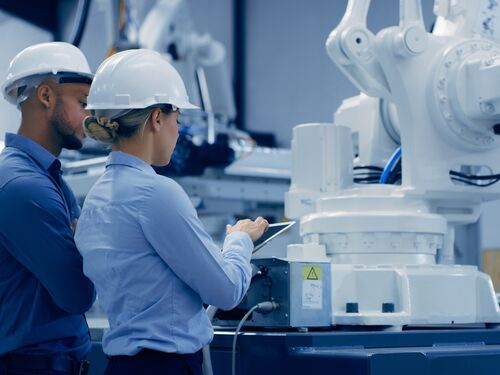
In spring 2025, nearly 47 percent of workers across all sectors reported using AI tools at least once a month to help them with their work — up from 34 percent the previous year, according to the American Psychological Association’s Work in America survey.
“AI adoption isn’t just creeping in, it’s accelerating rapidly — and for nearly a quarter of workers, it’s gone from an experiment to something that they’re doing every single week,” said Dennis Stolle of the APA’s Office of Applied Psychology.
About one in five workers feel pressured by their employers to use AI, and about three in 10 worry that they’re going to fall behind if they don’t, Stolle said. “The feeling that they have to adopt AI just to keep up is a new form of workplace stressor.”
Stolle and his colleague Mark Chan explained the survey results at a recent National Academies webinar that explored how the U.S. can help workers learn new skills to adapt to how AI is changing work.
“Technology and automation are affecting the jobs that are available,” said Margaret Beier, director of the Adult Skills and Knowledge Lab and chair of the Department of Psychological Sciences at Rice University, who also spoke at the event. “This really is going to necessitate a focus on reskilling, which we tend to define as gaining skills for a new role, and upskilling, which is enhancing skills for one’s current role.”
Workforce development ‘chronically underfunded’
The U.S. does not lack innovative training models or motivated workers and learners, but it doesn’t have a public funding system that can quickly seed new training programs or scale successful ones, explained Rachel Lipson, scholar in residence and co-founder of the Harvard University’s Project on Workforce.
“Workforce development in the U.S. is chronically underfunded compared to peer nations,” said Lipson. “We rank near the bottom in active labor market policy spending, at about 0.1% of GDP. That places us second to last in [Organization for Economic Cooperation and Development countries], next to Mexico.”
That lack of investment has consequences for workers who are displaced by new technologies and automation. “If you look at the last few waves of technological change or macro and structural shifts, it’s very clear in the U.S. that we have not done a particularly good job helping people through the journey of a transition from the time of a job loss until landing in a new job,” Lipson said.
“There’s lots of research to show that you need tons of social and psychological supports in order to be able to navigate the winds of those changes,” she continued. Beyond its immediate impact on earnings, job loss can have long-term consequences for workers’ health, their families, their children’s grades, and even for public safety in communities that suffer from significant, structural job losses.
“There’s lots [of impacts] from the last few waves of changes that hopefully should point us towards doing something a little bit differently this time around,” Lipson said.
Training tailored to ‘frontier’ and ‘retooled’ jobs
Looking ahead, training will need to be tailored to jobs depending upon which of three categories they fall into, Lipson explained. The first category is “frontier” jobs — entirely new jobs that are created by new technology, in this case AI. The term was coined by economist David Autor, whose research found that in 2018, about 60 percent of all jobs in the U.S. were in occupations that didn’t exist in 1940, Lipson noted.
“There’s going to be net new roles that arise because the underlying technology itself is new,” she said. “We may need net new training programs, and we may need funding models that can support unproven programs, because these roles just haven’t existed before.”
The second category is “retooled” jobs — occupations where the job title might be the same, but the skills within it are changing, because new tools like AI are incorporated or the environment is changing, said Lipson. “In some ways, I think this is going to be the most important one for workforce development,” she said. “It’s actually going to be really critical what happens in an employer context. That includes apprenticeships and other models for upskilling.”
The third category is legacy jobs — traditional occupations that will remain essential, such as tool and die makers. While such jobs may be less affected by AI, they still need attention as the workforce ages and workers retire, Lipson said. “We need to think differently about ensuring we don’t lose training capacity in fields that still really matter.”
Beier too pointed to the aging workforce, noting that the fastest growing sector of the labor force into the projected future are workers age 55 and older — a demographic trend that has implications for the type of training offered for new and reskilled jobs. Fluid reasoning ability and processing speed tends to decline over the lifespan, she said; research suggests that older learners can do as well as younger ones in self-directed learning contexts, but they often need to spend more time and effort to learn new skills.
Beier added that in addition to posing new challenges, technology can also provide individual workers with new ways to learn and train — through massive open online classes (MOOCs), YouTube videos, virtual and adapted reality, and AI itself. “Machine learning is really offering a lot of adaptive and personalized learning opportunities,” she said.
Jaime Teevan, chief scientist and technical fellow at Microsoft, spoke about organizational use of AI, stressing the need to incorporate AI effectively into teams. Some early research on AI and teamwork suggests that not only does AI help individuals perform better, but also that groups and pairs working together with AI are more likely to produce exceptional output, she said.
“We have to intentionally design AI to think about collaboration and not just individual output, and organizational leaders need to be thinking about how they’re restructuring their organizations in order to support that collaborative work,” said Teevan.
Beier noted that retraining efforts will also need to include workers who lack institutional support, such as those in the gig economy. “I think there needs to be a lot more support for individuals who are not organizationally affiliated, to figure out where they fit in the new economy,” she said. “My worry is we’re asking people to do an awful lot on their own, and there are just not a lot of resources available.”
In contrast to previous waves of technological change, said Lipson, there may be more universality in terms of the jobs affected by the AI wave — which may help build more public empathy for people dealing with job loss due to structural changes.
“If all people realize the vulnerability of things that can happen that are beyond your control, maybe that will help build some consensus around the kinds of supports that can really help people better weather those changes,” she said.