U.S. Needs New Drought Assessment Framework as Droughts Become More Severe and Unpredictable
News Release
By Solomon Self
Last update June 30, 2026
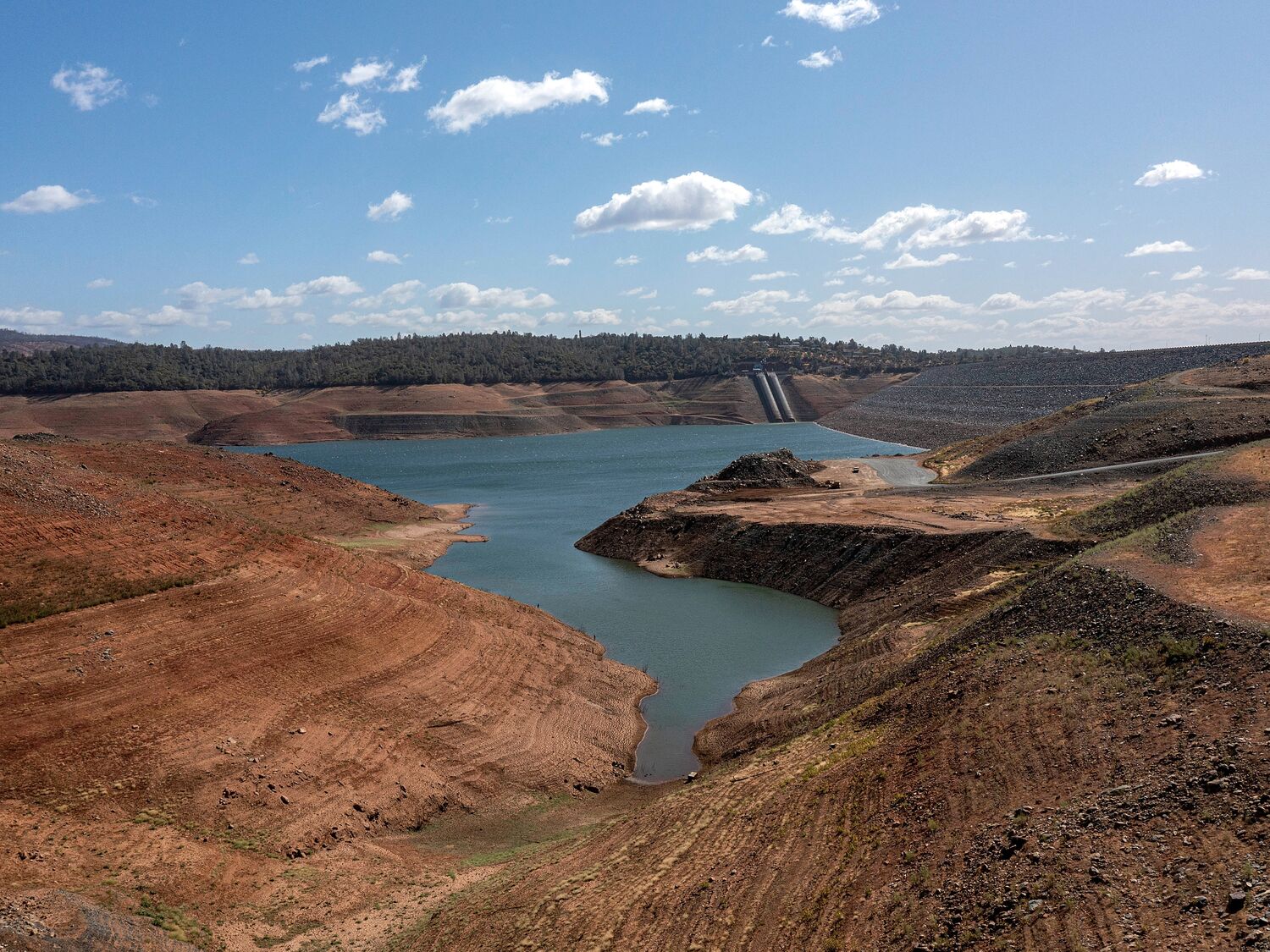
Low water levels at Oroville Lake during a drought in Oroville, California
WASHINGTON — Droughts in the United States are becoming more intense and unpredictable, and the nation needs to develop a new drought assessment framework to better understand and address them, according to a new report from the National Academies of Sciences, Engineering, and Medicine. The report urges the National Oceanic and Atmospheric Administration, the interagency National Integrated Drought Information System, other relevant federal agencies, and partners in the drought research and policy community to develop a new framework that distinguishes between short-term operational needs, such as drought monitoring and emergency response, and long-term planning for water management, infrastructure, and climate adaptation.
Climate-driven factors are reshaping drought in the United States, and the changing nature of drought threatens national resilience, the report says. Aridification in some regions and rapid onset droughts across much of the country are becoming more significant challenges. The U.S. is experiencing its first multidecadal “megadrought” in the Southwest. While contemporary drought assessment models have been effective in the past, they are insufficient to meet current realities.
“Many of the drought tools we rely on today were built around the assumption that climate conditions and dynamics remain relatively stable over time. That assumption no longer holds, and drought assessment must evolve accordingly,” said Jonathan Overpeck, Samuel A. Graham Dean for the School for Environment and Sustainability at the University of Michigan and chair of the committee that wrote the report. “We hope our report will spark a new era of drought assessment innovation and resilience.”
Researchers, farmers, infrastructure planners, emergency managers, and communities all depend on accurate drought assessments to make decisions about future risks and investments. Drought assessments designed to support immediate decisions, such as water restrictions, emergency management, and drought relief programs, require different information than assessments used for long-term planning, the report says.
To improve forecasting, the report recommends a two-pronged approach to allow decision-makers, researchers, and other stakeholders to address the immediate conditions while continuing to build future resilience. That approach should incorporate nonstationarity — the statistical reality that the frequency, intensification rate, severity, and duration of droughts are no longer stable — into drought assessment.
Understanding Drought Drivers
Given the difficulty in predicting drought, federal agencies and others involved in drought assessment should prioritize scientific research into drought drivers, dynamics, and aridification, the report says. Enhanced early warning capability and predictive understanding will also be important as flash droughts become more common.
Successful participation of all the partners essential to effective decision-making will be key to improved drought assessment, as will a high level of transparency in terms of how all elements of drought assessment are implemented. NOAA should consider forming a consortium that includes the research community, regulators, operational agencies, and other relevant stakeholders to share information and facilitate the development of common guidelines.
Data for Drought and Impact Assessment
The report recommends that federal agencies protect and strengthen the nation’s drought monitoring infrastructure, including stream gauges, soil moisture networks, snowpack measurements, weather stations, and Earth-observing satellites. Long-term records from these systems are essential for understanding how drought is changing and for helping communities prepare for future conditions.
The committee also recommended updating the way drought is measured. Because climate change is altering what is considered “normal,” agencies should evaluate drought conditions using multiple climate baselines rather than relying on a single historical reference period. The report also calls for greater transparency about how drought assessments are developed and how uncertainty is communicated.
A more consistent system for collecting and tracking drought impacts nationwide is also needed, the report says. Better information on impacts to agriculture, water supplies, ecosystems, public health, and local communities would improve drought assessment and help decision-makers target adaptation and response efforts. To support both adaptation and response, NIDIS should facilitate efforts to systematically collect, standardize, and integrate drought-impact information across sectors and regions, while developing best practices for incorporating those data into drought assessments, planning processes, and policy decisions.
Artificial Intelligence in Drought Assessment
Artificial intelligence and machine learning is likely to enable great strides in the improvement and utility of drought assessment, according to the report. Special care in the adoption of these technologies is advised, so as to prioritize transparency, reproducibility, and the avoidance of bias. The report also notes that good governance and ethical and sustainable use of AI will be important to ensure an overall benefit to society.
The study was undertaken by the Committee on the Future of Drought in the United States and sponsored by the U.S. Department of Commerce, the Interstate Council on Water Policy, the National Academy of Sciences Arthur L. Day Fund, and the National Academy of Sciences Maurice Ewing and Planetary Sciences Fund.
The National Academies of Sciences, Engineering, and Medicine are private, nonprofit institutions that provide independent, objective analysis and advice to the nation to solve complex problems and inform public policy decisions related to science, engineering, and medicine. They operate under an 1863 congressional charter to the National Academy of Sciences, signed by President Lincoln.
Contact:
Solomon Self, Media Relations Officer
Office of News and Public Information
202-334-2138; email news@nas.edu
Featured Publication
Improving Future U.S. Drought Assessment
Consensus Study Report
·2026
Since the beginning of the twenty-first century, the U.S. Southwest has been weathering the nation's first multidecadal megadrought, the most severe of many such droughts over the past 1,200 years. Droughts are becoming more frequent and longer-lasting, occurring against a backdrop of long-term regi...
View details