Previous Chapter: Appendix B: List of Committee Meetings and Briefings
Suggested Citation: "Color Plates." National Academy of Sciences. 2002. Technical Issues Related to the Comprehensive Nuclear Test Ban Treaty. Washington, DC: The National Academies Press. doi: 10.17226/10471.

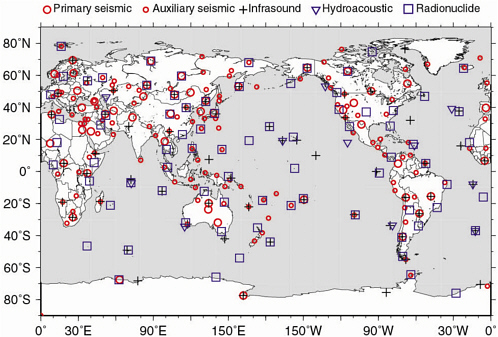
Figure 2–1 A global map showing five networks of IMS stations, which use the technologies of seismology, infrasound, hydroacoustics, and radionuclides. Data from all these stations are telemetered to the IDC in Vienna. Certified laboratories at 16 locations, not shown, contribute to the analysis of radionuclide data. (Figure courtesy of W.Y.Kim.)
Suggested Citation: "Color Plates." National Academy of Sciences. 2002. Technical Issues Related to the Comprehensive Nuclear Test Ban Treaty. Washington, DC: The National Academies Press. doi: 10.17226/10471.

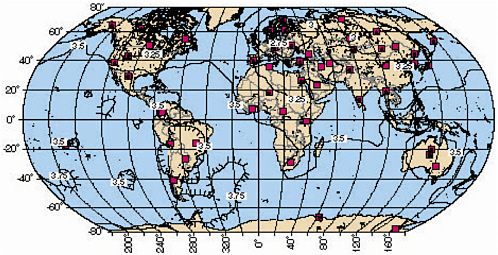
Figure 2–2 Contours of seismic magnitude for which signals would be expected (with signal-to-noise amplitude ratio greater than 3.2, i.e. 10 dB) at three or more stations of the IMS primary seismic network (solid squares), from 90 percent of the events at the contoured magnitude or larger. The contour interval is 0.25 magnitude units. The detection threshold for Europe, Asia, North America, and North Africa is in the magnitude range 3.5 to 3 or lower. (Figure provided by the Center for Monitoring Research)
Suggested Citation: "Color Plates." National Academy of Sciences. 2002. Technical Issues Related to the Comprehensive Nuclear Test Ban Treaty. Washington, DC: The National Academies Press. doi: 10.17226/10471.

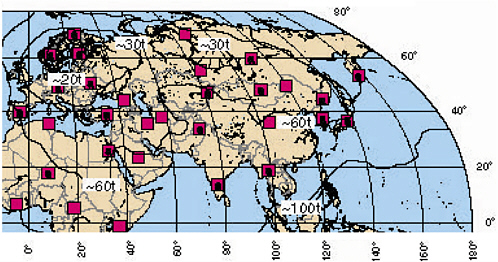
Figure 2–3 Contours of approximate yield for tamped explosions, for which detections can be expected at three IMS primary stations (solid squares). These contours are the same as those of Figure 2–2, but with an expanded view of Europe, Asia and North Africa, and using the approximate yields of Table 2–2 (expressed now in tons rather than kilotons) to interpret seismic magnitudes.
Suggested Citation: "Color Plates." National Academy of Sciences. 2002. Technical Issues Related to the Comprehensive Nuclear Test Ban Treaty. Washington, DC: The National Academies Press. doi: 10.17226/10471.

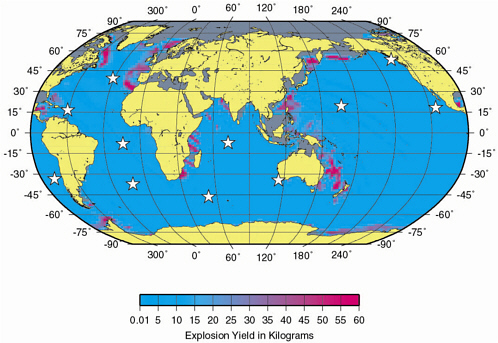
Figure 2–4 Projected 90 percent probable two-station detection thresholds for underwater explosions expressed in kilograms for the IMS network of 11 hydroacoustic stations. (Source: Center for Monitoring Research).

Suggested Citation: "Color Plates." National Academy of Sciences. 2002. Technical Issues Related to the Comprehensive Nuclear Test Ban Treaty. Washington, DC: The National Academies Press. doi: 10.17226/10471.

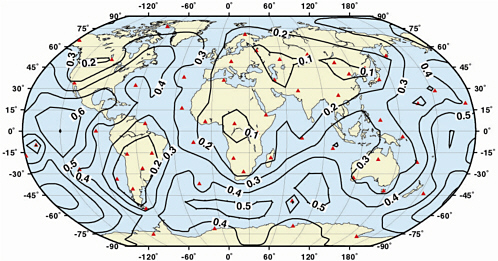
Figure 2–5 Projected 90 percent probable two-station detection thresholds for atmospheric explosions expressed in kilotons for the planned IMS network of 60 infrasound stations. (Source: Center for Monitoring Research.)

Suggested Citation: "Color Plates." National Academy of Sciences. 2002. Technical Issues Related to the Comprehensive Nuclear Test Ban Treaty. Washington, DC: The National Academies Press. doi: 10.17226/10471.

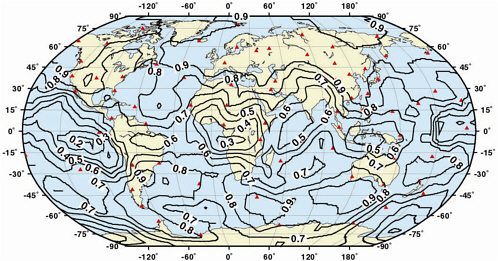
Figure 2–6 Probability of one-station detection of a 1-kiloton atmospheric nuclear explosion within five days by the planned 80-station IMS radionuclide network. (Figure provided by the Center for Monitoring Research.)

Suggested Citation: "Color Plates." National Academy of Sciences. 2002. Technical Issues Related to the Comprehensive Nuclear Test Ban Treaty. Washington, DC: The National Academies Press. doi: 10.17226/10471.

There was a problem loading page 91.

Suggested Citation: "Color Plates." National Academy of Sciences. 2002. Technical Issues Related to the Comprehensive Nuclear Test Ban Treaty. Washington, DC: The National Academies Press. doi: 10.17226/10471.

There was a problem loading page 92.

Suggested Citation: "Color Plates." National Academy of Sciences. 2002. Technical Issues Related to the Comprehensive Nuclear Test Ban Treaty. Washington, DC: The National Academies Press. doi: 10.17226/10471.
Page 85
Suggested Citation: "Color Plates." National Academy of Sciences. 2002. Technical Issues Related to the Comprehensive Nuclear Test Ban Treaty. Washington, DC: The National Academies Press. doi: 10.17226/10471.
Page 86
Suggested Citation: "Color Plates." National Academy of Sciences. 2002. Technical Issues Related to the Comprehensive Nuclear Test Ban Treaty. Washington, DC: The National Academies Press. doi: 10.17226/10471.
Page 87
Suggested Citation: "Color Plates." National Academy of Sciences. 2002. Technical Issues Related to the Comprehensive Nuclear Test Ban Treaty. Washington, DC: The National Academies Press. doi: 10.17226/10471.
Page 88
Suggested Citation: "Color Plates." National Academy of Sciences. 2002. Technical Issues Related to the Comprehensive Nuclear Test Ban Treaty. Washington, DC: The National Academies Press. doi: 10.17226/10471.
Page 89
Suggested Citation: "Color Plates." National Academy of Sciences. 2002. Technical Issues Related to the Comprehensive Nuclear Test Ban Treaty. Washington, DC: The National Academies Press. doi: 10.17226/10471.
Page 90
Suggested Citation: "Color Plates." National Academy of Sciences. 2002. Technical Issues Related to the Comprehensive Nuclear Test Ban Treaty. Washington, DC: The National Academies Press. doi: 10.17226/10471.
Page 91
Suggested Citation: "Color Plates." National Academy of Sciences. 2002. Technical Issues Related to the Comprehensive Nuclear Test Ban Treaty. Washington, DC: The National Academies Press. doi: 10.17226/10471.
Page 92
Subscribe to Email from the National Academies
Keep up with all of the activities, publications, and events by subscribing to free updates by email.