Materials Research to Meet 21st-Century Defense Needs (2003)
Chapter: Appendix C: Integration of Materials Systems and Structures Development
APPENDIX C Integration of Materials Systems and Structures Development
Forty years ago, Westbrook1 noted that structural materials vary in price by seven orders of magnitude, from gravel or cement at several cents per pound to industrial diamonds at $10,000 per pound. Not surprisingly, usage of a material in pounds per annum is inversely related to its cost per pound (see Figure C-1). However, Westbrook’s graph reveals an interesting principle: Judging from the slope of the usage cost trend as compared to the lines of equal market size, a significant reduction in the cost of a material will result in a larger increase in usage. For example, a reduction of a factor of two in the cost of a material should result, over the long run, in a fourfold increase in usage. Thus, one way to increase the size of the market for a structural material is to reduce the cost.
It is also useful to consider the value of a pound of weight saved over the life of a vehicle (see Table 3-2). With gasoline at $1 to $2 per gallon, a pound of weight removed from an automobile will save $2.00 over a 100,000-mile life. For a commercial aircraft, the fuel savings over a 100,000-hour life of the fuselage is $200 per pound. For military aircraft, the value can be $1,000 per pound. For spacecraft, the cost to put a pound of payload into orbit a single time is $20,000; for the reusable space shuttle the cost can drop to $10,000 per pound. The goal for a single stage to orbit shuttle is $1,000 per pound, but this has not yet been achieved.
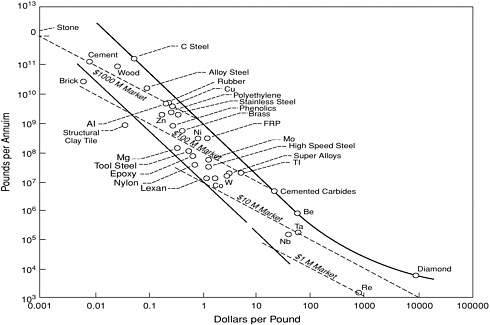
FIGURE C-1
Price-volume relationship for annual U.S. consumption of structural materials.
SOURCE: J.H. Westbrook, General Electric (retired), private communication, Septem-ber 27, 2002.
In spite of concerns about the cost of raw materials, their cost is only a relatively small fraction of the cost of a fabricated structure, typically 10 to 20 percent (see Table C-1). Combining the fabricated costs of a structure with the value of a pound saved gives maximum average cost of the material in a particular application. For example, for an automobile where the value of a pound saved is $2, $2 times a 20 percent cost of material in relation to total cost produces an upper limit (on average) of $0.40 per pound for the primary structural material of the automobile. Automotive-quality steel sheet is $0.30 per pound, while aluminum sheet is $1.50 per pound. Thus, even with a 250 percent lower density, aluminum cannot be justified in current automobiles when gasoline is $1.50 per gallon; esti
TABLE C-1 Typical Costs of a Fabricated Structure Made from Monolithic (Noncomposite) Materials
|
Component |
Percentage of Total Cost |
|
Raw Materials |
10-20 |
|
Design/Engineering |
10-20 |
|
Fabrication (forging, machining, joining, etc.) |
20-40 |
|
Nondestructive Testing and Quality Control |
10-20 |
|
General and Administrative |
10 |
|
Profit |
+10 to –10 |
mates of the breakeven point for aluminum auto bodies is $4.00 per gallon.2
Combining the values of Table 3-2 with the costs shown in Table C-1 makes it possible to generate a list of materials for various structures (see Table C-2). It should be noted that complex composites that possess remarkable mechanical properties can be equally remarkable in cost. For example, the liquid hydrogen tank for the X-33 space plane, one of the largest complex composite structures ever built, was the size of a small house yet weighed only 4,000 pounds. However, the fabricated cost per pound was $10,000. Thus, the percentages in Table C-1 do not apply to complex composites. For such composite structures, the material costs may be as little as 2 to 5 percent of the total fabricated structure cost.
Note that while light weight is important for anything that moves, the faster the object moves, the greater the value of weight saved. Thus, although the average value of a pound saved in an automobile is $2.00, the savings on reduced weight in an axle or wheel can be double or triple this value since the wheels rotate faster than the main structure—that is why aluminum wheels are cost-competitive with steel in automobiles. In an aircraft, a pound of weight saved on a disk of a turbine engine can be worth 10 times the same weight saved on the fuselage, because a pound saved on the engine can save 5 to 10 pounds on the wing structure.
While these values of weight saved and materials costs as a fraction of total structure costs may appear rather general, experience has shown these estimates to be surprisingly accurate. For example, Newport News Shipbuilding has estimated $10,000 per ton savings if a higher strength
TABLE C-2 Structural Materials Selection Based on Value of Weight Savings over the Life of a Structure
|
|
Dollars per Pound |
|
Automobiles, ships, and buildings |
|
|
Reinforced concrete |
0.15 |
|
Cast iron |
0.15 |
|
Mild steel |
0.15 |
|
Low alloy steel |
0.25-0.75 |
|
Plywood |
0.40 |
|
Aircraft |
|
|
Polyethylene |
0.65 |
|
Hardwoods |
0.70 |
|
Rubber |
0.75 |
|
Glass |
0.75 |
|
Epoxy |
0.85 |
|
Aluminum |
1.00-1.50 |
|
Polycarbonate |
1.25 |
|
Copper |
1.50 |
|
Stainless steels |
1.50-3.00 |
|
Graphite fiber-reinforced plastic |
1.25-1.75 |
|
Nickel alloys |
3.50-15.00 |
|
Titanium alloys |
5.00-15.00 |
|
Cobalt |
10.00-30.00 |
|
Boron-epoxy composites |
150.00 |
|
Spacecraft |
|
|
Complex composites |
100.00-500.00 |
|
Refractory metals |
100.00-300.00 |
|
Silver |
150.00 |
|
Gold |
5,000.00 |
ship plate (HSLA 65) can be substituted for the former steel.3 Since the higher strength steel would cost approximately $0.50 per pound, at 10 percent material, compared to total fabricated cost, the estimated savings aligns perfectly with these general rules.


