Previous Chapter: Appendix: Biographies
Suggested Citation: "Plates of Figures 1-8." National Academy of Engineering and National Research Council. 2003. The Carbon Dioxide Dilemma: Promising Technologies and Policies. Washington, DC: The National Academies Press. doi: 10.17226/10798.

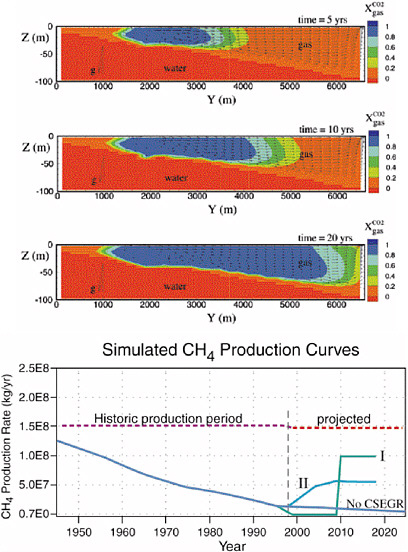
PLATE 1 Results from numerical simulations of carbon sequestration enhanced natural gas recovery (CSEGR) showing that pressure diffusion is more rapid than molecular diffusion and that up to 30 percent more natural gas could be produced from the Rio Vista Gas Field in California with CSEGR. Source: adapted from Oldenburg et al., 2001.
Suggested Citation: "Plates of Figures 1-8." National Academy of Engineering and National Research Council. 2003. The Carbon Dioxide Dilemma: Promising Technologies and Policies. Washington, DC: The National Academies Press. doi: 10.17226/10798.

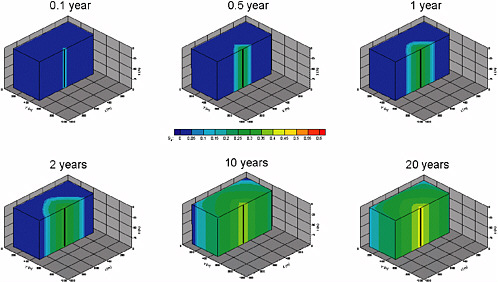
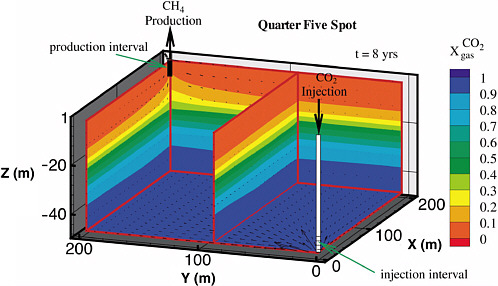
PLATE 2 Simulation showing the concentration of CO2 in a 5-spot injection pattern, which shows that the CO2 sweeps upward from the bottom of the reservoir. Source: adapted from Oldenburg et al., 2002.

Suggested Citation: "Plates of Figures 1-8." National Academy of Engineering and National Research Council. 2003. The Carbon Dioxide Dilemma: Promising Technologies and Policies. Washington, DC: The National Academies Press. doi: 10.17226/10798.

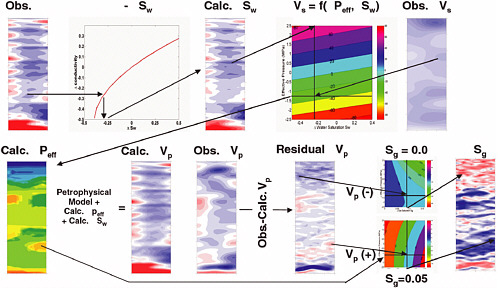
PLATE 3 Schematic drawing showing how the combination of electromagnetic and seismic imaging can be used to detect CO2 saturation in a reservoir. Source: Hovesten et al., in press.

Suggested Citation: "Plates of Figures 1-8." National Academy of Engineering and National Research Council. 2003. The Carbon Dioxide Dilemma: Promising Technologies and Policies. Washington, DC: The National Academies Press. doi: 10.17226/10798.

PLATE 4 Simulation of CO2 migration in a homogeneous reservoir where buoyancy forces are neglected. Source: adapted from Doughty et al., in press.

Suggested Citation: "Plates of Figures 1-8." National Academy of Engineering and National Research Council. 2003. The Carbon Dioxide Dilemma: Promising Technologies and Policies. Washington, DC: The National Academies Press. doi: 10.17226/10798.

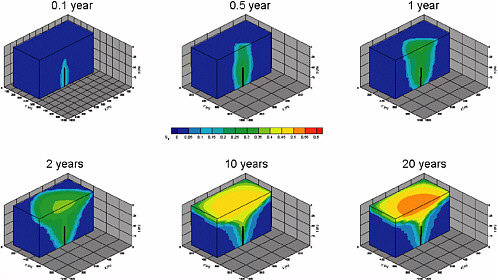
PLATE 5 Simulation of CO2 migration in a homogeneous reservoir. Source: adapted from Doughty et al., in press.

Suggested Citation: "Plates of Figures 1-8." National Academy of Engineering and National Research Council. 2003. The Carbon Dioxide Dilemma: Promising Technologies and Policies. Washington, DC: The National Academies Press. doi: 10.17226/10798.

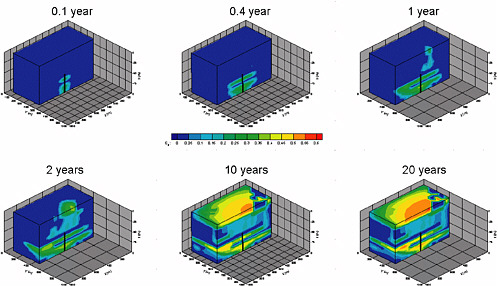
PLATE 6 Simulation of CO2 migration in a homogeneous reservoir where buoyancy forces are neglected. Source: adapted from Doughty et al., in press.

Suggested Citation: "Plates of Figures 1-8." National Academy of Engineering and National Research Council. 2003. The Carbon Dioxide Dilemma: Promising Technologies and Policies. Washington, DC: The National Academies Press. doi: 10.17226/10798.

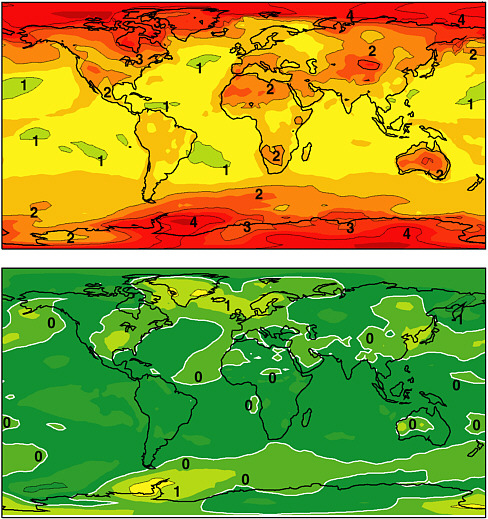
PLATE 7 The upper panel depicts the space-averaged and time-averaged temperature change (°C) with a doubling of atmospheric CO2 concentration from the preindustrial baseline. The lower panel shows the same result, again for a doubling of CO2 concentration, accompanied by a 1.8-percent reduction in insolation. No significant temperature changes are seen. Sources: Govindasamy and Caldeira, 2000.
Suggested Citation: "Plates of Figures 1-8." National Academy of Engineering and National Research Council. 2003. The Carbon Dioxide Dilemma: Promising Technologies and Policies. Washington, DC: The National Academies Press. doi: 10.17226/10798.

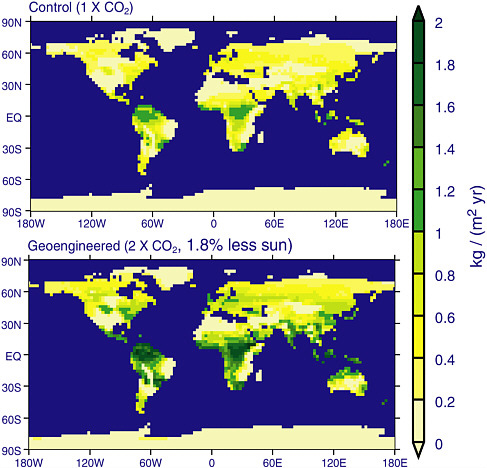
PLATE 8 Net primary (plant) productivity of terrestrial land masses, as modeled by IBIS code with slab ocean used in conjunction with the Community Climate Model (CCM3). The upper panel shows Earth with a preindustrial atmospheric CO2 concentration and with 1.8 percent less insolation. The globally aggregated land-plant productivity in the lower panel is nearly twice that of the upper panel, which implies an agricultural crop value difference of about $1 trillion per year in the enriched CO2 case. Source: Govindasamy et al., 2000.

Suggested Citation: "Plates of Figures 1-8." National Academy of Engineering and National Research Council. 2003. The Carbon Dioxide Dilemma: Promising Technologies and Policies. Washington, DC: The National Academies Press. doi: 10.17226/10798.
Page 133
Suggested Citation: "Plates of Figures 1-8." National Academy of Engineering and National Research Council. 2003. The Carbon Dioxide Dilemma: Promising Technologies and Policies. Washington, DC: The National Academies Press. doi: 10.17226/10798.
Page 134
Suggested Citation: "Plates of Figures 1-8." National Academy of Engineering and National Research Council. 2003. The Carbon Dioxide Dilemma: Promising Technologies and Policies. Washington, DC: The National Academies Press. doi: 10.17226/10798.
Page 135
Suggested Citation: "Plates of Figures 1-8." National Academy of Engineering and National Research Council. 2003. The Carbon Dioxide Dilemma: Promising Technologies and Policies. Washington, DC: The National Academies Press. doi: 10.17226/10798.
Page 136
Suggested Citation: "Plates of Figures 1-8." National Academy of Engineering and National Research Council. 2003. The Carbon Dioxide Dilemma: Promising Technologies and Policies. Washington, DC: The National Academies Press. doi: 10.17226/10798.
Page 137
Suggested Citation: "Plates of Figures 1-8." National Academy of Engineering and National Research Council. 2003. The Carbon Dioxide Dilemma: Promising Technologies and Policies. Washington, DC: The National Academies Press. doi: 10.17226/10798.
Page 138
Suggested Citation: "Plates of Figures 1-8." National Academy of Engineering and National Research Council. 2003. The Carbon Dioxide Dilemma: Promising Technologies and Policies. Washington, DC: The National Academies Press. doi: 10.17226/10798.
Page 139
Suggested Citation: "Plates of Figures 1-8." National Academy of Engineering and National Research Council. 2003. The Carbon Dioxide Dilemma: Promising Technologies and Policies. Washington, DC: The National Academies Press. doi: 10.17226/10798.
Page 140
Subscribe to Emails from the National Academies
Stay up to date on activities, publications, and events by subscribing to email updates.