U.S.-Iran Engagement in Science, Engineering, and Health (2000-2009): Opportunities, Constraints, and Impacts (2010)

Chapter: Appendix H: Selected Statistics: Human Development, Research, and Communications in Iran

Previous Chapter: Appendix G: Workshop Proceedings and Informal Reports
Suggested Citation: "Appendix H: Selected Statistics: Human Development, Research, and Communications in Iran." National Research Council. 2010. U.S.-Iran Engagement in Science, Engineering, and Health (2000-2009): Opportunities, Constraints, and Impacts. Washington, DC: The National Academies Press. doi: 10.17226/12921.

Appendix H
Selected Statistics: Human Development, Research, and Communications in Iran

Human Development

Adult Literacy Rate (1995-2005)

82.4 %

Youth Literacy Rate (1995-2005) age 15-24

97.4 %

Population Undernourished (2002-2004)

4.0 %

Population Using Improved Water Sources (2002-2004)

94.0 %

Public Expenditure on Education (2002-2005), % of GDP

4.7 %

Public Expenditure on Education (2002-2005), % of budget

22.8 %

Public Expenditure on Health (2004) % of GDP

3.2 %

Electrification Rate

97.0 %

Unemployment (1996-2005)

11.5 %

Employment in industry (30%), agriculture (25%), services (45%)

SOURCE: U.N.D.P. Human Development Report, 2007/2008

Research

R&D at Universities

Research Centers Associated with Universities: 165

Public Universities that Conduct Research: 53

Private Universities that Conduct Research: 23

Suggested Citation: "Appendix H: Selected Statistics: Human Development, Research, and Communications in Iran." National Research Council. 2010. U.S.-Iran Engagement in Science, Engineering, and Health (2000-2009): Opportunities, Constraints, and Impacts. Washington, DC: The National Academies Press. doi: 10.17226/12921.
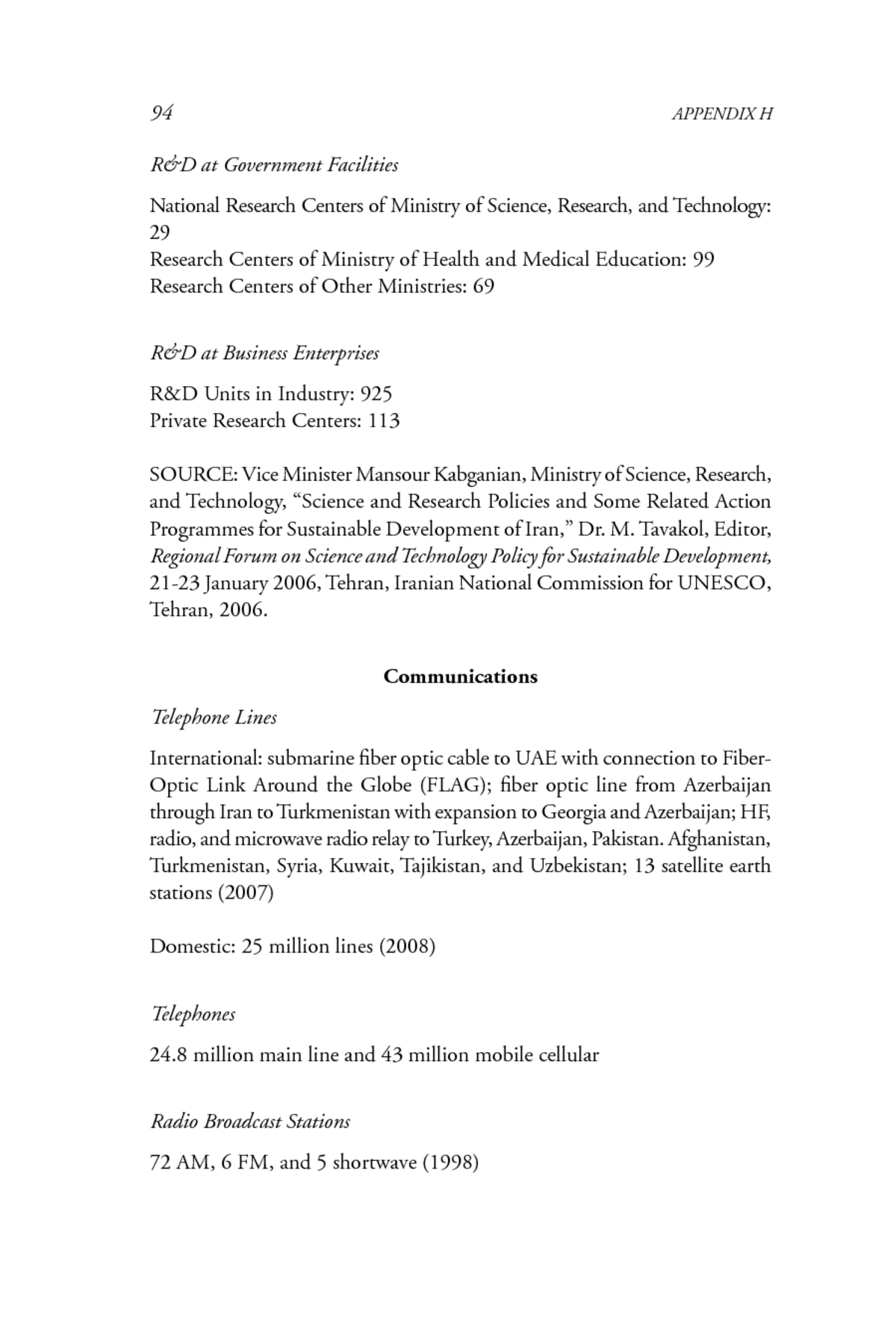
R&D at Government Facilities

National Research Centers of Ministry of Science, Research, and Technology: 29

Research Centers of Ministry of Health and Medical Education: 99

Research Centers of Other Ministries: 69

R&D at Business Enterprises

R&D Units in Industry: 925

Private Research Centers: 113


SOURCE: Vice Minister Mansour Kabganian, Ministry of Science, Research, and Technology, “Science and Research Policies and Some Related Action Programmes for Sustainable Development of Iran,” Dr. M. Tavakol, Editor, Regional Forum on Science and Technology Policy for Sustainable Development, 21-23 January 2006, Tehran, Iranian National Commission for UNESCO, Tehran, 2006.

Communications

Telephone Lines

International: submarine fiber optic cable to UAE with connection to Fiber-Optic Link Around the Globe (FLAG); fiber optic line from Azerbaijan through Iran to Turkmenistan with expansion to Georgia and Azerbaijan; HF, radio, and microwave radio relay to Turkey, Azerbaijan, Pakistan. Afghanistan, Turkmenistan, Syria, Kuwait, Tajikistan, and Uzbekistan; 13 satellite earth stations (2007)


Domestic: 25 million lines (2008)

Telephones

24.8 million main line and 43 million mobile cellular

Radio Broadcast Stations

72 AM, 6 FM, and 5 shortwave (1998)

Suggested Citation: "Appendix H: Selected Statistics: Human Development, Research, and Communications in Iran." National Research Council. 2010. U.S.-Iran Engagement in Science, Engineering, and Health (2000-2009): Opportunities, Constraints, and Impacts. Washington, DC: The National Academies Press. doi: 10.17226/12921.
Television Broadcast Stations

29 plus 450 repeaters (1997)

Internet

Hosts: 5.3 million (2006)

Users: 23 million (2008)


SOURCE: World Fact Book 2010: http://cia.gov/library/publications/the-world-factbook/geos/ir.html

Suggested Citation: "Appendix H: Selected Statistics: Human Development, Research, and Communications in Iran." National Research Council. 2010. U.S.-Iran Engagement in Science, Engineering, and Health (2000-2009): Opportunities, Constraints, and Impacts. Washington, DC: The National Academies Press. doi: 10.17226/12921.

This page intentionally left blank.

Suggested Citation: "Appendix H: Selected Statistics: Human Development, Research, and Communications in Iran." National Research Council. 2010. U.S.-Iran Engagement in Science, Engineering, and Health (2000-2009): Opportunities, Constraints, and Impacts. Washington, DC: The National Academies Press. doi: 10.17226/12921.
Page 93
Suggested Citation: "Appendix H: Selected Statistics: Human Development, Research, and Communications in Iran." National Research Council. 2010. U.S.-Iran Engagement in Science, Engineering, and Health (2000-2009): Opportunities, Constraints, and Impacts. Washington, DC: The National Academies Press. doi: 10.17226/12921.
Page 94
Suggested Citation: "Appendix H: Selected Statistics: Human Development, Research, and Communications in Iran." National Research Council. 2010. U.S.-Iran Engagement in Science, Engineering, and Health (2000-2009): Opportunities, Constraints, and Impacts. Washington, DC: The National Academies Press. doi: 10.17226/12921.
Page 95
Suggested Citation: "Appendix H: Selected Statistics: Human Development, Research, and Communications in Iran." National Research Council. 2010. U.S.-Iran Engagement in Science, Engineering, and Health (2000-2009): Opportunities, Constraints, and Impacts. Washington, DC: The National Academies Press. doi: 10.17226/12921.
Page 96
Next Chapter: Appendix I: Statistics on Higher Education in Iran
Subscribe to Email from the National Academies
Keep up with all of the activities, publications, and events by subscribing to free updates by email.