Memorial Tributes: Volume 21 (2017)
Chapter: JAMES W. MAYER
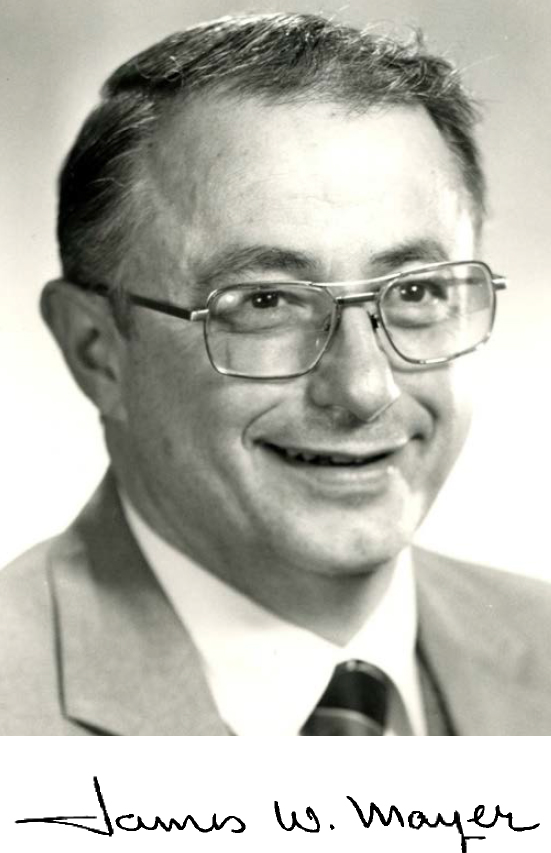
JAMES W. MAYER
1930–2013
Elected in 1984
“For original contributions to ion implantation, Rutherford backscattering spectrometry, and other major aspects of solid-state engineering research and education.”
BY THOMAS E. EVERHART
JAMES WALTER MAYER excelled as a scientist, engineer, and mentor, and as a family man and friend. He was born April 24, 1930, in Chicago and passed away June 14, 2013, in the presence of family in Kailua-Kona, Hawaii, where he and his wife had retired. He was 83.
After his PhD degree in physics from Purdue University and then Army service, he joined the Hughes Research Laboratories. Subsequently, he started his career in academia as a professor of electrical engineering at the California Institute of Technology in 1967, where in addition to research and teaching he became Master of Student Houses.
From Caltech he moved in 1980 to Cornell University’s College of Engineering as the Francis Norwood Bard Professor of Materials Engineering before becoming director of the Microscience and Technology Program in 1989. In 1992 he accepted the position of director of the Center for Solid State Science at Arizona State University (ASU), where he went on to become a Regents’ Professor in 1994 and Galvin Professor of Science and Engineering in 1997. During his career he authored or coauthored more than 750 papers, 12 books, and 12 patents.
___________________
A more detailed memorial is available in the Materials Research Society’s MRS Bulletin, October 2013, vol. 38, no. 10, pp. 774–775.
He made several key scientific and technological advances. In the 1950s his work was essential to the development of semiconductor detectors, used for measuring the energy of energetic particles and ionizing radiation. He helped develop Rutherford backscattering spectrometry (RBS) into a major analytic tool and used it to analyze many aspects of semiconductor growth, disorder, and several other properties of materials growth. He was a key contributor to the development of ion implantation to dope semiconductors, discovering methods of annealing that removed the disorder created by the implantation and making that technique a practical fabrication tool for integrated circuits.
In recognition of his achievements and contributions to the field, he was selected for the Materials Research Society’s Von Hippel Award in 1981, for having done “research on implantation that identified the damage and the epitaxial regrowth phenomena crucial to the semiconductor industry, and pioneered the use of ion beam techniques for materials analysis.” He was elected a member of the National Academy of Engineering, and he was a fellow of the American Physical Society and the Institute of Electrical and Electronics Engineers.
Jim Mayer was an excellent teacher of both undergraduate and graduate students, often returning to his lab at night to work with the latter. In addition to more than 40 graduate students, he mentored visitors and postdocs, most of whom became lifelong friends. And he established the Kaiserliche Königliche Böhmische Physical Society to encourage information exchange between scientists and engineers involved in such research.
Among his various interests (and publications) was analysis of paint pigments and ink, applying science to art. His expertise was such that he was invited to lecture at the Louvre. He also developed a course at ASU on “Patterns in Nature,” which later became a statewide online course, complete with a laboratory on wheels that could be used by K–12 students around the state. While at Cornell, he helped his wife start an elementary school that was quite successful.
Jim Mayer leaves behind his wife, Betty (née Billmire), four children, seven grandchildren, and four great-grandchildren, as well as many colleagues and students who are better scientists, engineers, and human beings because they knew him and were influenced by him.


