Understanding and Predicting the Gulf of Mexico Loop Current: Critical Gaps and Recommendations (2018)
Chapter: Summary
Summary
The Loop Current (LC) is the dominant physical process in Gulf of Mexico waters. As the LC meanders from the Yucatan Channel through the Gulf of Mexico to its exit through the Florida Straits, it brings with it a large, deep mass of warmer water and strong currents (see Figure S.1). The LC’s position varies greatly from its retracted state in the Yucatan Channel, directly east of the Florida Straits, to its extended state into the far northern and western Gulf. Why and when the LC suddenly intrudes north has not been able to be predicted with sufficient skill. Occasionally, an eddy (Loop Current eddy [LCE]) sheds from the LC and slowly migrates westward, bringing with it the LC’s warm water and strong currents. What triggers that separation and when are also not skillfully predicted. Research in this area is not new; field and numerical studies of the Gulf of Mexico’s circulation have been conducted for decades, yet vexing questions remain:
- What controls the penetration of the LC into the Gulf of Mexico?
- What controls the shedding of an eddy from the parent LC?
Answers to these two fundamental questions are necessary for advancing the ability to predict Loop Current System (LCS) behavior and thereby providing invaluable information for Gulf of Mexico oil and gas operations, disaster response, ecologically based management of living marine resources, tropical cyclone intensification predictions and track forecasting, and estimating the moisture flux into the U.S. heartland and the latent heat flux that drives extratropical storms and tornados. This study aims to describe critical components of a field campaign that would fill those gaps, thereby leading to significant improvements in both short-term and long-range predictions of the LCS.
In carrying out this task, the committee seeks to advise the National Academies of Sciences, Engineering, and Medicine’s (the National Academies’) Gulf Research Program (GRP) in investing funds that will ultimately allow modelers to
- Improve predictive skill in forecasting the LC and/or LCE current speed, vertical structure, and duration out to a forecast period of a few days to 1 week
- Improve predictive skill in forecasting the extension of the LC’s location and duration and LCE propagation out to a forecast period of approximately 1 month
- Improve predictive skill in forecasting an eddy shedding event from an extended LC out to a forecast period of approximately 3 months
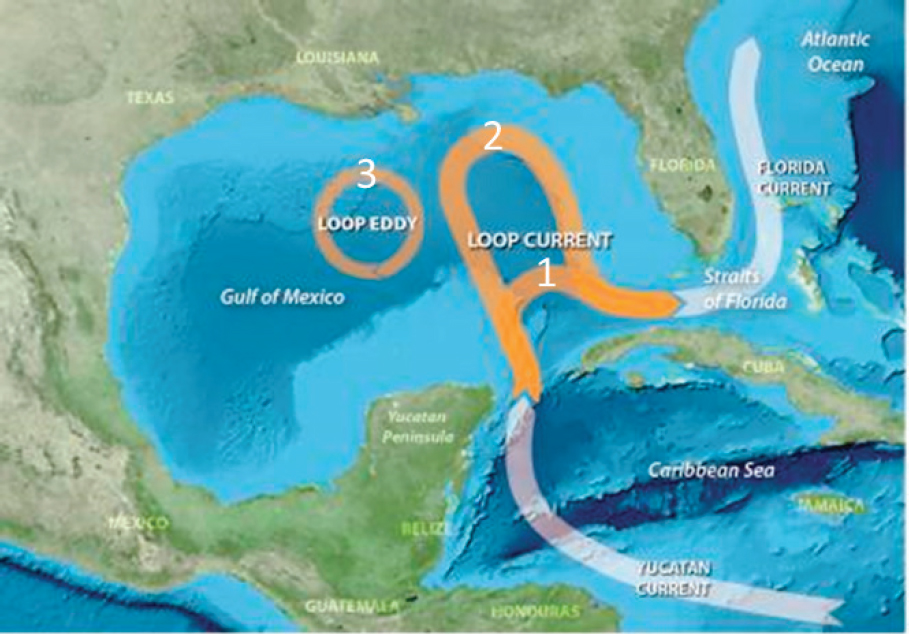
SOURCES: UCAR and NASA. https://www2.ucar.edu/atmosnews/perspective/3968/what-happened-oil.
The committee’s overarching recommendation is to create a comprehensive, long-term, vertically integrated, coordinated set of observations over the climatologically relevant LCS active area. This should lead to new analyses that result in new theory and understanding, which in turn can update model physics and provide opportunities to assimilate more near-real-time data. The campaign recommendation is divided into observational components, technological advancements, data assimilation and modeling, and analyses and theory:
- Observational components:
- A comprehensive, long-term (approximately a decade), LCS active area-wide ocean dynamic observation program that gathers data from the air–sea interface to the seafloor.
- New inflow/outflow investigations with targeted analyses of archival data, especially from international colleagues, and improved access to surface and water column observations in LCS inflow/outflow areas.
- A new investigation of bathymetric effects with targeted analyses of archival data and new access to water column observations across the shelves that bound the LCS area.
- Technology enhancements: Generally, current sensor and vehicle technologies adequately address the observational gaps, but there are opportunities for technological advancements to more affordably and reliably observe the LCS in a more relevant and timely manner for sustained periods.
- Numerical modeling and data assimilation: The gaps in numerical modeling and data assimilation relate first to relevant and timely assimilation of critical data and inclusion of the physical expressions that reflect new understanding gained by an improved observational program in the full water column, at the
-
inflow/outflow points, and as bathymetry affects LCS variability. Since observations will always be limited, the utilization of uncertainty predictions, multivariate data assimilation schemes, efficient adaptive sampling, and accurate Bayesian inference are equally important.
- Analyses and theory: The new observational wealth resulting from the proposed campaign will allow for new analyses and for the testing and emergence of new theories. Together with observations, technology enhancements, data assimilation, and modeling improvments, scientific analyses and theory are the keys to increasing our understanding of LCS dynamics.
The recommendations included in the report are components for a comprehensive campaign directed to the GRP so that it can devote available resources to these efforts through fair, competitive processes. The components are organized into recommended near-term activities and larger campaign-scale activities that will build on the near-term activities. The campaign is envisioned as an international, multi-institutional, collaborative effort designed to support an approximately decade-long campaign of targeted observations. Rough cost estimates based on committee experience are, over the span of a decade, in the $100–$125 million range.
The report concludes with the committee’s advice to the GRP on a set of campaign-related solicitations. The advice may be viewed in four principal parts: recommendations on several near-term funding opportunities for initial observations and studies that will better inform the campaign at large; advice on the major campaign solicitation, including selection process alternatives and organizational relationships between the GRP and its campaign performers; advice on the wide range of collaboration opportunities with various potential partners over the next decade; and estimated costs of carrying out the campaign, including procurements, operations and maintenance, data management, overall management and administration, scientific analyses, and data assimilation/modeling tasks.
- The GRP should work closely with the appropriate Mexican institutions, in the near term, to keep the Yucatan Channel and Florida Straits mooring arrays operating beyond 2018 (for the next decade) with appropriate data sharing; the Yucatan Channel array should take priority over the Florida Straits array.
- HF radars should be procured and operated to provide new real-time data, in the near term, for model assimilation and validation and to better understand complex and variable surface inflow/outflow regions.
- The GRP should advocate that Mexico install and operate at least two HF radar systems in the inflow area, one looking north (from the Cozumel Island area) and at least one looking across the inflow from the upper Yucatan Peninsula. If operational support is not available within Mexico, support for these radars and real-time sharing of their data output should be negotiated.
- The data from the Bureau of Ocean Energy Management (BOEM)-Mexico project time frame should be analyzed specifically to better understand the effect of bathymetry on LCS behavior. Furthermore, in the near term, attempts should be made to access the data from these moorings from the 2011–present time period, and to negotiate terms to keep these mooring arrays in operation beyond 2018 (for the next decade).
- A linear array of four to six moorings should be deployed in the water column to observe temperature and currents in depths from 75 to 1,000 meters, on the southwestern extent of the West Florida Shelf, north of the Dry Tortugas. This moored array should be sustained for several years to cover the evolution of several LCS extension-relaxation cycles.
- Secondary to Recommendation 13, deploy a similar cross-shelf array (a) seaward of the Florida “Big Bend” along 28.5° North Latitude, and (b) west of the south Louisiana “Bird’s Foot.”
- A single real-time mooring should be deployed, in the near term, at the “pressure point” (Liu et al., 2016), or at the shelf break region, just to the northwest of the Dry Tortugas, to get the long-term observational effort started earlier and to confirm times regarding when the LC is driving the West Florida Shelf circulation, a phenomenon hypothesized to also be controlling the LC itself.
- In the near term, a team of scientists and engineers familiar with acoustic data communication networks should be supported to determine the feasibility of designing (and, if feasible, building) an acoustic data communication network that might be adopted by bottom-moored arrays and provide near-real-time data to the surface in an affordable manner, considering the specific acoustic environment in the LCS campaign area.
- As funding may allow, a demonstration of near-real-time data collection from deep instruments using autonomous surface vehicles (ASVs), or similar technologies, should be discussed, and, if funded, the data should be assimilated to inform their value to model skill.
- The GRP-supported campaign should demonstrate sustained operation of HF radars mounted on moored buoys or other platforms in the Gulf from which there can be reliable communication to shore.
- The GRP-supported campaign should be open to adopting new technologies (e.g., larger gliders, hybrid gliders, new power sources, new guidance algorithms, shore launch and retrieval, and emerging long-endurance autonomous underwater vehicles [AUVs]) in its sensing fleet as the campaign matures.
- The GRP should advocate with funding agencies, inside and outside of governments, for the creation of a national glider training syllabus and certification program.
- Data assimilation and modeling experts should be brought into the program at the onset of the campaign.
- A new skill assessment among existing Gulf prediction systems should be completed in the near term to test current model performance in resolving both surface and subsurface circulation, to test long-range prediction capabilities, and to better inform the campaign’s final design.
- Modeling tasks funded under the GRP should be given the latitude and encouraged to adopt new methods as they mature.
- The GRP should actively solicit cost sharing or other computer center collaborations to ensure that the results of the campaign can be supported continually and operationally.
- The GRP campaign should encourage the development and testing of the statistical and stochastic modeling approach, especially for the mid- to long-range (a few months and beyond) prediction of the LCS.
- Numerical modelers should be consulted in developing the specific observational programs’ design, and that “adaptive sampling,” based on model results, be continually practiced throughout the campaign, especially for those observational subprograms that have a choice in timing, areas of deployment, and vertical/horizontal spacing.
- In the near term, the GRP should support a desktop-style study to digitally compile (and make publicly accessible) physical oceanographic data from Gulf of Mexico field studies carried out between 2002 and 2018.
- Science teams should be engaged early in the campaign process and campaign leaders should encourage focused process studies and the testing of new theories.
- By the close of this project, success should be measured by the ability to predict currents (including uncertainty) in the LCS active area and in areas where the LCEs propagate. The committee recommends a hierarchy of forecast periods, matched to the relevant processes and regions of interest:
- Improve predictive skill in forecasting the LC and/or LCE current speed, vertical structure, and duration in the oil/gas operating area out to a forecast period of days to 1 week
- Improve predictive skill in forecasting the extension of the LC (location and duration) and LCE propagation out to a forecast period of approximately 1 month
- Improve predictive skill in forecasting an eddy shedding event from an extended LC out to a forecast period of approximately 3 months
- As the crafting of the funding opportunity matures, the GRP should engage stakeholders, including federally operated and sponsored organizations, Mexican and Cuban agencies, and private institutions and industry, to discuss the campaign goals, explain the opportunities it supports, bring the ocean modeling community into the planning early, and explain the legal restrictions associated with the GRP funds.


