Bus Operator Workforce Management: Practitioner's Guide (2023)
Chapter: Appendix C - Additional Methodology Materials
APPENDIX C
Additional Methodology Materials
This appendix contains the following materials:
- Interview guide for stakeholders and industry experts
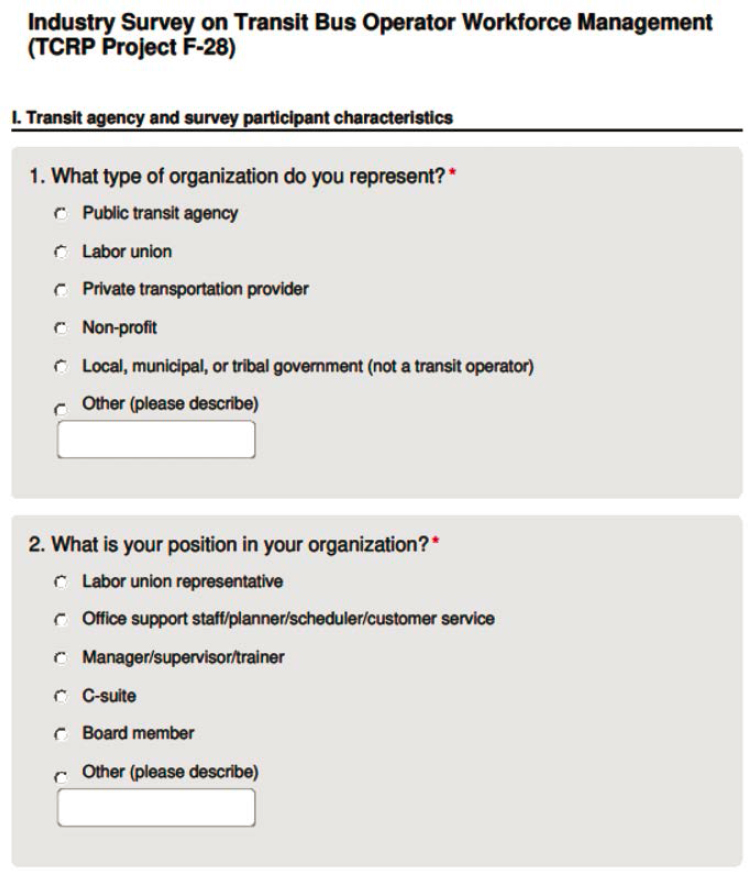
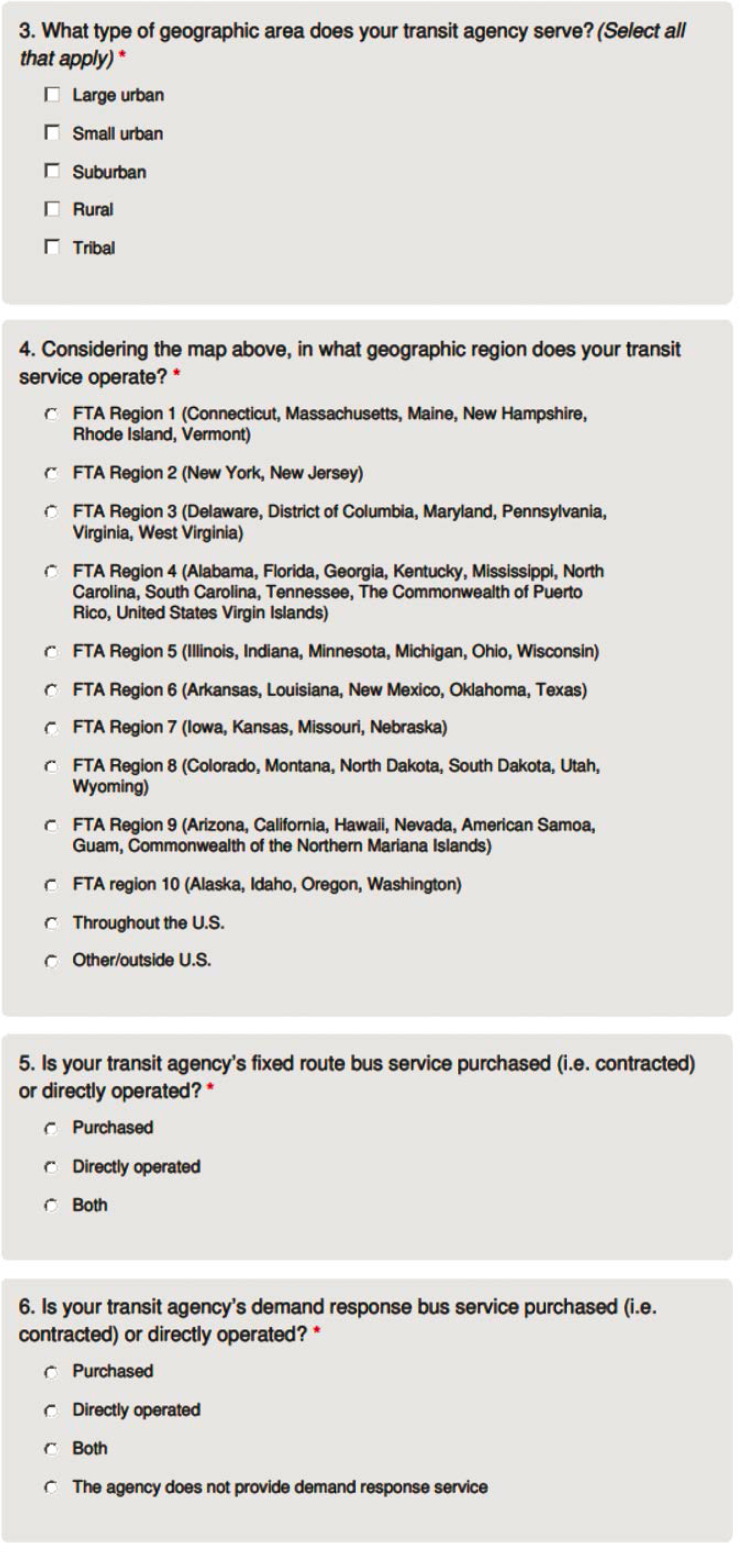
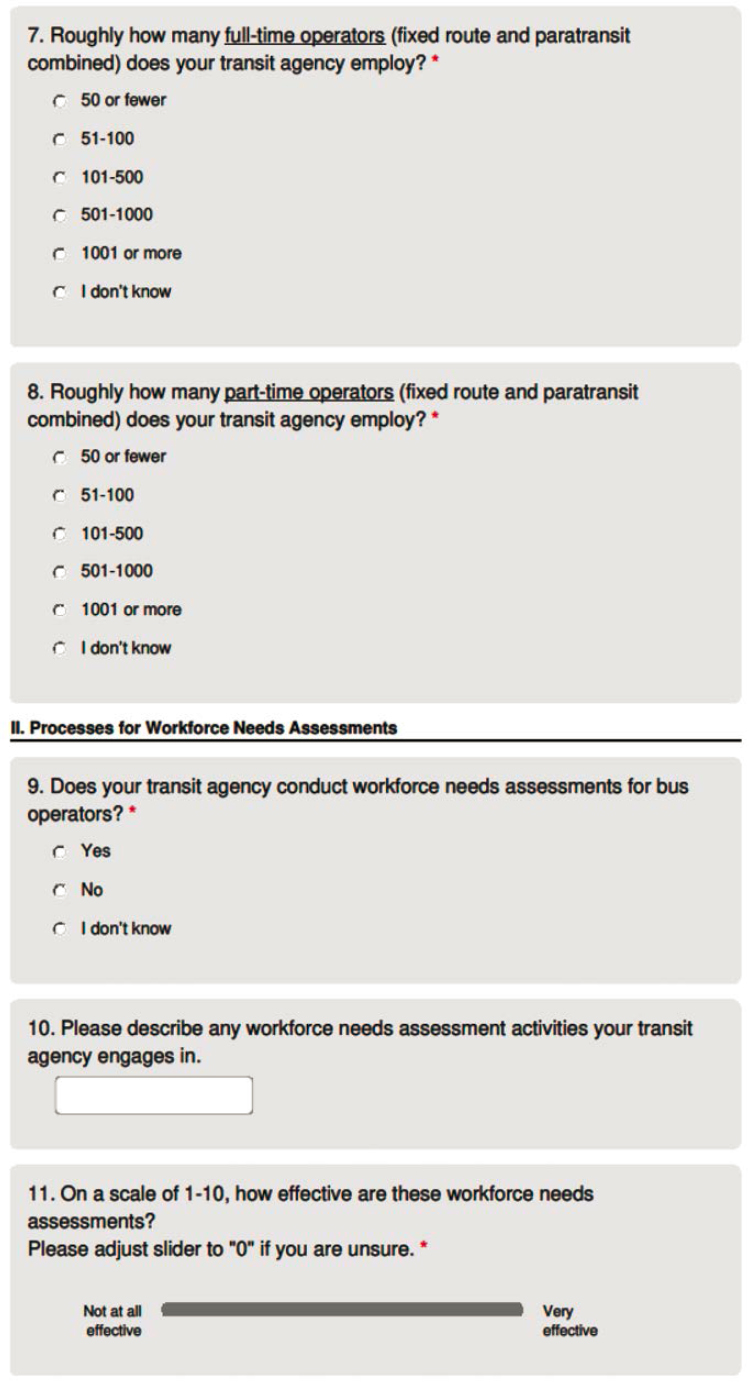
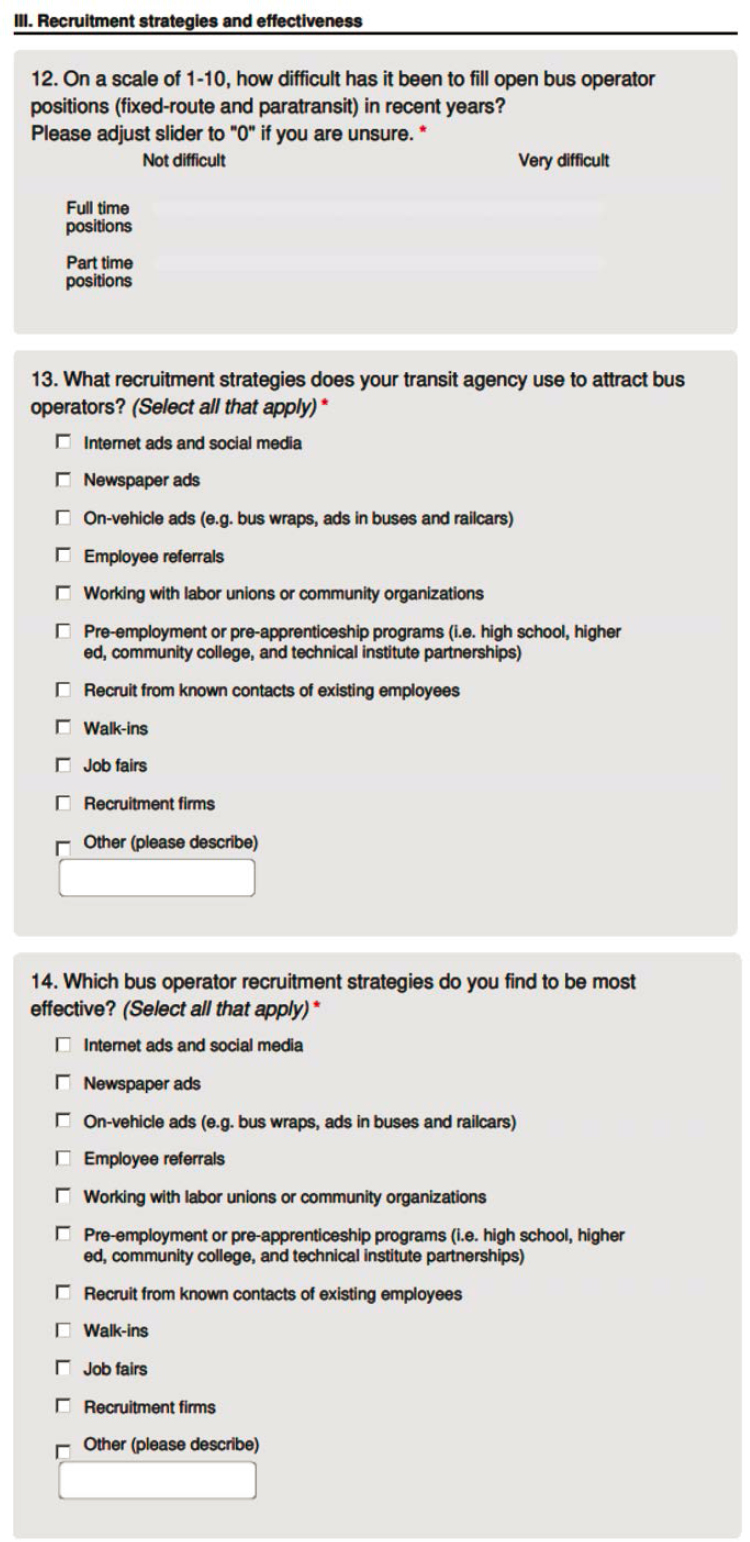
- Industry survey questions
- Case Study selection criteria
- Case Study interview guide
Interview Guide for Stakeholders and Industry Experts
At the beginning of each interview with stakeholders and industry experts, the team members introduced themselves, explained the goals of the study, and discussed how the interviewees’ information would be used. The team had a consistent set of questions that were asked, although the team customized its questions based on the transit agency’s programs and the answers to the research team’s questions.
The introductory remarks and the questions follow.
Introductory Remarks
Thank you for participating in this research for TCRP project F-28. My name is XX, and I am [title] at [organization]. This project is led by the Eno Center for Transportation, and the research partners are the Transportation Learning Center and Melissa Huber.
The goal of this project is to develop a practitioner’s guide to bus operator workforce management that reflects current practices for how agencies foster and sustain a culture of workforce innovation. This guide will address all aspects of workforce management for bus operators, namely operator workforce needs assessment methods, recruitment, operator selection and onboarding, training and mentoring, compensation, working conditions, safety and health, and retention and motivation. It will serve transit agencies of all sizes throughout the United States.
You were chosen to participate in this research because you are an expert on transit operator workforce development and management issues. We value your candid insight on workforce management practices, as well as your input on the kind of information that would be helpful to include in a practitioner’s guide. Our conversation will be off the record, and your name and institution will not be listed in our report.
Questions to Interviewees
Note to interviewer: Reference the stakeholder interviewee list for areas of expertise of each interviewee (e.g., rural/tribal, small urban, medium, large agencies; management or union; safety and health focused or training and development focused). Explore along those particular angles and ask probing questions. Ask interviewee to identify location for best practices whenever possible.
- Can you describe your background and experience related to transit operator workforce management?
- Generally, what are the major factors that affect transit operator workforce management? (New technologies: AV, ZEB, new on-board electronics, new farebox payment systems; Transit ridership; Workforce demographics; New service models; Labor Market; Social and political factors)
- Small/rural: Are these unique to small agencies?
- Large/urban: Are these unique to large agencies?
-
Workforce needs assessment:
- At an industry level, do you think there will be large shifts in the number of fixed route bus and paratransit operators needed in the next 5 to 10 years?
- If so, what are the causes? What are the implications?
- How are agencies/unions coping with these potential changes?
- At the agency level, what methods do transit agencies use to assess their operator workforce needs (# of operators needed to complete routes)?
- Are there best practices you would recommend that we look into?
-
Recruitment:
- From your observations, what are some key issues and challenges agencies face around operator recruitment?
- Have these issues and challenges changed over time (last 10 to 15 years)?
- What recruitment strategies have proven to be successful in addressing these challenges?
- Are there best practices you would recommend that we look into?
-
Application, selection, and onboarding:
- What are some key issues and challenges relating to operator application, selection and onboarding?
- Have these issues and challenges changed over time?
- How are agencies/unions addressing these issues?
- Are there best practices you would recommend that we look into?
-
Operator training and development:
- What are some key issues and challenges relating to operator training and development?
- Have these issues and challenges changed over time?
- How are agencies/unions addressing these issues?
- Are there best practices you would recommend that we look into?
-
Compensation:
- What are some key issues and challenges surrounding operator compensation?
- Have these issues and challenges changed over time?
- What helps to create a desirable operator compensation package (length of time to top pay, benefits, etc.) for both recruitment and retention purposes?
- Are there best practices you would recommend that we look into?
-
Work schedules and working conditions:
- What issues and challenges do bus operators face in the areas of work schedules, working conditions and safety/health?
- Have these issues and challenges changed over time?
- How are agencies/unions addressing these issues?
- Are there best practices you would recommend that we look into?
-
Retention and motivation:
- What are some key issues and challenges relating to bus operator retention?
- Have these issues and challenges changed over time?
- What methods have agencies and unions used to engage operators, boost morale and increased retention?
- Are there best practices you would recommend that we look into?
- How could a practitioner’s guide help transit agencies and unions implement the best practices we have discussed so far?
Industry Survey Questions
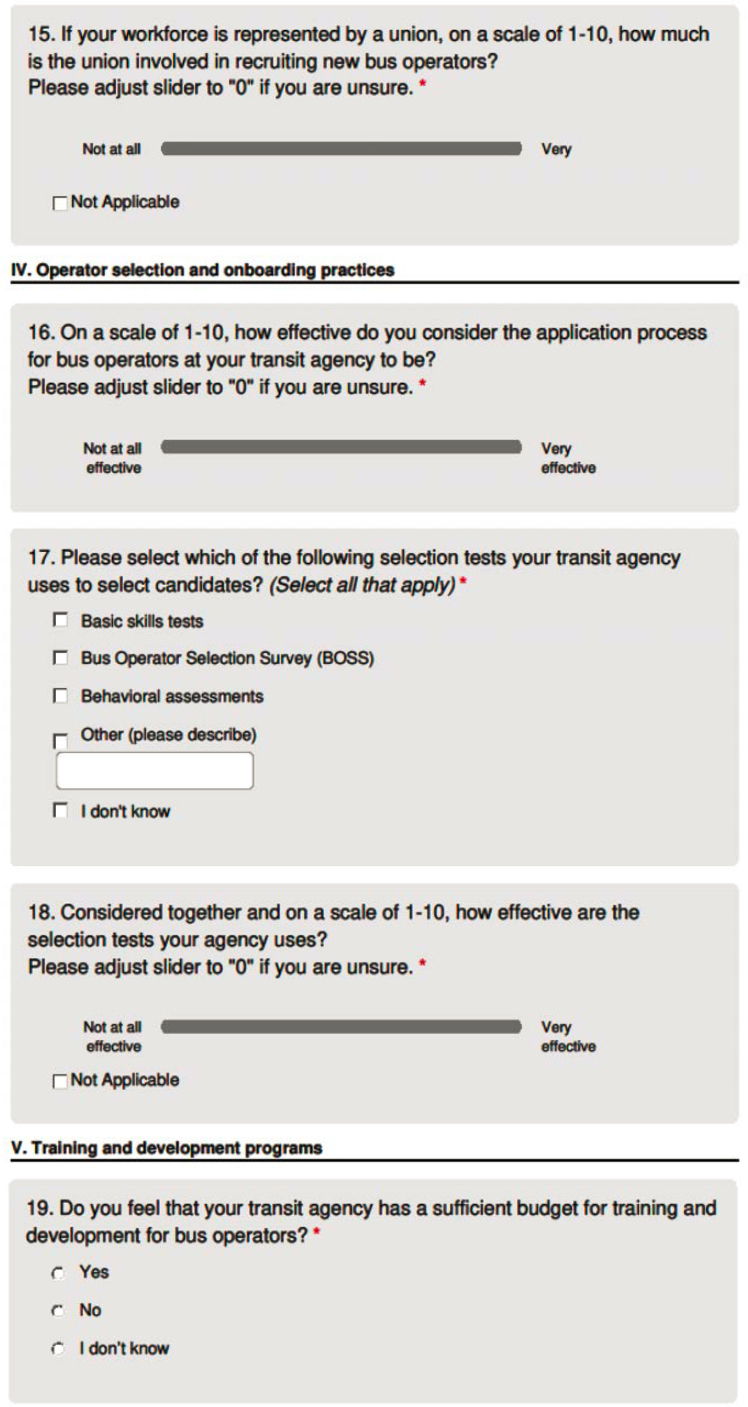
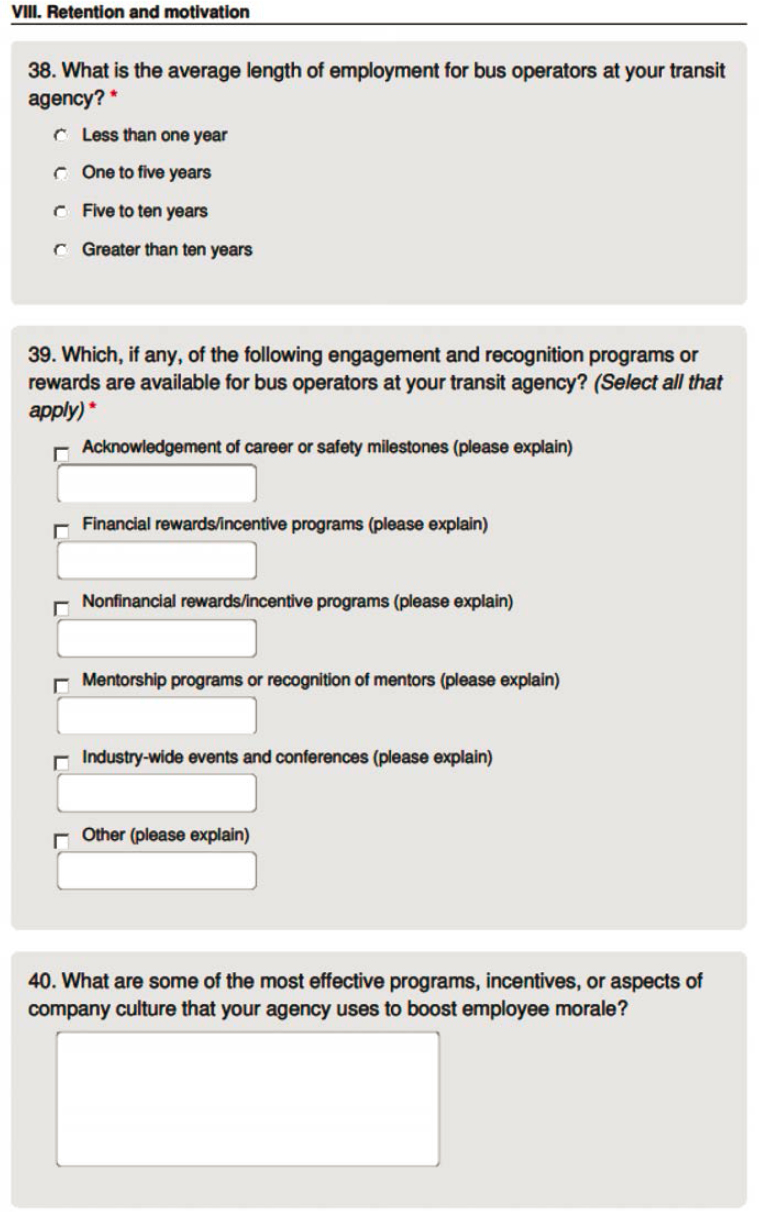
The research team designed an industry survey to gather information on the current state of bus operator workforce management programs, policies, and related workplace initiatives as well as management and labor perspectives on bus operator workforce conditions and programs.
Questions included a mix of multiple choice, sliding scale, and open-ended formats. While many questions required a response from the survey-taker, some did not. Thus, the total number of responses may vary between questions. The survey questions, as presented via Survey Monkey, follow.




Case Study Selection Criteria
This Practitioner’s Guide contains case studies about seven transit agencies. The research team selected these seven transit agencies based upon the following criteria: diversity of size and geography, a demonstration of innovative and effective programs, insight into more than one topic area of workforce development, an opportunity to hear from multiple perspectives at a transit agency, and survey responses.
Diversity in “Descriptive” Factors
The team ensured that case studies represented different characteristics of bus transit providers, including a range of geographic area sizes (large urban, small urban, suburban, rural, and tribal) and geographies (i.e., FTA regions 1–10); a mix of service that is directly operated, contracted, or both; and a mix of transit agency sizes based on the number of operators employed.
Demonstrated Innovative and Effective Programs
Based on analysis from the literature review, interviews, focus group discussions, and survey phases of research, the team identified prime candidates for case studies. These candidates employed novel practices and/or were seen as having effective practices. For example, the research team paid close attention to the open-ended responses to the survey, such as answers to questions like “In your opinion, is there sufficient training for bus operators beyond the initial onboarding phase at your transit agency?” and “What are some of the most effective programs, incentives, or aspects of company culture that your agency uses to boost employee moral?” In the interviews and focus group, the research team also specifically asked about effective programs or methods to address challenges.
Insightful Practices in More Than One Topic Area of Workforce Development
Once the research team identified a transit agency that was deemed particularly strong in one area of bus operator workforce development and management, the team considered the transit agency’s efforts in other topic areas and gave preference to transit agencies that were effective in more than one topic area of workforce development and management. For example, if a transit agency was identified as a potential case study due to their best practices in bus operator recruitment, the team then considered whether they had effective practices in other areas, like training and development.
Multiple Perspectives
The research team identified transit agencies from which they could gather multiple perspectives. In particular, the team sought to gather perspectives from labor and management in each case study. Management perspectives sought included CEOs and/or general managers, directors of human resources, and directors of training. For transit agencies that are represented by one or more unions, the team sought to gather input from all unions representing the bus operator workforce at that transit agency.
Survey Responses
From survey data, the team evaluated responses that indicated particularly promising or effective programs in the various research topic areas. The team selected transit agencies whose answers are indicated in bolded text.
Workforce needs assessments:
- On a scale of 1–10, how effective are these workforce needs assessments? Answered 5 or above Recruitment:
- On a scale of 1–10, how difficult has it been to fill open full-time bus operator positions (fixed-route and paratransit) in recent years? Answered 4 or below
Application, selection, onboarding:
- On a scale of 1–10, how effective do you consider the application process for bus operators at your transit agency to be? Answered 5 or above
- Considered together and on a scale of 1–10, how effective are the selection tests your agency uses? Answered 5 or above
Training and development:
- In your opinion, is there sufficient training for bus operators beyond the initial onboarding phase at your transit agency? Answered yes, provided thoughtful explanation
- Does your agency offer career ladder programs to provide bus operators with the ability to move up within an organization? Answered yes, provided thoughtful explanation
Compensation:
- How frequently does your transit agency conduct assessments on livable wages in your geographic area? Answered “annually” or “between every one and three years”
- How frequently does your transit agency conduct wage comparisons with other similar and major employers or industries in your geographic area? Answered “annually” or “between every one and three years”
- What is the length of employment required for operators to receive top pay at your transit agency? Determine average, then filter by anything below the average
Health and safety:
- Have collisions involving your buses been increasing, decreasing, or stable over the past five (5) years? Answered decreasing
- Have bus operator physical confrontations with passengers been increasing, decreasing, or stable over the past five (5) years? Answered decreasing
Work schedules and working conditions:
- How many days in advance do new bus operators know their work schedule? Answered “At least one week” or something more frequent
Case Study Interview Guide
The research team interviewed transit agency representatives to develop the seven case studies. At the beginning of each interview, the team members introduced themselves, explained the goals of the study, and discussed how the interviewees’ information would be used. The team had a consistent set of questions that were asked, although the team customized its questions based on the transit agency’s programs and the answers to the research team’s questions.
Introductory Remarks
Thank you for participating in this case study research for TCRP Project F-28. This project is led by the Eno Center for Transportation, and the research partners are the Transportation Learning Center and Melissa Huber.
The goal of this project is to develop a practitioner’s guide to bus operator workforce management that reflects current practices for how transit agencies foster and sustain a culture of workforce innovation. This guide will address all aspects of workforce management for bus operators, namely operator workforce needs assessment methods, recruitment, operator selection and onboarding, training, and mentoring, compensation, working conditions, safety and health, and retention and motivation. It will serve transit agencies of all sizes throughout the United States.
You were chosen to represent [transit agency or region name] in a case study in this research because you are an expert on transit operator workforce development and management issues. We are particularly interested in gaining insight into your transit agency’s experience with [list topic area strengths, like recruitment]. We value your candid insight on workforce management practices, as well as your input on the kind of information that would be helpful to include in a practitioner’s guide. Our conversation today will last for one hour and will be on the record. We are also interviewing other representatives from your transit agency as part of this research. Your institution will be highlighted as a case study in our report, though your name will not be listed.
Questions to Transit Agency Representatives
Workforce Needs Assessment
- What methods does your transit agency use to calculate the number of bus operators (full-time and part-time, if applicable) required to provide transit services now and in the future? (e.g., information on schedule adherence, season, absenteeism, and overtime)
- Do you conduct workforce forecasting activities to anticipate future workforce needs? What specific tools do you use?
- What workforce needs assessment methods do you consider to be most effective at your transit agency?
Recruitment
- What recruitment methods do you consider to be most effective at your transit agency? Have you had success hiring from within for operators? If so, which positions?
- What are some of the challenges your transit agency faces with recruitment, and how have you addressed them?
- Does your transit agency use pre-employment opportunities (e.g., vocational or educational programs) for outreach as part of your recruitment methods?
- How have your recruitment methods changed over time? How have recent technological developments impacted the recruitment process?
- How has the COVID-19 pandemic affected bus operator recruitment at your transit agency?
- Are your transit agency’s bus operators represented by a union? How is the union involved in
- bus operator recruitment?
Selection and Onboarding
- Application and Selection:
- What application and selection methods do you consider to be most effective at your transit agency?
- What assessment tests does your transit agency use to select bus operators? What are the benefits and drawbacks of these approaches?
- How have application and selection processes changed over time at your transit agency? How has technology impacted this process?
- What are some of the challenges your transit agency faces with applications and selection process, and how have you addressed them?
- What role does collaboration (between different departments within the transit agency, with external stakeholders, and between the union and the transit agency) play in the process of application and selection of bus operators?
- Onboarding:
- What onboarding methods do you consider to be most effective at your transit agency?
- How have your onboarding methods changed over time? How has technology impacted this process?
-
- What are some of the challenges your transit agency faces with onboarding of new employees, and how have you addressed them?
- What role does collaboration (between different departments within the transit agency, with external stakeholders, and between the union and the transit agency) play in the process of onboarding bus operators?
Training and Mentoring
- What mandatory and optional training offerings does your transit agency provide for bus operators, and what makes these programs successful? What, if anything, could be improved?
- How does your transit agency plan for training?
- Are your training programs delivered using in-house staff or outside organizations? How are the trainers and mentors trained?
- Do you have a sense of the cost of training per operator? How does your transit agency ensure that training receives adequate funding each year? What happens if funding for training is insufficient?
- Does your transit agency offer a mentorship program for bus operators? Please describe.
- Does your transit agency offer any career ladder programs for bus operators or prospective bus operators? Please describe.
Compensation
- Does your transit agency offer incentives to attract and retain bus operators? If so, what are these incentives, and how are they funded?
- What do the benefits (traditional, as in healthcare and retirement; and non-traditional, as in employee appreciation days) look like for full-time bus operators at your transit agency? How do new bus operators learn about their benefits?
- Does your transit agency employ part-time bus operators? If so, how do this group’s compensation and benefits differ from full-time bus operators?
- Are there issues that arise between senior and entry-level operators because of wage inequities? If so, how does your transit agency handle them?
Working Conditions
- What are some of the effective programs your transit agency has in place to maintain bus operator health and wellness?
- What steps does your transit agency take to minimize bus operator injuries due to passenger assaults, crashes, or other on-the-job incidents?
- What efforts does your transit agency take to maintain a safe working environment?
- What access to restrooms do bus operators have while on duty? How are the timing and location of restroom breaks determined?
- What other employer-provided amenities do bus operators have access to (e.g., childcare options, comfortable break rooms)?
- How do bus operators communicate concerns about working conditions?
Retention and Motivation
- What retention methods do you consider to be most effective at your transit agency?
- What are some of the challenges your transit agency faces with retention, and how are you addressing them?
- What programs (e.g., mentorship, employee recognition) does your transit agency offer to increase employee morale? What efforts do you take to be viewed as “an employer of choice” in your community?


