First, Do No Harm: Marshaling Clinician Leadership to Counter the Opioid Epidemic (2017)
Chapter: What Are the Associated Characteristics of Those with Opioid Use Disorder?
WHAT ARE THE ASSOCIATED CHARACTERISTICS OF THOSE WITH OPIOID USE DISORDER?
Persons with opioid use disorder do not fit a generalizable profile. Where studies in the 1970s and 1980s characterized the heroin problem as one primarily of urban minority populations (DuPont, 1971), today’s heroin users are more typically white men and women who were introduced to opioids through prescription drugs (Cicero et al., 2014). Overdose rates are higher in non-Hispanic whites than in African Americans or Hispanic Americans (Anderson et al., 2009; Ghandour et al., 2008; HKFF, 2015; Ringwalt et al., 2015). Men were previously more likely than women to die from opioid overdoses, but the gap is narrowing (CDC, 2015). Because the highest rates of overdose deaths occur among those ages 25 to 54, the recent and unexpected increase in death rates and decreases in life expectancy among middle-aged white men and women in the United States is ascribed in part to the rise in drug overdose deaths (Case and Deaton, 2015).
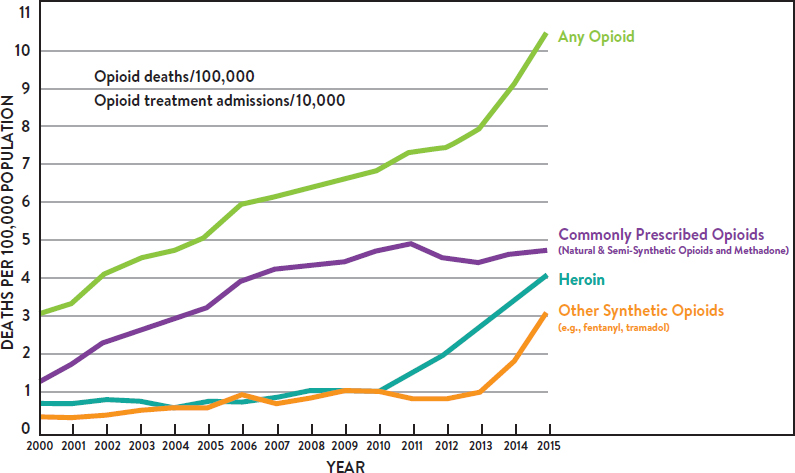
SOURCE: CDC, 2017a.
Previously, deaths involving opioid analgesics in rural areas outpaced those in cities (Keyes et al., 2014; Paulozzi and Xi, 2008), but rates for overdoses overall are beginning to even out. Disparities also exist among populations with respect to access to both pain management and treatment for opioid use disorder, as it
