Connecting Efforts to Support Minorities in Engineering Education: Proceedings of a Workshop (2023)
Chapter: 3 Sponsors of Programs for Minority Engineers
3
Sponsors of Programs for Minority Engineers
Eric Ducharme (GE Aviation, retired), cochair of the workshop planning committee and panel moderator, began the session by saying that “GE has a strong foundation of supporting education in the communities where they have a presence.” He discussed the GE Foundation’s Next Engineers Program,20 a $100 million program launched in 2021 with the eventual goal of engaging 85,000 students in 25 countries. Next Engineers has three programs and is being piloted in Ohio, South Carolina, South Africa, and the United Kingdom. For 13- to 14-year-old students, Engineering Discovery focuses on creating and building awareness about the engineering profession through short explorations. The weeklong Engineering Camp (ages 14–15) provides students the opportunity to interact with engineering faculty, staff, and business leaders as they complete design challenges. And Engineering Academy is a 3-year program that engages students ages 15–18 for approximately 80 hours each year outside of school time on topics like engineering design, creativity, problem solving, and teamwork. Students who complete the Engineering Academy program and are accepted to a postsecondary engineering program receive a $20,000 scholarship.
Lorelle Espinosa (Alfred P. Sloan Foundation) was the first panelist. The Sloan Foundation, she explained, “makes grants primarily to support original research and education related to science, technology, engineering, mathematics, and economics,” and the goal of the Sloan Higher Education Program is “to create diverse, equitable, and inclusive pathways to and through STEM graduate education and professoriate.”
She discussed two commissioned landscape scans: Assessing the Landscape for DEI Efforts in US STEM Graduate Education and Investments in DEI in STEM Higher Education Pathways;21 Figure 3-1 illustrates three levels of actors working on DEI initiatives in STEM higher education pathways. Espinosa reported that the sources of the largest DEI investments (shown in STEM zone 1 at the center of the ring) are NSF, (e.g., INCLUDES), professional societies like NSBE, and alliances such as the 50K Coalition. Another set of influential entities, though with a less concentrated focus on DEI, are private philanthropies such as the Sloan Foundation. In the outer ring are influential entities such as private corporations that are least focused specifically on DEI.
___________________
20 https://www.nextengineers.org/
21 Both documents are available at https://sloan.org/programs/higher-education/diversity-equity-inclusion/dei-literature-review-landscape-scan
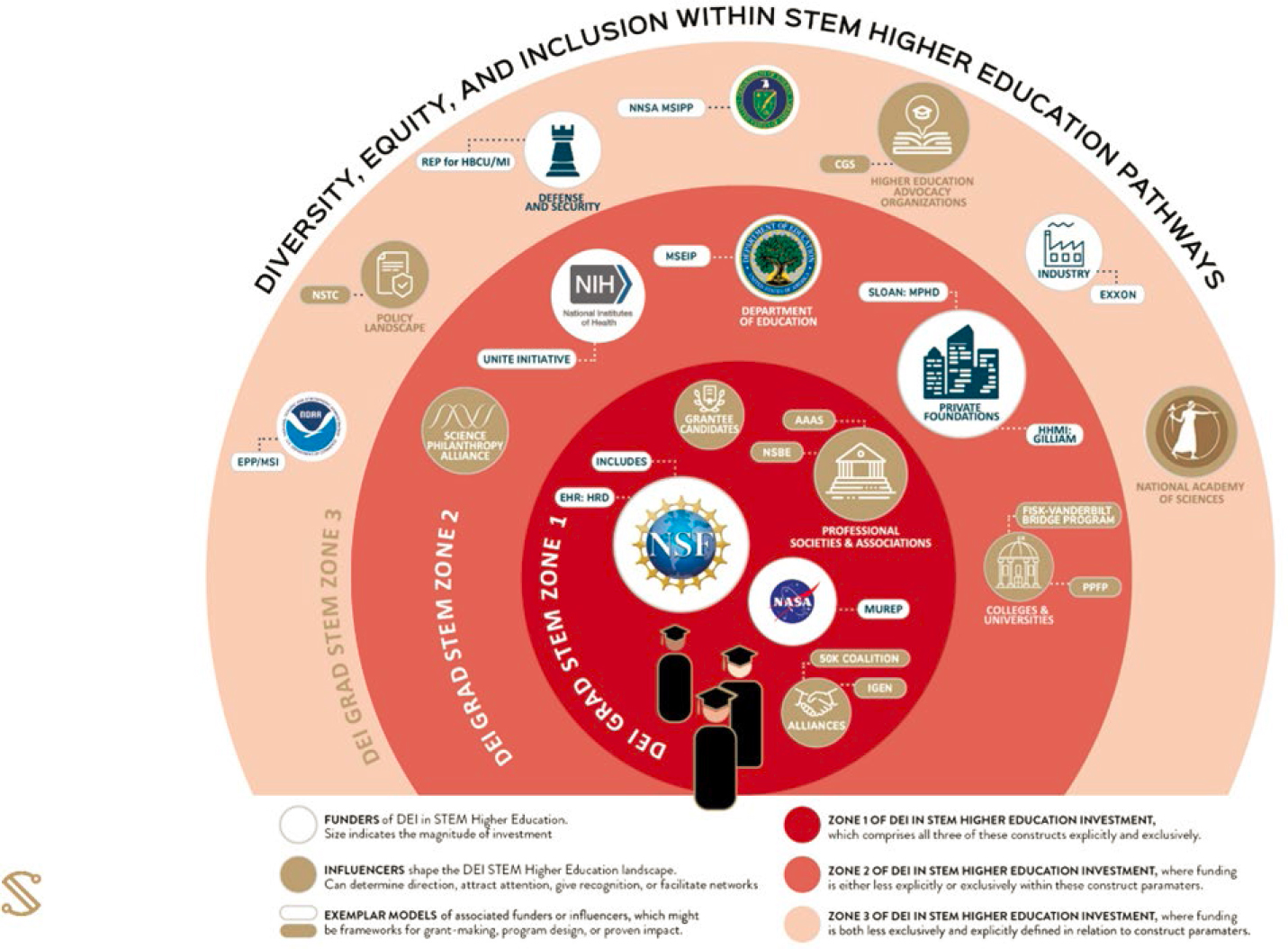
SOURCE: Presented by Lorelle Espinosa on March 18, 2022.
Espinosa then discussed gaps in grant-making approaches and investments, noting that funding declines as educational pathways progress, so, compared to K-12 and undergraduate funding, “there is dramatically less at the graduate level and the professoriate,” which is why Sloan focuses on graduate education and professoriate. “It’s also the case that investments overall are largely focused on the individual and not on the systems and the cultures within which these individuals reside,” she explained, adding that funding for DEI efforts in STEM higher education is not evenly distributed across US institutions but tends to remain in a relatively small number of institutions.
Turning to the literature review of effective practices to reduce disparities, support inclusion, and increase diversity in STEM pathways, Espinosa cited three main types of practices: (1) interventions serving individual students (e.g., financial support, research experiences), (2) institutional change efforts (e.g., professional development for students and faculty, changes in institutional policies or practices), and (3) efforts to enhance structures of support (e.g., advising and mentoring support).
She then described Sloan’s strategic priorities for funding at the graduate level: in addition to widening pathways to and empowering universities to transform graduate education, Sloan prioritizes funding to “pursue innovative efforts to diversify the STEM professorate.” She explained that the foundation considers racial equity and “look[s] through a lens of systemic
change when we make our grants,” examining internal practices to ensure that Sloan is “not reinforcing inequities in the way that we do our grant making.” To accomplish these priorities, three of Sloan’s approaches are to bring a systemic change lens to grant making, invest in Minority Serving Institutions (MSIs) as well as institutions with a demonstrated record of recruiting and graduating students of color in STEM fields, and “collaborate and coordinate with other funders” to achieve greater impact.
Espinosa described Sloan’s signature initiatives like the University Centers of Exemplary Mentoring (UCEM)22 program, which provides financial support, structured mentoring, and supportive community for students; and the Sloan Indigenous Graduate Partnership23 program, which seeks to “strengthen and expand university initiatives to recruit, train, and graduate Indigenous students through student scholarships and strong community support.” This program, she clarified, strives “to improve outcomes not only educationally but also as they pertain to the Indigenous communities” touched by the program. In addition, she talked about a program called Creating Equitable Pathways to STEM Graduate Education,24 which seeks to support pathways for Black, Indigenous, and Latine students from MSIs to STEM MS and PhD programs.
Christine Grant (NSF) discussed the Broadening Participation in Engineering (BPE)25 program in the Engineering Education and Centers of the NSF Directorate of Engineering. BPE “seeks to strengthen the future of the engineering workforce” by “increasing access to engineering, understanding the barriers, and transforming engineering cultures,” she said. The program focuses on individuals from populations that have been traditionally minoritized and marginalized in engineering and has four tracks: (1) planning and conference grants, which range from $50K to $100K; (2) research on BPE, with grants between $300K and $400K; (3) inclusive mentoring hubs, for which grants are approximately $800K; and (4) Centers for Equity in Engineering that award up to $1.2M. The latter two tracks are new BPE initiatives.
Grant cited some funded projects of the BPE portfolio: A Qualitative Study on Latina/o Persistence In and Beyond the Degree,26 Disrupting the Status Quo Regarding Who Gets to Be an Engineer,27 a report from the Association of Public and Land-Grant Universities on the status of broadening participation in engineering education,28 and the 2021 NAE workshop Sharing Exemplary Admissions Practices That Promote Diversity in Engineering.29
She also discussed a program called Historically Black Colleges and Universities – Excellence in Research (HBCU – EiR),30 whose goals are to increase support for researchers at HBCUs, improve research opportunities for students, and enhance research capacity at these institutions. Another NSF-funded program, administered by ASEE, is eFellows,31 which
___________________
22 https://sloan.org/programs/higher-education/diversity-equity-inclusion/minority-phd-program
23 https://sloan.org/programs/higher-education/diversity-equity-inclusion/sloan-indigenous-graduate-partnership
24 https://sloan.org/programs/higher-education/diversity-equity-inclusion/equitable-pathways-loi
25 https://beta.nsf.gov/funding/opportunities/broadening-participation-engineering-bpe-1
26 https://www.nsf.gov/awardsearch/showAward?AWD_ID=1734967
27 https://www.nsf.gov/awardsearch/showAward?AWD_ID=2042377&HistoricalAwards=false
28 https://www.nsf.gov/awardsearch/showAward?AWD_ID=1734899&HistoricalAwards=false
29 https://www.nae.edu/224594/Workshop-on-Sharing-Exemplary-Admissions-Practices-that-Promote-Diversity-in-Engineering-
30 https://beta.nsf.gov/funding/opportunities/historically-black-colleges-and-universities-excellence-research-hbcu-eir
supports postdoctoral researchers. She also mentioned the NSF INCLUDES program, designed “to enhance US leadership in science and engineering by developing STEM talent from all sectors of our society,”32 and the foundation’s partnership with the National Aeronautics and Space Administration in a program focused on building MSI-led coalitions to broaden participation in engineering.
Rosalind Hudnell (Intel Foundation, retired) opened with some background about Intel, which supports students on their engineering education pathways as part of its corporate responsibility. As the foundation “began to really look at diversity and inclusion, we began to look at data and to put more of our emphasis in K-12 and higher education on getting more students of color, particularly African American students, to complete their engineering degree,” she said. She elaborated that, while money matters in addressing these issues, “it was also mentorships and advocacy and policy at the local, state, and national levels that impacted access to education and specifically our ability to channel our resources.”
As the Intel Foundation recognized that “retention rate after the first year is a huge issue for minority students, and for female students, and a particularly huge issue for minority female students,” it decided to dedicate resources to supporting students who had been admitted to a university and expressed an intent to become an engineer. Hudnell explained that Intel’s efforts to retain students in engineering include strong collaborations with higher education leaders, deans of engineering schools, media, and other stakeholders.
She concluded with a call “to rethink what an engineering workforce really is and to figure out ways that we can drive systemic change and how education is delivered from kindergarten all the way through to professors, so that engineering becomes a skill competency” that graduates can use in many different career paths.
DISCUSSION
Ducharme asked the panelists how efforts such as a focus on transition from graduate school to the professoriate can enhance and improve opportunities around mentoring. Hudnell responded that mentoring can be done in a variety of ways, especially to teach young students what engineering is all about and that engineers are people with a variety of interests—such as sports, arts, fashion—besides their technical expertise. Grant added that as she moved forward in her career, “not just peer-to-peer mentoring but cross-cultural mentoring” was significant. She said that “creating a culture of mentoring is really important, celebrating it, and making it something that people get acknowledged for.” Espinosa agreed and added that programs like UCEM, with great models for team mentoring, are critical to creating a culture of mentoring, as is “the right level of continuous training for what it means to mentor in culturally competent ways.”
Taking a question from a workshop attendee, Ducharme asked Hudnell for her thoughts on increasing awareness of interesting engineering work. Hudnell cited a study commissioned by Intel several years ago that showed the “number one factor that indicated whether or not a student is going to go into engineering…was whether they had, while growing up, a consistent adult present in their lives who was already connected to the field.” She said that there may be an opportunity to do better in renaming and rebranding engineering degrees, to help connect the
___________________
dots for young people who are not familiar with engineering through an adult presence in their lives.
Conveying another question from the audience, Ducharme asked the panelists how someone from a predominantly White institution (PWI) learns more about best practices from MSIs and how to build those connections. Grant responded that “MSIs have an amazing track record for mentoring, nurturing, and creating cultures of support for students, for them to go on and be successful in the technological realm.” Both she and Espinosa highlighted the National Academies’ important work on MSIs, particularly the report Minority Serving Institutions: America’s Underutilized Resource for Strengthening the STEM Workforce (NASEM 2019). Espinosa added that “there is a level of intentionality that you find on [MSI] campuses” that has often been called “meeting students where they are or being student centered” and remarked that the rest of higher education can learn from these strengths of MSIs. She emphasized that partnerships have to be meaningful and authentic, not simply a token partnership for the purpose of grant applications. To this point, Grant also stressed the importance of having people from HBCUs at the table designing the programs that are going to be relevant to the communities grantees are trying to impact.
The session’s last audience question was for Hudnell, about the “desire to see a significant increase in internships” for undergraduate and graduate students in industry. She acknowledged that “internships are critical, not just for retention, but in some cases also for financial support and to have an ability to have a really strong resume to get jobs,” but cautioned against the tendency to tie internships to GPA rather than supporting all students in getting an internship.
This page intentionally left blank.


