Connecting Efforts to Support Minorities in Engineering Education: Proceedings of a Workshop (2023)
Chapter: 2 Transitions, Pathways, and Leverage Points for Engineers of Color
2
Transitions, Pathways, and Leverage Points for Engineers of Color
Karl Reid (Northeastern University) began his keynote talk by asking “Why haven’t we seen the transformative changes that one would expect given the amount of resources and efforts in this space?” Using data from the National Science Foundation (NSF),8 he reported that individuals from historically marginalized and minoritized racial and ethnic communities are employed in the STEM workforce in lower numbers compared to their presence in the general population.
Highlighting the efforts of Northeastern University’s Engineering PLUS Alliance,9 Reid discussed the importance of examining and leveraging the transitions from high school to community colleges or 4-year colleges, from community colleges to 4-year colleges, and from undergraduate to graduate study. Specifically, he noted that in the United States in 2020 30 percent of the associate’s degree holders but 20 percent of bachelor’s (BS) and 9 percent of master’s (MS) and PhD degrees in engineering were awarded to students from historically minoritized and marginalized populations. On the positive side, he said there is an opportunity to improve the diversity of bachelor’s and graduate degree holders by engaging students studying engineering at the community college level.
“We ration education based on race and socioeconomics in the United States. The quality of the teachers, the proficiency of the teachers, whether a student is assigned to special education—all of those things are rationed,” said Reid, adding that these are “social determinants of education.” Using Figure 2-1, he explained that these social determinants result in skill deficits in early years of education that compound in middle school, hindering high school preparation. “And then of course these things compound at the high school level as well,” Reid added, because “we ration STEM education. If you are in a high-minority district, you are only 50 percent likely to have the full complement of math and science in your high schools.” As students progress through their education pathways, these structural issues and the ways individuals respond to them result in lack of both college preparation and persistence to graduation.
___________________
8 The State of US Science and Engineering 2020 | NSF - National Science Foundation. Available at https://ncses.nsf.gov/pubs/nsb20201/u-s-s-e-workforce.
9 Information about the Engineering Plus Alliance is at https://engplusalliance.northeastern.edu/.

SOURCE: Presented by Karl Reid on March 18, 2022.
Reid pointed out that there’s no shortage of best practices and solutions to overcome some of the challenges to broadening pathways to engineering. He cited a 2016 National Society of Black Engineers (NSBE) position paper, Paving the Way: Institutional Interventions for Academic Excellence and Success in Engineering,10 which presented nine engagement strategies based on universities identified as successful in graduating students from historically minoritized populations in engineering, particularly African Americans. “Then we partnered with the American Society for Engineering Education (ASEE) to operationalize these engagement strategies, and put together the Student Retention Toolkit that’s available on Amazon today.” He also mentioned a collaboration between the NAE and ASEE11 on transforming engineering education. He acknowledged the existence of “a ton of these best practices,” but, because systems are designed to produce particular results, to truly transform, “we really have to change the systems,” said Reid.
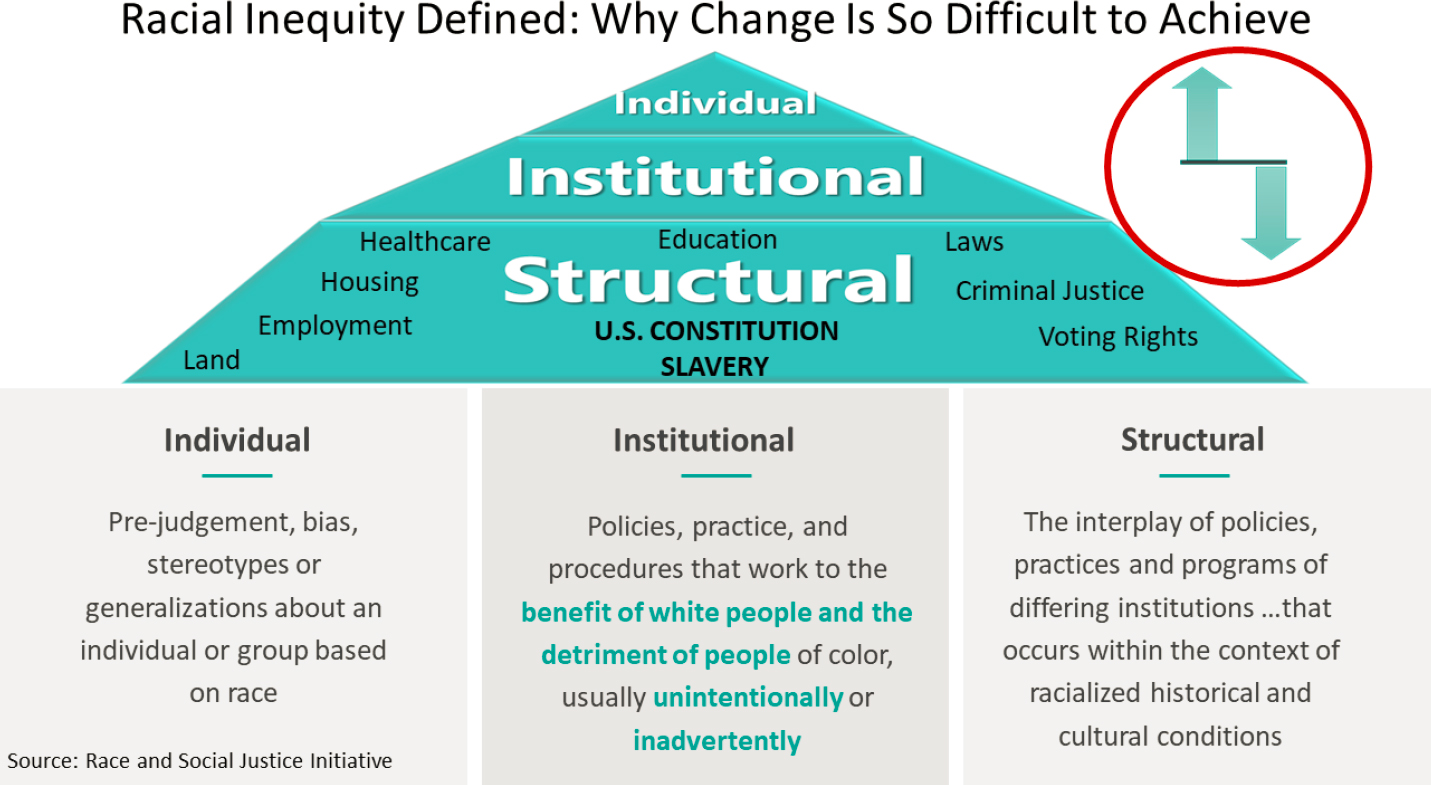
Discussing why change is so difficult to achieve, Reid pointed to the differences between individual, institutional, and structural racial inequity (Figure 2-2). But “the good news is that we are having difficult conversations at the institutional level, and that’s [not only] changing the way people individually operate and function but also beginning to dismantle the structural elements that reinforce these behaviors.”
___________________
10 https://diversityrecognition.asee.org/wp-content/uploads/sites/22/2019/03/Paving-the-Way-NSBE-White-Paper-Reid-Ross-Yates-Resource.pdf
11 https://nap.nationalacademies.org/catalog/18847/surmounting-the-barriers-ethnic-diversity-in-engineering-education-summary-of
SOURCE: Presented by Karl Reid on March 18, 2022.
Reid talked about Bellwether Education Partners,12 which is exploring three impact strategies that organizations use to address both current needs and long-term transformation in education. With direct impact “organizations provide programming for specific individuals”; although the results are promising, they are limited in scope and scale. Widespread impact is when an organization builds the capacity of partners to implement elements of its program model; Reid cited the 50K Coalition13 as an organization with widespread impact. Finally, systemic impact occurs when an “organization shifts their mindsets, relationships, and their power dynamics in order to create conditions for adoption that reinforce success in broadening participation and eliminate inequities,” said Reid.
He reviewed the progression from, first, sharing lessons from direct impact “with others,…replicating the successful models, and then expanding adoption and improving the direct impact model.” As these lessons of widespread impact are improved and leveraged into further work, organizations provide “research and development for the direct impact that ultimately leads to insights that gets us toward the systemic impact.”
Reid then discussed the Engineering PLUS Alliance, which has a goal of “transformative systemic and sustainable change that increases the growth rate in the number of people of color and women obtaining undergraduate and graduate degrees” in engineering. As the principal investigator for this program, Reid highlighted the goal of awarding 100,000 BS and 30,000 graduate degrees to individuals from populations traditionally minoritized in engineering by 2026. As part of the Alliance, the “stEm PEER Academy”14 will produce change agents
___________________
12 https://bellwethereducation.org/
14 https://engplusalliance.northeastern.edu/stem-peer-academy/
“equipped with the latest knowledge of the best practices of broadening participation, as well as organization development and systems change management.”
In closing Reid suggested that the US engineering enterprise focus on a bold goal “to drive all of our vectors in the same direction” and emphasized leveraging “existing networks and funds of knowledge. We can’t go into communities assuming that they don’t know the solutions. They do know solutions.” He also reiterated the importance of “letting the data speak, building in accountability, and recognizing our roles in propagating racial inequities.” He ended by stating that “we can only solve these complex problems by leveraging our diversity.”
DISCUSSION
Pierre asked Reid to comment on the sharing of information as a possible good step toward both understanding the system and achieving systemic change. Reid mentioned the idea of “collective impact”15 that “is used by public-private partnerships to solve complex social problems” and noted the five elements of achieving collective impact: “(1) a common agenda, (2) shared measurement metrics, (3) mutually reinforcing activities, (4) constant communications, and (5) a backbone organization.”
Taking a question from the audience, Pierre asked Reid about the estimated numbers for women of color in engineering. Reid responded that the numbers are low overall. He elaborated that disaggregating data shows that trends in degrees earned are different across populations and, as an example, mentioned data showing that the number of engineering degrees awarded to Black women was declining as the number of engineering degrees awarded to Latine students was increasing.
Another question from the audience concerned overcoming resistance to “systemic change, particularly from those for whom the system is currently designed.” Reid said that a first step is to understand the pain points of a university or any organization and to deliver solutions based on them. He added that commitment from leadership also plays an important role.
Pierre then asked whether the Engineering PLUS Alliance will coordinate efforts with organizations working toward systemic change in K-12 educational pathways. Reid answered that “NSF has really embraced this collective impact approach with its INCLUDES16 network,” and pointed to the STEM PUSH Network,17 which “is working to improve K-12 education and create standards,” and the Engineering for USA18 initiative working to bring engineering to high schools. He explained that the focus of the Engineering PLUS Alliance is on transition points such as K-12 to community college or other institutions of higher education.
Pierre asked Reid about his thoughts on the minimal progress in the percent of US engineering degrees received by African Americans in the past 10 years, referring to a “flattening of the curve.” Reid answered that “if you look at the growth rate in the number of degrees, NSBE reported a 61 percent increase in degrees awarded to African Americans from 2015 to 2020,” but the curve did not change because the number of engineering degrees overall also increased at similar rates. He pointed to “the systemic challenges that exist in the K-12 community and higher education”: “even if you pair Black students and White students on
___________________
15 https://ssir.org/articles/entry/collective_impact
16 https://www.includesnetwork.org/home
socioeconomic status, on SAT scores, on family income, etc., all these factors at the beginning, after four years there is a 16 percent gap in their outcomes. So something is going on in our institutions that we need to address.”
Answering a question about how to get more engineering graduates from historically minoritized racial and ethnic groups to continue in academia rather than entering industry, Reid highlighted a program run by the Office of Minority Education at Massachusetts Institute of Technology: “Laureates and Leaders” has a cohort model designed to encourage students to pursue graduate degrees and a career in academia. Discussing the idea of expanding PhD programs with internships and co-op experiences, he also cited GEM fellowships19 as a model.
Taking the last question from the audience on Supreme Court cases related to affirmative action, Reid observed that, “whether the Supreme Court makes the decision to eliminate affirmative action or not, I think the political winds are blowing. There are school districts that are challenging attention to race discussion, they are falsely characterizing critical race theory as the enemy. Suddenly talking about racism in America afflicts the very people who benefitted from racism in America.” He added that a decision either way prompts “us to be creative in how we achieve our goals.” He reiterated that the only solution to moving forward is a talented and diverse group of people coming together to solve complex social problems.
___________________
This page intentionally left blank.


