Preserving and Developing Ukraine's Human Capital in Research, Education, and Innovation: Proceedings of a Workshop—in Brief (2024)
Chapter: Preserving and Developing Ukraine's Human Capital in Research, Education, and Innovation: Proceedings of a Workshop—in Brief

Preserving and Developing Ukraine’s Human Capital in Research, Education, and Innovation
Proceedings of a Workshop—in Brief
The February 2022 Russian invasion of Ukraine has devastated the country, resulting in mass casualties, destruction of facilities and infrastructure, and significant internal and external migration. The invasion also ravaged Ukraine’s science and technology sectors, not only in terms of damaging physical facilities and institutions, but also by displacing scientists and creating challenging conditions that researchers who remain in Ukraine must face to continue their work. Of particular concern are the psychological impacts of the experience of war that affect all Ukrainians, including both researchers who remain in the country and those who have left.
Because scientific and technological advances will drive many of Ukraine’s future national security and economic growth decisions, it is critical to strengthen and rebuild its capacity to establish and maintain a robust science and innovation system that supports basic and applied research, trains the next generation of scientists and engineers, and provides mechanisms for science and technology (S&T) decision-making and advice to Ukrainian policymakers.
In support of this effort, the National Academies of Sciences, Engineering, and Medicine (the National Academies) convened a workshop on June 5, 21, and 28, 2023, on how to establish flexible, impactful, and sustainable programs, both today and in the future, to support Ukraine’s research community, particularly those still in Ukraine. During the workshop, speakers shared best approaches to strengthening and developing human capital needed to manage a modern research and innovation system. Participants also discussed efforts to provide funding or develop scientific collaboration in support of Ukrainian researchers. Workshop participants, including representatives from the Ukrainian government and research agencies, consisted of recognized experts in the design, implementation, and funding of scientific research initiatives, particularly those involving international cooperation; science and technology workforce development; and programs to manage and strengthen national systems of research, higher education, and innovation. Participants from the Ukrainian research community provided valuable perspectives about the barriers they are currently facing along with priorities and their vision for the future of research in the country.
In addition to the workshop, a side event was held on June 6, 2023, that included discussion of resources and connections for young scientists and engineers in and

interested in Ukraine. The goal of the session was to engage young scientists in discussions about how best to support their research and career goals and to connect them to resources that align with their research interests.
This Proceedings of a Workshop—in Brief provides a high-level summary of the workshop and side event discussions on ways to preserve and develop Ukraine’s human capital in research, education, and innovation.
OPENING REMARKS AND BACKGROUND
The first day of the workshop, held on June 5, 2023, focused on ways to develop support for scientists and engineers in Ukraine by strengthening capacity through international partnerships and science management skills. Presentations highlighted lessons learned from existing programs and opportunities to create new programs to address critical human capital needs.
Marcia McNutt, National Academy of Sciences, discussed the tragedy of the Russian invasion, particularly in terms of the displacement of so many in Ukraine, including researchers. Many scientists have no facilities to return to as a result of the war. As the greatest resource in Ukraine is its people, she said that we must find ways to support researchers and build capacity.
Early in the conflict, the National Academies engaged in initiatives to support displaced researchers from Ukraine, McNutt said. The organization also wants to expand support to those that are still in Ukraine to ensure they remain connected to the international science community. To this end, McNutt said that she will be traveling to Poland to announce grants to support these Ukrainian researchers in partnership with the Polish Academy of Sciences.1 The collaboration is designed to ensure that science does not suffer in the long term due to the war. McNutt noted that it is critical that we recognize the importance of science and innovation to support Ukraine’s security and future economy.
Rita Colwell, University of Maryland, and Co-Chair, Planning Committee, discussed the focus of the current workshop, to develop and preserve human capital in Ukraine, including identifying the practices and priorities that will ensure that the science and engineering talent in Ukraine can actively contribute to science and research. A key role for participants is to identify priorities for action on these issues. Oleksiy Kolezhuk, National Council for Science and Technology Development, and Co-Chair, Planning Committee, added that addressing the challenge of preserving human capital in Ukraine is critical to the success or failure of the country in the long term. A key part of the discussion will include how to scale up current funding and efforts and ensure coordination among these initiatives.
A key priority for Ukraine is developing its human capital and internationalizing science, said Dmytro Zavgorodnii, Ministry of Education and Science. The Ministry has several projects in the planning stages that are focused on improving the “ease of doing science,” particularly lowering bureaucratic barriers for research. An additional priority for the country is increasing digitalization within the science and technology (S&T) sector. The Vice Prime Minister is charged with advancing science, innovation, and education, highlighting the national commitment to these issues.
Zavgorodnii added that Ukraine can also build upon several strengths including innovations during wartime in the military sector and other sectors (health, education, among others). The country has also demonstrated its ability to support digital transformation in education. There are many scientists who have remained in Ukraine who are producing high level research and continue to be motivated despite the difficult conditions, he said.
International collaboration is essential for accelerating discoveries to address the biggest global challenges, said France A. Córdova of the Science Philanthropy Alliance. Córdova discussed her work representing an alliance of philanthropic foundations that are united by a commitment to these issues, particularly discovery science. This nearly 40-member organization has a shared recognition of the importance of curiosity-driven and use-inspired research. Ukraine’s contributions to discovery science have global applications; investing in basic research has a remarkable return on investment.
__________________
Córdova added that philanthropic funding can operate with flexibility and nimbleness, close gaps, push boundaries, accelerate high risk research, and scale impact through partnerships. This type of funding can also have an outsized impact on research, given that it is less constrained than government support.
A recent Science Philanthropy Alliance roundtable recommended that foundations focus on several areas In Ukraine, including building research capacity, supporting the S&T workforce, and welcoming Ukrainian researchers to institutions abroad. The Safe Passage Fund is a partnership to support researchers to ensure they can safely continuing work outside Ukraine. It provides a mechanism to connect them with research institutions so that they can continue to be a part of the international science community. The Simons Foundation has also provided new support for scientists on the ground in Ukraine, including $1.2 million in support of 405 scientists. Córdova added that science is a global endeavor and challenges can only be solved through international collaboration.
Yulia Bezvershenko, Science at Risk, and the National Academies, said that the war has heavily affected research innovation and education in Ukraine. There is a lack of data and no strong system in place to estimate the damage. The best estimates are that between 15 and 25 percent of research infrastructure has been damaged. In addition to infrastructure, Ukrainian researchers need psychological support, as well as access to finances, the ability to grow professional relationships, and job stability.
SUPPORTING SCIENTISTS AND ENGINEERS IN UKRAINE: STRENGTHENING CAPACITY THROUGH INTERNATIONAL PARTNERSHIPS
Bezvershenko moderated the first session focused on examples of programs, particularly lessons learned, around strengthening capacity for science and engineering in Ukraine.
Jerzy Duszyński, Polish Academy of Sciences, discussed the organization’s efforts to fund outstanding Ukrainian scientists. The Polish Academy of Sciences has offered grants to researchers in partnership with several other international organizations, including the National Academies. The program allows researchers to hold a double affiliation in both Ukraine and in Poland and all published papers and achievements will be credited to both Polish and Ukrainian universities. The program, launched in December 2022, received 174 applications. Thirteen outstanding proposals, including 64 individual scholars, were selected in research areas such as astronomy, environmental science, mathematics, materials engineering, psychology, and others. A previous version of the program, which was implemented by the Polish Academy of Sciences and the National Academies, was implemented on short notice, just one week after the war began. A key lesson learned from this prior initiative was the need for systematic and focused funding that is sustainable over the long term as well as standards for use in evaluating applications and performance.
In another example of a program that is supporting Ukrainian research, Jamie Arrowsmith, Universities UK International (UUKi), discussed the UK-Ukraine Twinning Initiative,2 which pairs universities from two countries to develop institution-level strategic partnerships. The initiative was designed in response to a concern that Ukrainian universities voiced regarding the ability to continue work while retaining talent in Ukraine and avoiding brain drain.
Through the UK-Ukraine Twinning Initiative,3 universities that have a shared mission and processes are paired and receive intensive support for a period of 6 to 8 weeks. The universities develop a memorandum of understanding and agree to partner for a period of 5 years. Since the invasion, 120 relationships have been formed through the initiative. These partnerships provide for staff exchanges and practical support, advice on preservation of heritage, and material support. A coordinated communications campaign has also been developed to share program impact, Arrowsmith said.
__________________
2 See: https://www.nationalacademies.org/news/2023/06/eighteen-ukrainian-research-projects-selected-for-long-term-funding-by-the-polish-academy-of-sciences-and-u-s-national-academy-of-sciences.
3 Additional information about the initiative can be found at https://www.twinningukraine.com/.
Arrowsmith added that a key lesson learned is that political support is critical to the success of this type of program and, as such, it is important to obtain public and political attention in order to sustain support of programs. In developing any university partnership, strategic engagement requires long term commitment and leadership, particularly at the institutional level, rather than the individual level, as staff will eventually leave the organizations. Successful partnerships are also bidirectional and reciprocal in nature. Resources are the most pressing issue, particularly given that the scale of need is significant and funding in the UK is also challenging to obtain. Matching ambition and desire with funding is difficult and thus, expectation management is important. He added that partners in Ukraine should drive our understanding of what is needed. He also noted that relationships should blend short and tactical engagements and collaborations, and long-term sustained support and universities should be realistic and transparent, engaging on what is practical and what may be out of scope. Coordination is essential to all this work.
Nataliia Yeremenko, European Fund for Displaced Scientists, All European Academies (ALLEA), said that the organization immediately established partnerships and participated in initiatives to support Ukraine in response to the invasion. This included active involvement with developing the 10 Point Action Plan to Support the Ukrainian Academic System and the Ukrainian Science Stakeholder group.4
The European Fund for Displaced Scientists5 supports scholars and scientific institutions impacted by the war in Ukraine, said Yeremenko. One funding opportunity supports the continuation and/or reinstatement of scientific operations and research collaborations in Ukraine. More than 100 applications were received from 89 institutions; 98 scholars within 7 institutions were selected.
The number of applicants to this program reinforces the urgent need for funds to support researchers in Ukraine. The European Union had programs in place to provide immediate support by accepting Ukrainian scientists or continuing programs in country. Strong cooperation and networking were key as was the ability to be flexible to respond to needs and be adaptable, noted Yeremenko.
Natalia Melcer, U.S. Department of Energy (DOE), discussed the agency’s efforts to provide funding and support for Ukrainian researchers. In April 2022, the DOE published a “Ukraine Dear Colleague Letter,” to encourage current DOE-funded academic researchers to consider collaborating with Ukrainian students and scientists. The DOE also offered one-year supplemental support, with the potential for extension, to impacted students or scientists in the U.S. or abroad.
The DOE received about 150 inquiries related to the letter, Melcer said; 24 awards were made and 2 are pending, totaling about $2.6 million in funding to support a mix of remote collaborations and students and/or scientists who have come to the United States. Regarding lessons learned from the program, she said that the program was supported by the research community and was well received by students/scientists who were able to work in the U.S. or relocate to other countries. However, subcontracting to Ukrainian institutions was difficult and the situation for the Ukrainian beneficiaries was dynamic. The project provided an example of a quick reaction of government institutions to use existing funding to provide immediate support to researchers in need.
Gregory Gabadadze, Simons Foundation, discussed the Foundation’s efforts to support Ukrainian scientists who have remained in the country. The Foundation was particularly interested in filling gaps, such as issues with infrastructure, including lack of electricity and internet. Through its work in Ukraine, the Foundation was impressed by the high level of basic science underway in Ukraine. There are remarkable researchers in Ukraine who are courageous and sacrificing and who are working to overcome existing challenges to continue to conduct their research, he said.
Researchers from Ukraine face challenges in applying for funding, said Yuriy Khalavka, Yuriy Fedkovych Chernivtsi
__________________
4 Visit https://allea.org/allea-signs-10-point-action-plan-to-support-ukrainian-academic-system/ for more information about this Plan.
5 For more information, visit https://allea.org/european-fund-for-displaced-scientists/.
National University. Every application requires enormous effort, and it can be a discouraging process. There is also a low success rate for individual applications. To address these challenges, researchers working in country need smaller, longer-term grants as well as opportunities for group or institutional support. Streamlining and simplifying the grant process will lessen application fatigue. Applications should also have a focused aim, scope, and target audience so that it is clear to applicants whether or not they would be a strong match for the opportunity, Khalavka said. Synchronizing initiatives and providing flat, systematic coverage for grantees are also important.
CREATING NEW PROGRAMS TO ADDRESS CRITICAL NEEDS
Lidia Borrell-Damian, Science Europe, moderated a panel focused on the creation of new programs to address critical needs of researchers in Ukraine.
Olga Polotska, National Research Foundation of Ukraine (NRFU) and V.N. Karazin Kharkiv National University, discussed organizational funding during the war. While the 2022 NRFU grant season was suspended due to the war, in 2023, the allocated budget was able to cover the additional 60.5 percent of the total sum needed to finance the previously selected projects and to support the new and suspended calls. Key areas of work identified for funding include:
- Strengthening international cooperation
- Revising operational activities
- Improving the legal framework
- Searching for opportunities to support the most relevant R&D projects
- Assessing potential risks and threats
- Intensifying communication activities
- Optimizing the internal operation work of the Foundation’s Directorate
- Searching for additional sources of funding
Polatska discussed top actions to support the NRFU and Ukrainian R&D system, including:
- Developing partnerships, such as joint initiatives and bilateral and multilateral calls.
- Creating institutional support, including trainings, workshops, etc.
- Expanding information and communication support, including exchange of information and best practices, popularization of the results of the NRFU grantees, and informing relevant audiences about the NRFU activities, etc.
- Engaging reviewers, including foreign experts, to minimize potential conflict of interest and raise objectiveness of project assessment.
The Foundation launched two calls in 2022, including individual grants for research development for Ukraine researchers and the Science for the Recovery of Ukraine in the War and Post-War Periods opportunity. Other opportunities to be released in 2023 include an agreement on reforming research assessment, initiatives to support female researchers, and a joint call with a sister organization, the Swiss National Science Foundation. There will also be opportunities for Ukrainian researchers through the European Union’s Horizon Europe office and an open call for researchers to become reviewers (see https://nrfu.org.ua/en/contests/we-invite-experts-to-cooperate/).
Emmanuella Delva of the U.S. Agency for International Development’s (USAID’s) Innovation, Technology, and Research (ITR) Hub – Research Division, discussed the work of the agency, including to invest in higher education and scientific research to help partner countries build capacity and solve critical challenges. The ITR Division convenes, researches, tests, and translates development solutions by working with universities, researchers, and development actors around the world. This Division also funds centers of excellence in the U.S. and in developing countries to further development research in critical focus areas. For example, the BRIDGE TRAIN initiative is a partnership between higher education institutions in the U.S. and developing countries to develop research, innovation, and training centers.
Delva noted several key takeaways from experience with the centers of excellence, including that flexible research opportunities and use of funding allows researchers to meet specific capacity needs. The centers have shown that partnerships with U.S. researchers allow local Ukrainian researchers to leverage expertise/tools and benefit from mentorship and training opportunities. She added that it is important to consider the funding purpose and characteristics that would make a higher education institution suitable to serve as a center of excellence.
Maija Kukla, National Science Foundation (NSF), discussed the agency’s work to fund and develop international collaborations, and encouraged researchers to look for open opportunities for funding. NSF offers funding through numerous disciplinary programs as well as targeted opportunities. It also covers travel to workshops and conferences. NSF’s Office of International Science and Engineering (OISE) provides opportunities to receive support beyond those limited to the U.S. Primary funding mechanisms through NSF include lead agency opportunities, and joint solicitations. Supplements to existing NSF awards can be added to support Ukrainian researchers. Kukla emphasized that any researcher can submit a proposal with international collaborators to NSF. NSF will also provide support for events and workshops, and there are no restrictions as to where these may occur.
Greta Facile, EU Funded Projects Department, DESY - EURIZON Fellowship Program, and Enrico Guarini, l’Università di Milano-Bicocca, provided information about the EURIZON project,6 a European Union funded activity that supports European scientific and technical collaboration in the field of research infrastructure with a focus on coordination and support measures to support Ukrainian scientists. The project is supporting fellowship programs for remote research and the sustainability of research institutions. It offers capacity building for all scientific domains and outreach activities.
In preliminary results from an analysis of the 785 applications received by the project, many Ukrainians still in the country reported working in research and expressed a commitment to excellent science, despite extreme circumstances, Facile noted. Another observation was the strong existing connections between Ukrainian and European scientists. However, Ukrainian researchers also discussed the many challenges they face in terms of limited funding; damaged facilities; electricity and connectivity shortages; forced displacement; team fragmentation; trauma and stress; and personal and family issues related to the war.
Programs and funding to support scientists in Ukraine should consider all scientific domains and funding for support staff, Facile said. Funding should also support Ukrainian scientists in maintaining contact with the global scientific community; accessing data, archives, and research tools; and creating networks and partnerships. Additionally, there is a need to provide fellowships directly to teams, where possible, rather than institutions. Flexibility and adaptability for funding schemes, harmonization efforts and programs, and coordination at international level are also needed. Involving Ukrainian scientists abroad, helping keep connections with home institutions, and involving them in the process of reconstruction is essential, she added.
Kostiantyn Kyrychenko, Sumy State University, discussed the challenges of conducting research in Ukraine, including maintaining security provisions on campus, restoring damaged facilities, migrating data to the cloud, retaining students and staff, continuing research projects, and fundraising. To address some of these challenges, there is a need for crisis management activities, including revision of higher education institutional strategies, rebuilding of managerial structures, improvement of digital government processes, and strengthening of internationalization of science. Taking action to improve and expand digitalization, alert/emergency facilities, and medical and psychological services will be critical.
Actions to increase student retention include increasing the attractiveness of study programs and access to teaching and learning tools as well as implementing quality assurance provisions for online studies,
__________________
6 For more information, visit https://www.eurizon-project.eu/news/calls/call_for_applications/.
Kyrychenko said. Ensuring continued research activity will require action to improve research infrastructure; access to databases, electronic library resources, and lab facilities; digitalization of research; building of networks; and twinning cooperation. Regarding saving resources and fundraising, there is a need for green and digital transitions, access to additional funding schemes, upgrading skills on project writing and management, measures for non-stop research and project activity, new services to local communities, and motivation of main change-makers. And finally, to expand internal and external networking, it is important to expand to a formal alliance of higher education institutions, including European university alliances as well as integrate Ukrainian ambassadors abroad.
STRENGTHENING NETWORKING AND SCIENCE MANAGEMENT SKILLS THROUGH TRAININGS, WORKSHOPS, AND PROGRAMS
Cathy Campbell, Chair, National Academies RESET Ukraine Action Group, and CRDF Global (Retired), moderated a session focused on strengthening networking and science management skills for Ukrainian scientists.
Anna Plater-Zyberk, Polish Academy of Sciences, discussed the organization’s efforts to support Ukrainian colleagues throughout the war. The organization has held online trainings, reaching over 600 participants in 2022, on topics ranging from how to use scientific databases, how to find research partners abroad, science and business applications, public speaking, project management, and how to be successful in grant writing. From the perspective of scholars in Ukraine, Plater-Zyberg said there is the need for stable, long-term funding, IT equipment, mentorship programs, psychological support, and training opportunities, particularly related to managing a research project, applying for grants, and digital competencies. A training from the European Commission was useful for setting up research programs in Poland and would be helpful if offered to research managers in Ukraine.
Mykola Lubiv, Science and Technology Center in Ukraine (STCU), discussed the importance of focusing on cybersecurity in Ukraine, given the high number of cyberthreats. In fact, Ukraine is the most targeted country for cyber-attacks in world at the moment. For Ukrainian scientists, it is not only important to understand how to protect their data, but also how to work with data and identify false information. Training and fellowships are needed in these areas, particularly related to knowledge security and data protection.
Kimberly Montgomery, American Association for the Advancement of Science (AAAS), discussed the organization’s efforts around science diplomacy, including its Center for Science Diplomacy, which focuses on relationships, community, and capacity building. AAAS also developed a course on science diplomacy in 2014 to expose scientists, policymakers, diplomats, and other interested stakeholders to this field. Almost 350 emerging leaders from more than 50 countries have been trained. In 2021, a participant pair model was adopted where pairs of scientists and policymakers applied and took the course together. The course will be held again (in person) in 2023 in Trieste, Italy. AAAS also offers capacity development programs and “train the trainer” courses. The organization’s science and technology policy fellowship program has been widely successful, and a similar model could be implemented in Ukraine to help connect scientists to policymakers.
Oleksandra Antoniouk, Kyiv Academic University, National Academy of Sciences of Ukraine (NASU), discussed the importance of improving soft skills, including working with policymakers and in building international networks for Ukrainian researchers. She suggested that research with a military focus be supported, particularly as this work could align with the redevelopment of the Ukrainian economy. There is a need to explore the military connection between weapons development and science, she noted.
Dmytro Sherengovsky, Ukrainian Catholic University, added that there are not enough people to teach science in Ukraine. Building alliances between universities or network hubs of universities that can support capacity may help to address this challenge. Focusing on service learning and consulting for local governments may also address some of these gaps.
Regarding training needs, psychological resilience, soft skills development, research competencies, grant writing, international collaboration, development of digital competencies, and academic integrity are of the highest priority right now. Supporting communities through research is critical, as are fellowships to support these types of alliances, said Sherengovsky.
Discussion – Day 1
Workshop participants discussed a common theme in the presentations—the need to strengthen coordination around funding opportunities and streamline the application process. Bezvershenko stated that ongoing regular communications and continual planning with the Ukrainian research community would be useful for coordination purposes. Campbell added that a possible solution could include creating a digital platform to track ongoing programs and developing a standard application format. Kolezhuk reiterated that applications are uncoordinated, and there is application fatigue for Ukrainian researchers. Science Europe already has a platform developed to capture some of this information and could be utilized.
Participants also discussed opportunities to develop human capital in Ukraine through training and other funding opportunities. Bezvershenko noted the importance of bringing researchers into policymaking, for example, considering the AAAS science and technology policy fellowship model. Sherengovsky added that the peer-to-peer approach has been successful in supporting up and coming researchers, while Kolezhuk noted that there is a problem with getting people who have the needed skills to provide advice to policymakers and decisionmakers. Kolezhuk noted that there are only a few people in the country who can provide science advice to the Ukrainian government. A state-run program, such as a recruitment program for the Ministry of Science, could be explored as one opportunity to bridge this gap.
Describing other training needs, Campell added that English language training could be advantageous, particularly if paired with science content. Another participant noted that the webinars that NSF conducts on grant writing are open to the public and could be utilized by Ukrainian researchers. Participants noted that there are also numerous online seminars and trainings on research grant management, financial management, and free currently available. executive development opportunities that could be useful to Ukrainian researchers. International scientific journals have provided open access to Ukrainian scientists as another opportunity to connect to the international science community.
Colwell said that it is critical to determine what our Ukrainian partners need and plan around these needs, but also be realistic about what can be achieved. Colwell noted that coordination is an issue that has continually been discussed throughout the workshop, including the role of a clearinghouse to compile and share activities and programs. Funders should understand that for every application, Ukrainian researchers must expend an enormous amount of effort, which diverts their attention away from their research. Thus, ensuring that each opportunity is streamlined, simplified, and targeted is important so as not to create undue burden for Ukrainian researchers during this challenging time. Institutional support is also important; we cannot just support researchers but must also support technicians and staff.
Participants noted that Ukrainian researchers must continue to be connected to global science, and therefore require partnerships, flexibility, and the ability to adapt. This includes forming alliances with universities within Ukraine and internationally. Kolezhuk added that the sheer number of approaches and programs available is impressive; however, this highlights the need for systemic collaboration among these initiatives to reduce duplication and ensure coordination. These are unprecedented times requiring unprecedented solutions, said Colwell.
SCIENTIFIC RESEARCH AND TRAINING FOR YOUNG PROFESSIONALS IN OR INTERESTED IN UKRAINE
Bezvershenko and Vaughan Turekian, the National Academies, moderated a June 6, 2023, side event to discuss resources and connections for young scientists and engineers in and interested in Ukraine. Speakers and panelists provided information for young scientists
about available research and funding opportunities and discussed challenges faced by those conducting research in Ukraine.
Maija Kukla, National Science Foundation (NSF), discussed modern trends in global research and education from the perspective of the agency. The future Ukrainian science ecosystem will benefit from an international strategy that includes cooperation for scientists abroad. To help support this need, the NSF provides support for international collaboration through direct funding, workshops and conferences, and targeted opportunities through the Office of International Science and Engineering (OISE) programs. Also, an open access research, data, and publications policy can support Ukrainian research by allowing for broader collaboration with U.S. research institutions, educational resources and cyber infrastructure, and a searchable database to identify partners and potential collaborators. NSF resources are also freely available online through the NSF Funded Projects Database.7
Alan Craig, European Research Executive Agency, discussed various funding and scholarship opportunities, noting that the priority of the agency is the researchers, not the research. The agency also supports any area of research, including the social sciences and humanities.
Craig discussed the objectives of the Marie Sklodowska-Curie Actions (MSCA) fund: to support excellent research and innovation and equip researchers at all stages of their careers with knowledge and skills through mobility across borders and exposure to different sectors and disciplines. The Fund helps to support Europe’s capacity for research and innovation. The MSCA4Ukraine8 is a program specifically targeting Ukrainian researchers displaced by war. The program has funded more than 120 Ukrainian researchers, both docotoral and postdoctoral, to continue their career outside of Ukraine. While the budget is now exhausted, the agency is exploring the possibility of additional funding.
The agency also supports Doctoral Networks, whose objective is to implement doctoral programs through partnerships of organizations from different sectors across Europe to train highly skilled doctoral candidates. Postdoctoral fellowships are also available which offer funding to Ph.Ds who wish to carry out their research activities abroad.9
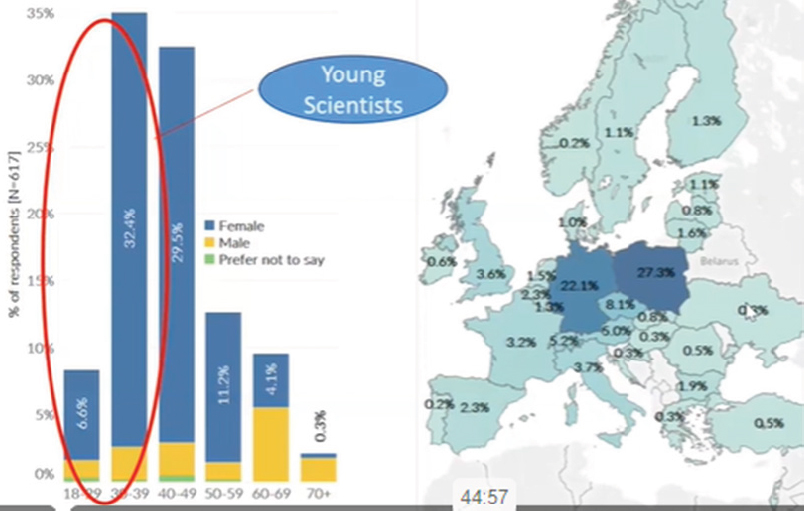
Yevheniia Polishchuk, Kyiv National Economic University, provided data about Ukrainian scientists living abroad, including young scientists (see Figure 1). Through a survey of 522 young Ukrainian researchers, the types of support most needed includes research grants (59.4%); internships (51.3%); permanent positions (38.3%); temporary positions (37.7%); scholarships (28%); postdocs (18.8%); and other types of support (1%). More than 52% highlighted the need for longer term support (12 months or longer).
Young Ukrainian scientists reported a number of challenges, including not enough offers in their discipline, particularly for social sciences and humanities (46%); lack of experience in applying for such funding (42.6%); language barriers (39.7%); complicated application processes (27.2%); short deadlines (19.6%); and other issues (13.1%). Applicants need to have a strong prior history of work to apply, which is a barrier for many. Mental distress is also a serious challenge for this
SOURCE: Polishchuk, Y. Presentation at Preserving and Developing Ukraine’s Human Capital in Research, Education, and Innovation: A Workshop and Side Event, held June 6, 2023.
__________________
7 To find funding opportunities at NSF, visit https://new.nsf.gov/funding/opportunities.
8 For more information, see https://sareurope.eu/msca4ukraine/.
9 These and other opportunities can be accessed at https://rea.ec.europa.eu/funding-and-grants/horizon-europe-marie-sklodowska-curie-actions_en.
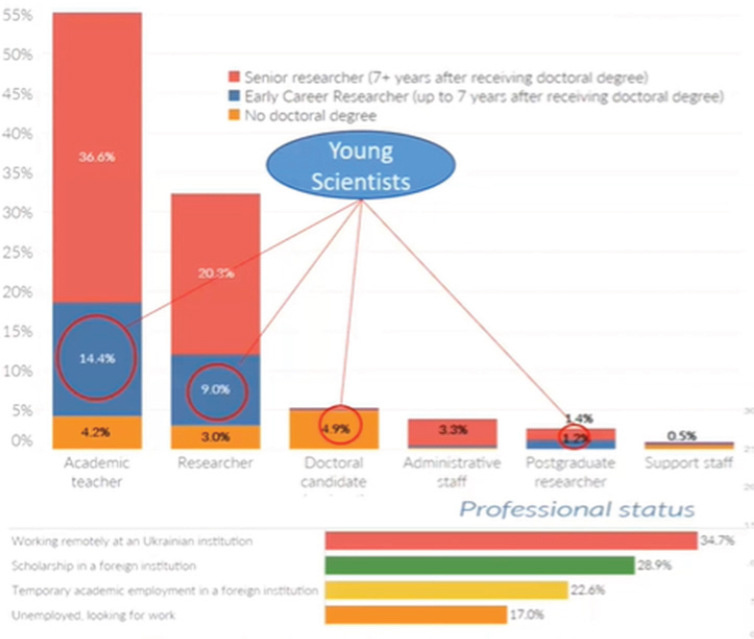
population. Figure 2 shows the distribution of young Ukrainian researchers living abroad across various career levels. Polishchuk noted that to better serve this population, there should be a stronger focus on mentoring and support for preparing applications and developing networks.
Valeriia Kovach, NASU, reiterated some of the challenges that Ukrainian scientists are facing, including damaged institutions and the impact of inflation on support for science. Scientists in Ukraine receive low salaries and thus, many leave the country. Between 2021 and 2022, the total number of young scientists declined by 15.1 percent and the number of Ph.Ds by 17.8 percent. Between 2020 and 2022, the total number of young scientists declined by 44 percent, and the number of Ph.Ds declined by 60 percent.
The Young Scientists Academy is working to develop a platform for young researchers. The first phase will be digital and will help young researchers to find projects, stipends, scholarships, and equipment. There are upcoming courses in English as well as a plans to design a brick-and-mortar center with co-working space.
Summary Discussion – Day 1
Workshop participants discussed how to expand opportunities for young Ukrainian researchers, including lowering barriers to entering the field. Kovach added that it is essential to provide psychological support for this population, including through mental health courses. Turekian noted, as the war continues, we know that the greatest failure would be if there were large number of scientists leaving Ukraine or leaving science. Turekian noted that there is a need for immediate action to make research more attractive to young scientists in Ukraine.
SOURCE: Polishchuk, Y. Presentation at Preserving and Developing Ukraine’s Human Capital in Research, Education, and Innovation: A Workshop and Side Event, held June 6, 2023.
SUPPORTING YOUNG SCIENTISTS IN UKRAINE
The second day of the workshop was held on June 21, 2023, and began with introductory remarks by Oksen Lisovyi, Minister of Education and Science, Ukraine. He noted that science is among the top priorities of Ukraine’s current leadership team and government. In fact, for first time in Ukraine’s history, the position of Special Prime Minister is focusing on preserving human capital digitalization, or the use of digital technologies to manage or develop human capital10—critical for the future of science and education in the country.
Lisovyi said we have not done enough in the past to address this need. There is an ongoing audit of scientific research that will help to examine current funding. It is important to focus on the internationalization of research and integration of Ukrainian scientists into the scientific community. Flexibility in funding is key during this time. While 90 percent of scholars remain in the country, we must consider how to integrate those who had to leave. The stability of Ukraine and the world will depend on how we address these education challenges, he said.
Carol O’Donnell, Smithsonian Science Education Center (SSEC), discussed the work of the Smithsonian to transform K-12 education through science. Early science education is economically and socially beneficial and should attempt to balance three areas: (1) knowledge and learning skills for personal and cultural purposes; (2) processes of scientific and technological research; and (3) development of values for professional, public, and political issues, either local or global.
__________________
10 Khoruzhy, L. I., Khoruzhy, V. I., Kubrushko, P. F., Karataeva, O. G., & Bitkova, L. A. (2023). Comparative analysis of human capital management strategies in the context of digitalization of the national economy. Frontiers in Sociology, (8)1114301.
O’Donnell discussed joint initiatives between the Smithsonian and Ministry of Education and Science of Ukraine. For example, the Smithsonian and the Ukrainian government are co-creating and adapting hands-on science kits for young Ukrainian learners using utilizing freely accessible instructional materials from the SSEC. There are also discussions about supporting teachers through virtual professional development and providing students in Ukraine’s Digital Learning Centers with direct links to digital assets found in the SSEC’s preexisting Distance Learning library. The goal is for students to see STEM as accessible to them and to build scientific literacy and sustainability mindsets.
Amy Flatten, American Physical Society (APS), discussed the needs young researchers in Ukraine, including a loss of research facilities, research, and thesis advisors. APS, a professional society focused on supporting researchers in physics, is helping to support Ukrainian scientists during this time. The Society wants to be sensitive to the current situation and does not want to contribute to brain drain. However, it also wants to be realistic about the context researchers are currently operating under in Ukraine. One example is a multi-year grant from the Alfred P. Sloan Foundation that is assisting physicists and physics students who are marginalized or under threat. The Distinguished Student Program – Ukraine, which will be launched soon, is specifically for young physicists affected by the Russian invasion and provides support to attend international conferences and to visit universities as well as multi-year grants. Supporting the ability for students to travel for learning opportunities (i.e., conferences) allows students to build connections to global science communities.
Boris Martin, Engineers Without Borders International, said that his organization has 39 affiliates around the world that provide skilled support to communities in need, particularly related to basic infrastructure and engineering. Some member associations are working in Poland to support those displaced from the war and living in shelters.
Reconstruction of Ukraine will require significant engineering capacity. It is an opportunity to learn and grow the workforce needed for the country to thrive again, Martin said. However, there are significant gender imbalances in engineering that must be addressed. Local communities should also be involved in their own reconstruction decisions.
Daniel Placht, the National Academies, discussed several programs offered through the Academies to support early career researchers, including the National Academies Global Frontiers Programs. These programs allow for partnering with local institutions, entities, and academies to gather researchers to solve key global problems. The specific programmatic objectives include enhancing access to current cutting-edge science for early career researchers and increasing the scientific dialogue and knowledge exchange among them; encouraging and strengthening scientific collaboration and the transfer of techniques and approaches across disciplines, and networking within and beyond the region; and equipping early career scientists, engineering, and medical professionals to assume leadership roles in their fields and beyond.
Discussion – Day 2
Bezvershenko said that the dedicated international programs for scientists in Ukraine are not enough to address the need and are highly competitive, so the success rate is low. This funding environment is particularly difficult for young researchers who lack experience, resources, and networks. In developing new programs, there is a need to discuss whether they are enough to ensure that young scientists will be able to be supported over the long term.
Flatten said that APS took a pragmatic approach by replicating an already-existing program and offering it to young people affected by the invasion. This was relatively easy to implement, but there were challenges to participation for Ukrainian scientists due to the invasion. Additional funds are needed to augment and address the specific needs of the population. It is possible to provide support for scientists to attend meetings relevant to their work, but considering how to extend that learning and networking after the meeting is a bigger consideration.
Rebuilding talent and the country will require creative, rather than traditional approaches to research, Martin said. However, remaining practical is important as are targeting programs to specific needs of scientists in Ukraine.
Placht noted that flexibility is key to implementing programs to support young researchers, as is offering opportunities to engage with significant scientific diaspora in neighboring countries, particularly women. Partnering with institutions in those countries that are working with female researchers can inform what is needed to address these gaps. More aggressive promotion of opportunities for young researchers may be effective in reaching this population, Bezvershenko said.
Participants noted that regarding professional societies and their role, additional mentorship from these society members will be well received; however, building more active local chapters may be a more important mechanism for further developing a network of support for Ukrainian researchers.
THE PERSPECTIVES OF FUNDERS
Turekian moderated the fourth panel that captured the perspectives of key funders who support research in Ukraine.
Zbigniew Błocki, National Science Center, Poland, discussed the organization’s work to fund basic science and provide ongoing grants to support the salaries of displaced researchers. He also discussed work to support grants to Ukrainian research agencies with collaborative funding from the National Academies, the National Science Center, and grant agencies from the Baltic States. These and other efforts highlighted that combining funding and expertise from several areas can be an effective approach to supporting science in Ukraine.
Angela Libatore, European Research Council, said that Ukrainian research needs both funding and structural support. At present, Ukrainian basic research is still at the level it was prior to the war. The European Research Council has been involved in several efforts and initiatives to address brain drain in Ukraine, including offering fellowships to support researchers during the war and offering online training.
The Council also asked grantees to open their laboratories to positions for Ukrainian researchers as well as allow them to keep their dual affiliation. Research is part of Ukrainian recovery plan and investing in research is necessary to the future of the country.
Libatore noted that science diplomacy is more necessary than in the past. Building science diplomacy from the bottom up, from scientist to scientist is critical. There are opportunities to draw upon networks that have been built up over time and relationships that have been developing over decades to support these diplomacy efforts.
Marcel Levi, Dutch Research Council, discussed the organization’s efforts to support researchers and Ukrainian research more broadly. Actions to aid individual researchers included creating a relief fund for Ukrainian, Russian, and Belarussian researchers who work in the Netherlands to provide financial support; providing grant support for Ukrainian refugees who want to work as scientists in the Netherlands; making contact and organizing information/communication sessions in order to optimize a safe working environment for Ukrainian, Russian, and Belarussian researchers who work in the Netherlands; supporting the National Research Fund of Ukraine by hosting a working visit to NWO to help them develop the structure of a research funding organization; among others.
Oleksiy Kolezhuk, National Council for Science and Technology Development, discussed efforts to maximize the impact of external support on Ukraine’s human capital. Despite systemic deterioration of the research sphere due to the war, Ukraine has a large number of researchers. Between 85 and 90 percent of researchers remain in Ukraine, however, there are limited options for continuing research, due to damaged research infrastructure, broken research teams, psychological impact, travel restrictions, and limited funding opportunities within the country. There is a need for both support for survival and development.
Kolezhuk highlighted the importance of international integration of Ukrainian science, such as creating research networks, outsourcing research, and preparing joint proposals. Sharing digital infrastructure and access to research infrastructure, such as physical laboratory space, tools, and technology, etc., is also vital. To increase impact of support for survival, he discussed reevaluating funding criteria to not be bound by projects, but instead provide stipends for people; implementing national fellowships system envisioned in Ministry of Education and Science of Ukraine plans; and creating an umbrella to consolidate/coordinate smaller funders/contributions. Priorities for support for development include international integration of Ukrainian science and support of capacity-building for developing reforms in the R&D sector.
Brett Makens, Novo Nordisk Foundation, said that the Foundation is increasingly engaging in international activities and has provided support for Ukrainian scientists. For example, its Scholars at Risk Program, in partnership with several other foundations, offers fellowship programs administered by Universities Denmark and Scholars at Risk Denmark to enable Ukrainian researchers from any academic field to temporarily serve as fellows at research institutions. Also, the Foundation supported the work of the National Academies and Polish Academy of Sciences’ Safe Passage program in 2022, which supported Ukrainian researchers at research institutions in Poland.
Denys Kurbatov, Ministry of Education and Science, Ukraine, said that education and science are facing big challenges in Ukraine. The estimated amount of damage caused to the research infrastructure due to the war is more than $500 million.
According to the Ukraine Recovery Plan, Kurbatov said that the main tasks related to building research in the post-war period include:
- Ensuring the maximum support of scientists working in Ukraine
- Creating the necessary conditions for the return of scientists to the area
- Gradually increasing the state GDP expenditures on scientific research to the average European level
- Deregulating and creating conditions for attracting non-budgetary funds for conducting research and creating science-intensive innovations
- Restoring and modernizing the research infrastructure network
- Providing grants to Ukrainian industry and subject matter experts aimed at increasing their innovativeness through scientific research
- Furthering integration into the European Research Area (ERA)
There is a need for more funding along with minimal application requirements.
Summary Discussion - Day 2
Workshop participants discussed strategies for making the scientific system in Ukraine more attractive to young scientists. Potential actions discussed by participants included making salaries more competitive, encouraging researchers who have moved to come back to the country to have access to labs, developing opportunities to fast track those who return to full time professor or associate professor positions, and ensuring that researchers are able to build their own team. It was also noted that helping those who are returning from war maintain their status and positions will be important.
Bezvershenko highlighted the importance of coordination in the discussions. She noted that coordination is not about hyper centralizing activities, rather, it can be about decentralizing. There is also a need for sharing lessons learned by those engaged in research. An overview of current activities, including knowledge management of what research is being conducted and funded and by whom, can help inform funders about funding needs and gaps.
Kolezhuk and Colwell reiterated the need for a clearinghouse or related structure to help coordinate
research, support, and related opportunities. There are many organizations funding Ukrainian science and each has their own rules and regulations, further highlighting the vital role of effective coordination. Coordination could also include creating opportunities for open science, both in Ukraine and in other countries, to share research and staff more freely. The NSF, DOE, and European Union Research Organization is establishing such a clearinghouse or center that will bring together researchers and foundations to work collaboratively to promote science in Ukraine.
Participants noted that K-12 education provides an opportunity to bring in public understanding and coordination and have a focus on a full sweeping reform of education.
KEY ACTIONS AND NEXT STEPS
During the final day of the workshop, held on June 28, 2023, participants discussed strengths of the Ukrainian system as well as the key gaps, needs, and challenges identified throughout the workshop. Colwell and Kolezhuk moderated a discussion of key actions to help advance and support human capital in science, research, and innovation in Ukraine.
Participants highlighted numerous strengths of the Ukrainian system throughout the workshop, including the:
- Demonstrated innovations in the military sector and other areas of the economy
- Strong support from the international community
- Digital platforms for young researchers under development
- High level of basic science and significant number of talented researchers
- Overwhelming number of Ukrainian scientists staying in the country who remain active in their work
- Research network hubs under development
- Active training programs at NASU and Kyiv Academic University
- Effective peer-to-peer research approaches
Key gaps, needs, and challenges facing the Ukrainian scientists identified by workshop participants included the:
- Need for financial support and job stability for researchers
- Loss of talent and not enough people to teach science
- Lack of tools and infrastructure (e.g., facilities, electricity, and internet)
- Significant need for training, particularly for younger scientists
- Difficulty with subcontracting, including grant management and reporting, and lack of a pipeline for science advisors
- Psychological challenges related to dealing with war
- Application fatigue and low success rates
- Need for better coordination at the international level
- Gender imbalances, particularly in engineering
- Need to bolster the reputation of Ukrainian research globally
Key Priority Actions
In light of these strengths and gaps, participants discussed key short-term (within 6 months), medium-term (6 months to 2 years), and long-term (more than 2 years) actions to help advance and support human capital in science, research, and innovation in Ukraine.
Ukrainian Government
Workshop participants identified numerous priority actions for the Ukrainian government to support and advance human capital in S&T in Ukraine. For example, in the short term, the Ukrainian government could take action to:
- Support efforts to reduce bureaucratic barriers for researchers and scientists
- Advance digitizing plans to support research activity
- Initiate a nationwide analysis and monitoring program for S&T innovation
- Work with other sectors to share information about opportunities with young researchers
Participants suggested a range of priority areas for the Ukrainian government to focus on to support Ukrainian researchers in the medium term, including the following:
- Continuing to support and reinforce the need for basic science
- Contributing to developing long-term partnerships to support S&T
- Beginning to rebuild physical S&T infrastructure (e.g., instruments, libraries, equipment, etc.)
- Encouraging more people to become engaged in science, technology, & innovation (ST&I) policy work through professional associations and government advisors, etc.
- Developing a ST&I policy fellowship program like AAAS’s Science & Technology Policy Fellowship
- Supporting the further development of digital infrastructure
- Developing plans for adapting to climate change
- Conducting external reviews of research institutions and S&T projects to inform funding and policy decisions
In the long-term, participants suggested that the Ukrainian government focus on the broader goal of rebuilding and modernizing the ST&I infrastructure. As Colwell noted, there is a need for longer term investment in these facilities.
Foreign Governments
Many participants noted that foreign governments could take immediate action (within 6 months) by emphasizing the importance of S&T to the North Atlantic Treaty Organization (NATO) and the European Union, thus, building additional support for Ukraine’s needs in these areas.
Nonprofits, Non-governmental Organizations, and Academia Engaged in Research
Workshop participants discussed many short-term actions nonprofits, non-governmental organizations, and academia could take to advance the S&T workforce in Ukraine, including:
- Increasing coordination and visibility of funding opportunities and programs available to Ukrainian researchers through the development and promotion of a clearinghouse. For example, the currently available Science in Ukraine website has collated some of this information, which could be more widely disseminated.11 With additional financial support and expanded partnerships, the organization would be in a better position to expand its audience and ensure that the information presented on the site is comprehensive.
- Enhancing and expanding the role of professional societies in research in Ukraine. Colwell noted, for example, that Sigma Xi, a scientific honorific organization, provides small funding opportunities that can be awarded quickly.
- Replicating programs such as the National Academies New Frontiers/New Voices programs to support young researchers in Ukraine.
- Investing in training for young researchers, including through English courses, grant writing, and program management.
- Building a network of partnerships between U.S./European universities and Ukrainian universities.
- Broadening a call for international reviewers to support grant reviews and research for Ukrainian scientists.
Financial Institutions and Funders
Financial institutions and funders play a vital role in supporting S&T in Ukraine. Participants identified a range of actions that these organizations could undertake in the near term to support human capacity in the country, including:
- Developing mechanisms to ensure that financial support for S&T goes towards that purpose.
- Redesigning funding opportunities to make them more flexible, clarifying their intention and target
__________________
audience, and reducing barriers to applying by simplifying the processes (removing tight timelines and burdensome applications).
- Broadening coordination between funders to expand opportunities for more researchers. For example, this could include developing opportunities for funders to cooperate on platforms that encourage combining programs with shared priority areas. This would increase the impact of the funding and reduce application redundancy.
- Reshaping funding streams and providing support for travel to enhance international cooperation.
Colwell noted smaller grants are needed, as is a focus on “funding most of the best we can fund rather than the best of the best.”
Private Sector
Participants noted that the private sector could take action in the medium term to support human capital in Ukraine through activities like:
- Supporting crowdfunding for fellowships, targeting specific needs and communities
- Lowering barriers to entry for S&T opportunities and fields, particularly for those who may not have been students of science prior to the war
- Expanding efforts to recruit Ukrainian S&T talent
- Conducting outreach about the importance of S&T fields in the rebuilding process
- Supporting the development of a Ukrainian research information system
- Creating manufacturing institutes
- Investing in communities in Ukraine, for example, near manufacturing areas
Finally, participants discussed ways to disseminate workshop messages and engage key stakeholders in next steps. To this end, Campbell and Colwell discussed opportunities to compile learnings and actions discussed during the workshop and share these with funders, government agencies, and private sector entities. Borrell-Damian and others, discussed sharing the workshop proceedings with the Science Europe and the World Bank networks to further disseminate the outcomes of this workshop.
DISCLAIMER This Proceedings of a Workshop—in Brief was prepared by Jennifer Saunders as a factual summary of what occurred at the meeting. The statements made are those of the author or individual meeting participants and do not necessarily represent the views of all meeting participants; the planning committee; or the National Academies of Sciences, Engineering, and Medicine.
PLANNING COMMITTEE Rita R. Colwell (Chair), Oleksiy K. Kolezhuk (Co-Chair), Bernard Amadei, Lidia Borrell-Damián, Peter D. Gluckman, Robin Grimes, Brett Alan Makens, Kimberly Montgomery, Olga Polotska, Yehor Stadnyi, Alfred Watkins, and Donald C. Winter.
A special thank you to Cathy Campbell and Yulia Bezvershenko for their contributions to the workshop. Language Exchange Translations, LLC (LEXT) provided interpretation in Ukrainian and English.
STAFF Vaughan Turekian, Executive Director, Policy and Global Affairs; Micah Lowenthal, Director, International Networks and Cooperation; Nicole Cervenka, Associate Program Officer; Candace Huntington, Research Associate; Flannery Wasson, Program Coordinator.
REVIEWERS To ensure that it meets institutional standards for quality and objectivity, this Proceedings of a Workshop—in Brief was reviewed by Eugene Chudnovsky, Lehman College, City University of New York; Elyse Hope, Science Philanthropy Alliance; Gerson Sher, National Science Foundation (retired); and Toby Smith, Association of American Universities. Marilyn Baker, National Academies of Sciences, Engineering, and Medicine, served as the review coordinator.
For more information, visit https://www.nationalacademies.org/our-work/action-group-on-rebuilding-engineering-science-education-and-technology-in-ukraine.
SUGGESTED CITATION National Academies of Sciences, Engineering, and Medicine. 2024. Preserving and Developing Ukraine’s Human Capital in Research, Education, and Innovation: Proceedings of a Workshop—in Brief. Washington, DC: The National Academies Press. https://doi.org/10.17226/27417.