Mental Health, Wellness, and Resilience for Transit System Workers (2024)
Chapter: 5 Case Studies and Effective Strategies
CHAPTER 5
Case Studies and Effective Strategies
Introduction
Practitioners repeatedly expressed a desire for case studies that summarize the exemplary programs identified throughout the research project, resulting in the development of this chapter.
Use Table 5.1 to identify the case studies that are most relevant to your agency’s challenges. Each case study describes in detail the program or initiative, the challenges or stressors it aims to solve, and considerations for transit agencies to establish similar programs, policies, or resources for their frontline workers. Read the description of each case study and the issues it addresses, and click on the title to navigate to the desired case study.
While these case studies and strategies showcase admirable examples nationwide, every program has room for improvement. No program is flawless, and there’s always space for growth. Agencies must strive to continually assess the effectiveness of their programs and adapt to the evolving needs of transit employees.
Table 5.1. Case studies.
| Title | Lead Agency | Initiative Description | Type of Initiative | Issues Addressed |
|---|---|---|---|---|
| Case Study 1: Using Technology to Connect Employees with Support | Metropolitan Atlanta Rapid Transit Authority (MARTA) | MARTA’s employee assistance program (EAP) provides employees access to numerous app-based and digital services to connect employees with health and wellness support. | Innovative practice | Access to mental health and wellness resources for workers whose roles may preclude services that are only available during typical business hours. |
| Case Study 2: Increased Access to Mental Health Services, Trained Professionals, and Other Benefits | Santa Clara Valley Transportation Authority (VTA)/ Amalgamated Transit Union (ATU) Local 265 | In collaboration with ATU Local 265, VTA supplements its EAP services with external resources that allow employees and their family members to work with therapists through The 526 Resiliency Center, located off agency property. | Innovative practice | Access to mental health services provided by licensed professionals. Privacy concerns raised by frontline workers who are afraid that accessing services through their employer or on agency property may negatively impact their job or work conditions. |
| Title | Lead Agency | Initiative Description | Type of Initiative | Issues Addressed |
|---|---|---|---|---|
| Lack of paid time-off for mental health, wellness, and recovery. | ||||
| Case Study 3: Incentives for Wellness Program Participation | Metropolitan Atlanta Rapid Transit Authority (MARTA) | In coordination with its health insurance provider, MARTA provides employees and their covered spouses with a onetime reward of up to $250 for participation in the Wellness Rewards program. | Innovative practice | Low utilization of existing mental health and wellness resources. |
| Case Study 4: On-Site Health Clinic Services | Indianapolis Public Transportation Corporation DBA (IndyGo) | IndyGo offers an onsite health clinic with licensed clinical staff, including nurse practitioners and doctors available for appointments. | Innovative practice | Barriers to accessing mental health and wellness services. |
| Case Study 5: Creative Marketing | Indianapolis Public Transportation Corporation DBA (IndyGo) | IndyGo developed a creative marketing campaign to spread awareness of their EAP resources as well as important health and wellness topics. | Innovative practice | Lack of awareness of resources and services available to frontline workers. |
| Case Study 6: Critical Incident Support Teams | Santa Clara Valley Transportation Authority (VTA)/ Amalgamated Transit Union (ATU) Local 265 | VTA and the ATU Local 265 collaborate to employ a Critical Incident Support Team to better support frontline workers in the field as they encounter major or traumatic incidents, such as collisions, person under train or vehicle events, and assaults. | Best practice | Lack of support for frontline workers during and after traumatic incidents. |
| Case Study 7: Red Kite Project Resiliency Training | Metro Transit | Metro Transit in Minneapolis works with an outside resiliency training company to provide a multiday training for employees. This training gives frontline workers the tools to better manage difficult situations and conflicts while performing their jobs. | Best practice | Frontline workers lack the tools, training, and resources to deal with the adverse conditions and stress encountered on the job. |
| Title | Lead Agency | Initiative Description | Type of Initiative | Issues Addressed |
|---|---|---|---|---|
| Case Study 8: Lactation Van for Nursing Operators | TriMet | TriMet in Portland transformed a paratransit van into a mobile lactation unit that offers a secure, comfortable, and convenient place to pump while completing a driving shift. | Innovative practice | The workplace conditions of frontline transit workers do not accommodate parents and caregivers. |
| Case Study 9: Training and Mentorship for Retention and Advancement | Santa Clara Valley Transportation Authority (VTA)/ Amalgamated Transit Union (ATU) Local 265 | VTA, in collaboration with the ATU Local 265, established the Joint Workforce Investment program, which provides training and mentorship to help ease new employees into their jobs, as well as opportunities for upward mobility and continual growth. | Innovative practice | Frontline transit workers feel unprepared for their jobs. Frontline workers lack clear pathways for career growth. |
| Case Study 10: Operator Restroom Workgroup | Maryland Transit Administration (MTA) | To support bus operator requests for consistent access to safe and clean restroom facilities, MTA launched an operator restroom workgroup to identify and address gaps in restrooms at layover locations. | Best practice | Lack of access to safe, clean facilities while working in the field. |
| Case Study 11: Union Assistance Program | Transport Workers Union (TWU) Local 100 | TWU Local 100, a union primarily representing NYC public transportation workers, developed a union assistance program to provide counseling and referral assistance to workers who are experiencing difficult home or work situations and offer rehabilitation services to workers experiencing substance use issues. | Best practice | Distrust in agency services and fear of retribution. Programs that support workers who are dealing with substance misuse. |
| Title | Lead Agency | Initiative Description | Type of Initiative | Issues Addressed |
|---|---|---|---|---|
| Case Study 12: Beyond Traditional Employee Assistance Program Services | San Diego Metropolitan Transit System (MTS) | MTS provides an employee assistance program that includes nontraditional services, such as legal, financial, and daily assistance services. While these additional offerings are not necessarily focused on mental health, they provide workers with necessary support systems. | Innovative practice | Access to mental health and wellness resources. Access to other services, such as daily-life assistance, legal and financial services, and online mental health and wellness resources. |
Case Study 1: Using Technology to Connect Employees with Support
Challenges addressed: Access to mental health and wellness resources for workers whose roles may preclude services that are only available during typical business hours.
The Metropolitan Atlanta Rapid Transit Authority’s (MARTA’s) employee assistance program (EAP) gives employees access to numerous app-based and digital services to connect employees with health and wellness support. Online access through mobile applications and websites allows MARTA employees to easily navigate the resources available to them through their health insurance and EAP vendor. The vendor provides a personalized strategy for MARTA employees and ensures access to all digital resources and apps, with one-on-one virtual assistance for finding resources, strategies for addressing health issues (e.g., managing diabetes and losing weight), and resources for managing stress through guided activities (e.g., mindfulness exercises and meditation). In addition to the app suite offerings, MARTA also provides other web-based resources, such as health education webinars, that focus on a range of topics. Digital offerings for MARTA employees include the following:
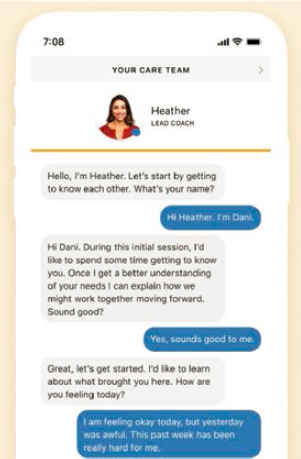
- Ginger app (Figure 5.1), which provides employees with 24/7, text-based emotional support coaching. Employees can speak to a counselor and get referrals. (More information is available at ginger.com/eap.)
- MyStrength app, which provides emotional health support through personalized planning tools, access to counselors, and recommendations for activities. (More information is available at mystrength.com.)
- Calm app for de-stressing, mindfulness, and meditation. (More information is available at business.calm.com.)
- Self-care resources available through MARTA’s insurance provider including articles, videos, audio activities, and self-assessment tools. Topics are focused on healthy sleep, relationships, and how to manage stress and life challenges. (More information is available at healthy.kaiserpermanente.org.)
- Lark, a free diabetes-prevention program that follows guidelines from (continued the Centers on for next Disease page) Control and Prevention to help members make small changes in diet, exercise, and sleep habits that can improve health and reduce the risk of diabetes over time. (More information is available at lark.com.)
- Periodic health education webinars.
MARTA introduces employees to the digital offerings when they are hired. Furthermore, a cross section of volunteers from various departments serves as “Wellness Ambassadors.” The ambassadors provide boots on the ground and establish two-way communications by sharing information about the agency’s health and wellness resources with employees and sharing feedback from employees at the monthly Wellness Ambassador committee meetings. As a committee, ambassadors work to develop solutions to address employee concerns and requests. MARTA raises awareness of the wide array of programs available by conducting group visits in coordination with their EAP provider, speaking at department meetings, hosting lunch-and-learns and webinars, and hosting an annual wellness fair.
Program Success
Because of the agency’s innovative EAP program, MARTA employees have myriad resources available to them 24/7. Online resources are easily accessible and anonymous, and they provide various important services.
MARTA frames its resources as a value-added benefit for existing employees and when recruiting new hires. The agency’s promotional materials focus on how its programs and resources serve as preventive measures, in contrast to reactive interventions (e.g., counseling following an incident). MARTA’s preferred communications approach focuses more on framing the EAP and other resources as positive wellness offerings rather than punitive requirements following incidents. MARTA is working on ways to measure the use and effectiveness of its offerings to understand their impact and inform future improvements to the resources offered.
Considerations for Using Technology in Your Wellness Approach
- Poll employees to identify digital offerings that might be useful to them.
- Explore existing relationships with vendors to understand digital offerings that may already be included with the services procured by the transit agency.
- Develop a plan to market digital and non-digital offerings to employees so they can be used in preventive contexts as wellness services rather than as punitive requirements following an incident.
Case Study 2: Increased Access to Mental Health Services, Trained Professionals, and Other Benefits
Challenges addressed:
- Access to mental health services provided by licensed professionals.
- Privacy concerns raised by frontline workers who are afraid that accessing services through their employer or on agency property may negatively impact their job or work conditions.
- Lack of paid time-off for mental health, wellness, and recovery.
Considerations for Increasing Access to Mental Health Resources
- Consider off-site mental health and wellness programs or partnerships because they allow for greater privacy and can help reduce the stigma often associated with seeking help.
- On-site mental health professionals remove several barriers to seeking help and can provide input on agency policy and procedures. However, agencies should identify and commit to funding such efforts to ensure continuity of care.
- For paid time-off related to mental health and wellness, agencies should be thoughtful in the design and implementation of the policy or benefit so that it achieves the intended purpose and is not used merely as additional vacation days.
Following a 2021 mass shooting at their Guadalupe Division facility, the Santa Clara Valley Transportation Authority (VTA) implemented several efforts to help their employees heal and recover from this traumatic incident. One such effort supplemented VTA’s EAP services with external resources that allowed employees and their family members to work with therapists through The 526 Resiliency Center. This program was established in collaboration with California State Senator Dave Cortese to provide counseling services to those impacted by the shooting. One of the key benefits of the program is that the facility is located off agency property, which provides increased privacy for employees who want to access services without fear of exposure or stigmatization. Some of the services offered by The 526 Resiliency Center include
- Group counseling;
- Individual counseling for children and adults;
- Family counseling;
- Trauma counseling;
- Eye movement desensitization and reprocessing therapy with a licensed professional, a technique used to reduce emotional responses to trauma; and
- Workshops on stress management, relationships, coping skills, and self-care.
Program Success
Providing mental health support following traumatic incidents is critical to ensuring that frontline workers are adequately supported. By providing an on-site mental health professional and paid time-off, VTA employees have the time and support necessary to navigate traumatic incidents.
The center offers both walk-in and scheduled appointments, with services offered in English and Spanish.
In addition to the off-site center offerings, VTA also hired a licensed psychologist to be on-site and support employees as they recover from the trauma caused by the mass shooting event. The increased and immediate access to a licensed professional helped remove several barriers to accessing care. The licensed psychologist also advised on program and policy changes to help employees recover from the incident and to improve overall employee mental health, wellness, and resiliency. One such program is “Check up from the Neck Up,” a monthly virtual webinar where the psychologist discusses various mental health topics. VTA varies the times and
days that the virtual webinar is held to help encourage live participation among workers with different schedules.
VTA recognizes that this is a costly solution, funded through a special program. While few transit agencies will likely be able to implement similar programming given existing funding constraints, the value of an on-site mental health professional is nevertheless immense, evidenced by positive employee opinions of the service.
In addition to counseling services, VTA is piloting a program that provides three paid mental health days per year, which can be used without prior approval and without penalty (i.e., no attendance points would be accrued by union employees who use the paid time-off) for managing sudden trauma and stress. The mental health days do not roll over and are not paid out at the end of employment. This approach encourages employees to use the mental health days to take a break or recover from stress.
Case Study 3: Incentives for Wellness Program Participation
Challenges addressed: Low utilization of existing mental health and wellness resources.
In coordination with its health insurance provider, the Metropolitan Atlanta Rapid Transit Authority (MARTA) provides employees and covered spouses with up to $250 per person, per year for their participation in the Wellness Rewards program. The program, developed in July 2020, provides cash incentives for participants who complete preventive services and programs to prioritize their health. The program aims to increase the use of existing resources and preventive care measures, which can benefit employee health, attendance, and resilience, both in the short and long term.
The Wellness Rewards program is connected to the agency’s Health and Benefits division and is managed through a wellness coordinator. Participants register through a portal on the insurance provider’s website and accept their wellness program agreement. A set of clinical or laboratory tests to measure an individual’s overall health and identify risks or potentially chronic conditions early on are conducted at no cost to the employee. Participants also complete a Total Health Assessment questionnaire online, complete any recommended cancer screenings based on age and sex, and have the option to sign up for lifestyle coaching. Once a member completes their health assessment, results are communicated to the wellness coordinator’s outreach team. Participant results are analyzed and then used to educate participants on the resources available to them, informing the development of a personalized approach. After completing the necessary steps, participants receive their $250 incentive. There are additional incentives for wellness follow-ups, exercise activities, and participation in other program activities.
Program Success
MARTA’s Wellness Rewards program is an example of how to successfully incentivize the use of mental health resources. Around 150 volunteers from various departments have participated in MARTA’s Wellness Ambassador program.
MARTA and the insurance provider also promote a new health topic each month. As part of their promotion, the insurance provider goes on-site to different locations within the transit authority to engage directly with participants and provide a service that complements the month’s topic. For example, when highlighting the importance of musculoskeletal strategies, chair massages are provided on-site.
MARTA’s “Wellness Ambassadors,” a cross section of around 150 volunteers who represent various departments, also help promote the program and spread awareness among employees. The Wellness Ambassador program is led by a wellness consultant, assigned by the insurance
provider, who works alongside ambassadors from different departments to develop program goals and a 12-month plan. MARTA continually seeks out user feedback through an annual Wellness Interest Survey. The results from the survey are shared with MARTA’S Wellness Ambassadors and used to develop the 12-month plan.
Considerations for Building a Wellness Program
- Even small incentives can encourage employees to take advantage of existing resources, which makes the costs of providing preventive services and resources more efficient and effective.
- Work with department heads, employee supervisors, and employees themselves to understand how best to incentivize employees to use existing resources.
- Consider conducting an annual interest survey to develop goals for an agencywide incentive program.
Case Study 4: On-Site Health Clinic Services
Challenges addressed: Barriers to accessing mental health and wellness services.
IndyGo in Indianapolis offers an on-site health clinic with clinical staff, including nurse practitioners and doctors who are available for appointments (Figure 5.2). The health clinic is free and open to all employees, even if they do not take part in the company-sponsored health insurance. Employee family members who use the agency’s health insurance can also visit the clinic at no cost.
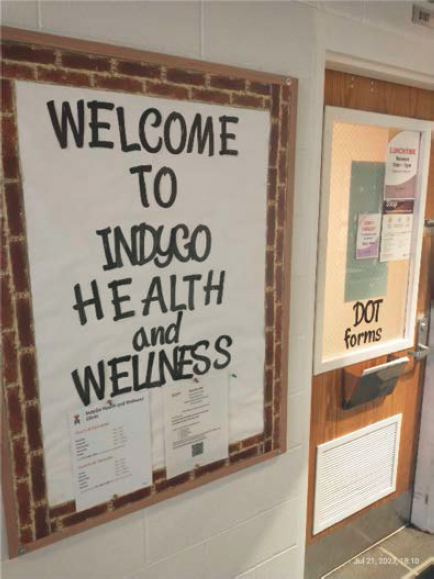
IndyGo established the clinic in March 2023 to provide employees and their families with easy access to healthcare, both to improve convenience and affordability and to achieve the best possible health outcomes in the workplace. IndyGo President and CEO Inez Evans stated that “the value of having an onsite clinic, and now a network of clinics around the city, will increase access and decrease the cost of healthcare for our team of dedicated employees” (IndyGo, 2022). IndyGo selected a healthcare vendor to run the clinic through a competitive RFP (request for proposal) bidding process. Through the provider’s network, employees and covered dependents can also access care at seven satellite clinic locations throughout the city, in addition to telehealth services. The clinic hours vary to accommodate frontline worker shifts. Instead of scheduling time away from work, employees can use this free service to see a doctor, complete commercial driver’s license (CDL) physicals, and receive some medications free of charge while at work.
Program Success
Transit workers often must navigate schedules that do not make it easy to get regular health checks. By providing an on-site health clinic, IndyGo is providing essential services that many frontline workers might not otherwise have the time or capacity to access.
Services offered by IndyGo’s health clinic network include
- Physicals and sick visits,
- Chronic condition management,
- Behavioral health counseling,
- CDL physicals,
- Medications, and
- Recurring “Lunch and Learn” events, where employees learn about health and wellness offerings through posted advertisements, newsletters, emails, and the agency’s intranet.
IndyGo’s wellness and teammate engagement coordinator is responsible for overseeing the partnership with their healthcare vendor and the on-site health clinic, with additional support from the chief people officer and the DEI and teammate engagement director. Collectively, they ensure that wellness and mental health are taken seriously, and they interact regularly with teammates to understand their needs. The position of wellness and teammate engagement coordinator is budgeted for operations funding, and IndyGo has found that the return on investment (ROI) more than outweighs the costs.
Employee participation is measured through goals and awards, such as discounted health insurance rates for attending at least three wellness coaching sessions, completing a physical, or participating in wellness goals that they help set. Other monetary awards are available for getting a flu shot; participating in a run, walk, or similar activities; or having a covered spouse who received a physical.
Considerations for On-Site Services
- Make a business case for funding an on-site clinic by emphasizing the ROI, which could include increased compliance with U.S. DOT physical examination requirements, fewer employee absences to manage chronic illnesses, and reduced healthcare costs for employees and employer.
- Identify a quality vendor through a competitive bid process to establish and manage the on-site healthcare services.
- Hire a dedicated agency employee to oversee and coordinate with the clinic vendor to ensure quality of services. Make a business case for funding a position that has the capacity and scope to prioritize wellness for employees, such as the wellness and teammate engagement coordinator.
Case Study 5: Creative Marketing
Challenges addressed: Lack of awareness of resources and services available to frontline workers.
Program Success
IndyGo’s Toilet Talk program is an effective way to communicate mental health resources to frontline workers. Toilet Talk flyers are engaging, creative, and affordable, and they can be regularly updated.
IndyGo in Indianapolis developed a creative marketing campaign to spread awareness of their employee assistance program (EAP) resources as well as important health and wellness topics. IndyGo’s “Toilet Talk” is a flyer with information on health and wellness topics displayed in restrooms behind plexiglass (Figure 5.3). The idea for Toilet Talk came from IndyGo President and CEO Inez Evans, who was motivated by a desire to engage with employees on the importance of health and wellness to both themselves and the agency. Staff responded positively to the promotion of mental health awareness, and Toilet Talk is a creative and fun way to share information and start conversations. It provides an easily accessible way for people to engage with mental health topics, which can make them feel more comfortable seeking support through provided resources when they need it.
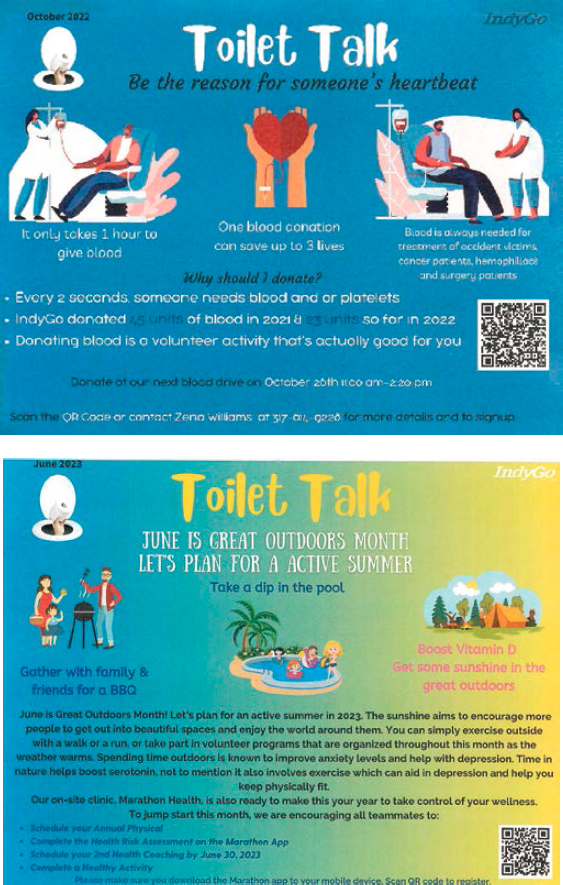
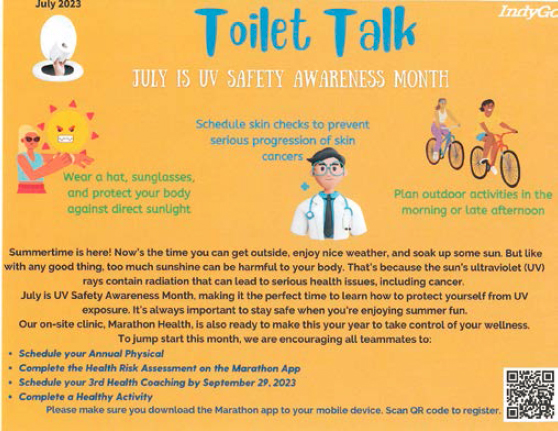
IndyGo’s wellness and teammate engagement coordinator receives information from IndyGo’s benefits advisory firm about wellness education and promotion topics, such as preventative health information and recipes. The human resources department coordinates the monthly flyer to present current information about the on-site clinic, health and wellness tips, and resources for health and wellness support in a creative and fun way. In an interview for the research project, IndyGo staff offered the following advice for agencies that may be interested in implementing a similar program: “Do it. Remain teachable and make sure that when promoting wellness, you are having fun and you are educated on current information on health and wellness.”
Considerations for Creative Marketing
- Identify where your target audience can be reached—these locations can be physical or virtual—and then identify marketing collateral that works for those places.
- Consider temporal elements of marketing—frontline workers may work different shifts and at various locations, so marketing materials should be multifaceted or adaptable to meet workers where they are.
- Be creative, and do not be afraid to change an approach if it is not effective.
Case Study 6: Critical Incident Support Teams
Challenges addressed: Lack of support for frontline workers during and after traumatic incidents.
Santa Clara Valley Transportation Authority (VTA) reported employing a Critical Incident Support Team (CIST) to better support frontline workers in the field as they encounter major or traumatic incidents, such as collisions, person under train or vehicle events, and assaults. VTA’s CIST team includes police, safety, and supervisor personnel with specialized training to respond immediately in case of a major incident. The team supports frontline workers and helps guide them and the public in responding to incidents.
Program Success
CISTs are becoming an increasingly popular strategy throughout the country. CISTs provide important mental health support for frontline workers while alleviating the burdens of dealing with incidents, filling out paperwork, and handling logistical requirements. VTA has made great efforts to provide frontline workers with various forms of post-incident support, a potential example for agencies nationwide.
VTA recognized that frontline workers encounter a wide variety of traumatic incidents while on the job, and the CIST was designed to reduce the psychological burden during and after these incidents. CIST team members help with logistical requirements immediately following an incident (e.g., paperwork) and provide ongoing peer or mentor support to impacted workers. This post-incident support helps frontline workers process the incident and recover so they can feel safe and confident returning to work.
VTA’s CIST team leverages best practices from the emergency response field. Developed by two light-rail operators, the program’s standard operating procedures borrow processes from research into how emergency responders address traumatic situations. CIST response begins with a request for support from an affected employee or a colleague or supervisor. Following this request, the Operations Control Center contacts a division dispatcher, who identifies the closest CIST member. The dispatcher then contacts the CIST member, provides them with the information needed to respond, and makes sure they are relieved if they are on duty. (While CIST members are volunteers and are not compensated for their time, they are paid for any time they spent responding to an incident when they had been scheduled to work.)
CISTs are designed to include personnel who are well-versed in policies and procedures for responding to an incident. They also may have specialized training, such as de-escalation training, or they may apply trauma-informed care approaches to help those impacted by the incident and its aftermath.
Considerations for Starting a Critical Incident Support Team
- When implementing a CIST, seek a wide array of volunteers who have experience in various incidents and can be empathetic to those impacted by an incident.
- CIST members should receive training in trauma mitigation, empathy, and de-escalation techniques, and they must be well-versed in policy, procedures, and resources to ensure impacted workers are sufficiently supported.
- Develop procedures for post-incident support in addition to support during the event. This will ensure workers feel fully supported and have the resources they need to return to work following an incident.
Case Study 7: Red Kite Project Resiliency Training
Challenges addressed: Frontline workers lack the tools, training, and resources to deal with the adverse conditions and stress encountered on the job.
Program Success
The Red Kite Project’s trainings on resiliency and conflict management techniques better prepare frontline workers for on-the-job incidents and provide a safe space for employees to talk about work difficulties.
Metro Transit in Minneapolis determined that frontline workers needed both help in conflict management while performing their jobs and a safe platform to speak freely about the challenges and stress of their work. Metro Transit identified a vendor, the Red Kite Project, to provide a multiday training intended to increase employees’ resiliency in the workplace. The Red Kite Project assists organizations and their workforce in rising above obstacles encountered in their work environment to promote worker well-being and safety. Their services aim to address employee burnout and disengagement, as well as reduce
conflict and violence in the workplace. Their trainings utilize best practices from behavioral health, violence prevention, martial arts, yoga, and other disciplines.
Metro Transit worked with the Red Kite Project to focus the three-day training on overall resiliency and conflict management techniques. Since the training is confidential and conducted by an outside party, employees have a safe space to speak freely in a group setting with peers about their challenges at work, without fear of repercussions. The training includes de-escalation tactics that operators can deploy in the field to address unruly passengers.
Feedback on the program from frontline workers has been overwhelmingly positive. Metro Transit is working to deploy a six-month follow-up survey to further understand the most useful aspects of the program. Metro Transit said the following about the program’s success: “Whether other agencies contract with [a vendor] or develop a resiliency program in-house, Metro Transit believes offering this sort of support training is very important so employees can navigate traumatic events that occur on transit.”
Considerations for Implementing Resiliency Training
- Resiliency training should include training on de-escalation and other techniques for frontline workers to manage difficult situations with riders and then recover from those difficult situations.
- Employee resiliency programs and trainings should include time and space for employees to share their job stresses and challenges freely and without repercussions.
Case Study 8: Lactation Van for Nursing Operators
Challenges addressed: The workplace conditions of frontline transit workers do not accommodate parents and caregivers.
TriMet in Portland, Oregon, began noticing that nursing operators were missing work and needed more support to be able to pump while at work. To support nursing parents in the field,

TriMet explored off-the-shelf location pods, like those found in public spaces; however, none of the models available were able to withstand the elements. As a creative solution, TriMet decided to transform a paratransit van into a mobile lactation unit that offers a secure, comfortable, and convenient place to pump while completing a driving shift.
Program Success
TriMet’s lactation van for nursing operators is an excellent example of an agency using available resources and partners to provide a critical need for their workers.
By using a paratransit vehicle, communicating the service early on, and partnering with the union and various departments, TriMet was able to appropriately meet the needs of new parents.
The lactation van’s services are scheduled in coordination with a nursing parent’s shift times so it can meet the operator during their scheduled break. Extraboard operators drive the vans to and from the relief locations and may stand in while the nursing operator pumps.
The availability of this resource is advertised through the internal communications teams and communicated by frontline managers who work with expectant parents. This helps identify the need for lactation van services early and allows sufficient time to inspect the vehicle and strategize for deployment when the nursing operator returns to work.
Several departments and the local union collaborated to create this program: The paratransit department provided the van; maintenance personnel and the nonrevenue vehicle department undertook the sourcing of equipment, furniture, and other supplies; and the union, transportation operations department, and maintenance department identified issues and addressed them together.
The resource’s initial deployment met challenges, such as scheduling a driver for the lactation van, but TriMet departments and the union worked together to adjust the program and brainstorm solutions. Feedback on the program has been very positive. The lactation van is also marketed to new employees and used in recruitment.
Considerations for Supporting Parents and Caregivers
- Building and testing a new program to support frontline workers can take time, collaboration, and revision. Agencies must be open to failure and be adaptive rather than give up after a first attempt or when challenges are encountered.
- Programs intended to support parents and caregivers should involve this target audience and incorporate their input into program development.
Case Study 9: Training and Mentorship for Retention and Advancement
Challenges addressed:
- Frontline transit workers feel unprepared for their jobs.
- Frontline workers lack clear pathways for career growth.
Santa Clara Valley Transportation Authority (VTA), in collaboration with the Amalgamated Transit Union (ATU) Local 265, established the Joint Workforce Investment (JWI) program. The JWI provides training and mentorship to help ease new employees into their job, as well as opportunities for upward mobility and continual growth. This program was founded in 2006 as a High Road Training Partnership between VTA and ATU Local 265 to address key issues faced by transit workers.
Despite differences between the union and the agency, both parties recognized that there was a need for improved training programs for transit workers, particularly operators, due to the complex nature of their role. In a customer-facing role that also requires the operation of a heavy vehicle, operators often experienced inadequate training and support, which led to lower retention rates and impacted their mental health and well-being. The agency and union worked together to create a program that could provide mentorship for new transit workers, with the goal of improving retention by sharing practices that could bolster mental health and wellness and by increasing professionalism among workers. Both parties identified leaders who were strong advocates for transit workers who would prioritize the partnership. To identify practices that were most popular among frontline workers, management, and the union, the JWI held focus groups led by a neutral third party. The results of the focus groups were used to create the JWI’s mentorship program.
The mentorship program was initially developed by identifying key transit operators who could act as mentors; these operators demonstrated leadership skills as well as a commitment to the profession and the community. Mentors were assigned to new operators after the technical training period ended, ensuring that those operators who were accepted to the mentorship program were committed to working with the agency. The mentorship program now has over 100 mentors for around 900 total operators working at VTA. The program consists of continued on-the-job trainings with mentor support, as well as classroom trainings in partnership with a higher education institution.
Program Success
VTA’s mentorship program provides a career ladder for the advancement of many frontline workers, providing them with the opportunities and trainings necessary to apply for management or specialized roles.
Through the mentorship program, VTA identified a need to better define operators’ career paths. This need was addressed through the development of a career ladder, allowing operators to acquire technical skills through the JWI program. Offering a career ladder helps the JWI focus on gender parity and community advocacy in populations that are underrepresented in the industry.
The program’s success has been measured using four key metrics: attendance, retention, accident occurrences, and customer service complaints. At the program’s conception, the JWI established a control group, which has served as a baseline for the effectiveness of having a mentor. Operator retention and attendance are significantly higher among JWI participants than the control group, and accident occurrences are less frequent. The program continues to evolve—for example, it currently offers an apprenticeship program for vehicle and track maintenance workers.
Considerations for Building a Training and Mentor Program
- Identify core values to guide the development of a mentorship program that is supported by agency management, union leadership, and frontline workers.
- Provide a career ladder that works in tandem with a mentorship program, providing internal mobility within agencies and opportunities for leadership.
Case Study 10: Operator Restroom Workgroup
Challenges addressed: Lack of access to safe, clean facilities while working in the field.
In response to bus operator requests for consistent access to safe and clean restroom facilities, the Maryland Transit Administration (MTA) launched an operator restroom workgroup that
identifies gaps in restroom availability at layover locations and develops potential solutions. To inform this effort, MTA interviewed staff from the San Francisco Municipal Transportation Agency (SFMTA) and other transit agencies to design an approach for solving operator restroom access issues. At the time, SFMTA had staff dedicated to creating and maintaining contracts with local businesses and property owners to use restrooms during—and sometimes after—business hours.
MTA took this model and created the operator restroom workgroup following their bus system redesign in 2017. The workgroup was relaunched in 2023 and is now led by the office of service development (OSD), which is primarily responsible for bus service planning and scheduling. The relaunch was driven by incidents where operators were denied access to restrooms they had previously been permitted to use.
Union Efforts to Improve Access to Safe, Clean Bathrooms
Amalgamated Transit Union (ATU) leadership has been actively advocating for better bathroom access throughout the United States and Canada (Healthy Work Campaign, 2020). In response to the many health issues caused by restrictions or delays in bathroom use, the ATU (2022) published Restroom Access: A Guide for Local Unions to inform and support union members and to educate the public on the importance of bathroom access for transit workers.
The ATU’s website provides news on local union efforts, scientific articles, surveys, flyers, posters, and educational media on the issue of bathroom access.
Program Success
Restroom access is an extremely important topic in transit planning and operations. MTA’s thorough efforts to improve access to bathrooms emphasized the importance of access and allowed frontline workers to participate directly in the improvement process.
The OSD is working with the MTA’s inreach coordinator, whose primary responsibility is to liaise between transit operators and other departments. However, the workgroup recognizes that success requires further engagement and buy-in from other departments at MTA, including the facilities, legal, real estate, and customer and community relations offices.
One of the relaunched workgroup’s first initiatives was surveying operators to gather feedback on existing and potential restroom facilities. The inreach coordinator and OSD staff visited each operating division to talk with workers and distribute surveys. The workgroup also used feedback collected from the monthly Operator Advisory Committee to identify the locations of restrooms that operators currently use.
After collecting some initial data, the workgroup systematically examined bus routes with the most operator complaints to identify restroom locations at each layover and at mid-route timepoints, if necessary. The workgroup then identified a series of potential solutions to address the lack of access. These solutions included
- Moving or adjusting timepoints and layover locations,
- Identifying a property owned or leased by MTA that could house a portable toilet or future comfort station,
- Identifying businesses near existing bus stops or layovers that have expansive operating hours and restroom access, and
- Adjusting alignments and adding stops, if necessary.
While identifying nearby businesses or locations owned or leased by MTA is preferable for portable toilets, the workgroup is open to all ideas. As of writing, the group is soliciting feedback on potential solutions from other departments to select the best option in each case.
The workgroup aims to accomplish several goals in the coming year:
- Develop sample agreements or contracts with businesses to formalize operator restroom access. These agreements could include financial compensation to help cover restroom maintenance costs.
- Develop a code of conduct for operators to address behavioral complaints that have been received from businesses in the past.
- Develop a guidebook or toolbox of potential solutions and considerations to address operators’ lack of access to restrooms. Clear documentation will help the agency continue to address this issue as the service evolves and as MTA staff grows and changes.
Considerations for Building a Similar Program
- Operators should be included in the identification of restroom access issues and in the development of solutions.
- Solutions to restroom access require involvement from many departments; MTA recommends involving other departments early in the process to gain their buy-in and support.
- For a large agency with many bus layover locations, like MTA, a full-time staff person dedicated to resolving restroom access issues and maintaining agreements with partners can help keep the program intact and effective.
- Increasing and maintaining access to restrooms for workers in the field has the additional benefit of building trust between agency leadership and frontline workers. However, agencies must dedicate the resources needed to maintain access and cleanliness of facilities to maintain the trust between parties.
Case Study 11: Union Assistance Program
Challenges addressed: Distrust in employee assistance programs or agency management.
To support the mental health needs of frontline transit workers, the Transport Workers Union (TWU) Local 100 in New York City developed a union assistance program (UAP) in 1988. Since then, the UAP has provided members with intervention services for substance misuse, family issues, and mental health issues, including stress, depression, anxiety, eating disorders, and gambling.
The UAP is a confidential, voluntary, and non-disciplinary service that allows workers to express the issues they are dealing with without fear of retribution. The TWU Local 100 also negotiated to include provisions that would allow union members to volunteer for drug or alcohol treatment before being identified by a random alcohol or drug testing program. The agreement also stipulates that the cost of treatment must be provided by the employer, beyond the existing health benefit plan.
One important element of the program is the monitoring and evaluation of participants. The program does not simply seek to connect participants to services. Instead, it focuses heavily on rehabilitating workers so that they may reach their goals, successfully complete the program, and reenter the workforce with a plan for their work and home life. The UAP also supports and monitors members who have been required to attend the program because they failed a drug test or drove while intoxicated. The TWU Local 100 program has continued supporting workers since its inception decades ago, and it has served as an example for UAPs throughout the country. Furthermore, members can find important educational resources and crisis hotlines on the UAP’s website.
Program Success
For years, the TWU Local 100’s UAP has been an example for many unions looking to implement a similar program. The UAP provides important services while ensuring confidentiality and support for frontline workers.
Unions can play a crucial role in supporting the mental health and wellness of transit workers. As an independent entity, unions can provide workers who need support with an environment that prioritizes confidentiality and a path to rehabilitation without endangering their livelihood.
Considerations for the Development of a Union Assistance Program
- Guarantee strict confidentiality for all participants in the program. Workers should feel safe and comfortable discussing their mental health concerns, without fear of repercussions.
- Develop a crisis intervention plan to address mental health crises promptly. Ensure that transit workers have access to immediate support in emergency situations.
- Develop rehabilitation plans for members that focus on achieving their goals and provide monitoring and follow-up.
Case Study 12: Beyond Traditional Employee Assistance Program Services
Challenges addressed:
- Access to mental health and wellness resources.
- Access to other services, such as daily-life assistance, legal and financial services, and online mental health and wellness resources.
After the onset of the COVID-19 pandemic, the San Diego Metropolitan Transit System (MTS) realized that employees were looking for more resources and services to support their own and their family’s mental health. Therefore, MTS decided to find an employee assistance program (EAP) provider that could provide a wide range of easily accessible services. Offered at no cost to employees, services are completely confidential and typically available 24/7.
Program Success
MTS goes beyond traditional EAP services, like mental health support, by providing access to legal, financial, and daily-life assistance services. While these services are not directly related to mental health, they alleviate many of the daily stressors that frontline workers face and often do not have the time or capacity to address.
To provide adequate mental health support for transit workers, employees can access up to eight counseling sessions per each unique issue each year. Counseling sessions are available for a variety of issues, including anxiety, relationships, depression, stress management, work–life balance, family issues, grief and loss, personal development, substance misuse, and many more. Services are free and confidential, with the option of speaking face-to-face via video call or chat. Services are also available 24 hours a day for any urgent or in-the-moment emotional support, which can be crucial for transit workers who are experiencing or have just experienced a traumatic incident. The confidentiality of counseling sessions also allows workers to express their grievances or personal issues without fear of repercussion.
MTS also offers its employees a range of online tools, resources, and applications to support mental health and well-being, including the following:
- Talkspace. This online therapy platform allows users to connect with a licensed behavioral therapist. Therapists are available 24/7. Users can send unlimited text, video, and audio messages to their dedicated therapists, and they can schedule 30-minute live sessions.
- MyStrength. The app provides online tools to improve emotional well-being. The app also provides resources to help users maintain a positive outlook, and it gauges each user’s mindset to provide feedback.
- Online resources. Members can access various tools, such as articles and self-assessments, video resources, a stress resources center, live and recorded webinars, and an adult-care and childcare provider search tool.
Apart from providing resources with a specific focus on mental health and wellness, MTS’s EAP also offers services that can help alleviate the stress of daily life outside of work. Financial services, legal services, childcare, and basic needs are important elements of an employee’s life that are often overlooked by employers. To provide a full range of support that can alleviate the stresses of daily life and support employee performance, San Diego MTS offers the following:
- Daily-life assistance. Employees can seek personalized guidance and resources regarding childcare, parenting, adoption, elder care, school and financial aid research, special needs, pet care, community resources, home repair, summer programs for kids, household services, and more.
- Legal services. Members have access to a free 30-minute consultation with a participating attorney for each topic. Topics include family law, civil law, criminal law, elder law and estate planning, divorce, wills, real estate transactions, and mediation services. Participants receive a 25% discount beyond the initial consultation and have access to legal documents and forms via the member website.
- Financial services. Members have access to a free 40-minute consultation for financial topics related to budgeting, retirement or financial planning, mortgages and refinancing, credit and debt issues, college funding, and tax and IRS questions. Participants receive a 25% discount on tax preparation services and have access to financial articles, calculators, and a financial assessment.
Considerations for Expanding an EAP Program
- Identify a vendor that can fit the changing needs of employees by suppling quality, consistent, and multifaceted services on different platforms.
- Review feedback and employee utilization continuously and adjust offerings as needed.
- Ensure that available program offerings are clearly communicated to employees.
While these services are not explicitly related to mental health, support in these areas can be extremely valuable for the mental health and well-being of transit workers, especially since work–life balance is a challenge for many frontline transit workers.


