Mental Health, Wellness, and Resilience for Transit System Workers (2024)
Chapter: 6 Toolkit
CHAPTER 6
Toolkit
Introduction
This toolkit reflects best practices identified through engagement with frontline workers and agency leadership from various transit agencies nationwide. Frontline transit workers shared the wide array of difficulties they face on the job and described the mental health programs they believed would best support them. Focus groups of transit workers and agency leadership also provided insight into the best format for this toolkit.
The toolkit provides guidance for enhancing existing mental health and wellness programs and for implementing new ones, with a range of formats tailored to the specific type of improvement or program (e.g., narratives, worksheets, checklists, frameworks, and step-by-step guides). The toolkit also provides research on the overall business value of establishing mental health and wellness programs for frontline workers, which can support efforts to identify dedicated resources to fund these initiatives. The primary aim of this toolkit is to assist agencies in supporting their frontline workers by facilitating the development and delivery of effective mental health and wellness programs.
How to Use This Toolkit
Table 6.1 is meant to help you navigate this toolkit. First, read the key issue statements, and identify those that resonate with your agency. One or more toolkit components are identified for each key issue statement. Read the descriptions and issues addressed, and click on the desired component to jump to that section of the toolkit.
Table 6.1. Toolkit components.
| Key Issue Statement | Toolkit Component* | Issues Addressed | Description |
|---|---|---|---|
| My transit agency is unsure if our employee assistance program (EAP) offerings are adequate, unsure how often the offerings are used, or both. | Program Evaluation | Evaluating program performance or effectiveness. | This section includes a framework for how agencies can create procedures for program evaluation. |
| Evaluating and Improving EAPs and Union Assistance Programs | Increasing mental health and wellness offerings. | This section includes detailed worksheets (Tables 6.3, 6.4, 6.5, and 6.6) with probing questions to help transit agencies and unions document their current processes related to assistance programs and assess and identify opportunities to enhance them. |
| Key Issue Statement | Toolkit Component* | Issues Addressed | Description |
|---|---|---|---|
| My agency has existing mental health and wellness programs, but we are unsure how effective they are. | Program Evaluation | Evaluating program performance or effectiveness. | This section includes a framework for how agencies can create procedures for program evaluation. |
| My agency is interested in expanding the mental health and wellness resources available to our frontline workers. | Establishing Wellness Program | Increasing mental health and wellness offerings. | This section includes information about wellness program components, steps for establishing a wellness program, and other considerations for building an effective wellness program targeting frontline workers. |
| Evaluating and Improving EAPs and Union Assistance Programs | Increasing mental health and wellness offerings. | This section includes detailed worksheets (Tables 6.3, 6.4, 6.5, and 6.6) with probing questions to help transit agencies and unions document their current processes related to assistance programs and assess and identify opportunities to enhance them. | |
| Increasing Training Offerings | Increasing mental health and wellness offerings. Building trust and empathy. | This section identifies three types of trainings that frontline workers or their managers and supervisors identified as useful for coping better with certain on-the-job situations. | |
| My agency struggles to communicate with our frontline workers about mental health and wellness resources. | Support Mental Health in the Workplace: Checklist for Leadership and Senior Managers | Improving communications about mental health in the workplace. Building trust and empathy. | This checklist provides a tool for agency leadership, union leaders, and those who manage frontline workers directly to better understand worker needs and communicate with them about mental health. |
| Improving Communications and Marketing of Resources | Increasing awareness of resources. Increasing program participant retention. | This section addresses findings that frontline workers often feel uninformed about mental health resources by providing guidance on communicating and marketing these resources. | |
| Increasing Training Offerings | Better preparing employees for their work environment. Training managers on empathy/compassion for frontline workers. Increasing mental health and wellness offerings. Building trust and empathy. | This section identifies three types of trainings that frontline workers or their managers and supervisors identified as useful for coping better with certain on-the-job situations. |
| Key Issue Statement | Toolkit Component* | Issues Addressed | Description |
|---|---|---|---|
| I have an idea for a new or modified program or policy to improve the mental health or wellness of frontline workers, but I do not know how to implement it. | How to Make the Case for Increased Benefits to Support Mental Health and Wellness | Increasing mental health and wellness offerings. Funding and implementing a program. | This section includes directions for agency staff on how to communicate the value of increased employee benefits to agency leadership. |
| Building Trust between Parties | Building trust and empathy. Promoting empathetic management. | This section details a three-step process for building supportive, positive relationships and increasing trust between agency leadership, union leadership, and frontline transit workers. | |
| My agency’s frontline workers distrust leadership and feel disengaged. | Building Trust between Parties | Building trust and empathy. | This section details a three-step process for building supportive, positive relationships and increasing trust between agency leadership, union leadership, and frontline transit workers. |
| Fostering Community among Frontline Transit Workers | Increasing employee engagement. Building trust and empathy. | This section includes creative ways to build a sense of community among frontline transit workers who may not naturally have an opportunity to regularly engage with their peers. | |
| Developing and Implementing Mentor and Peer Programs | Preparing employees for their work environment. Increasing employee engagement. Building trust and empathy. | This section includes a framework for the development of a mentorship program based on research from other agencies and industries. | |
| My agency’s frontline workers feel unprepared or unsupported in their jobs. | Increasing Training Offerings | Increasing mental health and wellness offerings. Preparing employees for their work environment. Building trust and empathy. | This section identifies three types of trainings that frontline workers or their managers and supervisors identified as useful for coping better with certain on-the-job situations. |
| Developing and Implementing Mentor and Peer Programs | Preparing employees for their work environment. Increasing employee engagement. Building trust and empathy. | This section includes a framework for the development of a mentorship program based on research from other agencies and industries. |
| Key Issue Statement | Toolkit Component* | Issues Addressed | Description |
|---|---|---|---|
| Providing Support during and after Incidents | Supporting frontline workers during and following traumatic events. | This section includes best practices for supporting frontline workers in the field: specialized critical incident response teams that can respond to incidents in the field (e.g., vehicle crash or person under train incident) and improvements to post-incident support. | |
| Building Trust between Parties | Building trust and empathy. Promoting empathetic leadership. | This section details a three-step process for building supportive, positive relationships and increasing trust between agency leadership, union leadership, and frontline transit workers. | |
| Some of my agency’s current policies and procedures are not supportive of employee work–life balance or mental health and wellness. | Providing Support during and after Incidents | Supporting frontline workers during and following traumatic events. | This section includes best practices for supporting frontline workers in the field: specialized critical incident response teams that can respond to incidents in the field (e.g., vehicle crash or person under train incident) and improvements to post-incident support. |
| Modernizing Operational Policies for a Healthy Workforce | Improving operational policies to provide flexibility and a better work–life balance to frontline workers. | This section includes ideas for modernizing operational policies and procedures to improve the work–life balance for frontline workers and provide more time to rest and recover from intense, stressful work. | |
| As a frontline worker, I want to learn how to advocate for myself and my peers to improve our overall well-being at work. | Self-Advocacy Tools | Empowering self-advocacy for frontline workers in the workplace. | This section includes resources for frontline workers to be their own advocates for mental health and wellness in the workplace. It includes information on worker rights, how to effectively communicate with management, how to leverage partnerships with human resources departments, and how to become a peer advocate or start a resource group. |
* Click on the titles of linked toolkit components to jump to those sections.
Program Evaluation
This project’s research findings indicate transit agencies are not consistently evaluating the effectiveness of their mental health and wellness programs, making it hard for them to know whether their strategies are working and how to adapt them as conditions change. Continuous improvement is vital for programs to effectively address constantly evolving issues. The guidance on capability maturity measurement in this section adds a tool to agencies’ and unions’ resource arsenals that can help them develop and continuously improve mental health and wellness programs.
This section summarizes core Capability Maturity Model Integration (CMMI) concepts. The conceptual framework of capability maturity was originally developed by researchers at Carnegie Mellon University. Formally known as CMMI, these concepts have been used for organizational performance improvement across many fields, including aerospace engineering and government. (For more information, see Godfrey, 2004). These concepts are especially useful for agencies, unions, and staff who are newer to evaluation, since the evaluation can be done qualitatively (What is working, and what needs improvement?) as well as quantitatively (How often does this need to happen to be successful?).
Table 6.2 defines five stages of capability maturity and provides examples of how these stages apply to management of mental health and wellness programs, namely employee assistance programs (EAPs) and union assistance programs (UAPs), at transit agencies. Capability maturity is used for evaluation throughout the transportation industry, most prominently by state departments of transportation for transportation systems management and operations (TSM&O).
Table 6.2. Capability maturity matrix.
| Stage | Characteristics | EAP/UAP Examples |
|---|---|---|
| (1) Initial | The work process is poorly controlled and reactive, relying on individual efforts on an individual basis—this stage has the highest risk of failure and greatest variability in quality. | Transit agency or union has secured a vendor for EAP/UAP services and offers other programs and resources through their healthcare provider. The burden is primarily on individual frontline workers to access services when they need them. |
| (2) Repeatable | The work process is documented well enough that it can be repeated the same way on a project basis, even for employees who are new to the process. Furthermore, work can be planned well in advance and monitored at a rudimentary level. | Transit agency or union has implemented a regular marketing plan to build awareness of EAP/UAP resources. However, resources are still dispersed among different websites, call centers, etc. Frontline workers must navigate various portals to find the resources they need. |
| (3) Defined | The work process is well-defined, and adoption is standardized. Processes of individual projects are tailored to the standard. Projects can verify and validate work integrity, and organizations can integrate the work of related projects. | In addition to having a marketing campaign that builds awareness of resources in various ways (flyers, lunch-and-learns, emails, etc.), the transit agency or union has also developed a single online resource hub that clearly explains where and how to access services. |
| (4) Managed | The organization quantitatively tracks process activities using standard metrics, such as hours worked, activity clearance, or percent complete, which makes complex organizational integration and performance management possible. | Building on the comprehensive marketing campaign and one-stop resource hub, the transit agency or union is also tracking which resources are most accessed as well as collecting metrics to see how worker well-being (e.g., absences, retention) has been impacted since the start of various activities and immediately following marketing blitzes. |
| (5) Optimizing | The organization engages in process analysis, which provides management and staff with sufficient visibility into relationships between processes and outcomes to collaborate for continuous improvement. | After reviewing utilization and outcome metrics, the transit agency or union begins measuring the effectiveness of individual EAP/UAP offerings to determine which should be discontinued, added, or expanded. The organization also uses employee focus groups and committees to help evaluate and improve EAP/UAP offerings and marketing of services. |
FHWA developed a suite of capability maturity matrix (CMM) tools focused on TSM&O work functions, such as ensuring travel time reliability, safety training, and timely asset management (National Operations Center of Excellence, n.d.). Transit agencies may consider perusing that guidance for examples and inspiration when employing CMM concepts.
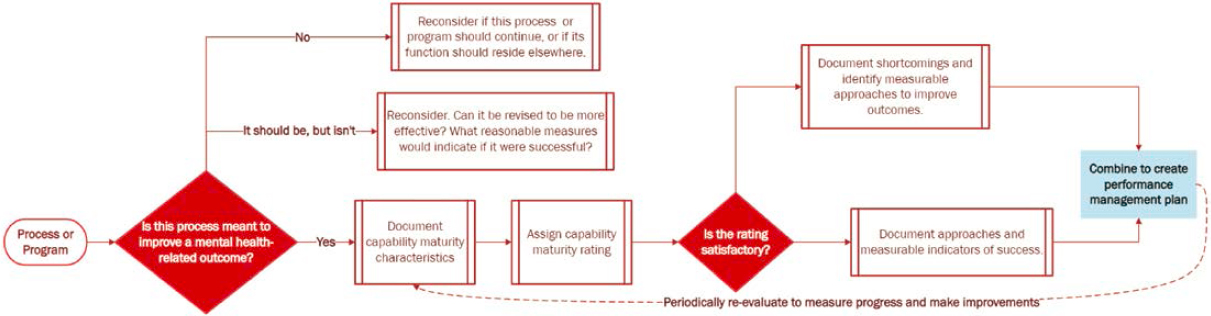
If desired, apply the CMM concept to worksheets throughout this toolkit by conducting a simple evaluation (Figure 6.1). Evaluation should rarely result in punitive action: Its purpose is to clarify what is and is not happening, clarify what is and is not in the program’s span of control, and make continuous improvements. Staff should work together to consider a program or its component processes’ functions and assign a capability maturity rating, preferably based on a categorical (yes or no) or quantitative indicator that measures the success of the desired outcome. If the function of a program or process is not related to improving mental health among transit workers, staff may consider whether it should be revised or managed elsewhere in the organization. Likewise, if a program or process could be used to improve mental health among transit workers but is not currently designed for such a purpose, staff may consider how to restructure and make it more effective.
Agencies and unions conducting the CMM evaluation need to use meaningful measures of success, periodically re-evaluate, and document progress. Staff may discover that creating a report on workforce mental health enhances organizational processes, clarifies their objectives, refines outcome measurement methods, and tracks progress toward these outcomes. This formalization can help structure continuous improvement by making it easier to trace how a program has evolved over time and prevent the repetition of unsuccessful strategies.
Additional Resources
For more information about the capability maturity matrix, see Godfrey (2004). See also FHWA’s developed suite of CMM tools focused on TSM&O work functions (National Operations Center of Excellence, n.d.).
Evaluating and Improving EAPs and Union Assistance Programs
While transit agencies and unions may offer assistance programs to their staff and members, research conducted for this project indicates the process for evaluating this programming is often unclear or nonexistent. Although employee assistance programs (EAPs) as offered by transit agencies may be more well-known, unions have also developed their own programming for
members. This section includes four tables, each one a detailed worksheet with questions to help transit agencies and unions document their processes related to assistance programs, as well as assess and identify opportunities to enhance them.
Union Assistance Programs
Transport Workers Union (TWU) Local 100 has provided a robust union assistance program (UAP) since 1988. The program provides members with assistance for substance misuse, psychological issues, family problems, and other personal issues on a voluntary and confidential basis.
The TWU Local 100 UAP was featured in a 2023 study commissioned by the International Transport Workers’ Federation. The report explored union-based initiatives to protect the mental health of young public transportation workers.
Each worksheet covers one of four main components:
- Marketing. Transit agency staff and union members may not be aware of the resources available to them. Table 6.3 helps agencies and unions identify the methods they are currently using.
- Accessing Services. Reducing barriers to access is a critical component of helping workers get the support they need. Since worker needs and preferences vary by individual, Table 6.4 helps transit agencies and unions document the different ways in which staff and members can access services.
- Vendor and Program Evaluation. The existence of a program provides a starting point to assist staff and members in addressing mental health and wellness needs, but agencies and unions need to conduct continuous quality control. Table 6.5 includes guiding questions to facilitate program evaluation.
- Building Trust. The research conducted throughout this project indicates employees may be hesitant to seek assistance due to privacy concerns and the fear of repercussions (e.g., termination due to seeking treatment for substance misuse). Maintaining confidentiality is critical for the use and success of assistance programs (Table 6.6). While programs are generally confidential, there are some instances in which providers must inform authorities (e.g., if an employee or member wants to harm themselves or others).
Additional Resources
For more information on evaluating EAPs, see Evaluating Employee Assistance Programs in University of Maryland, Baltimore’s digital archive (Masi, 1997).
For information on working with EAP vendors to provide additional mental health resources, see the National Safety Council’s Working with Benefits Providers: Mental Health Issues Checklist.
Establishing Wellness Programs
The Society of Human Resource Management (SHRM) found that wellness programs can help increase employee morale and improve overall health while decreasing an employer’s healthcare costs. Wellness programs can also increase the productivity of employees by reducing sick days. According to a survey of over 700 frontline workers conducted for this report, workers value having a variety of resources available to them in different formats. This means that a successful
Table 6.3. Worksheet: Marketing in EAPs and UAPs.
| Guiding Questions | Agency/Union Answer | Notes on Process/Metrics |
|---|---|---|
| Process Components | ||
| Advertising. How do employees, contracted staff, or union members learn about the assistance program? Check all the places where your agency/union advertises the program. |
Check all that apply:
□ Intranet □ Email to employees with agency addresses/email to members □ Text messages □ Flyers, posters, and postcards in common areas □ Sharing information during recurring meetings □ Sharing information during onboarding □ Sharing information during open enrollment periods □ Other (open-ended response) | |
| Referrals. Is there any person or organization that can refer employees or members who may need assistance program services? List any people involved in the process. | ||
| Barriers to implementation. What steps, if any, has your agency or union taken to ensure all employees are being reached? | ||
| Metrics | ||
| For each marketing avenue identified, how often is the avenue used to make a referral? (For example, when a link to the EAP/UAP website is emailed, how many clicks does the link receive?) | ||
| How does awareness of EAP/UAP services compare to the utilization rate of services? | ||
Table 6.4. Worksheet: Accessing services in EAPs and UAPs.
| Guiding Questions | Agency/Union Answer | Notes on Process/Metrics |
|---|---|---|
| Process Components | ||
| Eligibility. Who can access assistance program resources? |
Check all that apply:
□ Staff (direct hires) □ Staff (contracted) □ Staff (direct hires) and spouses □ Staff (contracted) and spouses □ Staff (direct hires) and extended family □ Staff (contracted) and extended family □ Union members □ Union members and spouses □ Union members and extended family | |
| Access. How can employees or members access assistance program services? |
Check all that apply:
□ Virtual □ In-person, group setting □ In-person, individual □ On-site, group setting □ On-site, individual | |
| Application. What is the process for staff or members to use assistance program services? Describe the steps that staff or members must take to request and use services, including the information they need to provide to access services and estimated wait times to receive services. | ||
| Barriers to access. What steps, if any, has your agency or union taken to address issues regarding access to services (including scheduling difficulties or technology challenges)? | ||
| Metrics | ||
| How many staff or members utilized assistance program services in the last calendar year? (Note: If you are unable to track the utilization of services, work with your vendor to identify ways of collecting the information.) | ||
| What was the most popular method of accessing program services? What was the least popular? | ||
Table 6.5. Worksheet: Vendor and program evaluation in EAPs and UAPs.
| Vendor and Program Evaluation | Agency/Union Answer | Notes on Process/Metrics |
|---|---|---|
| Process Components | ||
| Vendor selection. Describe the process for selecting an assistance program vendor (where applicable). What factors were considered when evaluating vendors (e.g., cost, coverage, specific services provided)? | ||
| Service level agreements. Describe the process for monitoring the vendor, in particular the vendor’s adherence to agreed-upon service levels (e.g., response times, number of available counselors). Describe the process, if one exists, for taking corrective action if the vendor does not meet requirements. | ||
| Facility assessment. Does your agency or union conduct an on-site visit to the vendor’s facilities? If so, what aspects of the facilities are assessed? |
Check all that apply:
□ Condition of physical office □ Accessibility of physical office □ Office location and ease of access | |
| Cost-benefit analysis. How does your agency or union calculate the cost and associated savings of programming, and what metrics are used to assess whether the program is operating effectively? (Note: There are costs associated with absenteeism, inability to recruit or retain talent, medical expenses, etc. How does your agency or union factor these costs into the analysis? Could the increased costs of offering more services be offset by savings achieved through more retention and less absenteeism?) | ||
| Reporting frequency. How often does your agency or union receive vendor reports? What do these reports measure? How are these reports used to assess performance and identify areas of improvement (including year-over-year)? | ||
| Surveying staff or members. Has your transit agency or union surveyed staff or members about the strengths and weaknesses of the program, as well as opportunities for enhancing it? If yes, describe the survey content, when the survey was administered, and the results as well as how they were addressed. | ||
| Vendor and Program Evaluation | Agency/Union Answer | Notes on Process/Metrics |
|---|---|---|
(Note: You might include questions related to the assistance program as part of other surveys, such as surveys for existing employee engagements.) Potential survey questions include:
| ||
| Surveying program users. Is there a process in place for surveying people who used the assistance program? If so, describe the process and how survey results are used to evaluate and enhance services. | ||
| Metrics | ||
| What is the current utilization rate for the assistance program? What is last year’s rate? (Note: If you are unable to track the utilization of services, work with your vendor to identify ways to collect that information.) | ||
| How many staff or members indicate they are satisfied with the program or services provided? | ||
Note: Masi (1997) was used to create this worksheet.
Table 6.6. Worksheet: Building trust in EAPs and UAPs.
| Guiding Questions | Agency/Union Answer | Notes on Process/Metrics |
|---|---|---|
| Process Components | ||
| Confidentiality. Do you know what information about program use you are legally able to request? Is there a policy in place to prevent any “off-the-record” conversations about staff or member cases? | ||
| Barriers to entry. What steps, if any, has your agency or union taken to address the stigma of seeking help (e.g., fear of a loss of confidentiality, fear of professional repercussions for seeking help)? | ||
wellness program designed for frontline workers should contain distinct components and offer services across various formats. Table 6.7 lists several components that agencies and unions can consider when designing a wellness program.
Steps to Establish and Design a Wellness Program
The SHRM has identified nine steps to establish and design a wellness program. These steps are outlined in further detail in this section.
- Conduct assessments and determine needs.
- Build support and gain buy-in from leadership.
- Establish a wellness committee.
- Develop goals and objectives.
- Establish a budget.
- Design wellness program components.
- Develop wellness program incentives or rewards.
- Communicate the wellness plan.
- Evaluate the success of the program.
Conduct Assessments and Determine Needs
The best way to begin developing a successful wellness program is to survey employees directly and collect baseline health data. This will allow the program manager to measure success and make continuous improvements over time. Transit agencies and unions should start designing their wellness program by evaluating what employees need most. Consider conducting focus groups, employee surveys, or health risk assessments to identify and understand these needs. Likewise, it may be a good idea to review health plans and existing EAP and UAP offerings to understand what, if anything, is already covered or included in other services that the transit agency is paying for. Staff should consider periodically revisiting these assessments to see whether the program is achieving its goals.
Key questions include:
- What are the biggest challenges your frontline workers face with regard to mental health and wellness?
- What resources or tools would help your frontline workers cope with these challenges?
- What wellness resources does your agency already offer?
Table 6.7. Components of a wellness program.
| Program Component | Description | Resources Required & Other Considerations | Magnitude of Cost (Low, Medium, High) |
|---|---|---|---|
| On-site health services | On-site health services reduce barriers to access by bringing health professionals to the job site for things like routine physicals, health screenings, counseling, and disease management. | Partnership with a healthcare provider as well as agency staff to help oversee the program’s execution are required. Additionally, space or facilities on-site would need to be identified to house the on-site clinic services. (See also Case Study 4: On-Site Health Clinic Services in Chapter 5.) | High |
| Health screenings | Health screenings can help detect diseases and other chronic health issues. Early detection can help employees achieve better health outcomes in the long term. Health screenings can be done in person or, to some extent, virtually. | Transit agencies can check with their healthcare providers and employee assistance program (EAP) or union assistance program (UAP) vendors to see if health screenings are included. If so, transit agencies will need to dedicate staff resources to promote the availability of free screenings. If not, agencies may need to procure a vendor to offer the screenings. In-person or on-site screening events may increase the utilization of this service, but this may also incur additional costs. | Medium |
| On-site gyms and fitness equipment | An on-site gym can encourage employees to stay active by providing access to an exercise facility and equipment. On-site gyms can also be coupled with fitness classes or other fitness programs (see next component). | Transit agencies will need to purchase fitness equipment and identify a space onsite to house the equipment. Transit agencies also need to consider the costs of maintaining, cleaning, and potentially staffing a fitness facility. | Medium to high |
| Fitness programs and activities | Fitness and exercise programs are designed to encourage employees to stay active and lose weight. These programs can include recurring group exercise classes, one-off events like “fun runs,” and fitness challenges where employees earn rewards or compete with one another to meet various fitness goals. | Fitness programs range in cost depending on the type of event or ongoing activity and whether outside resources, like a fitness coach, are required. At a minimum, agencies would need to dedicate staff time to organizing and executing activities. | Low to medium |
| Program Component | Description | Resources Required & Other Considerations | Magnitude of Cost (Low, Medium, High) |
|---|---|---|---|
| Stress-reduction programs | Stress-reduction programs aim to teach employees skills and techniques for reducing or managing stress at work and at home. Stress-reduction programs can include mindfulness or meditation sessions, yoga classes, and other techniques for stress reduction. They can be in person or virtual (either synchronous or on demand). | Depending on the offerings, stress-reduction programs can be led by agency employees or specialized instructors. For frontline workers, consider the format, time, and location of activities offered so that employees who work primarily in the field can still take advantage of stress-reduction programs. As with many other program components described in this table, transit agencies can check with their healthcare providers and EAP/UAP vendors to see if stress-reduction programs or mobile applications are included in their services. | Low to medium |
| Lifestyle improvement programs | These can include weight loss, smoking cessation, and disease management programs (e.g., how to manage diabetes). Lifestyle programs target employees who may need help changing behaviors or managing certain chronic conditions. These programs can take a wide variety of formats—including one-on-one coaching, group sessions, virtual or in-person counseling—and may include educational components (e.g., newsletters, daily emails with tips, or webinar series). |
More hands-on components, such as coaching, require expertise to execute. Transit agencies can check with their healthcare providers and EAP/UAP vendors to see if they already offer these services. Promotion of lifestyle improvement programs and offerings requires a time commitment from transit agency staff. (See also the toolkit component Improving Communications and Marketing of Resources.) | Low to high |
| Vaccination clinics or events | On-site events to provide vaccinations or other health screenings can be very effective in preventing illness and identifying chronic health issues. This type of event can remove barriers to employees | Consider working with your health insurance provider or a local pharmacy to set up an on-site clinic. Since many vaccinations and screenings are covered by health insurance, pharmacies and healthcare providers may be willing to host an on-site clinic at no cost to the transit agency. However, agency staff time will be required to organize and market the event. | Low to medium |
| Program Component | Description | Resources Required & Other Considerations | Magnitude of Cost (Low, Medium, High) |
|---|---|---|---|
| who would like to seek preventive care services but cannot do so because of their work schedule. | |||
| Lunch-and-learn or webinar educational series | Educational series can be deployed in person (e.g., lunch-and-learns) or virtually (e.g., webinars). These are usually short-format instructional events, usually dedicated to a single health-related topic. The benefit of a series is that employees get exposure to a wide variety of topics presented in a low-stakes, casual environment. This can make employees feel more comfortable learning about different topics. | Educational series take staff time to design, organize, and execute. Additionally, subject matter experts may need to be identified (internally or externally) and invited to speak on selected topics. In some cases, external experts may require consulting fees. | Medium |
| Reward or incentive programs | Reward or incentive programs are add-ons to a wellness program that encourage employees to increase their use of the resources an employer is already providing. A reward or incentive program can include nonmonetary rewards (e.g., a certificate and formal recognition in front of colleagues for completing a program), cash rewards, additional time off, or other prizes. |
Depending on the prizes or rewards available, the cost of this program component can be low or moderate. Consider what might motivate your employees. For example, tickets to a coveted sporting event may be more motivational than a cash prize. (See also Case Study 3: Incentives for Wellness Program Participation.) Additionally, transit agencies will need to dedicate staff time to organize, deploy, and track the rewards or incentive program. | Low to medium |
Build Support and Gain Buy-In from Leadership
Buy-in from management and union leaders is essential for building support throughout the organization, approving related policies or processes, and securing funding. One of the best ways to gain management support is to clarify a wellness program’s impact on the bottom line. For more tips on how to gain buy-in and make the business case for a wellness program, see the toolkit sections Building Trust between Parties and How to Make the Case for Increased Benefits to Support Mental Health and Wellness.
Key questions include:
- What are the benefits of the wellness initiative to the employees and the organization?
- What are the strategic priorities of the organization, and how can a wellness program contribute to those priorities?
Establish a Wellness Committee
An internal, employee-driven committee contributes to a wellness culture and builds organizational support. A committee that represents employees across various departments builds in diversity of thought and perspective for the wellness program offerings. A committee can also help generate organizational support for the effort. Additionally, committee members can help get their peers onboard with wellness programs and activities, reducing the stigma associated with seeking mental health support.
Key questions include:
- What programs and services are currently available to employees, and how do they meet current needs?
- How can members of this committee best support and represent their peers?
Develop Goals and Objectives
With the information gleaned from assessments and surveys conducted in previous steps, the committee can develop goals and objectives for the wellness program. Goals are the intended long-term outcomes, while objectives support goals with time-limited wording that clearly defines achievement.
Key questions include:
- What are the main goals of the program (e.g., reduced healthcare costs, improved productivity, increased retention)?
- What are the success metrics of the program?
Establish a Budget
To ensure program longevity through steady funding, the wellness program budget needs to be informed by identified goals and objectives. A thorough budget estimate should include the cost of incentives, marketing, provider fees, meeting provisions, committee member time, etc.
Key questions include:
- Would employees be willing to contribute to the budget (e.g., paying for a yoga class)?
- What wellness benefits does the current health insurance provider offer? What wellness programs does the EAP or UAP vendor offer?
- Are there low-cost activities or free community resources that could help meet employee needs?
Design Wellness Program Components
The assessment data and budget can be used to design the wellness program itself. Managers must ensure that there are no legal or compliance conflicts regarding ADA and the Genetic Information Nondiscrimination Act, the Health Insurance Portability and Accountability Act, and the Patient Protection and Affordable Care Act. (See also Table 6.7 for wellness program components.)
Key questions include:
- What are the main risk behaviors to address? How would addressing these behaviors align with meeting the needs of employees?
- Does the proposed wellness program avoid discrimination?
Develop Wellness Program Incentives or Rewards
Wellness programs can encourage participation by offering incentives with the hope of converting external rewards to intrinsic drive. Examples of incentives include the ability to accumulate points for participation in certain activities and exchange them for goods or gifts; other gifts or monetary rewards for participating in certain wellness program activities; and additional benefits, such as extra paid time off at work for completing certain activities. Competitions or challenges with prizes, such as a daily steps challenge, can also be effective at incentivizing participation in wellness activities.
Key questions include:
- What kind of reward system would best address the risk behaviors?
- How do the incentives help build long-term change?
Communicate the Wellness Plan
Once finalized, the wellness program needs to be communicated to the employees. A written wellness policy with a statement of intent and a description of involvement and the reward system can build participation. Marketing materials need to communicate that the organization’s social culture values health. (See also the Improving Communications and Marketing of Resources component of this toolkit.)
Key questions include:
- Which examples, based on anecdotal scenarios, would provide the most clarity on the initiatives?
- How can upper management support and endorse the program?
Evaluate the Success of the Program
Measuring the success of the program is essential in sustaining program support and participation. Baseline data from initial assessments can be used to monitor improvements. Examples of success indicators include participation rates, reduction in healthcare costs, and percentage of employees that stopped engaging in risk behavior. (See also the Program Evaluation and Evaluating and Improving EAPs and Union Assistance Programs components of this toolkit.)
Key questions include:
- How has this program affected the well-being of employees and the overall culture of the organization?
- How can you track the success of the wellness program against the identified goals and objectives?
Other Tips and Considerations for Building a Comprehensive Program
The following list includes some final considerations for developing a wellness program for frontline transit workers:
- Provide various offerings to cover the numerous challenges that frontline transit workers face, including wellness components that focus on both physical and mental health.
- Consider a variety of access methods: virtual, in person, group, and individual. Based on the survey of frontline transit workers (Chapter 3), there is a wide range of preferences for how to access wellness services.
- Build buy-in from top to bottom. Trust is a key reason why frontline workers feel isolated from transit agency managers and leaders. Involve frontline workers directly in program development to demonstrate that their employer values their input in agency decisions.
- Consider privacy—communicate to frontline workers that programs, activities, and other resources offered through the wellness program are confidential.
Additional Resources
For more information, see the how-to guide How to Establish and Design a Wellness Program and the article “The Real ROI for Employee Wellness Programs” from SHRM.
Support Mental Health in the Workplace: Checklist for Leadership and Senior Managers
According to the survey of over 700 frontline workers conducted for this report, frontline workers experience elevated anxiety and depression at work and reported high levels of workplace stress. Over one-third (35.8%) of survey respondents met the criteria for probable anxiety and 37% for probable depression. (For more detailed information on frontline worker survey findings, see Chapter 3.) Managers and leadership can do more to support the mental health and wellness of their employees. The following section is a modified version of the Occupational Safety and Health Administration’s (OSHA’s) Supporting Mental Health in the Workplace: Checklist for Senior Managers (OSHA, n.d.-a).
These checklists (Tables 6.8, 6.9, 6.10, and 6.11) are helpful tools that provide suggestions for agency leadership, union leaders, and those who manage frontline workers directly on how to frame worker needs, better support employees’ mental health, and alleviate stressors.
Table 6.8. Be a compassionate leader and establish a supportive tone.
| Checklist Item | Additional Suggested Actions |
|---|---|
□ Tell staff you are committed to supporting their mental health and well-being. |
|
□ Raise awareness about workplace stressors and reduce the stigma surrounding mental health issues and substance use. |
|
□ Be transparent. Ensure communication takes place regularly to alleviate the stress of uncertainty and to defuse misinformation or rumors that might be circulating. |
| Checklist Item | Additional Suggested Actions |
|---|---|
□ Consider creating a mental health task force or committee, with representatives from different levels of your organization (i.e., not only senior managers), to talk about existing and emerging workplace stressors and ways to reduce them. | |
□ Build a culture of connection and encourage coworkers to be supportive of one another. |
|
Table 6.9. Assess whether you can modify operations, assignments, schedules, policies, or expectations to alleviate or remove stressors.
| Checklist Item | Additional Suggested Actions |
|---|---|
□ Examine workers’ tasks to determine whether their workload has increased, and if so: |
|
□ Revisit organizational policies and, when possible, allow for more flexibility with leave policies, work schedules, and telework. | |
□ Provide training, tools, and equipment to help workers adapt to their job tasks and work environment. For example: |
|
□ Provide various methods for workers and supervisors to share their ideas on how to reduce or remove workplace stressors, without fear of scrutiny. Examples include: |
|
Table 6.10. Prepare supervisors to be empathetic and supportive.
| Checklist Item | Additional Suggested Actions | Potential Impact |
|---|---|---|
□ Train frontline supervisors on stress and mental health topics so that they have the skills and confidence to initiate discussions with workers and to recognize the signs and symptoms of stress and mental health emergencies. For example, consider requiring supervisors to take: |
| Employees will be able to trust management with hard conversations and work together with management to discuss solutions. |
□ Ensure that supervisors understand their role: to listen and validate workers’ feelings, concerns, and experiences. Ensure that supervisors understand that being dismissive of workers can be damaging. | Employees will feel supported by management. One reason why many frontline workers leave their jobs is due to issues with management. Genuinely empathetic management could improve retention rates. | |
□ Advise supervisors that they may need to alter their leadership style, including: |
| Employees may learn from management’s examples and develop better self-care behaviors, which can improve performance and retention. |
□ Instruct frontline supervisors to watch for declines in worker performance, an indicator of problematic stress. | By identifying stress early on, leadership can intervene and come up with solutions to ensure workers are taken care of and performance is improved. |
Table 6.11. Provide or share information about coping, resiliency, and mental health resources.
| Checklist Item | Additional Suggested Actions |
|---|---|
□ Provide self-care tools and stress management, mental health, and well-being resources: |
|
□ Share resources and outreach materials developed by entities outside your organization (e.g., federal and state governments, local support organizations) that raise awareness about the signs and symptoms of distress. Examples include: |
|
□ Participate in existing promotional campaigns on mental health throughout the year. For resources, promotional materials, and ideas, visit: |
|
□ Consider implementing a well-being challenge with self-care activities for workers. | |
□ Promote free or low-cost online tools and apps for stress reduction, mindfulness, and personal resilience (e.g., the U.S. Department of Veterans Affairs’ Mindfulness Coach, SAMHSA and the American Psychiatric Association’s My Mental Health Crisis Plan). |
Additional Resources
See the original checklist developed by OSHA (n.d.).
How to Make the Case for Increased Benefits to Support Mental Health and Wellness
Employee wellness is critical to maintaining a productive, resilient workforce in today’s rapidly changing employment landscape. Companies that prioritize the mental health and wellness of their employees not only exhibit a commitment to their staff’s overall well-being but also stand to yield substantial benefits in overall employee productivity and long-term business success. Specific benefits include lower healthcare costs, better recruitment and retention, reduced absenteeism, and improved employee engagement. Moreover, workplace health and wellness programs can help employees modify their lifestyles and move toward an improved state of wellness, even outside the
workplace. Worksite health and wellness interventions include health education, nutrition services, lactation support, physical activity promotion, screenings, vaccinations, traditional occupational health and safety, disease management, linkages to related employee services, and others.
This section of the toolkit includes example messages and some statistics to help agencies and unions make the case for increasing the benefits offered by mental health and wellness programs for frontline workers. The section concludes with a worksheet (Table 6.12) to help frame a “business case” for a particular program, policy, or pilot.
Example Messages and Related Statistics
- Transit agencies will save money. Mental health support can help reduce overall healthcare and disability costs. Statistics from the National Alliance on Mental Illness (NAMI) suggest that people with depression have a 40% greater risk of developing cardiovascular and metabolic diseases (NAMI, n.d.). Moreover, people with a serious mental illness are nearly twice as likely to develop such conditions. Thus, supporting employees’ mental health is critical to avoid these conditions and the associated costs of treatment.
- Increased wellness and mental health offerings lead to increased retention. A survey conducted by Mind Share Partners (2021) found that approximately 50% of full-time workers in the United States have had at least one mental health reason for leaving a job. These points suggest a greater need for employers to provide mental health support for their employees.
- Mental health programs increase productivity. According to the World Health Organization (WHO), anxiety and depression cost the global economy around $1 trillion per year in lost productivity (WHO, n.d.). WHO also estimates that every $1 spent on treating common mental health concerns is associated with a return of $4 in improved productivity and health. A study by Goetzel et al. (2018) demonstrated that about 86% of employees receiving depression treatment were found to have improved work performance.
- Employees will save money and be healthier. Participation in worksite health and wellness programs can help employees reduce their healthcare spending in the following ways:
- Through health education, employees can learn which preventive care services are covered by insurance, including screenings, immunizations, and well-woman exams. They can also have regular doctor visits for health assessment, lowering the long-term and more expensive costs that would be required to treat an illness.
- On average, smokers pay 15% to 20% more for monthly insurance premiums than nonsmokers (Tobacco-Free Life, n.d.). By participating in tobacco cessation programs, employees can manage or quit smoking, resulting in savings by reducing or eliminating tobacco costs in the short term and costs associated with chronic health issues caused by smoking in the long term.
- Creating a supportive and flexible working environment leads to enhanced performance and greater employee satisfaction. One study of employees found that working from home enhanced employee performance by 13%, increased job satisfaction, and led to a 50% drop in turnover rate (Jiang et al., 2023). This suggests that flexible work options, like remote work or flexible hours, can help employees better manage their mental health. In another study, nearly 50% of employees agreed that a strong relationship exists between the physical working environment and their motivation to perform (Bushiri, 2014). Therefore, creating a positive and supportive work environment can help employees feel more comfortable discussing and addressing their mental health needs.
Building Your Own Message
Building a case for a particular program or idea to improve the mental health or wellness of frontline employees may require convincing agency or union leaders that your idea is beneficial to the overall agency or to their personal workplace goals. To do this, think about how you will convey the idea and create a compelling case to leadership. Table 6.12 is a worksheet that agency or union staff can use to build a case for support.
Table 6.12. Worksheet: How to make the case for increased benefits.
| Prompt | Considerations | Agency Answer |
|---|---|---|
| How will you measure success? What tools, metrics, or data sources will you use to measure the program’s or policy change’s success? | Be prepared to explain how success will be measured and how you will know that the program delivered the desired results. | |
| Program or idea. Describe the program, policy change, or other idea you are proposing. | ||
| Purpose and goals. How will this program or policy change impact employee mental health and wellness? What specific goals will this program or policy change meet? | Think about the specific skills, tools, or resources that will be provided through this program or policy. | |
| Do your research. Is there independent research or literature that supports your ideas? Alternatively, is there a successful example from another transit agency that you can point to? What were the results of that program? | Others may be convinced by independently verified research. It will strengthen your case to have an example where such a program was successful. It may help to look beyond the transit industry for examples. | |
| Audience. Who are the key stakeholders that must be convinced to pursue this new program or policy? | Do you need to convince leadership? Your manager? The union? Your colleagues or peers? There may be more than one audience or group of stakeholders to convince that your new program or policy is worth investing in. List all the members of your audience. | |
| Audience values. What aspect of this program or its purpose will speak to each person or group identified in your audience? | Think about what is important to each audience member. What do they value? You may need to create a different pitch for each audience member. |
| Prompt | Considerations | Agency Answer |
|---|---|---|
| Operating and capital costs. What are the costs of implementing this program? | Think through a budget for the program or the cost implications of changing a policy (e.g., adding a paid mental health day). Will staff time be required to design, implement, or manage the program? How much time and at what rate? Will the time that employees take to participate in the program be paid or unpaid? Are there capital expenses to account for? | |
| Return on investment (ROI). What gains or savings will this program create? | It is compelling to match capital and operating expenditures with a real, tangible return on that expense. For example, “We will retain more employees because [XYZ] research showed for every dollar invested, [#] employees stayed [#] years longer.” This will be the most challenging piece of the message to create. Sometimes ROI is not numbers but rather qualitative items, such as increased employee satisfaction. | |
| Put it all together: Make the pitch. Write a compelling, brief message that explains the program idea and the impact it will have on employee mental health and well-being. Explain the ROI. | Think of this as the elevator pitch for your idea. Stick to only a few sentences. As you write your pitch, consider what is compelling to your audience members so you can align your goals with their goals. | |
Next steps:
| ||
Additional Resources
- Corporate Wellness Magazine article, “The Benefits of Employee Mental Health Programs.”
- Jiang et al. (2023) article, “More Flexible and More Innovative: The Impact of Flexible Work Arrangements on the Innovation Behavior of Knowledge Employees.”
- HR Exchange Network article, “Employee Experience: The Business Case.”
- Kaiser Family Foundation article, “2022 Employer Health Benefits Survey.”
- Goetzel et al. (2018) article, “Mental Health in the Workplace: A Call to Action Proceedings from the Mental Health in the Workplace: Public Health Summit.”
- Mind Share Partners (2021) report, 2021 Mental Health at Work Report.
- NAMI (n.d.) webpage, Mental Health by the Numbers.
- Bushiri (2014) dissertation, “The Impact of Working Environment on Employees’ Performance: The Case of Institute of Finance Management in Dar es Salaam Region.”
- The Work Foundation report, The Business Case for Employee Health and Wellbeing.
- Tobacco-Free Life (n.d.) webpage, Cost of Smoking.
- Understood for All, Inc., article, “Workplace Mental Health: 5 Ways to Support Employee Wellness.”
- U.S. Office of Personnel Management fact sheet, “Business Case for Employees: Worksite Health & Wellness Campaign Fact Sheet.”
- WHO (n.d.) webpage, Mental Health and Substance Use.
Improving Communications and Marketing of Resources
By effectively marketing your agency’s mental health resources for frontline workers, you can expand their utilization, increasing their benefit to your agency’s workforce. The distributed nature of transit industry jobs (i.e., frontline workers primarily work off-site and have work shifts at all times of day) necessitates deliberate planning to effectively communicate with frontline employees. To address findings that frontline workers often feel uninformed about this programming, this section includes guidelines for communicating and marketing mental health resources.
Understanding Your Audience
Effective communication requires an intimate knowledge of your audience. While the audience may seem obvious for communications with frontline employees, taking a few minutes to consider the job classifications that compose this group might yield some surprises. When interviewed about how best to communicate with frontline workers, transit workers generated substantially different answers to this question, even among individuals working at the same agency. Discussions with colleagues on how best to reach frontline workers ensure that marketing efforts reach all individuals who might benefit from mental health resources.
Equally critical to identifying your audience is recognizing their unique needs. An ideal means of communication for one transit worker might be totally inaccessible for another. The easiest way to understand what works for your employees or union members is to ask them. The Utah Transit Authority recruited a team of employees to develop a plan for connecting with employees to promote the accessibility of information. This approach ensures that diverse workforce needs are considered. If your agency does not have a task force dedicated to improving communications, then periodically check in with employees and ask what does and does not work for communicating mental health and wellness resources.
Making the Connection
Clearly communicating resources from onboarding through retirement is critical. Depending on your agency’s size, the agency may need to hire a dedicated staff person to coordinate
Tips to Make a Connection
- Be consistent and persistent: Market resources at regular intervals, from onboarding through retirement.
- Create a one-stop shop for employees to find information.
- Increase recognition by giving your mental health and wellness programs an identity under one wholistic brand.
- Share success stories of how resources have helped employees.
- Use a variety of media—in person, print, email, SMS, social media, etc.—to reach employees.
communications surrounding mental health and wellness resources (e.g., services available through an employee assistance program or union assistance program).
Maintaining a single source for this information ensures that while vendors might change, employees always know exactly where to turn for resources and information. Creating an intranet is a great way of compiling this information in a readily accessible location. When developing the site, ensure compatibility with mobile browsers, since many frontline workers will primarily access the intranet from a smartphone.
Another opportunity to increase utilization is by creating a compelling message to accompany resources. In creating an intranet, your agency has an opportunity to establish a brand for its resource hub. This brand gives efforts related to employee wellness an identity, encourages the use of these resources, and facilitates marketing efforts. Messaging on the benefits of resources may be the most powerful marketing tool at your agency’s disposal. Rather than relying on a vendor’s marketing materials, develop success stories attached to specific benefits, and share these alongside the resources on your intranet. Hearing or reading how resources helped employees is far more powerful than stock media, and it demonstrates how the resources can be used to address specific challenges unique to the agency and its employees. For example, transit agency employees have expressed concern about stress management, so success stories could demonstrate how an employee used stress management techniques gained from the resource hub.
Another critical element to improving communication is ensuring equal access to resources, regardless of work location or shift time. Consolidating resources is the first step in this process, but it is also critical to meaningfully engage with workers when and where they are available. Visiting break rooms and garages to speak with employees across shifts and distribute materials is a great way to ensure everyone hears the same message. Additionally, marketing across emails, SMS, social media posts, posters, and quick reference cards will help the message reach all employees, regardless of an employee’s preferred means of communication.
By leveraging technology, you can assess the effectiveness of your engagement and understand which marketing media work best. When directing employees to a resource hub, you can utilize a URL-shortening service (e.g., bitly) to create unique links and QR codes that can track how often a link is visited. Over time, you can identify trends across shifts and work locations to further refine your marketing efforts.
Communications and Marketing Worksheet
Table 6.13 presents a worksheet that transit agencies and unions can use to develop or refine a marketing approach for sharing information with frontline workers about available resources.
Table 6.13. Worksheet: Communicating and marketing mental health resources.
| Consideration | Item | Notes |
|---|---|---|
| Audience. Who is your target audience? Consider who regularly interacts with your riders; these individuals are frontline workers, and they may benefit from mental health and wellness resources to help them manage the stress associated with this role. | Identify frontline workers: □ Operators □ Station attendants □ Fare inspectors □ Police officers and security personnel □ Outreach workers □ Field supervisors □ Maintenance personnel □ Cleaners □ Customer service representatives □ Dispatchers □ Other: | |
| Means of communication. How will you reach your target audience? Consider the preferred methods of communication. Do communication methods differ for employees based on work location, shift time, and internet access? | Digital: □ Intranet □ SMS □ Social media | Ensure that digital communications support mobile browsers. |
Use QR codes to link employees to resources. | ||
Identify opportunities for employees to share stories about leveraging agency resources to address their mental health challenges. | ||
| Marketing opportunities. When and where can employees learn about the resources available to them? Any gathering provides an opportunity to remind employees of mental health resources. | When: □ Onboarding □ Staff meetings □ Training courses | |
| Ensure posted materials reach locations throughout your agency (i.e., not just headquarters). Materials that are regularly distributed to employees (e.g., run sheets) provide an opportunity to market resources. |
Additional Resources
See also the Mass Transit Magazine article “Improving Internal Communication” and the Transit Center article “Baltimore MTA’s ‘In-Reach’ Program Meets Bus Operators Where They Are.”
Building Trust between Parties
Trust can be defined as belief in the ability and integrity of another person or entity. It begins with authenticity from all parties involved and relies on the understanding that although there may be some interests at odds with each other, parties are engaging in conversations and collaborating in good faith. Trust between management, workers, and labor is integral for any transit agency to function well and provide high-quality service. Historically, trust has not been easy to maintain. Safety concerns, scheduling difficulties, operator pay, legislative changes, and budgetary constraints have frequently tested relations between parties, often diminishing recruitment and retention, employee satisfaction, and service.
Begin with Authenticity
Authenticity is crucial to the trust-building process. All parties must be ready to enter the trust-building process in good faith and with an awareness that collaboration will bring about culture change.
Likewise, COVID-19 had a profound effect on transit agencies and workers, making it even more difficult for agencies to recruit and retain frontline workers. This was particularly true early in the pandemic, when rapidly changing restrictions and conflicting messaging from local, state, and federal health officials made it difficult for frontline transit employees to know what was being done to keep them safe. Some employees interviewed for this study reported frustrations with the quality and consistency of contact tracing at their agency, making them wonder if administrative failures were leaving them unnecessarily vulnerable.
To address short staffing, workers at many agencies are being asked to pick up more hours to cover the shifts needed to deliver scheduled transit service. Transit agencies nationwide are facing shortages and low retention rates for frontline workers. One of the principal factors affecting retention rates is the mental and physical strain associated with operating a transit vehicle and handling passenger incidents. Now, more than ever, it is crucial for agencies and unions to work together to protect workers while ensuring that service is not diminished.
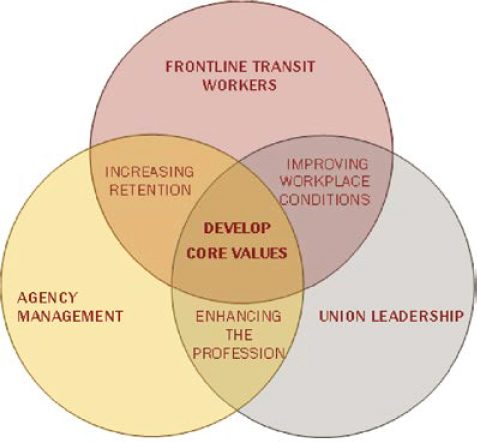
The following section of this toolkit describes a three-step process (Figure 6.2) to build and support positive relationships and increase trust between agency leadership, union leadership, and frontline transit workers.
Step 1: Define the Issues
Many of the issues faced by agencies, unions, and frontline workers are shared among all parties. From an agency perspective, low retention rates have directly affected the levels of transit service they can deliver. Workforce shortages have become common throughout the nation, and agencies are struggling to provide reliable transit services. Current workers have seen the effects of low retention rates and workforce shortages firsthand; demand for service has often led to workers taking on more or longer shifts to provide a minimum level of service. Transit operators have

also reported an increase in incidents involving aggressive or violent passengers. Recognizing the burden placed on their members, unions have sought to bargain for a healthier work–life balance for employees. Although many of these issues share the same solutions, distrust between agencies and unions remains, hindering the search for solutions that would solve common problems and improve the livelihoods of frontline transit workers.
Open and honest dialogue between agency leaders, frontline workers, and union representatives is required to help frame the shared challenges faced by workers. This can be achieved through a variety of ways, including town halls, coffee chats with leadership, dropping into existing meetings, digital engagement, labor-management committees, and collective bargaining.
- Town halls. Agency and union leadership can facilitate open conversations and collect feedback from workers directly by hosting a town hall–style meeting, where frontline workers can voice their thoughts among their peers and appeal directly to leadership. Agencies may consider holding such an event jointly with the labor union to demonstrate a united front in listening to frontline workers. Also consider the format and accessibility of the town hall format. More than one town hall event may be required to provide ample opportunities for workers to attend. A hybrid format (i.e., in person and virtual) may also allow more workers to attend.
- Coffee chats with leadership. In this format, agency leaders meet frontline workers where they are for individual conversations. One-on-one conversations are less formal and more conversational than town halls, which can help gather feedback from workers who may be less inclined to speak in front of large groups. This also helps to build individual relationships that are more personal between agency leaders and workers. Agencies need to be thoughtful about how to capture feedback from a broad sampling of workers by holding events on different days (including weekends) and at various times of day.
- Dropping into existing meetings. Another option is to leverage existing meetings or events to engage with frontline workers about their issues and challenges. This can include visiting frontline workers when they are already gathered for mandatory training or for a benefits information session.
- Digital engagement. Consider soliciting information through surveys or internal social media (e.g., message boards on the intranet). This can be a low-cost way to collect data quickly; however, digital engagement may be interpreted as impersonal and may not contribute to building (or rebuilding) relationships between workers and leadership.
- Labor-management committees. Labor-management committees, such as the Joint Workforce Investment (JWI) organized by Santa Clara Valley Transportation Authority (VTA) and the Amalgamated Transit Union (ATU) Local 265, are an innovative method for fostering cooperation around common goals, including frontline worker mental health and wellness. These partnerships allow workers to speak about the issues they face without fear of retribution, and they allow unions and agency leaders to work together to identify solutions.
- Collective bargaining. Collective bargaining is another effective tool for workers to ensure that their issues are heard and addressed by agency leadership. Open dialogue in the collective bargaining process is crucial to identifying the issues workers are facing.
Regardless of the means utilized to collect this information, it is important for agency and union leadership to communicate the next steps of this data collection process with employees. Be honest and realistic with employees about timelines for any solutions; emphasize that solutions are achieved over time and require ongoing communication and collaboration between parties.
Step 2: Identify Common Goals
The next step to building trust is to take the feedback gained in Step 1 and identify common goals between parties. Although agencies, workers, and unions may have distinct issues that are
sometimes at odds with each other, there are undoubtedly common goals that can guide the collaborative development of solutions. For example:
- Agencies want to improve retention rates and identify strategies to improve the mental health and well-being of their workers.
- Unions want to improve the working conditions of their members and to create career pathways.
- Workers want a job that can offer them benefits that outweigh the difficulties of working in transit; they are looking for stability and a career.
In this case, all parties are looking for very similar outcomes. While issues with the methods for achieving these goals are bound to arise, if an agency and a union are committed to improving conditions for their workers, then any effort to implement change should be able to identify common solutions.
Union–agency partnerships that were developed to solve issues affecting operators have demonstrated success when they were conducted as a new effort based on shared goals (Figure 6.3). Some partnerships are conducted separately from the collective bargaining process to identify common goals rather than negotiate contract terms, which are based on differing interests. Collaborative efforts have seen success when there is buy-in on all sides, as well as champions who are willing to compromise to achieve common goals.
Tips for Identifying Common Goals
- Efforts should be coled by agency and union leadership to demonstrate trust and a united effort between leaders.
- Consider conducting partnerships separately from the collective bargaining process.
- Collaboration is most successful when there is buy-in from all parties: agency, union, and workers.
- Find a champion from each party, for each effort.
- Be willing to compromise.
Step 3: Develop Bottom-Up Solutions
The development of solutions is one of the most fundamental yet complicated aspects of trust building. Programs cannot be developed by one party as a solution for all, but rather as a collaborative investment that prioritizes the input of those most affected. At the core of solution development, agencies and unions need to listen to the changes and solutions their operators are proposing. Solutions should be developed from the bottom up to ensure that they are not seen as disconnected mandates imposed from the top or, worse, measures that make frontline workers’ jobs harder. By acknowledging that frontline workers understand their work best and are capable of creating innovative strategies, bottom-up solutions foster trust between agencies and frontline workers.
One important recommendation for solution development is the inclusion of a neutral third party that can identify commonalities across proposed solutions. Agencies and unions are often
The Joint Workforce Investment
The JWI was developed as a partnership between VTA and ATU Local 265 to improve retention rates and professionalize a career path for operators. Both union and agency members highlighted the importance of creating a safe space to speak about issues and solutions, where the collective bargaining process is separate from the program.
The JWI was created with common core values that prioritize operators: serving the public, creating workplace solutions, increasing professionalism, and improving health and wellness. See Case Study 9: Training and Mentorship for Retention and Advancement for more information.
at odds, so the inclusion of a neutral third party ensures shared leadership in the development of strategies and can foster open and honest communication, free from fear of retribution.
Amplify the Voices of Those on the Frontlines
Bottom-up solutions foster trust between agencies and frontline workers by acknowledging that frontline workers have agency and the capacity to create innovative strategies.
Tabletop Exercise: Building Trust
The worksheet in Table 6.14 provides issues identified through engagement with frontline workers, transit agency leadership, and union leaders. This role-playing exercise can be completed by agency managers or union leaders to understand how each party might view each situation or scenario. For this exercise, each person should be assigned one of three roles: frontline worker, union representative, or agency representative. All parties should participate in the exercise across all three steps: (1) Define the issues, (2) identify common goals, and (3) develop bottom-up solutions.
Table 6.14. Tabletop exercise: Building trust across parties.
| Situation | Define the Issues (How Does the Situation Affect Each Party?) | Identify Common Goals (What Are the Common Objectives Across All Parties?) | Develop Bottom-Up Solutions |
|---|---|---|---|
| The agency is dealing with low retention rates. Service is becoming less frequent, and drivers must take more shifts. | Frontline Worker Union Agency |
| Situation | Define the Issues (How Does the Situation Affect Each Party?) | Identify Common Goals (What Are the Common Objectives Across All Parties?) | Develop Bottom-Up Solutions |
|---|---|---|---|
| Operators have limited access to restrooms while on the job. | Frontline Worker Union Agency | ||
| Incidents involving passengers experiencing mental health crises are becoming more frequent. | Frontline Worker Union Agency | ||
| Incidents involving violent or aggressive passengers are becoming more frequent. | Frontline Worker Union Agency | ||
| The lack of exercise is having serious effects on the health of operators. Operators are taking more sick days due to the physical strain of the job. | Frontline Worker Union Agency |
| Situation | Define the Issues (How Does the Situation Affect Each Party?) | Identify Common Goals (What Are the Common Objectives Across All Parties?) | Develop Bottom-Up Solutions |
|---|---|---|---|
| Frontline transit workers are unaware of the existing resources available to them. There are several existing programs, but they are not used by employees. | Frontline Worker Union Agency | ||
| Frontline workers do not feel like there is a career path available within the agency. Internal promotions are few and far between. | Frontline Worker Union Agency |
Increasing Training Offerings
Training has proven to be a successful strategy for transit agencies to improve employee satisfaction (McGlothin Davis, Inc., and Corporate Strategies, Inc., 2002). Agencies frequently offer basic training for frontline workers on topics such as vehicle operations; customer service; and internal policies for scheduling, leave, and basic requirements for their respective positions. However, many frontline workers emphasized how they were unprepared for some aspects of the job, such as dealing with passenger conflicts and maintaining a healthy work–life balance. New training offerings are a crucial tool that can provide workers with the skills they need to handle difficult situations.
Although trainings are most beneficial when targeted to new employees and frontline workers, management and leadership need to receive sufficient training so they can provide adequate support and direction to workers. Leadership is often unaware of the many difficulties frontline workers face, even though the decisions leaders make can have a serious impact on the work and lives of those on the frontline. Training offerings at the management and leadership level can help improve relations between workers and managers. Such trainings can also assist management in making more informed decisions about day-to-day operations that have an effect on operators’ mental health and wellness.
This section describes three types of trainings—a training identified as useful by frontline workers in order to better cope with certain on-the-job scenarios (Training C: Intervention Training for Frontline Workers); a training that is useful for leadership or managers of frontline workers (Training A: Empathy Training for Managers); and a training that is uniquely beneficial for both parties because it provides an opportunity to build trust and understanding between frontline workers and their leaders (Training B: Leadership and Manager Ride-Alongs).
To help navigate this section, Table 6.15 provides commonly faced challenges or sentiments within transit agencies and training offerings that can potentially alleviate those issues. Each training offering is broken down in further detail below for guidance on implementation.
Training A: Empathy Training for Managers
Empathy and communication training helps managers improve dialogue and leadership skills that focus on strengthening the relationship (i.e., trust) between leadership, managers, and frontline workers. Table 6.16 lists key elements necessary to build an empathy and communication training program, as well as a few resources for doing so.
Training B: Leadership and Manager Ride-Alongs
Day-in-the-life experiences can help managers and leaders better understand the challenges faced by their employees. The leadership ride-alongs described in this section are a key training identified by the frontline workers surveyed for this project. Ride-alongs are a valuable tool that gives agency leadership and management important insights into the day-to-day experiences of frontline transit workers. By placing managers with workers on the frontlines, ride-alongs also allow workers to share their concerns or suggestions for how to improve the operator experience directly with the people who can make those improvements. Table 6.17 provides a few components required to implement leadership ride-alongs.
Table 6.15. Training solutions for common challenges.
| Challenge or Sentiment | Potential Training Solution |
|---|---|
| Operators at my agency feel like they are unprepared to handle incidents with passengers. | Training B Training C |
| Managers do not have the experience or knowledge to provide operators with guidance concerning incidents with passengers. | Training A Training B |
| Relations between managers and frontline workers are tense. | Training A Training B |
| Incidents involving mental health crises or aggressive passengers on our system are occurring frequently or with increasing frequency. | Training B Training C |
| Leadership is unwilling to buy in on much-needed programs to improve working conditions impacting frontline workers’ mental health and wellness. | Training A Training B |
| The decision-making process does not consider the experiences of frontline transit workers. | Training A Training B |
| Frontline transit workers do not feel like their concerns are being heard. | Training A Training B |
| Our agency feels siloed. There are communication issues between different departments. | Training A Training B |
Table 6.16. Key elements of empathy and communication training.
| Training Element | Description |
|---|---|
| Purpose |
An emphasis on empathy and communication is vital for the development of a healthy workplace. Empathetic management can play a crucial role in improving the mental health and wellness of frontline workers through practices such as active listening and open discussion. Fostering empathy and communication has shown great benefits for companies and organizations worldwide, such as improved productivity and increased retention. When leadership learns to actively listen to the struggles frontline workers face and adequately communicate with frontline workers, relationships between parties improve, and their decisions are more considerate of the difficulties workers face. The following are key objectives to consider when developing an empathy training program:
|
| Audience |
Empathy and communication training can be a vital tool for agency leadership to develop a deeper understanding of the many issues frontline transit workers face every day. Leadership decisions have a direct effect on the mental health and well-being of workers. Leadership roles that can engage in empathy and communication training may include
|
| Key Components |
All parties should agree on what it means to be empathetic and to practice empathy. Empathy training can be tailored to the specific needs and experiences of workers in a specific industry. The following key components may be necessary to develop empathy training within a public transit agency.
|
| Training Element | Description |
|---|---|
| |
| Resources |
|
Training C: Intervention Training for Frontline Workers
Both focus group and survey participants highlighted significant challenges with effectively managing incidents involving passengers and skillfully intervening in a professional manner, without jeopardizing their own safety. Table 6.18 provides guidelines for training to help frontline workers address these situations.
Communicate Trust
Communicate to operators that ride-alongs are for observation and understanding, not for disciplinary purposes. Ensure that this is true in practice. Be sure that operators who choose to participate in the ride-alongs feel like they are not being observed for policy or procedural compliance; instead, they are educating management on their working environment and its challenges.
Other Considerations for Training Frontline Workers
Apart from creating and implementing new trainings for frontline workers or agency leadership, agencies nationwide have updated their existing policies and procedures to improve the onboarding experience, improve retention, and enhance the mental health and well-being of new operators. The following are some examples of changes that have helped agencies and frontline workers alike:
- One-on-one trainings. Operator route or line training usually includes shadowing a variety of routes with different operators. One-on-one trainings would provide new employees with the same trainer every day as they go through the process of learning different routes. This would help trainees build a stronger relationship with a long-term mentor who can provide support and guidance.
Table 6.17. Implementation of leadership ride-alongs.
| Training Element | Description |
|---|---|
| Purpose |
The purpose of a training must be clear up front. The objective of a ride-along might be to build trust with the public or, in some cases, to ensure there are no disciplinary or noncompliance issues with operators. Given the importance of operator mental health and wellness, the purpose of these ride-alongs is not to reprimand or to improve public perception, but rather to understand the difficulties and needs of frontline transit workers. By participating in ride-alongs, leadership and managers can make decisions about operating policies and procedures with an awareness of how those decisions can directly affect operators. When leadership experiences the difficulties of frontline work firsthand, this can also prompt internal changes that improve the mental health and well-being of operators, which improves service and increases retention. Key objectives of leadership ride-alongs include
|
| Audience |
Ride-alongs can be a vital tool for leadership to develop a deeper understanding of the many issues frontline transit workers face daily. The decisions made by leadership have a direct effect on the mental health and well-being of operators. Leadership that can engage in ride-alongs includes
|
| Key Components |
To fully understand the working conditions and environment of frontline transit workers through ride-alongs, there needs to be guidance for their successful implementation. If the results of these ride-alongs are not analyzed or evaluated in an organized manner, change is unlikely. The following list includes key components of implementation.
|
| Training Element | Description |
|---|---|
| Resources |
Similar programs that were designed to build understanding and trust through observation and dialogue have been successful with police and the public. While relationships between the public and police are not the same as those between managers and frontline transit workers, these programs have trust-building elements that may be applicable to public transit. Some example programs include
|
Table 6.18. Intervention training guidelines.
| Training Element | Description |
|---|---|
| Purpose |
Frontline transit workers must ensure the safety of their passengers—often while operating a heavy vehicle—and they are responsible for enforcing agency policies and rules. This can result in conflicts with passengers that may escalate to verbal and physical assaults. Likewise, the frequency of mental health crises among passengers is on the rise, increasing the number of times that frontline workers encounter these difficult situations. Intervention training is an important tool that can help frontline transit workers feel more prepared to assess, intervene, or seek professional help when dealing with passenger incidents. The purpose of this training is to help frontline workers navigate how to handle incidents to protect passengers and themselves. Key objectives for the implementation of intervention training include
|
| Audience |
Although this training mainly supports frontline workers, such as operators, managers can also benefit from understanding how to handle incidents. By participating, managers can understand how to best support frontline workers and can recognize workers’ efforts as they manage difficult situations. Participants that can engage in this training include
|
| Key Components |
Although one of the main purposes of this training is to protect frontline transit workers from harm, intervention may be necessary in situations where other workers, passengers, or bystanders are in danger. Therefore, the incident response training should include components that focus on both self-preservation and successful incident intervention. Key components include the following:
|
| Training Element | Description |
|---|---|
| |
| Resources |
|
- Mentorship programs. Mentoring stood out as one of the most popular types of training in the survey of transit workers for the research project. A mentorship element within driver onboarding provides new employees with the opportunity to learn important skills and strategies from more senior members. (The establishment of mentorship programs is explored in more detail in the Developing and Implementing Mentor and Peer Programs section of this toolkit.)
- Critical incident response teams. These teams, made up of employees with specialized training, can be deployed to the field during serious incidents to help frontline transit workers navigate difficult situations. (See the Providing Support during and after Incidents section of this toolkit for more information.)
- Increased mental health and wellness resources. To help frontline workers manage stress and achieve better health outcomes, transit agencies are deploying wellness programs to increase the offerings for wellness training and self-care. (See the Establishing Wellness Programs section of this toolkit for more information.)
Providing Support during and after Incidents
Frontline transit workers, particularly operators, mentioned how their role can be isolating in various ways. This isolation may worsen when dealing with difficult incidents on vehicles or at transit stops or stations: Workers often feel alone in handling these situations and cut off from agency support, both during incidents and afterward, as they cope with stress and trauma. Frontline transit workers expressed a need for greater in-field support to assist them in handling a variety of incidents, from vehicle crashes to passenger crises or conflicts. The following best practices were uncovered during research for this project: specialized Critical Incident Response Teams (CIRTs) that can respond to incidents in the field—such as vehicle crash or person under train (PUT) incidents—and improvements to post-incident support.
Critical Incident Response Teams
CIRTs, sometimes referred to as critical incident support teams or crisis intervention teams, have the potential to become an essential tool for any transit agency. Many frontline workers reported facing traumatic events on the job or having to deal with aggressive or violent passengers. On many occasions, these situations were neither handled with professional help nor handled in a timely manner. CIRTs address incidents associated with passengers experiencing mental health crises
by mediating conflict and connecting these individuals with organizations capable of supporting them. Many CIRTs have made a concerted effort to differentiate themselves from law enforcement to foster de-escalation and dialogue. They are often equipped with skills and training that allow them to provide guidance and support for both passengers and transit workers. CIRTs provide immediate and ongoing support after an incident and easy access to mental health professionals. The following are considerations for the development and implementation of CIRTs.
Recruitment
Agencies and unions that have implemented CIRTs have cited the importance of hiring members from the communities they serve. CIRT members can come from a variety of backgrounds, and they do not need a college degree. By hiring members who represent the community, a CIRT can connect better with passengers and provide high-quality and individualized support that is sensitive to social dynamics. When hiring CIRT team members or selecting them from your existing employee pool, important qualities to look for in candidates include
- Empathy,
- Excellent communication skills,
- Ability to work in high-pressure situations,
- Knowledge of the community that is being served, and
- Passion for people and community service.
Equal Access
Agencies should facilitate community members’ access to CIRT positions to ensure that team members possess a deep understanding of the community context.
Training
CIRT members must be prepared to handle situations that can often be sensitive and difficult to navigate. Members must understand larger socioeconomic dynamics and biases that can cause conflicts or incidents to escalate, such as the stresses that housing instability may place on an individual or the mistrust of authority experienced by people of color. Training elements that need to be present in a CIRT program include
- Mental health first aid,
- Communicating with people in crisis,
- Working against biases and microaggressions,
- Emotional intelligence training, and
- Empathy training.
Tabletop Exercise
One valuable exercise for CIRTs involves conducting drills or simulated practice scenarios that mirror common field situations. These drills should support existing training, allowing CIRT members to practice, hone, and maintain their skills. Table 6.19 provides a few examples of situations that transit workers identified as commonly occurring on transit vehicles and in stops or stations. These scenarios can be printed and cut out to make cards that can be shuffled randomly to conduct drills.
Additional Resources
- Bay Area Rapid Transit’s Transit Ambassador job description.
- Planetizen article, “Transit Systems Begin to Shift Away from Police Enforcement.”
- TriMet report, Reimagining Public Safety.
- TriMet video, “Safety Response Team Works to Help Create a Safe and Welcoming Environment on TriMet.”
- Health Affairs article, “Enlisting Mental Health Workers, Not Cops, in Mobile Crisis Response.”
- DCist article, “Metro to Pair Mental Health Experts with Transit Police and Staff in New Public Safety Initiative.”
Table 6.19. CIRT drill cards.
Scenario 1 There is a passenger who seems to be experiencing homelessness and is asleep on a bus. The passenger has been sleeping across two seats for the entire length of the route, and the run is ending soon. The bus operator is unsure how to handle the situation and does not know if the passenger will be argumentative, so the operator has requested support from the CIRT. You are at the bus terminal and are asked to support the operator. | Scenario 2 There is a passenger on a bus who is angry and yelling at other passengers. The passenger has not made any physical threats, but they are clearly under the influence of drugs or alcohol, and they are acting erratically. Other passengers and the operator are uncomfortable. The bus operator has requested CIRT support at the nearest station. You are at the nearest station and are asked to intervene. |
Scenario 3 You were tasked with accompanying an operator on their route. As passengers start to board, one passenger enters erratically and starts yelling at others. A second passenger quickly responds, and they begin to make violent threats toward each other. | Scenario 4 The CIRT has received a distress call from a worker at a rail station where a person who is experiencing a severe mental health crisis has communicated their intention to jump onto the tracks. This person is not making threats to anyone but themselves. You are at the station and are the first responder in the situation. |
Scenario 5 You were tasked with accompanying an operator on their route. You notice a man who is unnecessarily close to a woman and is making repeated comments about her physical appearance. The woman is clearly uncomfortable, but because the bus is crowded, she does not have room to move out of the way. The woman makes eye contact with you and asks for help nonverbally. | Scenario 6 A passenger on a vehicle has collapsed on the ground. Bystanders noted that before the passenger’s collapse, they had been nodding, closing their eyes, and speaking incoherently. The passenger’s lips are changing color, their face is pallid, and they are unresponsive. You are waved down by a passenger who believes an overdose is occurring. |
Scenario 7 A passenger is boarding on a route that recently had some changes. The passenger asks the operator about said changes, and the operator answers calmly. The passenger grows angry and frustrated at these changes and decides to lash out at the operator by spitting on them before alighting from the vehicle. The operator calls for your support since you are at the station. | Scenario 8 A passenger evaded their fare when boarding a transit vehicle. The operator followed procedure and requested that the passenger pay their fare two times. The passenger begins yelling and pacing up and down the vehicle aisle. The operator radios dispatch and pulls the vehicle over. You are part of the CIRT that responds to the location. |
| Write Your Own Scenario | Write Your Own Scenario |
Post-Incident Support Best Practices
Post-incident support has become essential to public transit workers, especially given the rise in traumatic experiences faced by workers in the field. Based on engagement with frontline workers conducted for this study, 69% of workers reported that they were threatened or saw someone else verbally or physically threatened, 33% of workers noted they had been physically assaulted or saw someone else be physically assaulted, and 9% witnessed an incident involving death by suicide or attempted suicide at work. Post-traumatic stress disorder (PTSD) has become increasingly common for frontline transit workers and operators due to incidents like these. Best practices in post-incident support can help agencies better support frontline workers following traumatic situations.
Providing Support to All
CIRT members will be on the frontline for crises and incidents that can often be traumatic. If an agency is planning to implement a CIRT, providing post-incident support for response team members is highly encouraged.
Following a potentially traumatic incident, agencies should consider providing the following services to involved workers:
- Connect the impacted worker with resources through the employee assistance program (EAP). For some incidents this may be a requirement, but managers should communicate that any required follow-on counseling or training is not punishment but rather supportive services to help the worker recover and return to work.
- Ensure continuity of care is available after EAP-funded services are expended. Some individuals may feel ready to return to work after only a few counseling sessions, while others may need continued access to services to heal from a traumatic incident and feel safe at work. How will the agency continue providing access to care once EAP-funded or employer-mandated care is expended?
- Be flexible with employees returning to work following a traumatic incident. Recovery may not look the same or take the same length of time for all individuals. Consider implementing flexible policies that allow workers to return to a normal work schedule following a traumatic incident in a way that suits each unique recovery process. Keep in mind that a return to work may be influenced by financial considerations. Ensuring that workers are financially secure is key to their mental health recovery.
- Pair the impacted frontline worker with a peer or mentor who is experienced and can help the worker navigate post-incident paperwork. Ensure that peers are aware of their role in supporting the impacted frontline worker rather than promoting “toxic positivity.” The peer or mentor should also be available for emotional support and periodically check in with the worker to see how they are recovering from the incident. This can help reduce the stigma associated with independently seeking out care for mental health.
Workplace Mental Health Checklist
The Occupational Safety and Health Administration (OSHA) provides a checklist that managers can use to support mental health in the workplace. The OSHA (n.d.-b) checklist was developed due to the reported rise in the number of people experiencing symptoms of anxiety and depressive disorders. The following section includes elements of the OSHA checklist that have been applied to frontline transit workers.
Ensure Management Is Compassionate
Remind frontline transit workers and other agency staff that you are committed to supporting their mental health and wellness. This may include
- Issuing an agencywide statement about the importance of mental health and wellness in the workplace;
- Identifying and reminding workers of available resources or staff they can access;
- Promoting a judgment-free workplace where workers can openly talk about negative experiences, without the fear of retribution or negative consequences;
- Raising awareness of the mental health and wellness issues that frontline workers face (e.g., sharing statistics from this report); and
- Promoting empathy in management and considering the implementation of empathy training (described in the previous section).
Assess the Viability of Operational, Scheduling, or Policy Changes to Alleviate Stressors
Managers should think about process or policy changes needed to help frontline workers recover from events. Consider the following:
- Examine frontline worker tasks and identify ways to alleviate stressors. For example, fare enforcement is a responsibility that causes stress among operators and, in many cases, puts them in danger.
- Increase flexibility by creating avenues so that frontline workers who have experienced a traumatic event can relocate to a new location or take over a different route to avoid triggers.
- Examine leave policies and allow more flexibility when possible, especially for mental health reasons.
- Increase or extend access to mental health resources beyond what is normally covered under health insurance plans.
- Create a mental health task force that can support frontline workers by creating the space to talk about issues they are facing.
- Implement peer or mentor support programs.
- Create a system for ongoing support for frontline workers where a mental health professional can check in and guide workers in processing their experiences and emotions.
- Provide more trainings to handle difficult incidents or for self-guided mental health support.
Additional Resources
See OSHA’s Supporting Mental Health in the Workplace: Getting Started Guide for Senior Managers, as well as the American Red Cross’s Psychological First Aid training course.
Modernizing Operational Policies for a Healthy Workforce
In addition to programs that directly support frontline workers, agencies and unions should evaluate broader operational practices that impact employees’ job satisfaction and overall well-being. Work–life balance was cited as an important tool for managing the stress of a job as a frontline transit worker. Likewise, more recovery time during strenuous shifts to collect oneself and recover is another tool requested by frontline workers. The capacity of frontline workers to effectively manage their mental health and well-being is directly shaped by the organizational policies overseen by agency leadership.
Some policy suggestions in this section would increase the cost of operating transit services. Furthermore, some of the proposed measures may require changes to an agency’s collective bargaining agreement. However, any increase in cost resulting from these policy changes must be weighed against the costs of high absenteeism and turnover. Consider examining the Building Trust between Parties section of this toolkit for tips on how to work with unions, leadership, and frontline workers themselves to identify and achieve common goals.
Policy Suggestions
Late Night, Early Morning, and Weekend Work
Most workers prefer working during the day on weekdays, and for some workers—especially those with caretaking responsibilities—having to frequently work evening or weekend shifts
can even be a reason to resign. Agencies can help create a more palatable assignment of shifts by offering incentive pay to those who work late at night, early in the morning, or on the weekends. Workers who are not particularly bothered by working those shifts have an incentive to pick them; and when workers are required to pick up those shifts, they will feel they have been compensated for the inconvenience.
Some agencies that have explored incentive pay have found that different parties disagree about which shifts should be eligible for the bonus. Agencies should dialogue with unions and workers about how the incentive program is structured. Policy suggestions have been adapted from engagement with frontline transit workers, detailed in the first section of this report, and from APTA’s (2023) Transit Workforce Shortage Synthesis Report.
Seniority in Selecting Work Shifts or Schedules
Many unions see the seniority system, in which operators with longer tenures get to pick their shifts before more junior counterparts, as an important benefit they provide to their membership. Unfortunately, systems that overemphasize seniority can discourage workers from joining the agency or lead new workers to quit shortly after they have started. Without completely undoing the seniority system, agencies can work with unions to modify the schedule selection process so that newer employees have better job satisfaction by
- Switching from a cafeteria-style system to a rostering system. Agencies may want to consider adopting a rostering system for their schedule selection process, where operators choose one collection of bundled shifts out of several rather than selecting individual shifts one at a time. This allows agencies to ensure that no work schedule is comprised entirely of the most undesirable shifts. Moving to rostering can require substantial negotiation with unions, both to establish which collections of shifts might be attractive to workers and to change collective bargaining agreements to permit rostering.
- Imposing restrictions on picking shifts. If agencies find they are unable to move to a rostering system, they may explore requiring all workers to choose a minimum number of early, late, or weekend shifts so that those picks are more evenly distributed among workers of different tenures.
Days Off and Compressed Work Schedule
Another way to improve work–life balance, allow frontline workers time to recover from their often stressful jobs, and improve their resilience in the workplace is to address regular time-off policies. Providing consistent days of the week off, providing two consecutive days off, and offering a compressed work schedule that allows for three days off are all ways that transit agencies can provide more time for workers to rest and recover from their shifts.
Time-Off Policies
Some agencies prevent new employees from taking time off within the first year of employment. While these policies may be designed to reduce absenteeism, they may be counterproductive by depriving new workers of the opportunity to rest and recharge.
Split Shifts
Split shifts, where workers have an unpaid gap in the middle of the day between their runs, are a source of worker dissatisfaction. One way to mitigate the impact on morale is to limit the number of split shifts any worker has to work during a given week, either through scheduling policies or rostering.
Mandatory Overtime
For many workers, not knowing when their shift will be over represents a major reduction in quality of life. This poses special burdens on workers with family obligations at home, particularly
parents, and therefore also may preclude potential workers from joining the agency in the first place. However, many agencies rely on mandatory overtime because their worker absenteeism is so high. The most comprehensive way to reduce the need for mandatory overtime is to reduce absenteeism.
Another way to deal with mandatory overtime is to introduce a pay differential to encourage workers to sign up or be available when other workers call out. Agencies should consider increasing the number of extraboard operators to fill unexpected needs instead of forcing operators whose relief driver did not show up to cover shifts.
Layovers
Agencies should explore ways to improve layovers for operators. First, agency planners should ensure that workers have adequate time for short breaks to use the restroom and stretch their legs. If certain routes regularly come in a few minutes behind schedule, it can keep operators from being able to take a break. Worrying about missing a break can increase stress on the job.
Agencies should also make sure that layover points have adequate amenities. Essential break space elements include access to a toilet, protection from the elements, and good lighting. Operators also tend to prefer laying over in areas that are busier and have more foot traffic, since it is safer to wait in more populated areas.
Implementation
Putting these suggestions into action may require careful and contentious negotiation with an agency’s workers and unions. However, it is possible to change collective bargaining agreements to improve operations and increase worker satisfaction in ways that unions will accept, and this has been accomplished at agencies across the United States. (See Case Study 11: Union Assistance Program to learn about the Transport Worker’s Union [TWU] Local 100’s exemplary employee assistance program.) This section provides two suggestions for how agencies can approach these conversations.
Establish Common Goals
Agencies can make progress by working with unions to establish common goals. Agencies want a motivated, reliable workforce so they can provide their riders with a high level of service. Unions want to ensure a good standard of living for the workers they represent, and they want to maintain their membership. Therefore, both entities are motivated to ensure that agencies are successful at hiring and retaining happy and healthy workers, which means ensuring that all workers have adequate working conditions.
Creating a Culture of Dialogue
Agencies can take steps to make sure they are sensitive to workers’ concerns and are seen as available and responsive. To promote a culture of dialogue at transit agencies, managers and leaders can
- Institute an “open-door” culture where managers and leaders are visible and available to workers,
- Spend time in the field to get to know frontline employees, and
- Hold periodic listening sessions and town halls to solicit worker feedback and demonstrate an interest in the experience of workers.
Developing a culture of open communication and dialogue can build trust with workers and support agency efforts to make operational changes that might otherwise be viewed with skepticism.
Additional Resources
See also Transit Workforce Shortage Synthesis Report (APTA, 2023).
Fostering Community among Frontline Transit Workers
The U.S. Surgeon General’s Framework for Workplace Mental Health and Well-Being noted that a sense of community is important because social support contributes to a sense of belonging, which reduces feelings of isolation and loneliness (U.S. Surgeon General, 2022a). Building strong relationships is essential for building trust among transit employees, developing a culture of collaboration and teamwork, and creating an overall sense of belonging. It can be challenging for frontline transit workers to build a sense of community when they often work alone and away from their colleagues. This can be isolating, and it may leave workers feeling like they do not have supportive peers or managers who understand the challenges of their jobs. Building a community among frontline workers is challenging—it requires out-of-the-box approaches along with concerted and thoughtful programming. The following are some creative ways to build a sense of community among frontline transit workers who may not naturally have an opportunity to engage with their peers.
Create a Strong Set of Core Values
A positive work culture starts with defining core values for the workforce to embody. Having a shared language for workplace values helps establish a feeling of community among employees. Core values should ground an agency’s work, represent the best of the organization, set the organization apart from other workplaces, and provide a guiding light when faced with difficult choices. (See FTA’s core values in Figure 6.4.)
Defining core values is a process that should include employees and leaders alike. If your transit agency has not established an official set of core values, consider creating a committee
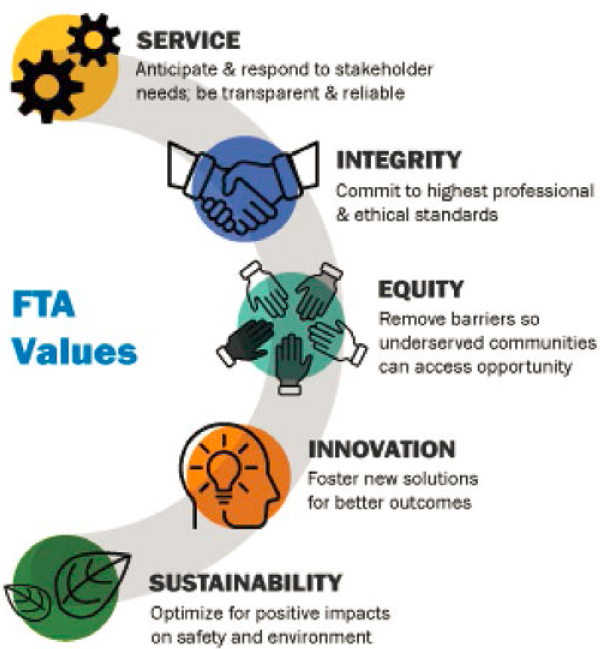
Figure 6.4. FTA’s core values.
with diverse representation from across the organization to do so; be sure to include employees from different departments and levels, and ensure the resulting group represents various ages, ethnicities, and backgrounds.
Once core values are established, communicate them widely. Core values should be easily recognizable and known by every employee. Be sure to tie everyday work back to the agency’s values.
Develop an Employee Recognition Program
Another way to build a sense of community is to employ a recognition program. By appreciating one-time achievements, longevity, and noteworthy performances, organizations can raise morale and reduce stress, absenteeism, and turnover among employees. Many transit agencies have awards, ceremonies, and appreciation days to celebrate the ordinary and extraordinary achievements of their frontline workers (Figure 6.5).
Plan Fun, Non-work Opportunities
A sense of belonging and community also helps employees feel connected to their work. However, group activities during the workday can unintentionally exclude frontline workers as well as caregivers. Consider planning other ways for frontline workers to gather and connect, such as organizing a hike or employee picnic, attending a professional sports event as a group, or organizing volunteer activities.
Since transit operations occur at all hours, not all employees will have an opportunity to attend all events. Provide many opportunities for employees to attend a variety of events at various times throughout the year.
Organize Group Volunteering Events
Group volunteer events are a great way to rally your employees around a cause that is close to the mission of the organization. It is an excellent way to show your employees that you care and to build relationships between frontline workers and the community members they serve. Although volunteer events are extremely valuable, they are often perceived as a way to seek favor with frontline workers. Ensure that authenticity is at the center of volunteer events and that agency leadership is just as active, or more active, in participation.
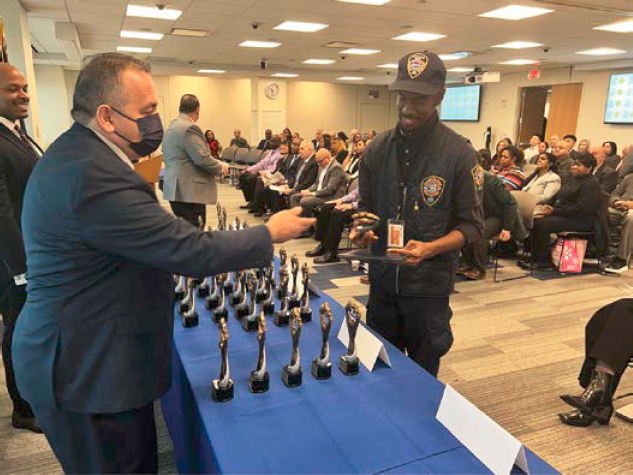
It can be difficult to accommodate all employees to attend in-person volunteer events at once. Think about a week of events or recurring activities that happen on different days of the week and at different times of the day so that everyone has the opportunity to participate, if they wish.
Use Storytelling to Create a Sense of Shared Experiences
Incorporating employee and leader testimonials into organizational communications helps bring a personal connection to the workforce. Storytelling helps connect employees to their work and bring meaning to seemingly menial tasks. Transit agencies can solicit stories of both exceptional and ordinary events in which frontline workers impacted the lives and communities they serve. For example, highlight a transit employee who goes out of their way to help a member of the riding public. Interview the employee and impacted rider, gather quotes and photos of both the rider and the employee, and share these materials in a poster or virtual medium, such as an employee newsletter.
Peer Support Groups
Peer support groups allow workers to discuss challenges and difficulties with peers who are experiencing similar circumstances. Peer support groups allow workers to discuss issues openly in a group setting, giving workers access to many new perspectives that can help them navigate challenging situations. Group sessions can also build camaraderie and trust among teams, creating a support network that can work together to solve common problems.
Employee Resource Groups
Employee resource groups (ERGs) have become a common practice throughout the modern work landscape to foster diverse and inclusive workplaces. ERGs are often comprised of members who share a common characteristic, such as gender identity, ethnicity, race, or life circumstance. ERGs bring together workers with similar backgrounds or identities to foster a safe space for them to express their concerns and propose new solutions. ERGs also provide mentorship opportunities through the sharing of common experiences. For example, an ERG for new parents can be especially helpful for transit workers due to the difficulties of balancing irregular schedules with childcare.
Develop a DEI Committee
Diversity, equity, and inclusion (DEI) committees help workplaces bring changes and implement policies or programs to increase diversity, ensure employees are treated equitably, and identify ways to be more inclusive in the workplace or break down barriers for employees so they feel a sense of belonging.
University of Southern California (2023) defines a five-step process for establishing a DEI committee:
- Identify potential DEI committee members from various backgrounds. Include employees from various departments, racial and ethnic backgrounds, and life stages.
- Recruit members. Emphasize that committee membership is voluntary.
- Create organizational buy-in for DEI efforts. Demonstrate support from the top and bottom of the organization to create buy-in. Allocate paid time and resources to committee members so they can complete their duties.
- Define clear and actionable goals. Begin by drafting a mission statement, and then define short- and long-term goals.
- Establish processes to communicate and weather change. Committee membership is bound to fluctuate and change over time, so consistency of processes for adding members, maintaining regular meetings, and communicating among members is key to the committee’s longevity.
Additional Resources
See these additional resources for ways to build community among frontline transit workers:
- The U.S. Surgeon General’s Framework for Workplace Mental Health and Well-Being (U.S. Surgeon General, 2022a).
- Society for Human Resource Management’s “How to Engage Employees in a Hybrid Workplace” and Managing Employee Recognition Programs.
- WebMD Health Services’ How to Build a Sense of Community in the Workplace.
- The Management Center’s How to Develop and Use Core Values.
- University of Southern California (2023), How to Create a DEI Committee So More Voices Can Be Heard.
Developing and Implementing Mentor and Peer Programs
Engagement with frontline workers demonstrated a high level of interest in mentorship or peer programs to support new employees. Based on research findings and engagement, frontline workers may be more inclined to seek and accept support from peers or mentors than from supervisors or mental health professionals. Established mentoring programs have been cited by many agencies as a key factor in the retention of new employees. Mentoring programs provide an opportunity for on-the-job training from individuals who have experience with the issues new employees will face and necessary strategies for dealing with those issues.
This section contains a framework for developing of a mentorship program, based on research from other agencies and industries. This framework was developed with elements from A 5-Step Guide to Start a Mentoring Program (Together Mentoring, n.d.) as well as Creating a Mentor Program (Society for Human Resource Management, n.d.), both of which provide key steps and list the various types of mentorship.
Establish Goals for the Mentorship or Peer Program
The first step in developing a mentorship program is to establish goals. It is important for agencies to decide what they would like to achieve with the program. For example, potential goals may include
- Providing emotional and mental health support,
- Improving employee retention,
- Creating future mentors and leaders within the agency, and
- Promoting diversity, equity, and inclusion.
Agencies should also develop objectives that measure the success of established goals. For example, agencies could measure retention rates before and after the program is implemented. In some cases, agencies have set up control groups to measure the effect of programs on retention rates more accurately.
Goals should be developed in coordination with frontline workers and can be developed with the support of unions through labor-management partnerships. (See Case Study 9: Training and Mentorship for Retention and Advancement, which details the mentorship program developed by Santa Clara Valley Transportation Authority in partnership with the Amalgamated Transit Union Local 265.)
Additional things to consider including in a mentor program include
- Paid time to participate in the program,
- Special bonuses for more tenured employees to act as mentors, and
- Training for mentors and resources for them to use, as applicable.
Select a Program Model
There are a variety of models for mentorship or peer programs, each with its own benefits and shortcomings. After goals are established, agencies and unions must determine which mentorship model will fit agency needs and goals. Different mentorship models include traditional, one-on-one mentorship; group mentorship; peer-to-peer mentorship; peer support groups; employee resource groups; and speed mentoring, among others.
Traditional, One-on-One Mentorship
One-on-one is the most common form of mentoring. Each mentee is paired with a mentor, typically a more tenured employee. Mentors in the transit agency can ride along with new employees on their first days, providing important advice and strategies to face daily challenges. Senior mentors can also provide a sense of job security for new employees, demonstrating how far they can advance within the agency. One-on-one mentors provide personalized attention, trusting relationships, and tailored advice. This type of mentoring is particularly important for transit workers due to the nuanced challenges they face dealing with customers, traffic, and vehicle operations.
Group Mentorship
Mentees are placed in groups with a mentor who can lead discussions and provide specialized support. Although advice may not be as tailored or specific as it would be in the traditional mentorship model, this model gives participants the opportunity to learn from someone senior as well as their peers, who are facing similar challenges. This type of program can also be more far-reaching, allowing for more mentees with fewer mentors. Among frontline transit workers, this type of program can be especially helpful for bus drivers who operate similar routes or encounter common issues at the same stations or locations.
Peer-to-Peer Mentorship
Peer-to-peer mentorship (sometimes called a “buddy program”) is a form of mentorship that is used across many industries. “Buddies” are often peers at a similar level to a new hire who can provide important, role-specific feedback. This mentorship model can also foster openness, as mentees are less likely to be afraid of retribution if they are expressing concerns to a peer rather than someone in a supervisory role. Within the transit industry, a buddy program can provide important advice on topics that are not often discussed with managers, including advice on combatting fatigue, and open a dialogue about hygiene or cleanliness when using shared vehicles.
Peer Support Groups
Peer support groups allow workers to discuss challenges and difficulties with peers who are experiencing similar circumstances. Peer support groups allow workers to discuss issues openly in a group setting, which can allow workers to hear many new perspectives that can help them navigate challenging situations. Group sessions can also build camaraderie and trust among teams, creating a support network that can work together to solve common problems.
Employee Resource Groups
Employee resource groups (ERGs) have become a common practice throughout industries to foster diverse and inclusive workplaces. ERGs are often comprised of members who share a common characteristic, such as gender identity, ethnicity, race, or life circumstances. ERGs bring together workers with similar backgrounds and create a safe space for workers so they can express their concerns and come together to propose new solutions. ERGs also provide mentorship opportunities through the sharing of common experiences. For example, an ERG for new parents can be especially helpful for transit workers due to the difficulties of balancing irregular schedules with childcare.
Speed Mentoring
Speed mentorship programs provide employees with an opportunity to talk with a different senior coworker every so often to acquire different perspectives from leadership and experienced workers. Speed, or flash, mentoring provides the opportunity to develop relationships in workplaces that are siloed. Speed mentoring can also be less time-consuming, which can be helpful for transit workers who are experiencing increased work demands.
Identify and Appoint Mentors
A crucial aspect of developing a mentorship program is the process of selecting mentors. To develop criteria for selecting mentors, agencies and unions can look to their mission and vision statements as well as their core values. This will also enable them to identify frontline workers who exemplify what it means to work at their agency. The Joint Workforce Investment (JWI), mentioned previously in this toolkit, started its mentorship program by identifying champions within the agency who demonstrated the organization’s core values. Agencies and unions should also give employees the opportunity to ask for mentorship positions, with an understanding that while not everyone can be assigned as a mentor, passionate people are encouraged to seek positions of leadership.
Mentorship programs also provide a framework for a career ladder program. Mentors who participate in the program can gain important skills that are necessary for management positions, opening opportunities for internal promotions. By implementing mentorship programs, agencies are building future leaders within the organization and identifying employees with high potential for management while ensuring employee succession.
Measure Success
As stated earlier, agencies and unions need to continue monitoring the effectiveness of their mentorship programs using consistent and measurable objectives. For example, the JWI measured success using four different metrics: operator attendance, retention, accident occurrences, and customer service complaints. Measuring success is crucial to understanding whether the mentorship program is successful or if other tools are necessary to improve the mental health and well-being of frontline transit workers.
To learn more about the JWI and its mentorship program development, please see Case Study 9: Training and Mentorship for Retention and Advancement.
Additional Resources
- High Road Training Partnerships: The High Road to Public Transit.
- Creating a Mentor Program (Society for Human Resource Management, n.d.).
Self-Advocacy Tools
In November 2022, the U.S. Surgeon General released a groundbreaking report on workplace mental health. The report, The U.S. Surgeon General’s Framework for Workplace Mental Health and Well-Being (2022a), discusses an essential framework for fostering a mentally strong workplace that focuses on the worker’s voice.
As you seek to support your mental health and well-being at work, it is vital that you exercise your voice as a frontline transit employee. As an employee, the actions you take independently and with your peers can increase your agency’s awareness of the importance and many benefits—to both employees and the overall agency—of supporting frontline worker mental health and resiliency.
As a self-advocate, your voice and actions can
- Promote the importance of advocating for employee mental health and reducing the stigma associated with seeking help;
- Contribute to the development and implementation of policies, programs, and resources at your agency to benefit frontline employee mental health and well-being;
- Help educate your peers on the available resources to support frontline workers’ mental health and well-being; and
- Foster a culture of inclusion, connectivity, and well-being that will contribute to the success and resiliency of your agency and its workforce.
This section of the toolkit provides direction and resources for frontline transit workers to advocate on behalf of themselves and their peers. Included in this section are
- Understanding Workers’ Rights,
- Dialogue and Effective Communication with Management,
- Human Resources as a Partner, and
- Peer Advocacy and Resource Groups.
Understanding Workers’ Rights
Workers’ rights include various human rights, from decent work and freedom of association to equal opportunity and protection against discrimination. These rights also extend to specific aspects of the workplace, including health and safety regulations and the right to privacy. According to the International Labour Organization (ILO), about 2.78 million workers die annually from occupational accidents and work-related diseases (United Nations Global Compact, n.d.).
Since 1919, the ILO has worked with its constituents (governments, employers, and workers) to develop international labor standards that outline basic principles and rights at work. Among these standards, the ILO’s governing body has identified eight conventions as “fundamental” since they address critical aspects of workers’ rights. These fundamental conventions encompass freedom of association, collective bargaining, equal pay, nondiscrimination, and eliminating forced and child labor. In addition to these fundamental conventions, the ILO has also developed non-fundamental conventions covering a range of issues related to workers’ rights, including wages, working hours, occupational health and safety, maternity protection, and social security. Prior research strongly suggests that workers’ rights—including union power, employment protection legislation, and income security arrangements—positively affect productivity and real wage growth.
The U.S. Department of Labor, whose primary mission is to support and protect the well-being of American workers, advocates for forming and organizing unions and collective bargaining. Workers’ voices are critical for a better work environment, a productive workplace, and long-term sustainable improvements in labor standards compliance. The U.S. National Labor Relations Act addresses the right to create a workers’ union as a bargaining representative for improving wages and working conditions. Employees have the right to be represented by unions fairly, in good faith, and without discrimination. This includes several actions, such as collective bargaining, handling grievances, and operating hiring halls.
Dialogue and Effective Communication with Management
Communicating effectively with senior management about frontline worker mental health can benefit you and your peers. Engaging agency leaders on this topic can enhance their understanding of the diverse issues affecting the mental health of their frontline workforce. These conversations can also prompt leadership to establish supportive programs and resources that promote frontline workers’ mental health.
Prior evidence suggests that a lack of proper communication from higher management could lead to uncertainty, apprehension, lack of knowledge, and a sense of uncontrollability over the situation, resulting in significant anxiety and mental health issues among frontline workers. Building a strategic communication plan with senior management may be very useful to succeed in your job and to reduce work-related stress.
Strategies and tips for engaging in an effective dialogue with senior management include
- Communicate often with leadership to maintain a healthy working relationship and understand their work-related expectations.
- Seek continual feedback about your job performance.
- Have an open mind, a positive attitude, and a willingness to find the middle ground.
- Write down the key points you hope to discuss before meeting with your manager.
- Be an active listener, and if you do not understand something, ask your manager to repeat or clarify what was said.
- Be sure to request important job-related information, such as salary raises and hour changes, through email or other written forms of communication.
- State your needs clearly and calmly, such as “I need the information” instead of “You did not give me the information.”
- Discuss issues with your manager before they become insurmountable.
- Use frequent communication and regular meetings during a difficult phase.
- Avoid speaking with management when you are experiencing strong negative emotions, such as anger.
- Avoid gossip in the workplace.
- Use visuals to explain your point (e.g., posters, charts, infographics).
- Follow internal communication platforms, such as newsletters, to get updates and relevant information about your job and organization.
- Engage in cross-functional projects or teams, where you may have the opportunity to interact directly with your manager.
- Ask open-ended questions of your managers—such as “What do you mean by [x]?” or “What brought you to this decision?”—to gain a better understanding of the issues.
Human Resources as a Partner
Your agency’s human resources (HR) department is an important resource for supporting your mental health and well-being. The HR team is knowledgeable about agency policies, your rights and responsibilities as an employee, and details on the resources and potential accommodations available to support your mental health and well-being.
One of the key resources typically available is an employee assistance program (EAP). You may have some familiarity with your agency’s EAP offerings, but there may be additional information on how the EAP can aid you. The HR team is well-versed in these offerings and can provide you with detailed information that may assist you and your family. If you work within a labor union, a union assistance program with resources and tools may also be available to you.
In addition to seeking out HR for resources and programs to support your mental health, you can also seek their leadership in promoting staff education about the available resources to support frontline workers’ mental health.
Peer Advocacy and Resource Groups
There can be tremendous power and benefit to establishing a workplace peer support network or resource group organized around employee mental health and wellness. Peer advocacy and resource groups can
- Provide a way for you to share personal, lived experiences as a frontline worker with your peers and normalize discussion of mental health concerns;
- Foster camaraderie, social support, connections, relationship-building, and a feeling of community among your peers;
- Encourage collaboration, teamwork, and a culture of inclusion;
- Generate broader agency awareness for the importance of recognizing and addressing issues that affect frontline workers’ mental health and well-being;
- Offer a mechanism to amplify your voice, and the voices of your peers, to agency leadership and management on the topic of frontline worker mental health and well-being;
- Present an opportunity for you and your peers to educate one another on agency resources available to support frontline worker mental health and well-being;
- Stimulate conversations about ideas, actions, policies, and programs that may support your mental health and well-being;
- Create a channel by which you can collectively advocate for frontline worker mental health; and
- Reduce the stigma that often surrounds mental health conditions.
Peer resource groups can promote frontline worker mental health through a variety of actions and activities, including convening events to promote social connection and increased awareness for mental health issues, sharing educational resources, developing agencywide campaigns focused on frontline worker mental health, and providing a venue for fostering workplace social connections and connectivity. You and your peers can also collaborate with your HR team and senior management to develop or acquire relevant training and educational materials on topics such as mental health first aid.
Frontline transit workers who participated in this research offered two examples of different types of peer resource groups implemented at agencies throughout the nation. These examples focus primarily on building social connections among frontline workers rather than directly advocating for mental health concerns. However, they noted mental health benefits associated with participating in these organized peer groups:
- Creating an equity and inclusion team focused on providing opportunities for all agency personnel to connect with one another and the larger community in which they work. A component of this program involves agency staff volunteering to attend community festivals and events. At these gatherings, they often represent their transit agency to support recruitment activities and bring a static bus to the event that the public can explore to learn more about public transit.
- Establishing an employee club or engagement committee that offers group social experiences, such as organized outings to a baseball game or opportunities to participate in other community events.
To form a peer resource group that promotes frontline worker mental health, builds overall social connectivity, and fosters an inclusive culture at your transit agency, you can take the following steps:
- Converse with your peers to determine their interest in establishing an employee resource group or wellness committee. At a minimum, all frontline employees should be invited to participate so that diverse voices and opinions can be shared.
- Collaborate with management to ensure their awareness of the group’s formation and its goal of supporting employee mental health as well as business goals.
- Establish goals for the group, and discuss strategies to achieve those goals.
- Determine group logistical details, such as a meeting location (e.g., in person or virtual) and frequency of meetings and events. Keep in mind that shift schedules may prevent all frontline workers from participating at the same time, so focus on ensuring that all can be accommodated at least some of the time.
- Develop a strategy to “spread the word” in your agency about the group’s activities, and determine preferred communication methods, such as word of mouth, posters, newsletters, social media, and webpages.
- Seek involvement from other agency departments and units to support the group’s work, as well as local mental health organizations that can offer educational and local resource information.
Additional Resources
Below are some resources on topics discussed in this toolkit section:
- Understanding worker rights:
- Dialogue and effective communication with management and working with human resources as a partner:
- How to Advocate for Your Mental Health in the Workplace.
- Ten Tips for Speaking to your Manager Effectively.
- How Employees Can Advocate for Better Workplace Mental Health.
- Seven Strategies for Improving Your Management Communication Skills.
- Fifteen Tips for Communicating with Your Manager.
- Communicate Effectively with Your Boss.
- How to Communicate with Senior Management.
- Peer advocacy and resource groups:
- Workplace Well-Being Resources.
- Community Toolbox, section on creating and facilitating peer support groups.
- Five Ways to Improve Employee Mental Health.
- Public Transportation Workers Toolkit.
- Benefits of Mental Health Communication in the Workplace.
- Workplace Mental Health: Five Ways to Support Employee Wellness.
- Mental Health Resources for Employers.


