3
Whole Community
Highlights from the Presentations
- The “whole community” extends to many different, overlapping communities; for an academic medical center, it includes the immediate neighborhood, the region, the medical community, local businesses, and others (Churchwell).
- A hospital is well situated to serve as an anchor institution and convenor to connect people and organizations that might not know of each other (Churchwell).
- Churches and other communities of faith can provide support and resources to reach families and to prepare students to become self-advocates (Harris).
- To build on the appeal of sports among young people, a successful approach can showcase opportunities beyond playing sports, such as owning a sports-related business (Harris).
- Three observations have guided the growth of preengineering programs in Detroit and Chicago: (1) Parents want the best for their children, with few exceptions; (2) children are interested in science and engineering, especially K–3; (3) there are teachers who care about the children and want them to do well (Hill).
- When 80 percent of the first cohort of the Chicago Pre-College Science and Engineering, Program, Inc., went on to major in
- science, computer science, or engineering, organizations and foundations saw the value in the hands-on, math-focused program (Hill).
Joan Reede, M.D., M.S., M.P.H. (Harvard Medical School) reflected on the keynote by Dr. Valerie Montgomery Rice (see Chapter 2), who discussed how Morehouse School of Medicine provides strategic, intentional, comprehensive programming to create an environment of empowerment across multiple stages of students’ lives. Dr. Reede turned to the broader topic of the role of the community in fostering this environment. She explained that the concept of “whole community” crosses the education, public health, school, and other sectors in collaboration to improve student development. Even the Federal Emergency Management Agency has recognized the need to involve a wide range of players in national preparedness, she observed, using three approaches: (1) understanding the actual needs of the whole community, (2) engaging and empowering all parts of the community, and (3) strengthening what works in a community on a daily basis.
Dr. Reede posed a series of questions to Kevin Churchwell, M.D. (Boston Children’s Hospital), J. Otis Harris (HBCU Council of the Shiloh Baptist Church), and Kenneth Hill (Chicago Pre-College Science and Engineering Program [ChiS&E]). As she noted, the three discussants share a commitment to equity, diversity, and inclusion across multiple organizations, sectors, and locations, and they have developed innovative policies and practices. Dr. Reede asked the panelists to help participants understand their institutions and programs, and panelists were asked to present the evidence and data they may have on engagement with their respective communities to ensure inclusivity in science, technology, engineering, and mathematics (STEM).
THE MEANING OF “WHOLE COMMUNITY”
Dr. Reede asked the three presenters to elaborate on how their organizations define and work with the whole community. Dr. Churchwell explained that Boston Children’s Hospital has been around for 150 years as a leader in the care and development of the discipline of pediatrics. In considering whole community, the hospital serves a number of different types
of communities. “We look at those who we serve. Who is part of that? For us, it starts with the neighborhood around the hospital. It extends to cities and towns around Boston and the Commonwealth of Massachusetts to all parts of the region,” he said. The community also extends nationally and internationally, because of the hospital’s leadership in pediatrics, as well as within the medical community as a teaching hospital for Harvard Medical School and other institutions. He also pointed to connections to community health programs and the hospital’s commitment to the development of economic opportunities for companies and other organizations led by people of color. “We are committed to develop those relationships in terms of anchor institution opportunities.”
Mr. Harris explained that the HBCU Council of the Shiloh Baptist Church was formed in 2003 when the Progressive National Baptist Convention asked churches to highlight Historically Black Colleges and Universities (HBCUs) in their work. The council serves the congregation and the greater Washington, D.C., area.1 In his career as a middle school educator, he realized many Black students do not do well on SAT and ACT tests and developed partnerships with the Princeton Review and College Board to provide free practice tests to students. The HBCU Council now holds a College Preparedness Workshop for students and families. Many parents are unfamiliar with the college process to be able to guide their children, and high school counselors can be overwhelmed, leaving students to slip through the cracks. Regarding whole community, the programs are free for everyone, and all are welcome. The aim is to provide a nurturing environment as students prepare for and attend college. “Students must become their own advocates, and learn how to do it,” Mr. Harris commented. “We help them learn not to wait until the last minute.”
Mr. Hill related how he has worked with communities in Detroit, Michigan, and Chicago, Illinois. In Detroit, where he began the Detroit Area Pre-College Engineering Program (see also Chapter 5), the activity initially centered on Hartford Memorial Baptist Church. Reverend Charles Adams convened meetings for parents about how to prepare students for engineering. Mr. Hill then connected with the Council of Baptist Pastors, Wayne State University, public schools, and city and state agencies. He echoed Mr. Harris’s observation about the importance of strong parent engagement. When he moved to Chicago around 2008, he said he planned to retire
___________________
1 For more information, see http://www.hbcucouncil.com.
but instead built a similar program to that in Detroit, called the Chicago Pre-College Science and Engineering Program.2
When presenting ChiS&E, Dr. Hill highlighted the program’s science and engineering activities for the whole Chicago community: Chicago Public Schools K–12 students and their parents. Dr Hill noted that the program develops student and parent knowledge as well as a love of learning in areas of STEM. He noted the first cohort of students entered college last year, 80 percent of whom were admitted in science, computer science, or engineering. “That data got people’s attention,” he said. “How did that happen? I carried three things with me from Detroit to Chicago. First, parents want the best for their children, with few exceptions. Second, children really are interested in science and engineering, especially in grades K–3. Third, there are teachers who care about the children and want them to do well.”
THE ROLE OF ORGANIZATIONS AND INDIVIDUALS TO MAKE STEM MORE INCLUSIVE
Dr. Churchwell shared how Boston Children’s Hospital is creating an infrastructure of inclusion. While the work had already begun, he said, it has been “turbo-charged over the past 3 or 4 years.” He described the hospital’s declaration of six goals related to equity, diversity, and inclusivity (EDI) (see Figure 3-1).
Recognizing that the staff does not reflect the racial and ethnic representation of the hospital’s patients and families, Boston Children’s is recruiting and retaining a diverse workforce to improve pediatric heath equity. Examples to develop career pathways include STEM programs for high school students, internships for high school and college students in clinical and nonclinical departments, work-study programs with mentorship, HBCU summer internships, and programs for veterans. External partnerships include those that further local purchasing and workforce development; support housing, business development, and learning and play spaces; and strategic recruitment to improve nursing workforce diversity.
In reflecting on his work in Detroit and Chicago, Mr. Hill said each context is different, but his three observations about parents, students, and teachers (see above) are universal. He also acknowledged the challenge in showing the opportunities in STEM fields, given the emphasis on sports in society. “Guerrilla educators” encourage children, starting with activi-
___________________
2 For more information, see https://chiprep.org.
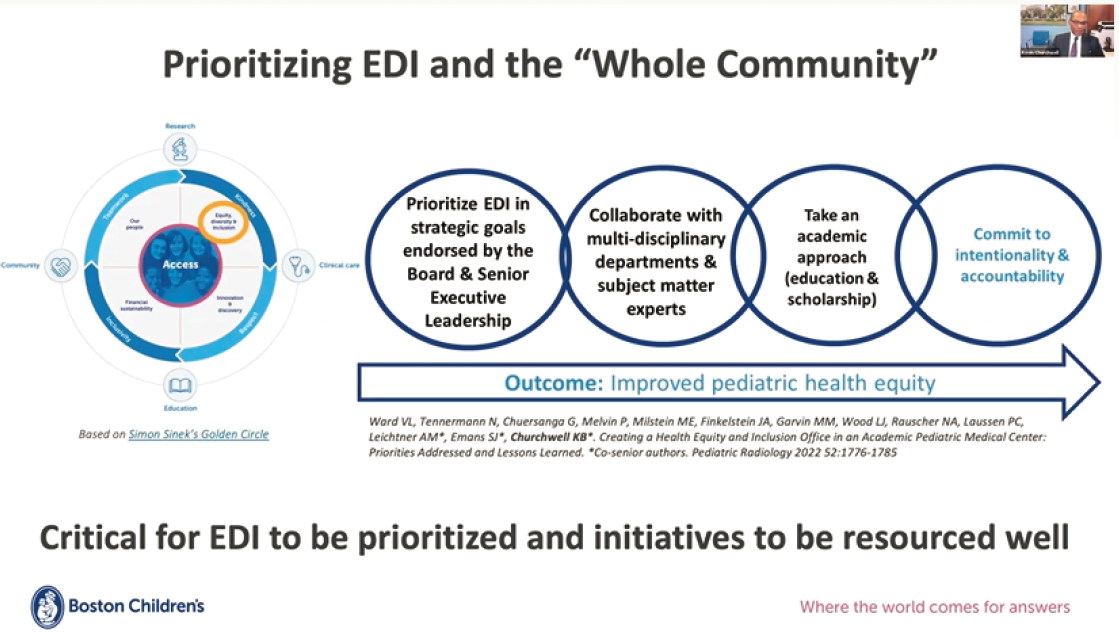
SOURCE: Kevin Churchwell, Workshop Presentation, September 19, 2022, from Ward et al., 2022.
ty-based instruction in K–3. Algebra is introduced in these early grades. Parents are engaged to ensure that their children achieve. Allies include teachers, community members, some parts of the media, organizations, and foundations.
Mr. Harris agreed that parent involvement is critical, and also noted the role of teachers, since they are the people with whom students spend the bulk of the day. When he started a mentoring program, he brought in role models. Building on the appeal of sports, he encourages students to think beyond just the playing, for example, to owning a business connected with sports. The HBCU Council also explains how students can receive scholarships if they maintain their grade point average, besides loans. The message to impart is that “School is your job.”
Dr. Reede commented on the importance of infrastructure, as described by Dr. Churchwell, and the overarching belief in the value and worth of the children, as recounted by Mr. Hill and Mr. Harris. “It’s a matter of understanding the obstacles, not giving up but putting supports in place.”
UNDERSTANDING THE SYSTEM
Dr. Reede asked the panelists to discuss evidence, including where data fit in. Dr. Churchwell concurred with the need for data. Many institutions work on these issues, and it is necessary to go from a siloed to a more integrated approach. He urged consideration of a continuum, starting with the very young children whom Mr. Hill focuses on, then to the older students with whom Mr. Harris works, then on to an academic medical center like Boston Children’s. “How can we communicate the continuum of opportunity for young people?” he posed. “Part of it is to get the data and show what works. We can get more funding and support to show an integrated cumulative way to move the needle.” Dr. Reede underscored the value of integration and connection: “The child in school is the same child who comes into a clinic. Complementary connections must be built across the system. Children need us to do that.”
Mr. Hill described ChiS&E’s work in greater detail. It provides highly engaging, age-appropriate hands-on science and engineering activities for Chicago Public School students and their parents. It has an annual enrollment of 400 students and 300 parents. Each grade has a different STEM focus, starting with civil engineering in kindergarten, and integrates advanced math concepts. Among the class of 2021 cohort, 34 percent went to college intending to major in science (many pre-med), 26 percent in
engineering, and 20 percent in computer science. He noted the program’s focus on math enhances its credibility and pulls in universities, corporations, and foundations.
Mr. Harris said the HBCU Council identified lack of access to HBCUs as a part of the system that needed attention. When asked whether to build programs outside the system or to change the system, he posited that both are needed. When asked about breaking down silos, Dr. Churchwell noted that a role for anchor institutions, such as hospitals, would be to help make the community aware of what else is out there. “Maybe one of our most important roles is as a convenor,” he suggested. “We are able to reach out to the spokes on a wheel and create connectivity.” Dr. Reede agreed with Mr. Hill’s comments about the central role of parents but pointed out that many children are supported by grandparents or other caregivers. Mr. Hill clarified that, for example, in the K–3 program, any family member can be involved.
Dr. Reede concluded that to understand the whole community, it is important to take the time to understand the system and the issues. Everyone has assets to bring to the table to design, accomplish, and measure the effect of programs. It is important to work together at scale, she said.
REFERENCE
Ward, V. L., N. Tennermann, G. Chuersanga, P. Melvin, M. E. Milstein, J. A. Finkelstein, M. M. Garvin, L. Wood, N. A. Rauscher, P. C. Laussen, A. M. Leichtner, S. J. Emans, and K. B. Churchwell. 2022. Creating a health equity and inclusion office in an academic pediatric center: Priorities addressed and lessons learned. Pediatric Radiology 53:1776–1785.
This page intentionally left blank.


