Implementing and Leveraging Machine Learning at State Departments of Transportation (2024)
Chapter: 1 Introduction
CHAPTER 1
Introduction
Artificial Intelligence (AI) and its main subfield Machine Learning (ML) are permeating every industry and enabling new opportunities for extracting useful information from data to support both real-time and off-line applications. By harnessing the capabilities offered by modern AI/ML methods, sifting through vast amounts of data has become practical to identify patterns and derive insights to support decision-making. Many applications of such ML methods have already been deployed by technology companies, and new ones are being developed at a rapid pace. For example, recently, generative AI/ML models have gained unprecedented popularity with the AI bot ChatGPT attracting 100 million users within two months, making it the fastest-growing consumer application recorded in history (Hu and Hu 2023). As acknowledged by many experts and strategists, AI/ML is a transformational technology with significant implications across all industries as well as societies, organizations, and governments. The total potential global economic value of AI/ML is estimated to be $17.1 trillion to $25.6 trillion (McKinsey, 2023).
One of the most visible sectors where AI/ML is anticipated to have a transformational impact is driving automation. Self-driving cars equipped with sensors and advanced AI/ML algorithms are already being tested across the world and in the USA for autonomously navigating and making real-time decisions on the road. These driverless cars are expected to reduce road fatalities and crashes dramatically as most crashes are caused by human error. Beyond autonomous vehicles, AI/ML methods have a wide range of potential applications in transportation. From forecasting traffic conditions to detecting pavement cracks, AI/ML is entering into agency operations in a variety of ways. Given the enormous potential of AI/ML in transforming the transportation industry and its services, state Departments of Transportation (DOTs) need to strategize and deploy solutions that improve transportation safety, efficiency, equity, and sustainability.
State DOTs and other transportation agencies currently do not have a clear guide or roadmap for exploring and adopting AI/ML. To support state DOTs, this NCHRP 23-16 project is focused on creating resources that build awareness of AI/ML in transportation and document success stories, shared insights, limitations, and lessons learned from early deployers. The main objective of this project is to advance the understanding and use of ML tools and techniques at state DOTs and other transportation agencies. This is accomplished by:
- Demonstrating the opportunities and benefits offered by ML in the context of transportation systems, i.e., matching high-value state DOT needs with mature, deployable ML concepts.
- Describing the development and implementation processes, data requirements, performance metrics, and evaluation for ML methods.
- Identifying skills, capabilities, resources, and organizational capacities necessary to leverage ML in the transportation workforce and evolution of the workplace.
- Documenting existing ML applications at transportation agencies and providing a detailed account of their experience with ML.
- Providing insight into costs, benefits, performance, and limitations.
- Compiling and sharing available ML frameworks, tools, and code for common use cases.
- Creating a guideline document outlining the key considerations in developing and adopting ML applications.
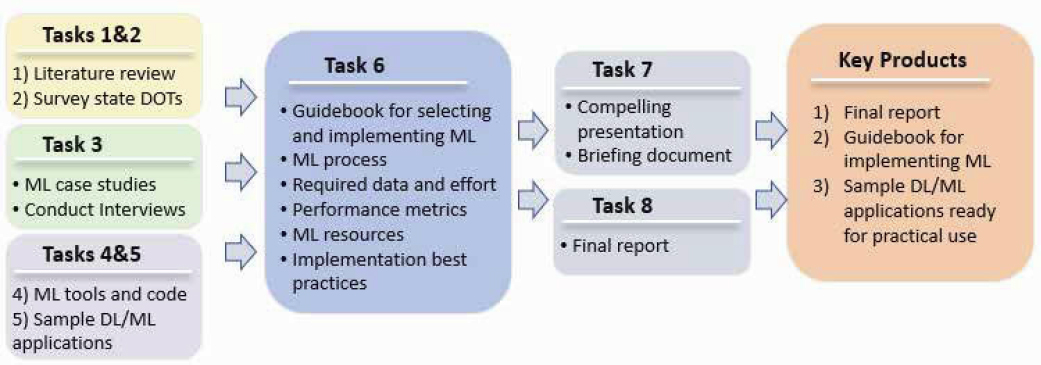
To address these objectives, the framework and tasks depicted in Figure 1 were followed by the research team. The main components of the project are briefly described below.
- Review of the state of the art and practice: Through an in-depth literature review and survey of state DOTs, relevant ML methods and their applications in transportation are analyzed and synthesized. The outcomes of the literature review and state DOT survey are documented, respectively, in Chapter 2 and Chapter 3 of this report.
- Case studies: Interviews were conducted with five state DOTs to document any existing and potential near-term ML applications. The findings from the case studies and their details are described in Chapter 4.
- Compilation of available ML tools and creating sample ML applications: A list of illustrative available codes and tools for major use cases of ML is created. In addition, three sample ML applications that can be implemented with minimal effort are created. Chapter 5 presents the sample ML tools and Chapter 6 the three sample ML models applicable to transportation.
- Development of a guide: A guide is created for state DOTs on how to select and implement appropriate ML techniques. This guide outlines and describes key steps in the ML pipeline and provides a roadmap for an agency ML program. The guide also helps agencies understand situations where ML may not be applicable. A summary of the guide is provided in Chapter 7. The guide is published as a separate document.
- Briefing documents: An executive summary of this study is provided as an appendix along with a set of presentation slides highlighting the opportunities offered by ML.
This report and the accompanying ML guide are anticipated to fill an important gap and establish a solid framework for linking ML methods to transportation applications. The documents present the technical challenges, existing limitations, and potential benefits of leveraging ML for advancing next-generation transportation systems. The guide includes a 10-step roadmap to building agency ML capabilities and is designed to help agencies make informed decisions about how to deploy ML solutions.
While the core capabilities offered by AI/ML pertain to improving efficiency and automating routine tasks, the implications for both the public and private sectors are highly complex as AI/ML algorithms are becoming more sophisticated and widely available. Adapting to the fast-growing innovations in AI/ML while tackling ethical and social challenges is nontrivial. Ethical considerations in AI/ML encompass a broad spectrum of issues, including privacy concerns, bias and fairness, original content ownership and copyright, accountability, and the potential for misuse. On the other hand, social challenges include shifts in the labor market (as some jobs may be replaced by AI/ML) and the digital divide as some have access to
AI technologies and some do not. Addressing all these challenges comprehensively is beyond the scope of this project. However, where appropriate, these considerations are briefly discussed and any relevant findings from the surveys and case studies are reported.


