Optimizing Recruitment and Admissions Strategies in Health Professions Education: Proceedings of a Workshop (2024)
Chapter: 4 The Post-Admissions Process
4
The Post-Admissions Process
HIGHLIGHTSa
- Selection and admission processes could, if modified, better target students who are willing and ready to adapt to a future of lifelong learning. (Wong)
- Admissions at the University of California (UC), Davis, uses the Davis scale, which gives scores for variables including family income, parental education, family assistance, work, need-based financial aid, and coming from an underserved area. (Henderson)
- The admissions process and education pathways at UC Davis have significantly increased the diversity of the student body and have brought the experience of the “average American” to health care. (Henderson)
- Using a unique ID would allow for collecting information on pre-admissions, admissions and post-admissions; tracking the effectiveness of admissions; collecting accurate data on how many qualified applicants are admitted into programs; and gathering data on whether the right students are being attracted to the right health care professions pathway. (Spector)
- A school could use the unique ID to find graduates in practice databases; however, making this possible would require collaboration and partnerships. (Rajwany)
a This list is the rapporteurs’ summary of points made by the individual speakers identified, and the statements have not been endorsed or verified by the National Academies of Sciences, Engineering, and Medicine. They are not intended to reflect a consensus among workshop participants.
The final workshop session of the series was held on March 28, both virtually and in person in Washington, D.C. The session’s objectives were to understand how university administrators and others measure the success of their admissions processes; to learn about tools used for attaining the desired goals of the admissions processes; and to explore support provided to those who are doing the admissions. Workshop co-chair Halaevalu Vakalahi welcomed participants and gave an overview of the previous sessions. The series began, she said, with framing the conversation around the theory of change; this is a collective process of shifting not just the way people in the field do business, but how prospective students see the possibilities in the health professions. This workshop series was designed to spark interest in partnering as thought leaders for developing the future health professions workforce through robust admissions and post admissions processes. In this final session of the workshop, Vakalahi said, presenters from China and the United States would engage with participants to explore lifelong learning, holistic admissions, and unique ways of tracking admissions outcomes. The session would close with an open discussion among workshop planning committee members, presenters, and workshop participants.
LIFELONG LEARNERS
The education and training of the health care workforce has changed over the last 100 years and has been influenced by technological and societal changes, said Tien Yin Wong, vice provost of Tsinghua University in Beijing. In the traditional model, physicians are educated in undergraduate and medical schools that teach basic medicine and clinical medicine over the course of 5 to 8 years. Graduates go on to be trained in hospitals and health care systems, progressing through the phases of internship, residency, attending, and physician. This period lasts between 5 and 15 years, Wong said. The students who are admitted today will be practicing in a “very different future” with different ways of practicing health care and different models and settings. The question, he said, is how should those in the field select and admit appropriate students for this future, and how can these students be prepared to be health care professionals in this future work environment?
The current admissions process tends to emphasize prerequisites and criteria that are focused on biomedical science. However, Wong said, these criteria may not produce the types of health professionals that are needed for the future. The determinants of health are very complex, Wong noted, and students need to understand a broad range of social, behavioral, economic, and public health issues. A recent academic article called for medical schools to recalibrate their student selection process, aligning criteria for admission with competencies expected of medical school graduates, whether they choose to become practicing clinicians, physician–scientists, members of the public health workforce, or policy makers (Prober and Desai, 2023). It also argued that “selection criteria that overweight . . . standardized test scores should be replaced by assessments that value and predict academic capacity, adaptive learning skills, curiosity, compassion, empathy, emotional maturity [and] communication skills.”
Wong added that health professionals of the future will be expected to understand and use digital technologies, including telemedicine and artificial intelligence (AI), and to incorporate patient data into their clinical decisions. The students who are selected for this future would be those who are interested in interdisciplinary education in health, informatics, data science, biomedical engineering, and AI. Furthermore, it is important for health professionals to be prepared to work together in multidisciplinary teams. At the Duke–NUS Medical School in Singapore, undergraduates in dentistry, medicine, nursing, and pharmacy participate in a common curriculum for health care professional education, learn together, and collaborate in their first 2 years. The curriculum combines aspects of health care, data science, AI, and information technology, Wong said.
Following formal education and training, health care professionals ideally are lifelong learners. Changing the paradigm would entail shifting from a system in which education and training take place in traditional medical schools and health care settings to one in which education and training are part of a lifelong continuum. This means that academic health systems would take on new roles stretching beyond the early years of a health professional.
In his conclusion, Wong shared three key ideas. First, the selection and admission processes, if modified, could better target students who are willing and ready to adapt to a future of lifelong learning. Second, the selection and admission processes could select students who are keen on broad educational experiences, including “hard” technology skills and “soft” social, public, and communication skills. Third, health professionals can be trained in such a way that the systems provide a continuous, seamless, “education-training” continuum of learning. To make these changes, Wong said, it will be necessary to identify the characteristics and predictive factors that could be used to select students who would be lifelong learners.
Discussion
After Wong’s presentation, workshop participants were invited to ask questions. Merrick noted that Wong talked about the importance of students who are seeking broad experiences and who will be adaptive to lifelong learning. He wondered whether health professional schools might be trying to find and recruit those types of students or whether schools could be trying to create those types of students. A lot of students come to school not knowing what they want or what is needed, Wong responded, and schools may need to do “more cultivating than harvesting.” Alefishat added that students come to health professional school with many different types of backgrounds, from engineering to biology to public health. She asked Wong to comment on how students from such diverse backgrounds can be selected and prepared to serve as the health care professionals of the future. Wong answered that “it is very difficult to predict what field you will need in the future.” Traditionally, medical students were selected based on their aptitude in life sciences; now selection has shifted to include students who focus on engineering, genomics, or computer science. In the future, the way that medicine is practiced may change in an entirely different direction, resulting in new selection criteria. However, Wong said, the critical thing is to select students who are willing and able to become lifelong learners and to learn new knowledge and skills as the practice of health care changes. Reamer Bushardt, the provost and vice president for academic affairs at the MGH Institute, asked Wong how diversity and inclusion fit into the framework of an applicant-centered model of admissions. Bushardt noted that there is still a lot of demographic homogeneity in many health professions. He added that some health professional programs use a model in which both admissions and learning are based on building teams of synergistic learners to support individual and team development and asked Wong for his thoughts on this model of admissions. Wong replied that his program purposefully selects applicants from a diverse range of backgrounds, from law to arts to sociology. This diversity creates value, he said. Health care work now increasingly relies on teamwork and is less centered on doctors; the diverse backgrounds and training of learners contribute to the innovative team-based approach used in complex health care environments. “Health is a complex situation and it cannot be dealt with [using] a . . . traditional physician-centric approach,” he observed.
Another question from the audience stemmed from Wong’s involvement in admissions with a variety of health professions and across multiple countries. The participant asked him to compare and contrast these different experiences. Wong responded that a common problem everywhere in the health care system is that people drop out after entering the workforce because they had an incorrect or idealized impression of the world in which
they would work. Universities teach in a “very nice, clean, very simple environment,” and when graduates enter the complex world of health care they may find that it is more stressful and difficult than they imagined. This is a waste of resources and a very expensive approach to training health care professionals, he said. This is a common trend across many countries and professions. A difference between countries, Wong added, is that China takes a “blunt approach” to admissions by relying heavily on standardized scores, whereas other countries incorporate more subjective criteria such as personal essays that describe volunteer work or extracurricular activities. He noted that this objective approach can actually result in a more economically diverse cohort because higher-income students are the ones who are more likely to have the opportunities to volunteer or pursue extracurriculars. Students who did not have these opportunities but who performed well on standardized exams can get into health professional schools in China but may not be able to do so in the United States. However, he noted, one downside of this approach is that schools do not know the “softer skills” and characteristics that students have that could speak to their likelihood to stay in the profession.
HOLISTIC ADMISSIONS
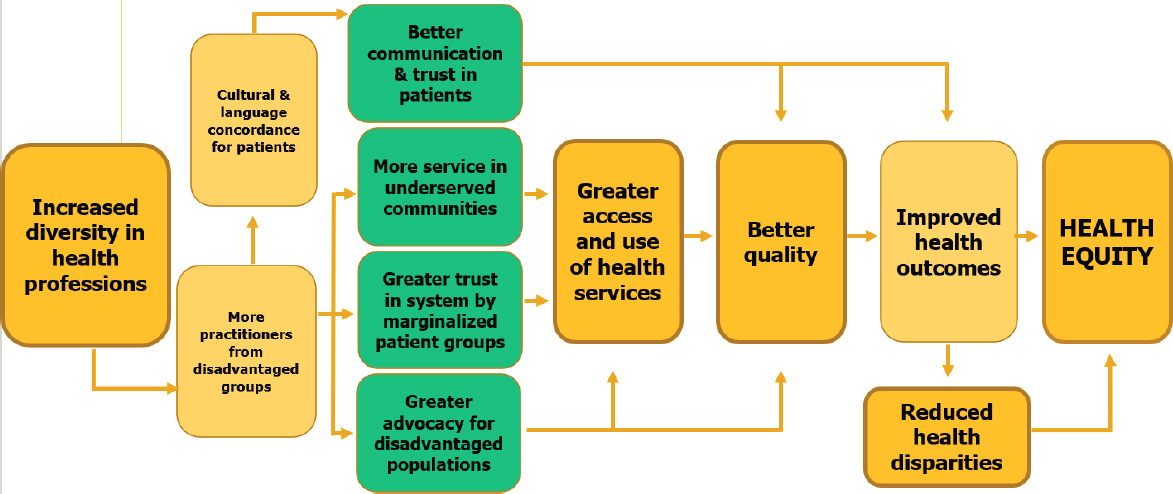
Affirmative action has been banned in California since 1997, said Mark Henderson, the associate dean of admissions at the University of California, Davis, Health. As a result, all of the schools in the state became less diverse from a racial and ethnic perspective. Diversity is important because it improves health equity, Henderson remarked. Figure 4-1 illustrates the relationship between diversity in the workforce and equitable health outcomes. Increased diversity means more practitioners from disadvantaged groups, along with cultural and language concordance for underrepresented patients. The diversity in practitioners and improved concordance leads to better communication, more service in underserved communities, greater trust in the system, and greater advocacy for disadvantaged populations. These, in turn, lead to greater access and use of health services, better quality, improved health outcomes, and reduced disparities; all together, these lead to health equity.
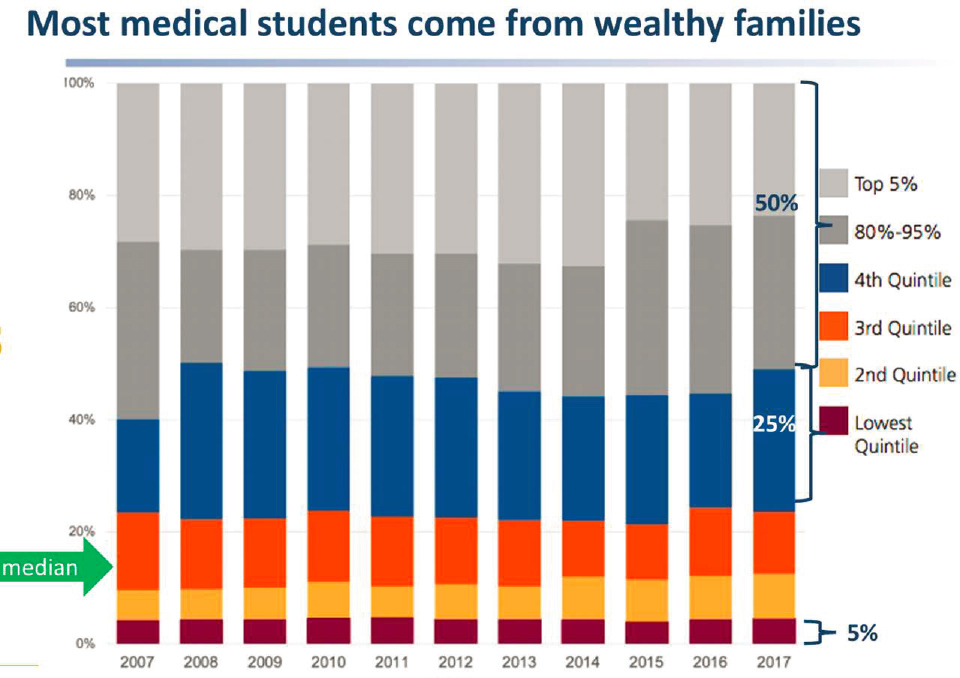
Over the past 25 years, the United States has become more racially and ethnically diverse, Henderson said, but medical schools have become less diverse. Between 1997 and 2017, the percentage of matriculants from underrepresented groups dropped by 16 percent. Further, the majority of medical students come from wealthy families; half of students come from the top quintile of family income, while only 5 percent come from the lowest quintile (Figure 4-2). A 2022 study found that the likelihood of being accepted to medical school rises in direct proportion to family income,
SOURCE: Presented by Mark Henderson on March 28, 2024. Adapted from Saha and Shipman, 2006. U.S. Department of Health and Human Services.
SOURCES: Presented by Mark Henderson on March 28, 2024. Adapted from Youngclaus and Roskovensky, 2018.
Henderson said, and high-income representation in medical school is increasing over time. This trend is greatest among White and Asian students. Henderson commented on these wide and widening disparities among students of different family incomes, saying it reminded him of a quote from Martin Luther King, Jr., who said, “We have deluded ourselves into believing the myth that capitalism grew out of the Protestant ethic of hard work and sacrifices. Capitalism was built on the exploitation of black slaves and continues to thrive on the exploitation of the poor, both black and white.” While this quote was made in a different context, Henderson said that “it doesn’t seem right” that poor students are “shut out” of medical school.
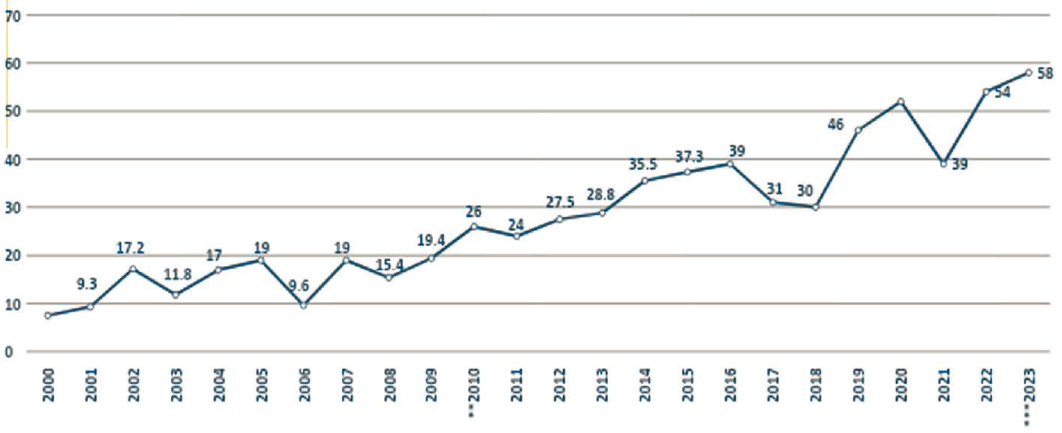
The question, he continued, is what can be done about it? UC Davis offers one model for improving diversity even in the face of a state ban on affirmative action. Between 2000 and 2023, UC Davis tripled the enrollment of students from communities that are underrepresented in medicine (American Indian/Alaskan Native, Black/African American, Hispanic/Latinx, Native Hawaiian/Pacific Islander, or two or more of these races) (Figure 4-3). This shift is the result of slow, steady progress over time. Henderson said that one of the most important drivers of the shift was the mission of the school. The universities of California were founded with the idea of creating schools “that would educate the wealthy and low-income alike, so all could benefit.” Based on this foundational idea, the admissions team at UC Davis School of Medicine has the mission of “matriculating future physicians who will address the health workforce needs of our region.” There are many elements to fulfilling this mission, Henderson said, including committed, longitudinal leadership; diverse input of students and trainees; the use of multiple mini-interviews; holistic review of applicants; incorporating the lived experiences of health care; offering need-based scholarships and financial aid; and developing partnerships with local high schools and community colleges. As a result of this approach to admissions, the medical students at UC Davis look very different than medical students in other schools, Henderson said. Almost half (45 percent) are first-generation college graduates (compared to 14 percent nationally), low- and middle-income students make up a higher proportion of students, and 75 percent of students receive financial aid.
Admissions at UC Davis uses the Davis scale, which gives scores for such variables as family income, parental education, family assistance, work, need-based financial aid, and coming from an underserved area. Traditional metrics for admission—such as grade point average and test scores—are confounded by opportunity and privilege, Henderson said. The Davis scale helps to provide context to traditional metrics, which are often confounded by educational opportunity or privilege, and nudges admissions committee members to be more holistic and look more deeply into each applicant. Henderson said that scores on the Davis scale can be seen
SOURCES: Presented by Mark Henderson on March 28, 2024; Henderson et al., 2021. What does it mean for medical school admissions to be socially accountable? AMA Journal of Ethics 23(12):965–974. Copyright 2021, American Medical Association. All rights reserved. The AMA Journal of Ethics® is a registered trademark of the American Medical Association.
as markers for grit, resilience, and ability to overcome obstacles—all very important qualities in a medical career.
After students are admitted to UC Davis, there are a number of inclusive pathways designed to meet community health needs. Around 30 percent of UC Davis students are in one of these community health scholar pathways, of which 80 percent are from underrepresented groups or low-income households. These programs focus on the needs of a specific community or geographic area, recruit and admit students from those areas, and give students experiences in the communities during school. There are currently five pathways which focus on rural, urban underserved, Central Valley, and Native American/American Indian communities and primary care. Among the students who have graduated from these pathways, 43 percent go into primary care internal medicine or family medicine, about 50 percent work in an underserved area, 33 percent work in a rural area, and 87 percent stay in California.
Henderson highlighted three of the pathways at UC Davis. The primary care pathway is a program that allows students to complete medical school in 3 years instead of 4 and proceed directly to a primary care residency. Students are selected based on their real-world primary care experience, for example, as a certified nursing assistant or medical assistant. On average, these students start medical school with lower grades and lower test scores than traditional students, he remarked. Most are older, and 65 percent are first-generation students. All students receive full tuition scholarships, reducing the debt burden which deters many from pursuing primary care careers. Primary care physicians are critical for community health outcomes, Henderson said, and programs like this are working to address the primary care workforce crisis. The second program Henderson highlighted facilitates the transfer of students from community college to medical school. Partnerships with local community colleges allow students to get priority or guaranteed admission to UC Davis. Many residents in family medicine have attended community college, especially those who are Latino or African-American, and ignoring community colleges is “cutting out a very rich source of diverse talent for the future workforce,” Henderson said. Finally, Henderson highlighted a program designed to train more students from federally recognized tribes. Students who have unsuccessfully applied to medical school spend 10 months in a residential post-baccalaureate program in Portland, Oregon. If they complete the program, the students are conditionally accepted to several medical schools in Oregon, Washington, and California.
The admissions process and education pathways at UC Davis have significantly increased the diversity of the student body and have brought the experience of the “average American” to health care, Henderson said. Students’ lived experiences in the world and in health care inform their
education in the classroom, their clinical experiences, and eventually their practice in the community. These students have faced many of the same challenges as their patients, and their experiences are key to successfully serving a diverse community of patients. He underscored that making this shift is a “marathon, not a sprint,” and it requires intentionality, iteration, perseverance, and slow, steady progress.
Discussion
Following Henderson’s presentation, workshop participants were invited to ask questions and make comments; Addams moderated the discussion.
Financial Support and Debt
In his question, Cahn observed that many of the pathways Henderson described had financial support built in. He asked if the program tracks the debt of students, particularly those who move into medical specialties that are less well compensated. Henderson replied by describing the primary care track that was intentionally designed to address this problem. These students all receive full tuition scholarships and graduate with less than $40,000 debt, compared with the average medical student who leaves school with a $200,000 debt. Scholarships at UC Davis are given based in part on Davis scale scores, so the money is targeted at the neediest students. Student debt for students from underrepresented groups has gone down over the years, Henderson said, and is down by about 35 percent across the whole school. Henderson noted that these scholarships cost money and said that the money for the primary care scholarships comes from Kaiser Permanente of Northern California, an organization that “feels the pinch” of the primary care shortage. Other programs are funded in part by state funding. Henderson emphasized the point that financial support is critical for increasing diversity; “if you bring students that are low-income into your school and then deprive them throughout medical school, nobody wins.”
Holistic Admissions at Other Health Professional Programs
Breitbach asked Henderson if other health professional programs at UC Davis use some of the same holistic principles in their admissions process. The nursing program at UC Davis, Henderson said, is only about 10 years old, so it was able to create its admissions process “from the ground up” and incorporate many of the same elements as the medical school. The nursing school does not use exactly the same variables but does use elements of it as part of a multi-pronged process. The law school and other
professional programs at UC Davis have also begun incorporating elements of the holistic admissions process. Haddad joined the discussion, commenting on the scalable platforms that can be used to add these elements to the admissions process. Using an adjustable platform, he said, allows each school and program to emphasize the criteria that fit with their mission.
SCOTUS Decision on Affirmative Action
A workshop participant asked Henderson if his program was affected by the 2023 Supreme Court decision that prohibited the use of race-based affirmative action in college admissions (Students for Fair Admissions v. President and Fellows of Harvard College, 2023)
Henderson responded that the 1997 California law on affirmative action was more restrictive than the Supreme Court decision, so the court ruling did not affect their program. Another workshop participant asked Henderson to advise those in admissions who are struggling to increase diversity in the wake of the Supreme Court decision. Henderson replied by emphasizing the importance of admissions committees staying “laser focused” on other aspects of the application. One approach is to focus on the “lived experiences” of applicants. He pointed out to the audience that the Supreme Court opinion allows lived experiences related to an applicant’s race to be considered in admissions. Another approach, he said, is to build relationships with local high schools and community colleges. Most health professions schools are located in areas where there is “plenty of diversity” in these schools, so tapping into these resources is an “obvious thing to do.” Community college student bodies are reflective of the United States in terms of race, income, and other characteristics, and they are “right in your neighborhood.” However, Henderson added, there has traditionally been discrimination against such students in the medical profession. Finally, Henderson said that an admissions approach that is focused on a goal—for example, improving care in rural America—could allow admissions to prioritize criteria that are related to this goal.
Other Experiences with Holistic Admissions
Addams asked workshop participants to share their own experiences with holistic admissions. Cameron said that holistic admissions can be a “buzzword.” Many institutions say they do holistic admissions but do not have a deep understanding of what it entails. Cameron then shared her experience, where the process began with looking at competencies and trying to figure out what competencies students need beyond the standard metrics. The interview process involves an asynchronous video interview that faculty can review, followed by a Zoom event in which faculty and applicants can
interact. Merrick shared his experience with holistic admissions in an allied health school. The school had more demand than capacity, he said, so the admissions process was selective. Merrick agreed with Henderson that the school’s mission can be a driving force for the admissions process. At his school, they looked carefully at the mission of each program, how it fits the collective mission of the school, and how the mission could drive the selection criteria to find qualified applicants. The process looked at many different criteria, including socioeconomic status, being first-generation, and being from an underserved area. In addition, they asked faculty and providers to identify the characteristics and experiences that make a good provider in a certain field. The admissions team built these variables into the process and looked for characteristics such as empathy, commitment, and selflessness through personal interviews, evaluations, observation, and other methods. This admissions process, Merrick said, was totally agnostic of race, gender, or other protected characteristics. However, when doing a post hoc analysis of the students who were admitted, they found that the percentage of traditionally underrepresented students tripled in the first cohort and that proportion was maintained moving forward. He further commented that some people are hesitant about holistic admissions, fearing it will affect such outcomes as board scores. Merrick rejected that notion, saying the board scores in his program did not change at all despite the demographic changes to the student body.
Personal Stories
A virtual participant said that she encourages applicants to include personal stories in their applications. Talib built on the comment saying that there can be tension between the value in personal stories and the potential for applicants to be asked to relive their trauma. Asking students to tell their story, particularly students from historically marginalized and excluded backgrounds, is asking them to be “very vulnerable.” This issue feels like the “elephant in the room” after the Supreme Court decision, Talib said, and it is important to consider how to elicit stories that genuinely represent a student while not re-traumatizing them. Henderson reflected on the comments before saying that in carrying out the admissions process at UC Davis, they have found that an important part of thriving at school is being able to ask for help. Many students come from adversity and trauma, he noted, and the way they deal with these challenges can be predictive of how they will deal with challenges in school. Jennifer Graebe, the director of the Nursing Continuing Professional Development & Joint Accreditation Program at the American Nurses Credentialing Center, said that being sensitive to the lived experiences and traumas of applicants is essential and that it is important that the concept of trauma-informed care be the foundation
of a holistic admissions approach. In addition, once students are admitted, taking a similar approach must be taken to support their academic journey. Henderson added that the Native American pathway program at UC Davis is based on a shared experience of having failed at applying to medical school. All the students in this pathway start with that “trauma,” so the program seeks to build them back up and support them in elevating their cultural assets and their lived experiences and identities.
Mitigating Bias
Cahn remembered from Henderson’s presentation that the admissions committee at UC Davis includes students and faculty who are not admissions professionals. He asked Henderson what kind of training these committee members receive, particularly on mitigating bias in interviews. Cahn said that there is significant psychological research about the power of seeing a face and the potential for making judgments based on irrelevant information. In his response, Henderson said the admissions process at UC Davis attempts to mitigate bias in several ways. First, the admissions committee goes through annual implicit bias training. Second, they use multiple mini-interviews, which he said are not a panacea, but do dilute bias. Third, and most critical, the committee has been enhancing its own diversity. Students are a particularly key component of the admissions committee, he said, because their lived experience is completely different from traditional admissions committee members. While students do not have an official vote on admissions, they have been essential in surfacing issues and considerations during deliberations. Henderson added that the Davis scale has also been useful in “moving minds.” In other words, having a high score represent disadvantage and a low score represent advantage helps admissions committee members recognize the value in the variables in the scale. Addams added that another way of mitigating bias in the admissions process is to conduct an ongoing evaluation that can help determine if there are interviewers or reviewers who are “out of line” with others and to make a mid-course correction. This approach takes resources and time, however. Henderson said that time and resources are a major barrier to making changes in the admissions process. “It’s easier for people to just . . . accept the same students” than to invest the time and money necessary to focus admissions on criteria that matter for the future of health care.
Diversifying Faculty
There has been a serious examination of who and how applicants are admitted to health professional schools, said Jody Frost, co-chair of the Global IHPE Forum. She asked Henderson if there has been a parallel
movement to shift how faculty are selected. Henderson responded that changing the faculty will be a long, slow process. UC Davis has taken a “grow your own” approach; some graduates of the earliest pathway programs are now serving as faculty in those programs. This is not an easy solution, he said, and it takes a long time. However, instead of focusing on bringing in people from “some fancy university,” schools may be better served by taking advantage of the talents that already exist in the community. A participant asked if UC Davis has attracted more diverse faculty in recent years due to its efforts to diversify the student body. Henderson replied that the increase in diversity has had two impacts on the faculty. First, being a majority-minority school has changed what happens in the classroom—faculty have had to educate themselves and grow in order to handle challenges and uncomfortable conversations. Second, the reputation of the school in terms of diversity, equity, and inclusion is beginning to bring in young faculty recruits who are interested in joining the efforts. Addams added that a group of medical schools is piloting a toolkit to bring holistic principles into their faculty recruitment and hiring. The group is considering questions such as what is valued in promotion and tenure and whether what is valued is a holdover from the past or is relevant to the future of health care.
UNIQUE ID FOR OUTCOMES TRACKING
A unique nurse identifier (UNI), said Nur Rajwany, the chief information officer of the National Council of State Boards of Nursing (NCSBN), identifies a nurse without the need to use the nurse’s personally identifiable information within a dataset. For the last 15 years, NCSBN has worked with the U.S. nursing regulatory bodies to assign a unique nurse identifier (NCSBN ID) to every one of the more than 5 million nurses in the United States. Rajwany shared an example of how the system works. If a nurse is licensed in multiple states, he or she will show up multiple times in the data that states send to NCSBN. NCSBN uses social security numbers and birthdates to identify duplicates in the data and then merges all records into one record with one unique ID. Rajwany noted how this system would not be possible without the participation of all nursing regulatory bodies. New nurse applicants are automatically assigned an NCSBN ID through a robust and secure nursing exam application process. Rajwany noted that a free process through the Nursys e-Notify system allows organizations, including graduate nursing programs, to retrieve the NCSBN ID UNI of nurses in their employ, registry, roster, or dataset. This system is widely used, Rajwany said, and has been in place for 10 years.
Assigning a unique ID to nurses has a number of benefits, he said. First, nursing’s contribution to the health of individuals and communities
is difficult to measure. An identifier is essential to the aggregation, synthesis, and publication of data and research that better capture nursing processes to enable the scientific inquiry for researchers to measure and quantify nursing care impacts on health outcomes. Second, the unique ID makes it easier to identify and associate a nurse in the Electronic Health Record and Enterprise Resource Planning and other health information technology systems. Through big data analytics it can then be possible to demonstrate nursing’s contribution in a value-based care model. Finally, the use of a unique ID facilitates the reconciliation of disparate nurse datasets for research and academic inquiries without the need for any protected nurse’s personally identifiable information. Sharing databases with personally identifiable information, Rajwany said, is a “huge data security and cybersecurity issue.” By using a unique ID, researchers can share datasets and collaborate freely. The unique ID allows for easy searching of a nurse in any nurse dataset that has assigned the UNI to its nurse records (e.g., NCSBN’s Nursys system, Nursing Regulatory Body nurse license verification public portal). Federal, state, and local systems will also be able to benefit from accurate and easy search of a nurse without using the nurse’s private information, as soon as they complete the implementation of associating the unique nurse identifier to the nurse records in their datasets.
Since applicants to graduate level nursing programs are already licensed nurses, these students have already been assigned the NCSBN ID unique nurse identifier, Rajwany said. If a nurse applies to three different programs, that individual will be identifiable through the same unique ID. The NCSBN ID can facilitate more accurate and updated nurse licensure information, including Advanced Practice certification and licensing. Using this system, colleges of nursing can improve internal review processes involving post-licensure advanced degree students, faculty, preceptors, or nurse employee compliance with requirements for nursing program accreditation.
Spector added to the conversation, saying that, in the context of undergraduate nursing education, a unique ID would be very valuable. Using a unique ID would allow for collecting information on pre-admissions, admissions, and post-admissions; tracking the effectiveness of admissions; collecting accurate data on how many qualified applicants are admitted into programs; and gathering data on whether the right students are being attracted to the right health care professions pathway. Further, Spector said, if the NCSBN ID was extended to all prelicensure nursing students in the United States, every student would have an NCSBN ID that would remain the same as the student became a nursing license applicant and then a licensed nurse. This would be true even if students switched programs during their course of study or took pauses in their educational journey. Spector added that NCSBN is in a unique position to help with the creation of a unique identifier for undergraduate nursing applicants and ensure that
the NCSBN ID remains the same when the nursing student transitions over to licensed nurse.
Discussion
Following Rajwany’s presentation, workshop participants asked questions. Breitbach opened by saying that a major challenge in health professional programs is tracking down graduates to gather information about what they have done since graduation. He asked if using a unique ID would be useful in this situation. Rajwany responded by noting ways that a school could use the unique ID to find graduates in practice databases; however, making this possible would require collaboration and partnerships. Merrick asked where and when learners should be put into this system if it were to be implemented for undergraduate students? He pointed out that around 60 percent of undergraduate students change their major, so assigning an ID in the system upon enrollment would result in a lot of unnecessary data. Rajwany acknowledged that these issues would have to be considered when creating a unique ID system for all undergraduate programs. That said, he also made the point that there are “plenty of IDs to go around.” A student could be assigned an ID and keep it forever regardless of whether the student pursues the intended career path or not. A workshop participant then asked whether the unique ID system could be used to track nurses that leave the profession or who re-enter the profession and if it could be analyzed for characteristics such as region, race, or educational institution? Rajwany stressed that while the ID system would facilitate research like this, it would be up to the stakeholders to collaborate with others in collecting these data. Once the data have been collected and entered into a database, the ID system would allow researchers to examine the data and look for trends and associations.
DISCUSSION AND CLOSING
In the final session of the workshop, planning committee members, speakers, and guests were invited to share their thoughts on any of the pre-workshop and workshop sessions. All of the comments were from a U.S. perspective. Merrick moderated the session and asked participants to consider how to take the presentations and discussions and turn them into “something that is tangible, usable, and that can take us to the next step.”
Breitbach led off the discussion by noting that many presentations had emphasized the importance of intentionality of design with the outcome in mind. The first step in making a change is to understand the problems to be addressed, he reiterated, and then one intentionally designs a framework that will address these issues and achieve the goal. Part of this
intentionality, Addams said, is clarity about the mission and goals of the institution. She noted that many college applications ask students to write about who they are and what they want to become, but the colleges could ask themselves the same questions. Institutions could consider self-directed questions such as: Who are we as an institution? What is truly important to us? What’s driving us? and What are our priorities? Before identifying the attributes and characteristics institutions seek in their student body, it is important for institutions to know “who they are,” she asserted.
Compassion
During Custodio’s presentation, he asked workshop participants to choose the most important characteristic that they would look for in health professional applicants. Cahn observed that nearly everyone chose “compassion.” However, he said, he has heard very few examples of health programs foregrounding compassion in recruitment and admissions. He wondered whether this is because compassion is too difficult to measure or too non-traditional as an admission criterion. Merrick agreed that if compassion is highly valued in a field, there would need to be ways to quantify and measure it. Measuring compassion may be more complicated than measuring other characteristics especially since some students can “game the system” by doing volunteer work only to look good on an application.
Early Engagement
Many speakers talked about engagement with learners and the importance of engaging as early as middle school or even kindergarten, said Katie Eliot, representing the Academy of Nutrition and Dietetics. She noted that for individuals from underserved communities—such as those targeted by UC Davis—early engagement is even more critical. When children do not see adults in their community in the health professions, early engagement can help them see a career in health care as something that is a real possibility. Merrick agreed that early engagement is especially important in underserved communities. Young children are not thinking about admissions criteria, he said; instead, they are thinking about who they are going to be in the future. With this age group it is necessary to establish interest in the field as well as to help them believe that they can become what they want. Once both interest and belief have been established, he said, you have “tilled the soil enough that you’re ready to plant the seed.” Merrick reflected on his role as dean of a health professions college, saying that there is a lot of emphasis on events such as campus visits for prospective applicants but that he is increasingly realizing that it is “too late at that stage.” The point of a campus visit is not to create interest in the field of
health care, but instead to convince an already-interested applicant to “pick my institution instead of your institution.”
Cheryl Hoying, the National League for Nursing representative to the IHPE Global Forum, shared examples of some approaches for engaging young people and developing their interest in health professions careers. She said that by inviting school counselors to tour the health care system they become aware and up-to-date on what different jobs look like and what types of positions are likely to be in-demand in the future. She also has partnered with Boy Scouts and Girl Scouts to bring kids into a health care setting. Over the course of 8 weeks, scouts toured different areas of health care and engaged in hands-on activities such as donning masks. Hoying called out community colleagues as potentially valuable partners in early engagement to foster the future workforce.
Graebe told workshop participants about a concept in public health called the whole community approach. In DeKalb County, Georgia, a collaborative group of stakeholders use this approach to engage with learners and to create pipelines and pathways toward health professions careers. Stakeholders including health systems, universities, public schools, legislators, and health professionals worked together to create opportunities for K–12 students to learn about health profession careers, and it required commitment to integrate into curriculum the core competencies they would need in those chosen careers and to be supported as they progress from elementary school into health professions education. Graebe emphasized how this commitment to the students was not about “checking boxes,” but about giving the students power and control in their academic journey. “We need to learn from case examples like this one,” she said, and to implement programs that are already successful rather than creating something new.
Collaboration on Admissions
Bushardt told participants about a “light bulb” moment he had during Henderson’s presentation. Despite nearly 25 years working in workforce and pathway development and having built regional consortiums of different institutions, Bushardt said he had never considered reaching out to neighboring universities to address challenges. He said that he was leaving this workshop with a broader perspective about the value of working together with other universities, rather than competing on enrollment. Merrick said that the Global Forum on Innovation in Health Professional Education often talks about systems-level thinking and addressing issues at the macro, meso, and micro levels. “A lot of us approach admissions on the micro level,” he said, looking at admissions as a means for addressing the specific needs of the specific program. There is value in looking at admissions from a broader perspective and considering how institutions could collaborate and
coordinate across all health professions. Frost suggested that one area for collaboration could be an effort to identify a set of core attributes that are essential to all health professions. These attributes could be communicated to potential applicants to guide their preparation for a career in the health professions. Cahn added that he and other workshop participants discussed the possibility of creating an interactive career exploration tool. A young person could answer a set of questions and based on a set of agreed-upon skills, behaviors, and attitudes that are characteristic of different professions, the tool would give the young person ideas of what health care careers he or she might be well-suited for. Moeller, who presented in the pre-workshop, reminded the audience about an existing tool that focuses on science-based aptitudes to help students. The tool is precise and scalable and can be used with students living in underserved areas for creating personalized career pathways, she said.
Cultivation versus Selection
Merrick observed that while admissions is often thought of as a selection process, it can be looked at through a broader lens as one piece of a holistic approach that is aimed at cultivating and producing future health care professionals. He said that among the college students who start out identifying as pre-med, only 16.5 percent actually complete their undergraduate degree with all the prerequisites needed to apply to medical school. “What happens to that other 83.5 percent?” he asked. Currently, there is no organized approach to capture these individuals who are interested in health care and to redirect them into programs where they can succeed. There are a few programs that are experimenting with ways to guide and retain undergraduates who are interested in health care. For example, at the College of Health and Human Services at the University of Toledo there is an undergraduate health sciences major that serves as a generic pre-health care pathway for multiple disciplines. One of the barriers, however, is that many pre-med students are housed in other colleges within the university. When some of these students realize that they do not have the interest or aptitude to pursue medicine, they do not have a ready-made path to find a new profession that may be a better fit. Breitbach built on Merrick’s comment, saying that career services offices can serve as a bridge for these types of students. He suggested that instead of using interest surveys to point students toward specific professions, perhaps surveys could be used to give students a domain area of multiple professions. Then mentors, along with tools like aptitude tests and career guidance, could be used to help students focus their interest within that domain. Merrick agreed that a structured approach for guiding and redirecting students is key. He told workshop participants about a unique opportunity at his institution. Buildings are being torn down
and rebuilt, and he has proposed that all of the pre-health advising in the entire university be housed in the same suite to have a “one-stop shop” for everyone in that space. In addition, there are efforts underway to reconcile the introductory courses that all students take and to align the course with health professions exploration and pathways.
Moving Forward
Merrick asked participants to identify key messages from the workshop and to consider approaches for moving these messages into action. He said that one message that stood out to him was the concept of using admissions as a tool to align future practitioners with anticipated gaps or needs. He gave the example of the work at UC Davis, where admissions and pathways are built around the needs of different populations in the community. “How do we use admissions to solve our problems?” he asked. Frost commented on how admissions traditionally looks at predictors of success in applicants and selects individuals who are likely to be successful in the program. She suggested that these predictors are probably “moot,” given the rapid changes in health care and technology, and that a better approach might be to use admissions to fulfill the mission of the institution. Frost then said it is unlikely that UC Davis would have seen the same kind of success in getting graduates into primary care in underserved communities if the admissions process had been focused on predictors of success. Making this shift requires a reframing of admissions and a new emphasis on admitting applicants whose purpose and goals are aligned with those of the institution. Vicki Hornyak, an associate professor in the Department of Physical Therapy at the University of Pittsburgh, agreed, saying there is a desire to move away from traditional metrics and toward an admissions process that is based on a mission-driven, interprofessional definition of what makes a good health care provider. Cahn referred the audience to research that showed students with biomedical undergraduate majors performed the worst on every category of academic performance in medical school. It may be helpful, he said, to gather empirical evidence on what characteristics or experiences do and do not contribute to success in health professional school and practice. This evidence may show us that “continuing the way we’ve always done [admissions] won’t give us anything new,” Cahn noted. Merrick expanded on this idea and said there would have to be a reconsideration of the prerequisites that are required for entry into health professional programs. Instead of focusing on individual disciplines and rigorous science, perhaps prerequisites could be focused on other areas of value, such as an understanding of health care inequities and the social determinants of health. Merrick said this knowledge is something that could be “part of the fabric and part of the lens through which they see
all of health care as they learn to be a provider.” Currently, undergraduate programs are so prescriptive that students can easily fall behind if one course is out of sequence. Instead of these strict pathways that start in the first semester of college, perhaps students could be allowed to explore and learn about health care more generally and find their way toward a path that best fits them.
Closing
Frost closed the workshop by identifying several messages that stood out to her. First, “every applicant matters.” Some schools have more demand than capacity, and others have more capacity than demand. Every applicant, whether successful or not, has value, and losing capable applicants is a big problem. It is important for institutions to find a way to guide these applicants toward other areas of health care. Another key message, Frost said, is to be careful to consider key attributes that are important for the health workforce of the future and to build those attributes into the admissions process. In addition, as admissions processes evolve it will be important to track outcomes to see whether the “right” students were selected and where they ended up. Finally, Frost said, it is critical for health educators to understand that “our job is just beginning when we admit students into our programs.” It is the responsibility of educators, guidance counselors, and the whole institution to “nurture young learners and older learners and then ensure that every student who’s admitted to a program is given resources and the opportunities to succeed.” While making these changes is a big lift, Frost said, “I know we can get there.” After the COVID-19 pandemic, education is in a rebuilding season, and there is energy and excitement to make changes. Frost thanked participants for attending the workshop and contributing invaluable input. Frost adjourned the meeting and encouraged participants to take a “little kernel” back to their own institutions to continue the dialogue.


