Xavier Cortada: Climate Science Art (2024)
Chapter: A Very Different Voice
A Very Different Voice
The climate art of Xavier Cortada inspires Jennifer Jurado’s work on climate resilience. This article is based on Lisa Margonelli’s interview with Jennifer Jurado and was published in Issues in Science and Technology, Fall 2024.
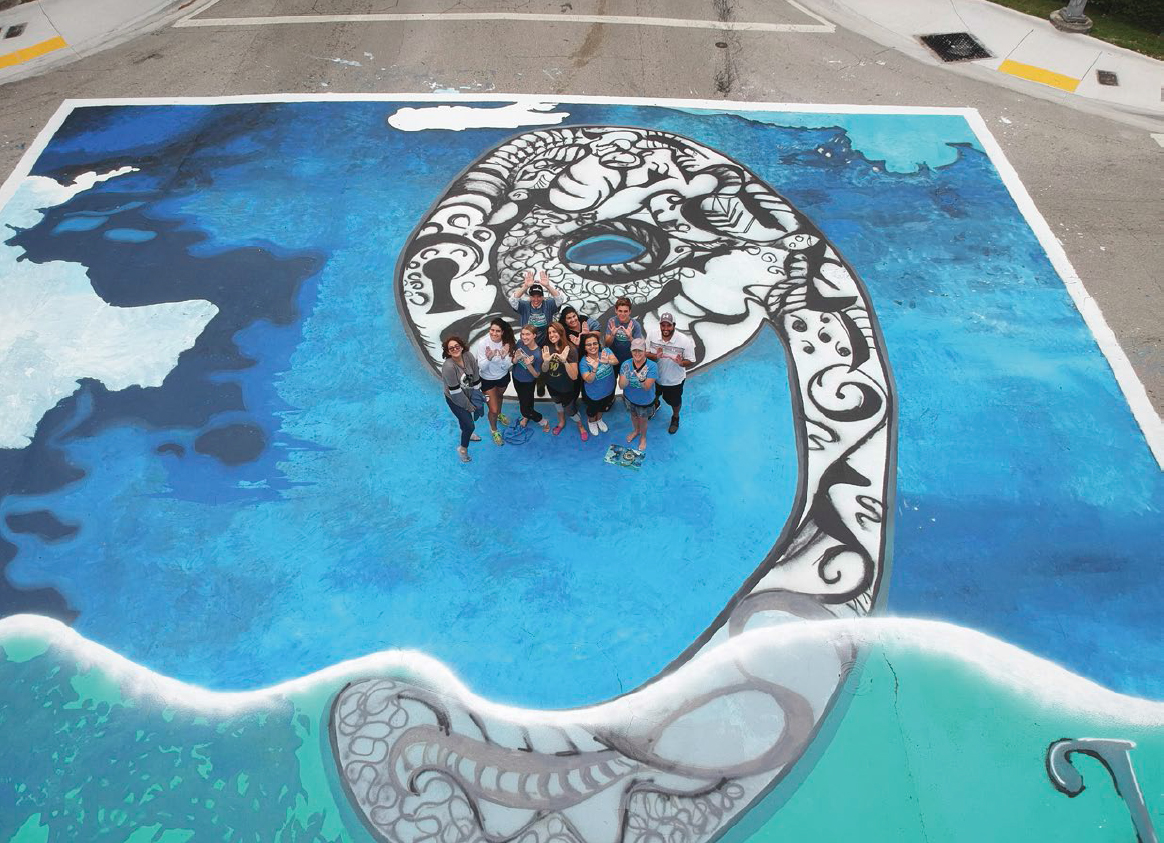
Xavier Cortada’s The Underwater is a series of public art installations that reveals the vulnerability of Florida’s coastal communities to rising seas. In the form of murals, crosswalks, concrete monuments, and yard signs, the artworks prominently feature the elevation of the site where they’re located. Through community workshops, apps, and even buswraps, these works raise awareness, spark conversations about climate, and catalyze civic engagement. As the chief resilience officer of Broward County, Florida, this kind of engagement is vital to me: I’m responsible for leading climate mitigation and adaptation strategies across our 31 municipalities with 1.9 million people. Our land is between 4 and 9 feet above sea level, and we have nowhere to retreat if it floods. A lot of my effort is focused on helping to guide planning and management decisions that support our natural resources as well as our built environment, in addition to working with state, federal, and local agencies on a coordinated strategy to reduce the severity of the impacts of climate change. In Broward County, we’ve been working on climate initiatives since 2000. But despite all our progress, we’ve really struggled with communications and community engagement. We don’t have the large community-based activist groups that have served as on-the-ground partners in some other places. And we are aware that government isn’t always the best messenger, and that we need a diversity of voices.
I first encountered Xavier’s work at an environmental youth summit with a few thousand students. I was really overwhelmed with the quality of the work and the students’ connection with the history behind it. Xavier explained his own experience as an artist: he had gone to Antarctica and felt the ice melt in his hands and realized how that connected to the communities that he loves. He was utilizing this creative messaging of art to engage and communicate in such a powerful way.
After I met Xavier and discovered his work, we in Broward County began to envision how we might work with him directly. The people who typically work in this arena tend to communicate like I do—meaning, we’re all technical people. No matter how I try to simplify things, I have trouble getting my message across. But Xavier is a very different voice. Talking with him wasn’t like an academic conversation; it was one of really deep connection. What he says has its origin in his heart. We asked Xavier to present to our climate task force, and then we began to plan to work together with schools. One thing that struck me is that Xavier engages in a different kind of climate conversation. Often people are just overwhelmed and feeling a sense of devastation and loss when it comes to climate change. Xavier is able to talk about providing individuals with agency—that you have an important stake in what’s happening, and you have the capability to be an important messenger. He emphasizes the power of your voice and your participation, that this is about your community. Another reason we were excited to work with Xavier is that he really understands and cares about young people. He leaves them feeling empowered and capable and invested. When children join a workshop, they learn about sea level rise. They can use an app to see what their local elevation is, and how changes in sea level will affect their school and their neighborhood. They work on making a yard sign with the elevation of their home and Xavier paints an incredibly beautiful mural in the hallway of their school, with the elevation of the school. Imagine how empowering it is for those 100 students to be the keepers of this knowledge: they’re the experts, they’re able to lead that next level of conversation. I think he leaves all of us feeling like we’re not destined to inherit the problem. We have the capacity to be part of the solution. We not only hosted workshops at 10
public schools, but we also invited Xavier to speak and hold a workshop at Water Matters Day—our county’s largest environmental event, with 3,000–4,000 attendees annually. Later we organized a community climate conversation with Xavier focused on our central county neighborhoods, and we are installing Xavier’s art on the façade our county garage. It’s a beautiful tile mural featuring the elevation of the garage in downtown Fort Lauderdale. And just now, actually, I was able to sign off on an additional art installation we will feature right outside our commission chambers. So much about Xavier’s conversation is trying to get people to pause long enough to ask the question: “What am I looking at?” And to use that art as an opportunity to have conversations that wouldn’t have happened otherwise.
Jennifer Jurado is the chief resilience officer and deputy director of the Resilient Environment Department, Broward County, Florida.
Lisa Margonelli is the editor-in-chief of Issues in Science and Technology.