Knowledge Management at State Departments of Transportation: Research Roadmap (2025)
Chapter: 1 Introduction
CHAPTER 1
Introduction
Knowledge Management for Transportation Agencies
In recent years, state departments of transportation (DOTs) and other transportation agencies have been challenged to adapt to changes in technology, public expectations, government regulation, and growing financial constraints. The ability of agencies to operate successfully and adapt to a changing environment largely depends on the capabilities of their workforce. DOTs need well-trained, experienced, and adaptable employees who can work together as a team.
Like many organizations, DOTs and other transportation agencies face a host of workforce-related challenges. These challenges include the retirement of seasoned employees and increased staff turnover, leading to institutional knowledge loss, and mismatches between existing workforce competencies and evolving requirements.
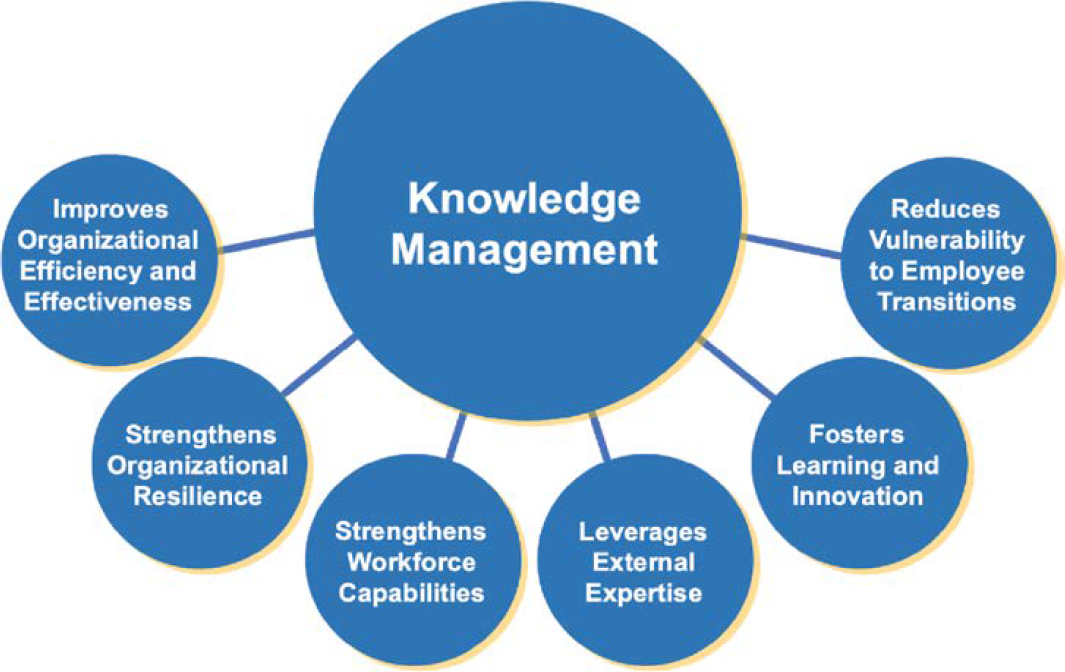
Knowledge management (KM) includes an established set of practices for creating, capturing, sharing, and leveraging the knowledge of an organization’s employees. This knowledge includes tacit knowledge built through years of experience that has not been written down and explicit, codified knowledge that may exist in multiple forms, such as standard operating procedures (SOPs) and best practice documents and manuals. KM can be implemented at different levels and within different functional areas of an organization. From a strategic perspective, the goal of KM is to ensure the workforce has the knowledge it needs to meet current and emerging future needs. Achieving this goal typically involves conducting knowledge audits and risk assessments to understand gaps and vulnerabilities and aligning Human Resources, information technology, training, and line management functions with a coordinated strategy to address these gaps and needs. KM is multifaceted in nature, with elements of data and information management, library science, business intelligence, artificial intelligence (AI), strategic workforce planning, staff training and development, organizational learning, and innovation management. Figure 1 illustrates the benefits of KM implementation in a DOT.
KM was first recognized as a discipline in the early 1990s and has been implemented in various forms in both public- and private-sector organizations around the world. Over 20 academic journals are devoted to KM topics. An International Standards Organization (ISO) standard for KM (ISO 30401-Knowledge Management Systems) was published in October 2018: It formalizes key elements of KM and defines general requirements for implementation.
KM at Transportation Agencies
Early examples of KM at DOTs were in place in the early- to mid-2000s. Virginia DOT (VDOT) created a KM division in 2003, motivated by two significant reductions in force. Around the same time, Pennsylvania DOT (PennDOT) established several Communities of
Source: Adapted from Spy Pond Partners, LLC 2015, Figure 2
Practice (CoPs)—a KM technique for person-to-person knowledge transfer. In 2004, Texas DOT (TxDOT) conducted a pilot program for capturing knowledge about rigid pavement forensics. Since then, interest in KM has grown within transportation agencies. While a few formally established and resourced KM programs do exist, several DOTs have implemented KM techniques, including CoPs, After Action Reviews (AARs), mentoring programs, and central information repositories.
Transportation KM Research Stewardship
Established committees within TRB and AASHTO are working to advance KM in transportation. In 2007, the AASHTO Research Advisory Committee (RAC) created a Transportation Knowledge Networks (TKN) task force to focus on information and knowledge sharing within the transportation community. TRB established a KM task force in 2011 “to advance and disseminate practices that facilitate improved knowledge sharing and retention throughout the transportation industry and government agencies.” In 2020, this task force was merged with the TRB Library and Information Science for Transportation (LIST) Committee to form the Information and Knowledge Management (IKM) Committee. In 2016, AASHTO created the Committee on Knowledge Management (CKM) to “address the processes and technologies that facilitate interactions between stakeholders, as well as the strategies and practices necessary for an organization to share knowledge between individuals and across groups to support current work and innovation.” The CKM met for the first time in May 2018. The TRB IKM’s Research Task Force and the AASHTO CKM’s Research Subcommittee work together to identify KM research needs (RNs) and develop and advance research projects.
A Research Roadmap for KM
NCHRP Project 23-14, “Research Roadmap for Knowledge Management,” was undertaken to develop a research roadmap for advancing KM in state DOTs and other transportation agencies. Research roadmaps have been developed for several other transportation topic areas, including
pavement management, connected and automated vehicles, active transportation, and transportation and public health. Developing a research roadmap provides an opportunity to review what research has been conducted, consult with stakeholders to identify needs and gaps, and develop a logical plan for filling these gaps.
This KM research roadmap identifies and describes RNs and presents a series of research problem statements (RPSs) for funding consideration over a 5-year time frame. It also identifies focused research implementation projects that can facilitate the adoption of currently active and completed research and future research included in the roadmap.
Document Organization
The remainder of this document is organized as follows:
- Chapter 2 summarizes the KM research products currently available to transportation agencies.
- Chapter 3 identifies what additional research would be of value to transportation agencies—based on consultation with stakeholders in multiple transportation agencies.
- Chapter 4 presents the research roadmap content, including its intended goals, the identified needs, and a 5-year program of projects that would address these needs.
- Appendices A and B provide additional details from the literature review and stakeholder engagement activities, respectively.
- Appendix C details the identified RNs.
- Appendix D presents the full RPSs.
- Appendix E presents a plan for communicating the contents of this roadmap.
- Appendix F presents a maintenance plan for the roadmap, defining when and how it is supposed to be updated to reflect the results of completed research and evolving needs.


