Guide for Truck Parking Information Management Systems (2025)
Chapter: 5 Procuring and Deploying TPIMS

CHAPTER 5
Procuring and Deploying TPIMS
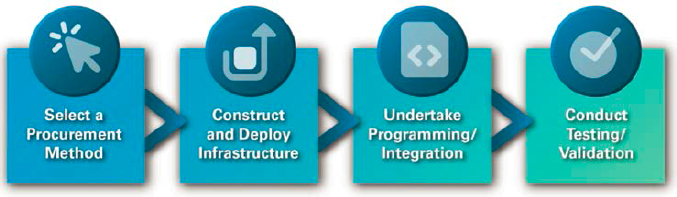
This chapter presents the procurement options that have been used to implement and operate a TPIMS. For each of the options, the advantages and disadvantages are discussed. To procure and deploy a TPIMS, take the following four steps (also illustrated in Figure 19):
- Select a Procurement Method.
- Construct and Deploy Infrastructure.
- Undertake Programming/Integration.
- Conduct Testing/Validation.
These procurement and deployment tasks can be handled in-house by transportation agency staff, contracted individually by a third-party contractor, or rolled out in part or full as a turnkey deployment such as a design-build contract.
Procurement options are discussed for each individual step, followed by a discussion covering procurement for more than one service in a combined fashion. These procurement options allow for the acquisition of the services required to deploy an operational TPIMS.
To help a transportation agency determine the best procurement process for a TPIMS project, the various options are explained based on experiences of other transportation agencies. The advantages are presented for transportation agencies to consider the options within the context of the agency’s procurement policies and regulations.
Select a Procurement Method
The first step is for a transportation agency—having identified an operational model, requirements, and a preferred design—to identify a method to procure the system. Transportation agencies have several options available to them depending on their agency procurement rules.
Design-Bid-Build
The first is the traditional design-bid-build option, which most American transportation agencies utilize for civil infrastructure procurement to receive competitive bid prices that meet the project specifications. With this option, the design of the infrastructure (discussed in the previous chapter) is done either in-house at the transportation agency or by an engineering consultant hired by the agency. Selection of an engineering consultant is typically qualifications-based, meaning that the consultant with the best expertise, as opposed to the lowest price, is chosen. The designers develop plans and specifications that are used in a bidding process to select a contractor and guide the contractor in the infrastructure installation. Selection of the contractor is typically based on the lowest bid for the required work, or it may be a “best value” type of selection based both on qualifications and price.
Design-Build
Design-build is the second common option, which streamlines the design and construction to work in an integrated manner. With this option, construction contractors and designers partner to pursue one contract that designs and installs the infrastructure. To establish guidance, the transportation agency (or their engineering consultant) will develop concept plans and/or performance requirements for a system, and the design-build team will develop proposals that include a proposed approach to complete the project successfully and a price for the work. The transportation agency will often pick the design-build team that provides the best value. Oversight of a design-build contractor is also crucial, which may be done in-house by the agency or via a contracted party or consultant, such as a program manager.
Service Provider Contract
A third option is often referred to as a service provider contract. This procurement type is very similar to the design-build method, except it is often guided by a service level agreement and allows the contractor to make design decisions that meet that service level. With this option, a contractor—often a system integrator—will identify the technology that they believe meets the requirements and then subcontract with a civil contractor to construct any civil infrastructure and designers to help produce any necessary plans.
A consideration is whether a large upfront payment will be made to cover the deployment cost or if the installation, operations, and maintenance will be covered by periodic payments. If there is not an upfront payment, the length of the contract will impact the magnitude of periodic payments. This approach can be used for agency TPIMS at rest areas, but it is more often applicable to private-sector TPIMS implementations as the agency is essentially paying for a data feed and does not have an ownership or maintenance interest in the infrastructure used to generate the data feed.
See Table 9 for the pros and cons of each procurement option.
The procurement option that is preferred for a transportation agency will depend on agency procurement rules and consideration of other constraints. Table 10 provides a summary of different approaches used by various transportation agencies for TPIMS.
Construct and Deploy Infrastructure
Deployment begins with the procurement of infrastructure and technology components of the system. Infrastructure can include sensor support structures, conduits, pull boxes, cabinets, camera poles, signs, sign support structures, power supplies, communications cables, power
Table 9. Pros and cons of procurement options.
| Procurement Option | Pros | Cons |
|---|---|---|
| Design-Bid-Build |
|
|
| Design-Build |
|
|
| Service Provider Contract |
|
|
cables, and communications network devices. This type of infrastructure is used to support conventional ITS deployments, such as traffic management, surveillance, and electronic toll collection systems, and would be familiar to most transportation agencies. Transportation agencies will typically have standard drawings and specifications that can be used to direct the installation of this infrastructure; however, some may need to be tailored to the specific TPIMS detection technology being used. The design plans and special provisions will define how the typical infrastructure should be installed. The agency will also need to provide oversight for the construction to make sure the infrastructure is installed as planned.
Technology featured in TPIMS deployments includes sensors to monitor parking availability, CCTV cameras for monitoring and confirming available space counts, and typically DMS to report information at the roadside in advance of the parking facilities. The camera and dynamic sign modules are a relatively standard technology that has been used extensively in ITS programs, so they can be procured based on a low-bid process that meets detailed specifications. However, sensor technology is still rapidly evolving, and different types of technology can provide the same functionality. It is preferable to procure sensor technology with a best value selection process rather than through a low-bid selection.
As an example, Texas DOT used a best-value procurement to select the detection technology to use for their portion of the I-10 TPAS project (I-10 Corridor Coalition 2020). Detailed functional requirements were developed as a basis for defining what the detection technology must be able to accomplish. The required proposal included information on the proposed technology, the proposed approach to meet the functional requirements, experience with similar systems, and a price to provide the technology. A Texas DOT committee evaluated the scope of the proposals and then factored in the proposed cost to make a final best-value selection.
Undertake Programming/Integration
For the initial TPIMS deployment, the transportation agency will need to consider the implementation of a back-office system to process sensor data to determine parking availability. The approach to this depends a great deal on data ownership, introduced in Chapter 3. An agency’s
Table 10. TPIMS procurement approaches by various transportation agencies.
| Agency | Design-Bid-Build | Design-Build | Service Provider Contract | Procurement Year1 | Notes |
|---|---|---|---|---|---|
| Arizona DOT | X | 2023 | Designed by a consultant. | ||
| California DOT | X | 2023 | Infrastructure was designed in-house, and a detection technology vendor was selected based on pilot deployments. | ||
| Florida DOT | X | 2016–2018 | The project was deployed by district, and procurement varied: Design-Bid-Build using on-call consultants, and Design-Build via a request for proposals (RFP). | ||
| Indiana DOT | X | 2018 | Designed by a consultant. | ||
| Iowa DOT | X | 2017 | Best-value selection process was used for a service provider RFP. The selected service provider did the design, installation, maintenance, and operations. | ||
| Kansas DOT | X | 2018 | Designed by a consultant. | ||
| Kentucky Transportation Cabinet | X | 2017 | The system design was by an on-site ATMS operations contractor. | ||
| Michigan DOT | X | X | 2014–2018 | Design-bid-build was done by consultants via RFP for public rest areas; design-build was done for private truck stops via RFP. | |
| Minnesota DOT | X | 2012–2017 | The system design was done in-house. | ||
| New Mexico DOT | X | 2023 | Designed by a consultant. | ||
| Ohio DOT | X | 2017 | Designed by a consultant. | ||
| Texas DOT | X | 2024 | The design was done by a consultant, and detection technology was selected by best value. | ||
| Wisconsin DOT | X | 2015–2018 | Designed by a consultant. |
1 Date ranges reflect multiple procurements for pilot programs and full-scale deployment.
involvement with data management will be far less with a private facility. Clarifying data ownership remains essential, regardless of arrangement. This section assumes an agency has relatively unfettered access to the data and its use.
The application capable of doing this process can be developed in-house as a standalone application, developed as a new module within an existing central software system, or obtained from a private vendor (as discussed in Chapter 3). Private vendors may have an application already developed or could develop a custom application. Subsequent TPIMS deployments, such as those in later phases, may be added to the existing system and only require the system to allow for integration and scalability.
The TPIMS back-office system must be developed to provide multiple functions. Some of these functions (e.g., data processing) may be handled at the parking sites, depending on the
detection technology and the capabilities of the infrastructure and technology deployments at the facilities. The following list summarizes the required functionality of the back-office system:
- Communications with the sensor technology being used at the parking facilities to monitor truck parking usage and report back the raw data.
- Ability to process sensor data to estimate the number of available parking spaces.
- Ability to access camera images or video of the truck parking area.
- Provision of an interface that allows an operator to compare system-reported parking availability to actually observed availability and adjust the information communicated to drivers if it does not match the reality on the ground.
- Ability to post parking availability information on roadside signs, either directly or through integration with existing sign control software.
- An additional consideration is that the availability data for parking areas must be transmitted to the appropriate dynamic sign module. The availability values will be generated from the agency’s TPIMS and may need to be obtained from a neighbor agency’s TPIMS in the case of a corridor that passes through multiple states.
- Ability to provide parking availability data to the agency’s Advanced Traveler Information System.
- Provision of an API to provide third parties and private traveler information providers access to the data.
- Ability to archive the availability data reported, along with data on system resets to allow for performance assessments.
While not essential, it may also be beneficial to provide functionality to generate summary reports from the archived data to facilitate ongoing performance assessment. The data can also provide a resource for additional research on parking patterns and needs to better serve drivers.
Integration with the field devices, testing, and validation will be required for all TPIMS deployments by agency staff or a contracted entity. The integration can be completed by the contractor that is installing the technology, who will often subcontract to a system integrator to make sure all devices are exchanging information properly.
Conduct Testing/Validation
Testing and validation is a critical step that can be completed by the contractor under the oversight of agency staff or an unbiased third party, such as an agency’s engineering consultant that was not involved in the construction. As discussed in Chapter 1, a key to success with the systems engineering development process is testing, verification, and validation, depicted on the right side of the systems engineering V-diagram in Figure 1. Most transportation agencies with existing ITS programs have standard testing requirements, often aligning with the systems engineering approach. These requirements often include (with minor name variations):
- Component Testing. Verifies a device operates per specification. Factory certification with an independent testing group often suffices.
- Standalone Testing. Verifies that an individual site, made up of several components, is meeting the requirements. This is often traceable to requirements established by the detailed design.
- Subsystem Testing. Verifies that a series of sites are collectively meeting the requirements. This is often traceable to requirements established by the high-level design.
- System Acceptance Testing/System Verification. Verifies that the collective system is operating per the requirements. This is often traceable to the system requirements established as part of the planning phases.
- System Validation. Verifies that the system is performing per the user’s needs, often from a non-technical standpoint, in accordance with what it is meant to do. This is often validated by stakeholders who participated in the development of the ConOps document earlier in the planning phase.
Selection of the appropriate procurement approach, given agency process and other constraints, will allow the TPIMS to be deployed in a manner that achieves project goals and objectives. Construction of the project infrastructure and integration of the system components into a fully functioning system will require a robust testing and validation process, given the novelty of the system and technology used.


