Communicating a Balanced Look at Local Airport Activity and Climate Change (2025)
Chapter: 1 Introduction to the Guide
CHAPTER 1
Introduction to the Guide
The objective of ACRP Project 02-102 is to present a balanced look at local airport activity and climate change. The concept is to provide airports with a scalable set of resources and guidelines to give a balanced and objective view of the benefits and costs of air travel and local airport activity.
This Guide provides a detailed presentation of the key information airports will need to provide authoritative communication to their communities and stakeholders on how local airport activity drives economic growth and the ways that the airport and other participants in the aviation value chain can work to abate negative consequences for the environment. Throughout the Guide, the reader will find references to authoritative sources to stay current on the issues.
How to Use the Guide
There are three main areas of the Guide:
- Chapters 2 through 4 establish a baseline of information on the effects of aviation on climate change, who is responsible, what can be done about it, and what the costs would be to communities if aviation activity stopped growing. From these materials, a “Narrative” is provided, summarizing findings in a way that may help airports build their communications.
- Chapter 5 addresses concerned groups and stakeholders, who they are, their beliefs about continued aviation growth, and their goals.
- Chapters 6 and 7 provide case studies and materials that airports may use to create their own communications on climate change, how aviation and the airport are addressing it, and the airport’s role in the economy.
Establishing a Baseline of Information
Chapters 2, 3, and 4 build an information base to help an airport develop communications.
- In Chapter 2, the reader will find authoritative information on climate change and the role aviation plays in overall emissions that are warming the earth’s atmosphere.
- Chapter 3 focuses primarily on establishing what airports and other participants in the aviation value chain are responsible for and what each can do to mitigate the effects of aviation activity on the climate.
- Chapter 4 discusses the role of the airport in the local economy and provides links to research materials created in this work program to help document this role for individual airports. Details on how to apply these tools at individual airports are discussed in Appendix A.
Appendix C provides references to an online resource and a list of reliable resources to keep up with developments in this fast-moving field.
The materials in these chapters are then used to create a Narrative that summarizes a balanced look at local airport activity and climate change. Airports may decide to use some parts of a Narrative in their own communications depending on local circumstances. The chapters where more detailed information can be found are summarized in the following Narratives.
Narrative: Balanced Communications on Local Airport Activity and Climate Change
Climate change is a complicated and fast-moving subject. An important objective of this Guide is to present material that airports can use to create their own communications on climate change and the economic contributions of aviation to their community. The wide variation in circumstances that airports face suggests that the Guide be positioned to feature a menu of items from which each airport can choose to communicate with stakeholders. To this end, the following Narratives summarize the material in the Guide and provide references where the reader can find more details for their individual needs. It is hoped that the Narratives will provide a useful guide for airports to assemble their own communications on aviation contributions to climate change and economic growth.
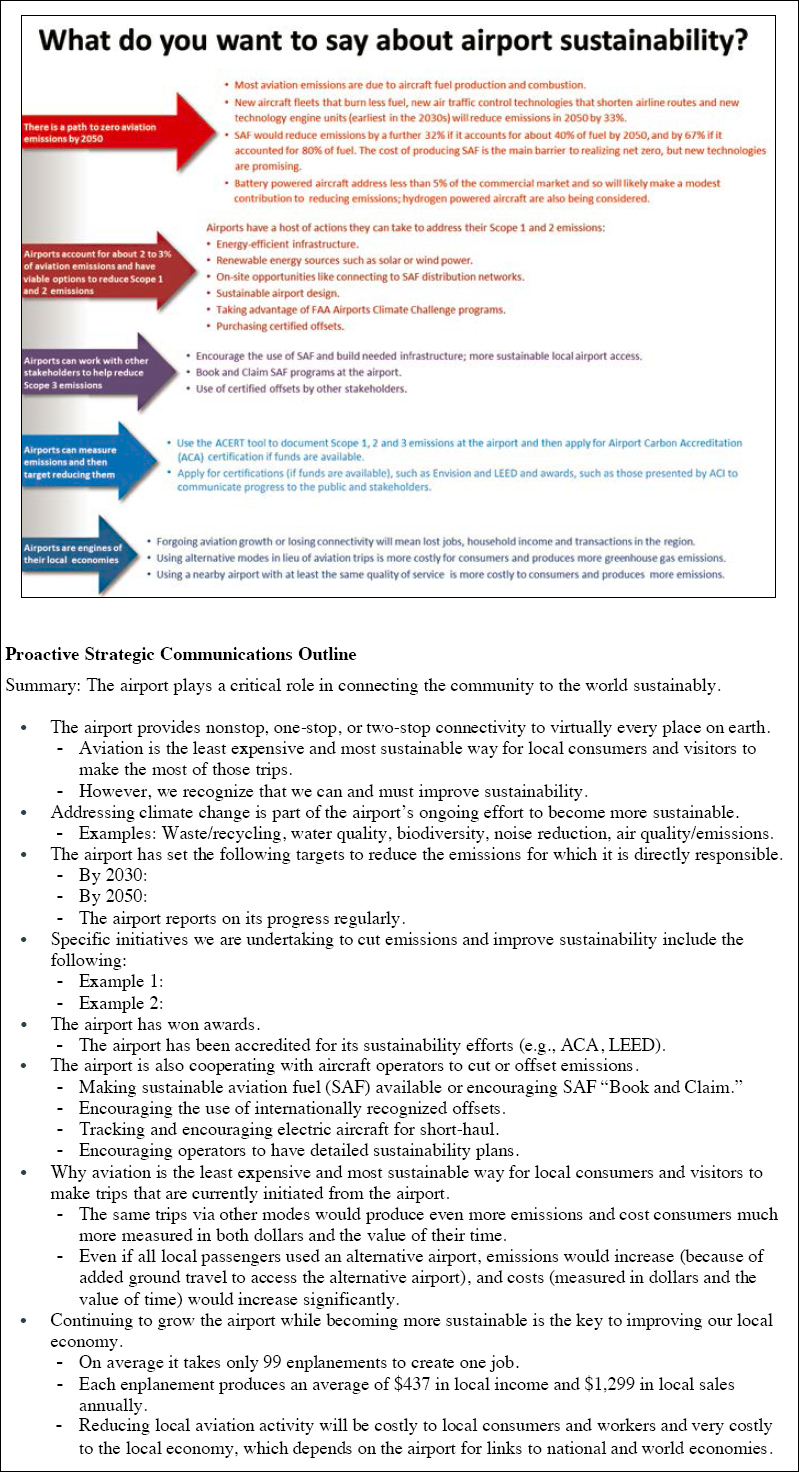
Chapter 2 Narrative: There Is a Path to Zero Aviation Emissions by 2050
- If there is no abatement and no new technology aircraft, then economic and population growth would likely cause aviation emissions to double by 2050.
- However, there is a path to substantially reduce emissions. According to the 2021 U.S. Climate Action Plan, relative to a scenario where technology is frozen:
- New aircraft fleets that burn less fuel, new air traffic control technologies that shorten airline routes, and new technology engine units (earliest in the 2030s) will reduce emissions in 2050 by 33%.
- Sustainable aviation fuel (SAF) would reduce emissions by a further 32% if it accounts for about 40% of fuel by 2050 and reduces emissions per gallon burned by about 80%.
- SAF would reduce emissions by a full 67% if it accounts for 80% of fuel burned and reduces emissions per gallon by 80%.
- Battery-powered aircraft address less than 5% of the commercial market and so will likely make a modest contribution to reducing emissions.
- New fleets, new air traffic control technologies, and new technology engines will almost certainly happen, and airlines and other operators will have incentives to adopt them to cut fuel costs.
- The cost of SAF is the main challenge to realizing a zero-emissions path. It currently costs two to four times more than jet fuel. Many national governments, including the United States, are subsidizing the commercialization of SAF, which will drive its costs down.
- The path to zero aviation emissions is a developing story. Advances in battery technology or fuel cells could speed the development of zero-emission commercial (airliner) aircraft sooner than expected.
- Combining hydrogen created by electrolysis using renewable energy and CO2 captured via carbon capture at industrial sites may also develop faster than anticipated and speed the development of economically viable SAF.
Chapter 2 Narrative: Airports Can Measure Emissions and Then Target Reducing Them
- A useful way to organize, measure, and promote accomplishments is to use the Airport Carbon and Emissions Reporting Tool (ACERT) from the Airports Council International (ACI) to document Scopes 1, 2, and 3 emissions at the airport and then apply for Airport Carbon Accreditation (ACA) as progress is made.
- Airports can also apply for certifications like Envision, Leadership in Energy and Environmental Design (LEED), and awards such as those presented by ACI to communicate progress to the public and stakeholders.
Chapter 3 Narrative: Airports Account for About 2% to 3% of Aviation Emissions and Have Viable Options to Reduce or Eliminate Their Scopes 1 and 2 Emissions
- Ninety-seven percent of the emissions in the aviation sector are from the combustion of fuel and are attributable to airlines and other aircraft operators; airports do not control and do not have direct responsibility for these emissions.
- Airports account for about 2% to 3% of aviation emissions, counted as Scopes 1 and 2 emissions.
- Airports have a host of actions they can take to address their Scopes 1 and 2 emissions:
- Energy-efficient infrastructure: Airports can invest in energy-efficient infrastructure, such as LED (light-emitting diode) lighting, smart HVAC (heating, ventilation, and air conditioning) systems, and energy-efficient building materials, which can significantly reduce energy consumption and emissions.
- Renewable energy sources: Airports can invest in renewable energy sources, such as solar or wind power, to generate their electricity, which can help reduce emissions and energy costs.
- On-site opportunities: As technologies develop, there may be opportunities for airports to invest in economically viable projects that support climate goals. For example, airports may invest or partner with private entities to support charging electric aircraft with renewable energy or support the availability of SAF via interconnection with existing airport distribution systems.
- Sustainable airport design: Airports can invest in sustainable airport design practices, such as green roofs, rainwater harvesting, and natural ventilation systems, which can help reduce energy consumption and emissions from the airport infrastructure. The Envision certification process is one way to realize these goals and communicate certified benefits to the community.
- Taking advantage of FAA’s Airports Climate Challenge programs: These programs provide financial support for initiatives, including charging stations for ground support vehicles, conversion of on-road vehicles to zero emissions, recycling, heating and cooling backup systems, and planning for new energy supply infrastructure.
- Purchasing certified offsets: These offsets should satisfy key criteria: additionality, avoiding overestimation, permanence, exclusivity, and avoiding social and environmental harm. Airports can encourage other stakeholders, including passengers, to offset the environmental impact of their travel.
Chapter 3 Narrative: Airports Can Work with Other Stakeholders to Help Reduce Scope 3 Emissions
- Airports can work with stakeholders, including airlines and other aircraft operators, to cut Scope 3 emissions by encouraging the use of SAF and helping build infrastructure to support its delivery.
- Consider encouraging Book and Claim programs at the airport.
- Encourage accurate and transparent tracking of the benefits of substituting SAF for jet fuel through the Sustainable Aviation Buyers Alliance (SABA).
- Encourage the use of certified offsets by other stakeholders when the offsets have known and permanent benefits.
- Encourage the use of carbon removal (through carbon capture and storage) credits when and if they become more available.
- Encourage passengers and the workforce to use public transportation to cut Scope 3 emissions from automobiles at the airport.
Chapter 4 Narrative: Airports Are Engines of Their Local and Regional Economies
- Airports create jobs, generate household income, and drive output in their local and regional economies.
- Forgoing aviation growth will mean lost jobs, household income, and transactions in the region.
- Forgoing efforts to improve the connectivity of the airport will also be costly.
- Using alternative modes instead of aviation trips is costly for consumers in terms of their out-of-pocket costs and time and would produce more emissions.
- Flying from another airport with about the same connectivity will also be costly for consumers who lose time accessing a more distant facility and create more ground emissions in the process.
Groups and Stakeholders Concerned About Aviation Activity
The Guide then turns to challenges that airports have faced or may face in the future from groups that focus on the damage aviation does to the environment and why economic growth could drive even more damage in the future.
Chapter 5 discusses the views of a range of entities, from protest groups to climate public interest organizations, who are concerned that current aviation activity and the levels it will reach in the future drive climate impacts that are hard to abate. Many of these groups state that the only way to offset these impacts is to curtail aviation activity. The Guide discusses these statements and identifies many of the organizations that are active in this area.
Communicating Climate Change and the Role of Airports in the Local Economy
The last two chapters and Appendix C focus on developing proactive communications and strategies to present the role of the airport, its role in climate change, and ways to mitigate its effects.
- Chapter 6 presents strategies to communicate the airport’s side of the story. What is the airport’s story in response to groups concerned about aviation activity? How should the airport get the story out?
- Chapter 7 reviews some sample communications and presents an outline of strategic communications. It also presents the results of detailed case studies of 12 airports.
- Appendix C discusses how to stay updated on these topics.
Each airport will have to decide how best to communicate with its stakeholders on climate change. Figure 1-1 presents building blocks drawn from Chapter 7 to help initiate the process.
Appendix B provides a series of case studies summarizing how several large and small commercial airports address climate change and communicate their actions to stakeholders.