School Active Shooter Drills: Mitigating Risks to Mental, Emotional, and Behavioral Health (2025)
Chapter: 1 Introduction
1
Introduction
Fully 95% of U.S. public schools conduct active shooter drills. However, the lack of consistent standards informing these practices has led to significant variations in their implementation, raising questions about both efficacy and possible negative impact on students and staff (Executive Office of the President, 2024). These drills may increase preparedness, but they may also induce feelings of anxiety and fear among students, their families and school staff. Limited research on the long- and short-term effects of school active shooter drills on the mental, emotional, and behavioral health of students and staff has left many of these questions without definitive answers. Accordingly, Congress directed the National Academies of Sciences, Engineering, and Medicine to study the mental, emotional, and behavioral health outcomes resulting from the implementation of school active shooter drills and the use of school-based security to ascertain what is known about the impact of these interventions on outcomes among K–12 students and staff. The appropriation can be found in House Report 117-403 (U.S. House of Representatives, 2022).
In 2003, a National Research Council report on the history of school violence (Deadly Lessons: Understanding Lethal School Violence) found that, while school violence is statistically rare, it can have lasting psychological effects on students and staff. However, recent studies indicate that school active shooter drills—designed to prepare students for such incidents—may also exacerbate anxiety, fear, and stress. Two National Academies reports—The Promise of Adolescence (2019b) and Vibrant and Healthy Kids (2019c)—em-phasize the importance of addressing the unique needs of children
and youth and the potential negative effects of stress on their development. These reports explain that failing to do so can lead to academic struggles, adverse mental health effects, and other long-term health consequences.
Some students and staff may be particularly vulnerable to negative effects of school active shooter drills (NASEM, 2019b,c). For example, individuals with anxiety disorders, histories of past trauma, or disabilities may experience heightened distress and require individualized accommodations to enable them to participate in drills. Similarly, some students may need individualized emergency preparations to process information quickly or maintain silence during drills. Others may need language supports to understand and follow instructions or mobility supports to accommodate physical limitations. Unfortunately, little research or guidance is currently available to help staff understand and to address the needs of all students.
Schools face a complex challenge: balancing preparedness with the need to safeguard student well-being. A trauma-informed approach to school safety, grounded in evidence-based practices, is essential to ensure that drills are effective and do not cause harm. The aim of this report is to ascertain what is currently known about the impacts of school active shooter drills on the mental, emotional, and behavioral health of students and school staff and to provide guidance that can inform policy and practice on how to prepare for active shooter drills in K–12 schools, while also exploring some of the broader complexities of school safety. The report identifies a variety of school safety and security practices that are likely to be effective while minimizing unintended harms.
SCOPE OF THE STUDY
In 2023, the 117th Congress requested a comprehensive study on the mental health effects of lockdown drills and active shooter
drills6 in elementary and secondary schools in the United States. This legislation, the Consolidated Appropriations Act of 2023, directed the National Academies to undertake a study focused on the mental, emotional, and behavioral health outcomes of these drills. The goal of this legislation is to gain a better understanding the potential risk of adverse psychological effects and to identify best practices for mitigating those effects, as well as to identify practices that can improve safety and security while minimizing harm. The legislation forms the basis for the committee’s statement of task (Box 1-1).
In response to this congressional direction, the National Academies Board on Children, Youth, and Families convened an expert committee in 2024 to carry out the requested study and develop this report. The 14-member committee includes experts in trauma-informed care, K–12 school administration and leadership, K–12 school security policy and program, developmental-behavioral pediatrics, child and adolescent psychiatry and psychology, criminology, developmental neuroscience, developmental and family psychology, school psychology, public health, public policy, and program development.
BOX 1-1
Statement of Task
The National Academies of Sciences, Engineering and Medicine (the National Academies) will convene an ad hoc Committee of experts to conduct a consensus study on the impact of active shooter drills and other school security
___________________
6 The term active shooter drills encompasses a range of practices, including but not limited to lockdown drills, options-based drills, and full-scale simulation exercises. These terms—particularly lockdown drills and active shooter drills—are often used interchangeably, though lockdowns represent only one component of a broader spectrum of practices used in schools. Where possible, the committee specifies the nature of the drills described in the evidence reviewed. Additional key terminology is defined later in the chapter.
measures on student mental, emotional, and behavioral health and wellbeing. The committee will consider potential effects on children and youth in grades K–12, as well as those with disabilities. The report will include recommendations on policy and practice that take children’s diversities into consideration and minimize potential adverse effects for students and school staff. The committee’s report will address questions including, but not limited to, the following:
- What is known about the possible mental, emotional, and behavioral health effects (either long- or short-term) on students and school staff resulting from active shooter/lockdown drills and related school security measures (e.g., metal detectors, police presence)?
- What is known about potential effects on students with disabilities, Black and Latinx children, dual language learners, children with special needs, as well as those belonging to different age groups?
- What are the components, criteria, and/or features of active shooter/lockdown drills, as well as best practices and procedures both leading up to and following the drills that can promote resiliency and minimize adverse mental, emotional, and behavioral health effects on children, youth, and school staff?
- What supports, school programs, and staff expertise are needed in order to implement, monitor and evaluate the best practices identified?
Interpreting the Study Charge
The committee’s statement of task was focused narrowly on understanding the short- and long-term impacts of school active shooter drills and related school security measures on the mental, emotional, and behavioral health of students and staff. Importantly, the committee was not charged with determining whether school-based active shooter drills or related security measures are effective in preventing school violence—although questions of effectiveness
are important, especially in light of potential psychological risks. Where relevant, the report references existing evidence on effectiveness to help frame the outcomes associated with different approaches. However, the committee recognizes that school leaders, policymakers, families, and other decision-makers face complex decisions and contend with difficult trade-offs in the face of uncertainty when balancing the imperative to protect the physical safety of students and school staff with the need to protect their mental, emotional, and behavioral health. Accordingly, the committee does not offer conclusions regarding the effectiveness of specific strategies in protecting students and school staff from active shooters; instead, the report focuses on the available evidence related to mental, emotional, and behavioral health outcomes and best practices that can mitigate potential harms. The committee did not consider whether such drills should be eliminated entirely, as its charge was to identify strategies that can reduce potential harm and support the well-being of those affected when these practices are used.
The committee interpreted the statement of task to refer specifically to drills designed to prepare for firearm-related threats. As noted, the term lockdown, which is mentioned in the statement of task, is one of many practices that are sometimes used as part of school active shooter drills; however, lockdowns are also used for other types of threats or emergencies. Although some organizations have adopted broader terminology, such as armed assailant drills, that does not specify the type of weapon, the committee uses the term school active shooter drills to focus on drills related to the threat of active shooters as specified in its charge.
The statement of task also specifies both metal detectors and police presence as security measures of interest, guiding the committee’s judgment that Congress intended the study to include in-depth examination of these other security measures in addition to school active shooter drills. Recognizing that some schools may not have sworn law enforcement personnel on site, the committee also inferred that Congress intended consideration of police presence to include other types of school safety personnel. In addition, the committee identified locked doors as a security measure related to
the implementation of school active shooter drills with the potential to impact mental, emotional, and behavioral health outcomes for students and staff. Although a wide range of school security measures are available to K–12 schools, the committee prioritized consideration of metal detectors, police presence, and locked doors, because they are widely implemented among schools in the United States.
Although active shooter events take place in a many other settings, including movie theaters and workplaces, the statement of task focused clearly on school active shooter drills—specifically in K–12 (elementary and secondary) school settings and in pre-K settings as applicable, given that some elementary schools may also serve pre-K students. The committee views schools as fundamentally distinct from other settings because all states require children to attend schools, and because schools are generally intended and understood to serve as a distinct environment for development and learning. Accordingly, the committee did not investigate youth-oriented settings other than schools or companion facilities that are designed with the developmental needs of students in mind.
Research highlights the need to consider students’ developmental stages when assessing school safety plans, strategies, and training. Ensuring safe and secure environments supports students’ physical, emotional, social, and cognitive growth. Accommodating these developmental changes is essential for fostering a safe and supportive learning environment (Berk, 2022; Kingston et al., 2018; Sprague & Walker, 2021).
Unfortunately, the existing research evidence bearing directly on the impact of school active shooter drills is quite thin. To address this challenge, the committee also drew on complementary research related to child and adolescent development, trauma-informed and developmentally appropriate practices, school safety, emergency preparedness, and violence prevention to supplement the evidence directly related to the impact of school active shooter drills. Also, although it was not asked to address strategies for preventing active shooter events, the committee recognizes that school active shooter drills are an emergency preparedness strategy implemented in
response to firearm violence, and that the threat of active shooter events itself may also have adverse impacts on the mental, emotional, and behavioral health of students and staff. In addition, recognizing that school environments and school climate shape how interventions are implemented, and that drills do not occur in isolation from these factors, the committee considered school active shooter drills and other school security measures within a broader context of comprehensive emergency preparedness strategies that promote safe and supportive school environments.
As directed by the statement of task, the committee also paid particular attention to the specific groups of students identified in the statement of task, including students with disabilities, students with special needs, Black and Latinx children, multilingual learners, and children in different age groups. Giving specific consideration to these groups enabled the committee to provide comprehensive guidance on best practices for the implementation of drills and security measures focused on prevention, intervention, and responsiveness as components of a broader safety strategy for minimizing harm. Consideration of these groups also informed the committee’s identification of supports, programs, and expertise needed to implement, monitor, and evaluate recommended best practices.
Study Process
The committee met five times over a 1-year period in 2024–2025. To inform its deliberations, the committee adopted a broad approach to evidence-gathering, drawing on a wide range of methodologies, evidence types, and scientific perspectives. Thus, the committee reviewed literature relevant to the statement of task, including peer-reviewed articles, policy papers and reports, book chapters, government documents, existing legislation, editorials, and relevant National Academies reports.
In addition, the committee conducted two public information-gathering sessions and eight listening sessions. The listening sessions included several panels and provided perspectives from students, teachers, parents, school nurses, school psychologists, school
counselors, school social workers, experts on students with disabilities, and experts on students who require language supports. While these sessions were not designed to be representative of all perspectives, practices, or lived experiences within these groups, they highlighted key issues included in the statement of task and offered valuable context for understanding the real-world implementation of drills and for identifying areas of potential concern regarding adverse outcomes. These discussions also provided important background information that enriched the committee’s review of the empirical literature, served as an important input to the committee’s deliberations, and helped contextualize—though not determine—its conclusions, recommendations, and the future research agenda described in Chapter 7.
FIREARM VIOLENCE AS A PUBLIC HEALTH ISSUE
It is important to understand the social environment in which school active shooter drills are being implemented. According to the Centers for Disease Control and Prevention (2022), firearm violence persists as a “significant and growing” public health issue in the United States. Indeed, the U.S. surgeon general issued an advisory report on firearm violence in 2024, underscoring the urgency of this challenge. Each year, more than 100,000 individuals in the United States, including more than 17,000 children, are shot directly with firearms. Indeed, firearms are now the leading cause of death among children and teens in the United States (Villarreal et al., 2024). Recent studies have found that exposure to gun violence has a profound impact on surviving communities, families, and schools, and has particular impacts on children (Holloway et al., 2023; Leibbrand et al., 2020; Mitchell et al., 2019). The long-term consequences associated with these exposures are substantial, including poor mental and physical health, recidivism for injury and crime, and a threatened sense of safety and well-being (Rajan, 2024).
Over the past several years, firearm violence in K–12 schools has increased. The Washington Post reported that nearly 400,000
students have been exposed to gun violence (specifically in K–12 schools) since the Columbine mass shooting that took place in Littleton, Colorado, in 1999 (Cox et al., 2025). Notable upticks in school-based firearm violence have been documented since 2015. In this context, K–12 schools across the United States have begun implementing numerous safety and security policies and practices in an effort to secure their buildings and prepare their communities for the possibility of gunfire on school grounds. These security measures include metal detectors, armed guards, and zero-tolerance policies, and school active shooter drills have become one of the most commonly implemented safety practices.
These policies and practices have significantly changed daily school experience over a relatively short time frame (Rajan et al., 2022; Turanovic et al., 2022). In 1999, before Columbine, fewer than 20% of schools had security cameras; now more than 80% do. Similarly, as of 2019, 98% of K–12 schools were conducting lockdown drills7; far fewer had implemented such procedures prior to the Sandy Hook school shooting of 2012 (National Center on Safe Supportive Learning Environments, 2022). As described in detail in this report, evidence related to the effects of these widespread practices is limited, and their implementation therefore warrants careful study and guidance.
SCHOOL SAFETY IN THE 21ST CENTURY
The Safe School Study (National Institute of Education, 1978) was the first comprehensive national assessment of school safety. It demonstrated that students’ increased exposure to violent behavior and criminal activity in the communities where they lived was associated with aggression, misbehavior, victimization, and disorder within their schools, as well as declines in academic progress and
___________________
7 Lockdown refers to a protocol that is used when there is a credible threat inside or near a school and typically includes procedures such as locking all doors of a school, turning off lights, covering windows or moving out of sight of windows, and remaining silent until an all-clear signal is given.
success. This landmark study highlighted the intrinsic relationship between communities and schools and recommended further investigation to deepen and expand understanding of these relationships and how they affect safe and healthy learning for students (Gottfredson, 2001; Mayer & Furlong, 2010; Peguero & Bondy, 2021). In the wake of the Safe Schools Study, many social science studies have explored how to establish barriers or safeguards to attenuate the corrosive impact of community violence on school safety.
Shortly after the Safe School Study was issued, however, the crack-cocaine epidemic of the mid-1980s ushered in a rapid and unprecedented increase in rates of urban crime and violence across the nation, with firearm-related homicides more than doubling from 1985 to 1990 (Astor & Benbenishty, 2018; Cornell, 2017; Gottfredson, 2001). In response, Congress enacted the Gun-Free School Zones Act (1990), prohibiting the possession or discharge of a firearm in a public school zone; this bill also declared it to be unlawful for an individual to discharge or attempt to discharge a firearm in a public-school zone—defined as a distance of less than 1,000 feet from the property of a public school (Astor & Benbenishty, 2018; Cornell, 2017; Gottfredson, 2001). However, the Supreme Court declared this law to be unconstitutional in United States v. Lopez, and its policies were never enacted.
In 1993, the Gun-Free Schools Act conditioned continued access to federal funding under the Elementary and Secondary Education Act (1965) on the willingness of public schools to expel for at least a year any student bringing a gun, knife, or other weapon to school. The act also required schools to report such incidents to the local criminal or juvenile legal system. The act included funding for schools to buy security equipment and train security personnel (Astor & Benbenishty, 2018; Cornell, 2017; Gottfredson, 2001). Recent research has indicated that an unintended consequence of the “zero-tolerance” safety policies included in the Gun Free Schools Act was the so called “hardening” of conceptual and physical barriers between communities and schools (Cornell et al., 2020; Morris, 2016; Noguera & Syeed, 2020; Skiba & Peterson, 2000).
A number of other school safety policies and approaches have also deepened and strengthened barriers between communities and schools. In accordance with the notion of “target hardening” (making a building more secure so that it is more difficult to attack), schools have increased their use of multiple perimeters of fencing, conducted “identification checks” for entry; deployed metal detectors and security cameras; controlled access to school buildings and yards; and used biometric scanners, bullet-resistant glass, fortified school entrances, and increased law enforcement presence to oversee entry to the school (Ebsary, 2018; Kupchik, 2010, 2016; Tanner-Smith et al., 2018). Additionally, research suggests that there has been a significant decrease in family engagement with schools because of reductions in school-related extracurricular activities that often welcomed and included community partners, especially within under-resourced and underserved communities and schools (Bradshaw et al., 2021; Kupchik, 2010, 2016; Noguera & Syeed, 2020). Some research indicates further that families and community partners have encountered increased complexities, barriers, and restrictions inhibiting engagement and communication with school faculty, administration, and personnel (Astor & Benbenishty, 2018; Morris, 2016; Rios, 2011, 2020).
School safety encompasses more than just security policies or the implementation of measures designed to “harden” campuses against external threats. While such strategies are designed to prevent violent incidents, they often overlook a critical dimension of safety: students’ psychological well-being (Cornell et al., 2020; Nickerson et al., 2021). Research on school safety underscores the importance of fostering psychological safety as an additional area of harm prevention. This broader perspective widens the focus of school safety to include cultivating positive school climates and implementing multitiered systems of support that encourage prosocial behavior, emotional development, and a sense of belonging (Cornell et al., 2020). These approaches align with growing consensus that safe schools are not merely those free from violence—but also those that nurture connection, respect, and structure.
By contrast, punitive measures such as zero-tolerance policies and aggressive security protocols have shown limited effectiveness and, in some cases, may contribute to negative academic and behavioral outcomes (Cornell et al., 2020). Yet, despite this evolving understanding, definitions of what it means for a school to be “safe” still vary widely among educators, researchers, policymakers, and the public. Bridging these perspectives highlights the need for a balanced approach that integrates physical and psychological safety, grounded in the specific context and climate of each school community.
21st-Century School Shooting Events
A series of school shooting events at the turn of the 21st century is widely understood to have shaped the social and cultural understanding of school violence in the United States as well as the policies or practices that it evoked. These events also highlight some of the contextual variations that have made it difficult to address and prevent violence at schools.
The shooting at Columbine High School occurred on April 20, 1999. At the time, it was the deadliest mass shooting at a K–12 school in U.S. history. This tragic event remains one of the most infamous school shootings in the United States and is often mentioned when a new school shooting occurs. Although school shootings did not start at Columbine, some observers contend that this tragic event signified the emergence of a distinctive era of mass shootings (King & Bracy, 2019; Muschert et al., 2013; Schildkraut & Elsass, 2016). Associated with this belief is the frequent reference to the Columbine Effect, the idea that school shootings have changed, socially and culturally, how U.S. society thinks about school violence, shootings, and security (King & Bracy, 2019; Muschert et al., 2013). The term first appeared as the title of a December 6, 1999, article in Time magazine in which the author discussed the post-Columbine movement toward tightened security measures in schools (King & Bracy, 2019; Muschert et al., 2013). After the Columbine shooting, the now-common term active
shooter, once used mainly by law enforcement, became mainstream in the nation’s school safety discourse (Fortin, 2022; Martaindale & Blair, 2019; Muschert et al., 2013).
In 2002, the Advanced Law Enforcement Rapid Response Training (ALERRT) Center at Texas State University was established through a partnership among the San Marcos Police Department, the Hays County Sherriff’s Office, and Texas State University. The ALERRT program was created in response to the need for new tactics to respond to active shooter events and uses a “Special Weapons and Tactics” (SWAT) approach focused on conducting active shooter training for professionals and agencies with responsibility for responding to these incidents. The purpose of this training is to prepare first responders to isolate, distract, and neutralize an active shooter; to improve coordination and integration of law enforcement, fire, telecommunications, and emergency medical services; and to educate and certify local and state law enforcement officers in teaching strategies for surviving active shooter events. In 2003, ALERRT received federal funding and began to train officers across the country. Since that time, it has trained more than 1,500,000 law enforcement officers from more than 9,000 law enforcement agencies across the nation. Officers in approximately half of U.S. law enforcement agencies have received the training (Blair et al., 2013; Doss & Shepherd, 2015; Martaindale & Blair, 2019).
In 2002, the U.S. Secret Service and the U.S. Department of Education released a report titled The Final Report and Findings of the Safe School Initiative: Implications for the Prevention of School Attacks in the United States. This report was the culmination of the 1999 Safe School Initiative, a study undertaken through a partnership between the Secret Service and the Department of Education following the Columbine event that examined the thinking, planning, and other preattack behaviors of individuals who carried out school shootings. The 2009 report describes the prevalence of school violence in American schools, defines “targeted” school violence, describes some common—but not predictive—characteristics observed among perpetrators or school violence, and lays a foundation for systematic “threat assessment” and “targeted” school
violence prevention. As a result of this report, many schools and districts have incorporated threat assessments into their school safety planning (Borum et al., 2010; Vossekuil et al., 2002).
Following the 2006 Platte Canyon shooting in Bailey, Colorado, in which seven female students were taken hostage and one was killed, the parents of the slain student created the “I Love U Guys” Foundation. The foundation’s Standard Response Protocol was introduced to districts, departments, and agencies in 2009 (The “I Love U Guys” Foundation, 2022; see Box 1-2). Since then, thousands of U.S. schools, districts, departments, agencies, and organizations have adopted this protocol, and some states have adapted it for their respective law enforcement agencies (see Box 1-2 for an overview).
BOX 1-2
Key Components of the I Love U Guys Standard Response Protocol
The “I Love U Guys” Standard Response Protocol has three overarching goals: (1) to provide a simple, easy-to-remember framework that can be used across a range of potential crisis events and practiced as part of school emergency preparedness activities including school active shooter drills; (2) to enhance coordination between schools, students, staff, parents, and first responders; and (3) to improve overall safety and reduce response times during emergencies. Five standard responses in the Standard Response Protocol can be performed by participants—including students, staff, teachers, and first responders—to respond to various emergencies.a Which actions are used depends on the circumstances or nature of the situation:
- The first action is hold in location, such as “in your room or area”; this action is used to clear a specific area and hallways in order to manage a situation.
- Staff close and lock the door and continue with regular activities.
- Second is secure, which means “get inside, lock outside doors”; it is used to safeguard students and staff within the building. Once students and staff are inside and doors are locked, regular activities proceed as usual. This is used for threats that can be mitigated by bringing everyone inside.
- Third is lockdown, which indicates “locks, lights, and out of sight”; it is used to secure individual rooms and keep students quiet and in place. Students and staff maintain silence and do not open doors. A lockdown is called when there is an active threat—such as an active shooter—inside or very close to the building that requires immediate protective action.
- Fourth is evacuate, used to move students and staff from one location to a different location in or out of the building.
- Fifth is shelter, which is used for hazards such as tornados, earthquakes, or hazardous materials spills. When the shelter directive is given, the hazard and the appropriate safety strategy are named (e.g., “Shelter! Earthquake. Drop, cover and hold.”).
For each of the standard responses, there are specific student and staff actions. The Standard Response Protocol emphasizes shared vocabulary and clear communication to reduce confusion and includes plans for notifying parents. Training and drills are emphasized to reinforce familiarity with the protocol and may involve law enforcement and other first responders. The protocol is designed to integrate with broader emergency response systems and can be adapted to meet the specific needs of a school or district, allowing for local adjustments while maintaining a consistent core structure.
a The “I Love U Guys” Foundation also has a curriculum on Standard Reunification Method, which outlines a process for school staff to reunite students with their parents/caregivers after each of these standard response actions and provides guidance to school staff for practicing reunification exercises with school and district personnel, emergency responders, and community partners.
SOURCE: Committee generated, based on “I Love U Guys” Foundation (2022).
On December 14, 2012, the deadliest school shooting at an elementary school in U.S. history occurred at Sandy Hook Elementary School. As a result of this event, elementary schools in school districts across the United States reviewed safety protocols, added school resource officers to their staffs, and instituted additional hardening measures. This shooting prompted renewed debate about ensuring school safety and spurred eventual congressional action. The federal Safe Communities, Safe Schools Act (2013) amended the National Instant Criminal Background Check System (NICS) Improvement Amendments Act (2007), the Brady Handgun Violence Prevention Act (1993), the Omnibus Crime Control and Safe Streets Act (1968), and various provisions of the federal criminal code. The amendments required background checks for all firearm sales, prohibited straw purchases of firearms, and expanded the school safety grant program. In 2013, the Federal Bureau of Investigation (FBI) certified the ALERRT program and officially designated it as the national standard for active shooter training (Flannery et al., 2021; Malloy, 2015; Martaindale & Blair, 2019; Rygg, 2015).
On February 14, 2018, a shooting at Marjory Stoneman Douglas High School in Parkland, Florida, resulted in 17 deaths—the deadliest school shooting at a high school to date. Following this shooting, the federal Student, Teachers, and Officers Preventing (STOP) School Violence Program was signed into law on March 23, 2018, as part of the Consolidated Appropriations Act (2018), increasing funding for metal detectors, security training, and similar safety and security measures. STOP’s purpose is to give students and teachers
the tools they need to recognize, respond quickly to, and prevent school shootings and other acts of violence (Flannery et al., 2021; Schildkraut & Nickerson, 2022).
On May 24, 2022, a shooting at Robb Elementary School in Uvalde, Texas, resulted in the deaths of 19 students and two teachers. Some commentators suggested that language barriers and proximity to the U.S.–Mexico border may have led to less timely responses to the shooting, as well as miscommunication, confusion, and delays in getting critical information to families during and after the shooting (U.S. Department of Justice [DOJ], 2024). On May 18, 2023, Texas State Bill HB3 enacted measures to enhance public school safety, including the developing, implementing, and funding public school safety and security requirements and providing safety-related resources. Additionally, a federal action report by DOJ in January 2024 recommended initiatives to bolster school safety, including enhanced training for law enforcement and school staff; upgraded security infrastructure for school doors and locks; mental health screenings for victims; and better communication among law enforcement, school officials, and the community (DOJ, 2024; Lopez, 2024).
DEFINITIONS AND TYPOLOGY
Lack of consensus on the definition of an active shooter drill, its components, and its implementation has resulted in wide variation in school practices. This lack of uniformity not only creates challenges in understanding how specific practices are linked to outcomes for students and staff but also creates a patchwork approach to school safety in the United States. This section describes the key concepts and terminology related to school active shooter drills and provides key definitions that are used throughout this report.
Pertinent Definitions
Box 1-3 defines terms used throughout this report. Less frequently used terms not defined in this box are defined as necessary in the chapters where they appear.
BOX 1-3
Key Terminology
School active shooter drill
A procedure in which a school practices an emergency protocol designed to protect students and school staff against assault by an armed assailant with a firearm. This term is often used to refer to a broad spectrum of practices used in schools, including but not limited to, lockdown drills, options-based drills, and full-scale simulation exercises.
Active shooter simulation
Exercises that mimic active shooter events and can include (but are not limited to) the following components:
- The activation of emergency alarms.
- The presence of an individual pretending to be an active shooter or law enforcement officer, or both, inside a school.
- The firing of a gun with blanks.
- Recordings of the sound of a gun being fired.
- Simulated injury or violence.
- An attempt by an intruder to breach classroom doors inside a school.
- The expectation that individuals inside the school will role play fighting an intruder.
Elementary school
“A non-profit institutional day or residential school, including a public elementary charter school, that provides elementary education, as determined under state law” (Elementary
and Secondary Education Act of 1965 [20 U.S.C. § 7801(19)]); typically includes grades K–5. As some elementary school settings may also include pre-K classrooms, the committee includes pre-K populations where relevant.
Lockdown
A protocol used when there is a credible threat inside or near a school; typically includes procedures such as locking all doors of a school, turning off lights, covering windows or moving out of sight of windows, and remaining silent until an all-clear signal is given.
Mental, emotional, and behavioral health
The interconnected aspects of a child’s psychological wellbeing, emotional regulation, and social functioning; encompasses their ability to manage emotions, form relationships, and engage in adaptive behaviors that support healthy development and lifelong well-being.
Mental health services provider
A state-licensed or state-certified school counselor, school psychologist, or school social worker, or a mental health professional qualified under state law to provide mental health services to children and adolescents.
Options-based practices
Practices that provide students and school staff with a range of strategies that can be used in the event of a threat (e.g., locking/barricading doors or evacuating the school building) and are intended to allow participants to consider the nature of the threat as well as contextual factors, such as their immediate physical setting and the broader school environment, to determine the appropriate response.
Secondary school
“A nonprofit institutional day or residential school, including a public secondary charter school, that provides secondary education, as determined under State law, except that the
term does not include any education beyond grade 12” and typically includes both middle and high school (Elementary and Secondary Education Act of 1965 [20 U.S.C. § 7801(45)]).
Secured-perimeter lockout
A protocol in response to a safety threat outside of the school or campus. It involves moving all students and staff are moved from outside to inside the school building and then locking the outside doors of a school building. Entry to and exit from the school are prohibited, but instruction can continue.
School resource officer
A law enforcement officer with sworn authority who has specific training in school-based law enforcement and crisis response and who is assigned by a law enforcement agency to work collaboratively with one or more schools using community-oriented policing concepts (National Association of School Resource Officers, n.d.).
Standard response practices
Individual, predefined actions or procedures designed to guide students and staff in responding to different types of emergency situations, including school active shooter events. For each response practice, staff and students are taught specific steps to take to complete the response. The intent is to teach the specific actions that can be used to respond to most emergencies—rather than emphasizing the specific dangers—and emphasize procedural repetition, with the aim of helping students and staff respond quickly and efficiently in an emergency.
Standard Response Protocol
An action-based safety framework developed by the “I Love U Guys” Foundation that integrates multiple standard response practices into a structured and unified system. The protocol includes five standard response practices that can
be used for schools to respond to emergencies (Hold, Secure, Lockdown, Evacuate, Shelter). It provides a common language and set of directives that guide students, staff, and first responders in effectively managing threats and crises. It emphasizes clear, consistent communication and coordinated actions to enhance safety and emergency preparedness.
Walkthrough
An activity designed to familiarize students, school staff, and first responders with their roles and responsibilities in the event of an emergency. These exercises are conducted at a pace that allows participants to go through emergency procedures step by step with opportunities to ask questions, clarify roles, and have discussion.
What Are Active Shooter Events?
U.S. federal agencies define an active shooter as “an individual actively engaged in killing or attempting to kill people in a confined and populated area” with a firearm (Federal Emergency Management Agency, 2020). The FBI (n.d.) expands this definition to include more than one individual in an incident and omits the word “confined” because the term excludes incidents that occur outside buildings. Active shooter events can take place in many different locations, including schools, movie theaters, and workplaces. U.S. federal agencies also limit the definition of active shooter events to those that involve deadly force (i.e., the attack is in progress and involves deadly force), unrestricted access (i.e., the attacker[s] has unrestricted access to multiple victims), immediate action (i.e., direct and immediate law enforcement action is necessary and likely to save lives), and dynamic pace (situation is exigent, dynamic, and rapidly evolving). The FBI and Department of Homeland Security stress that these additional factors are needed to define active shooter events because such events warrant a coordinated response by multiagency law enforcement and other first responders to save
lives. The FBI (n.d.) has established the ALERRT framework as the standard law enforcement response to active shooter events in schools (see also Federal Emergency Management Agency, 2020). It is also important to define the official response in a way that includes distinct federal, state, and local agencies.
A variety of terminology has been used to refer to active shooter events, including active shooter attack, armed assailant incident, active attack, mass casualty attack, and the like. In this report, the term active shooter event is used consistently to refer to these incidents (Blair et al., 2013; Doss & Shepherd, 2015; Martaindale & Blair, 2019).
The definition of an active shooter event in a school setting is closely tied to the terminology used for active shooter drills, as the way drills are framed may shape perceptions, policies, and response strategies for real incidents. Although individual states, cities, counties, districts, and localities may establish distinct definitional parameters for what constitutes an active shooter event at school, this report focuses on cases involving a firearm. In addition, the definitions used by some states, cities, counties, districts, and localities may include events outside of school; however, this report focuses specifically on active shooter events occurring within the physical parameters of a school campus (Blair et al., 2013; Doss & Shepherd, 2015; Martaindale & Blair, 2019).
What Are School Active Shooter Drills?
Before discussing the specific features of school active shooter drills, it is worth noting that some experts consider these drills to fall within a broader general category of school emergency drills. All-purpose school emergency drills have been conducted over many years to prepare students and faculty members for fires and extreme weather events where geographically appropriate (Blair et al., 2013; Cornell et al., 2020; Schildkraut & Nickerson, 2022; U.S. Department of Education [ED], 2013). The committee decided, however, that school active shooter drills need to be analyzed on their own terms rather than as illustrative of school emergency drills precisely
because school active shooter events are dynamically different from all other emergency threats. Specifically, a school active shooter drill involves children of all ages and is likely to have mental, emotional, and behavioral health effects that are distinctly different from those associated with other safety drills.
In reviewing the types of active shooter drills and programs commonly used in schools, the committee identified three primary categories of practices that are associated with school active shooter drills: discussion-based practices, standard response practices, and options-based practices. These practices, used to prepare students and staff for potential threats, are conceptually distinct with different learning goals and objectives; however, they may share common activities that are implemented differently depending on the approach. This section of the report describes each category and discusses practice terminology shared across categories and exercises or activities designed to prepare for complex emergency responses to active shooter events. The committee notes that none of these practices is applied across schools universally (Blair et al., 2013; National Association of School Psychologists [NASP] et al., 2021; Rygg, 2015; Schildkraut & Nickerson, 2022).
Discussion-Based Practices
Discussion-based practices introduce students to the purpose and procedures of school active shooter drills; familiarize them with the role of emergency responders; and orient them to basic safety protocols, such as identifying the nearest exits and entry points. These practices do not require students to physically practice emergency actions. Instead, they focus on foundational knowledge through activities such as staff-led discussions, social stories or storybook readings, coloring books, and student–teacher tabletop exercises that use games or child-friendly activities to teach emergency procedures.
Walkthroughs are a discussion-based practice that focus on familiarizing students and staff with roles and responsibilities in a school active shooter drill. School leaders, staff, and—in some cases—students conduct a joint walkthrough to understand each
other’s roles. First responders may sometimes also be included. Walkthroughs are meant to be a thoughtful, slow-motion drill that allows for questions and discussion along the way (Blair et al., 2013; NASP et al., 2021; Rygg, 2015).
Standard Response Practices
Standard response practices are designed to provide structured, predefined actions that students and staff can take for different emergency situations, including school active shooter events, rather than relying on situational decision-making. For each response practice, staff and students are taught specific steps for completing the response. The intent is to emphasize the specific actions required during an emergency—rather than the specific nature of the threat—and to develop mastery of skills through repeated exposure, with the aim of helping students and staff respond quickly and efficiently in an emergency.
Lockdowns and secured-perimeter lockouts are two examples of practices that can be taught as standard response practices. The actions practiced in a lockdown during a standard response drill typically involve locking doors to secure the space, turning off lights, moving students out of sight, and requiring students to remain quiet. While performing these steps, students and staff are nonresponsive to anyone at the door, and ignore all bells and alarms unless instructed otherwise. At the end of the lockdown, an all-clear signal may be given, followed by an announcement over the school public address system.
Secured-perimeter lockouts, often simply referred to as lockouts (the Secure action in the I Love U Guys Standard Response Protocol), involve bringing all students and staff inside the school before locking exterior doors and windows. Once students and staff are inside, entry to and exit from the school building are prohibited. Whereas in a lockdown, an active shooter is believed to be inside the school building, in a secured-perimeter lockout, the imminent threat of danger is outside the school building (e.g., an unauthorized person on school grounds, a potential threat in the neighborhood
such as a robbery with a suspect at large; Blair et al., 2013; Schildkraut & Nickerson, 2022; Schildkraut et al., 2020).
As described above, the “I Love U Guys” Foundation’s Standard Response Protocol (see Box 1-2) includes standard response practices. This program has been adopted widely in school settings across the United States and adapted by state school safety centers and individual schools to tailor protocols to meet specific state requirements.8
Options-Based Practices
Options-based practices emphasize in-the-moment action and adaptive decision-making in situations where standard response strategies may not be feasible, such as in response to an immediate threat (e.g., an active shooter enters a classroom or hallway). These practices emphasize situational awareness and response strategies based on the type of threat and available options (Donovan, 2023; Miotto & Cogan, 2023; Schonfeld et al., 2020; Simonetti, 2020). Box 1-4 discusses examples of some common options-based practices.
BOX 1-4
Overview of Options-Based Practices
A range of options-based protocols has been developed to offer strategies for responding to immediate active shooter threats within schools. These protocols typically promote a framework in which staff and students are trained to assess their surroundings and choose among different protective actions. Common elements include the ability to evacuate when possible, secure classrooms or hide from danger when necessary, and disrupt or defend against an assailant as a last resort (Blair et al., 2013; Coleman, 2018, 2020; Martaindale & Blair, 2019; O’Regan, 2019).
___________________
8 See, e.g., https://txssc.txstate.edu/tools/srp-toolkit.
Each program uses distinct language and instructional methods, and varies in its degree of adaptation for K–12 audiences:
- ALICE stands for Alert (be aware of danger); Lockdown (barricade the room and prepare to evacuate or counter if needed); Inform (communicate about the shooter); Counter (create noise, distraction, movement, and distance to reduce shooter’s ability to cause harm); and Evacuate (when safe to do so). In early grades, such as preschool and kindergarten, the focus is on basic skills like listening to adults and recognizing alarm sounds, sometimes taught through games and songs. For early elementary students, the emphasis shifts to understanding different types of emergencies and practicing following adult instructions to stay safe in a variety of situations and to evacuate safely. Late elementary students are introduced to response options such as identifying exits and creating basic barriers. Middle school students learn more involved techniques, including more structured barricading and distraction methods. In high school, students are taught how to assess evacuation options in more complex scenarios—such as using windows—and how to create distractions to protect themselves, while reinforcing that direct confrontation is not expected or encouraged (Navigate360, 2023).
- Avoid-Deny-Defend, developed by the Advanced Law Enforcement Rapid Response Training (ALERRT Center), is a civilian-oriented model focused on escaping the area, hiding, creating barriers, and defending oneself only when necessary. To address the unique needs of school settings, ALERRT collaborated with Safe and Sound Schools to create the Staying Safe: Student Safety Preparedness Curriculum, which includes tailored strategies for younger and older students. For pre-K and
- elementary grades, the framework uses terms such as “Getting Out,” “Keeping Out,” and “Hiding Out.” For middle and high school students, the language shifts to “Deny, Defend, and Disrupt,” with “Disrupt” offering a broad range of actions—such as shouting or creating distractions—rather than physical resistance.
- The H.E.R.O. program is designed specifically for schools and uses developmentally varied instructions and approaches. H.E.R.O. stands for Hide; Escape; Run; and Overcome (for preschoolers, O = Obey). Younger students, including preschoolers, are taught to follow adult direction through use of stories and classroom lessons before physical enactment of drill procedures are practiced. Older students receive instruction on independent decision-making through discussions and classroom activities before practicing drill procedures (Safe Kids Inc., n.d.).
Common Activities Across Practice Categories
In preparing this report, the committee found many inconsistencies in how terms are used, the goals of different drills, and the action steps taken in the drills. While defining the goals of each practice brings some clarity, it is important to note that some terms used to describe actions that may be part of school active shooter drills are shared across categories of drill practices. They may, however, be used in varied ways depending on the purpose, context, or approach of the drill. For example, in the context of a standard response practice, the term lockdown refers to a specific, predefined set of actions that students and staff are expected to follow (i.e., locking doors, turning off lights, remaining quiet, and moving out of sight). The purpose of these drills is to reinforce consistent, repeatable responses. In contrast, in options-based drills, a lockdown is one possible strategy that can be used to respond to the specific
circumstances of an emergency. Because options-based practices emphasize in-the-moment decision-making, the specific actions taken during a lockdown may vary depending on the nature of the threat and the safest available option. The specific actions may also go beyond those typically practiced in a standard response practice (e.g., barricading entry and exit points).
Activities or Exercises Designed to Prepare for Complex Emergency Responses to School-Based Active Shooter Events
Some school safety activities and exercises are designed to bring together school leaders, staff, law enforcement, first responders, members of the school safety team, and other community partners to review or rehearse emergency response protocols. These practices involve collaborative planning for complex emergency scenarios and provide an opportunity to clarify roles, procedures, and coordination strategies among participants.
Tabletop activities can be guided discussions related to emergency management techniques to increase preparedness. They are designed to occur in a safe and controlled environment where school safety partners focus on problem-solving rather than performing the specific actions they might use in an emergency. Their purpose differs from discussion-based practices mentioned earlier (where a school staff member orients students to an emergency response protocol). In tabletop activities, a facilitator guides participants—law enforcement personnel, members of the school crisis team, school leaders, faculty, staff, and other partners—in discussing a hypothetical active shooter event at school. The participants discuss such an event verbally and imagine what they would do to respond. The facilitator introduces complicating variables, inviting the group to think critically about their plans as they become more comfortable with critical and adaptive thinking and responsive behaviors. Tabletop exercises are designed to invite discussion and interactive engagement focused on understanding and preparing for a school-based active shooter event (Gerlinger & Schleifer, 2021; NASP et al., 2021).
Full-scale active shooter simulations or exercises are often used as part of training for emergency responders and law enforcement personnel; they may also involve members of the school safety team, school leaders, school staff, and other members of the community who are involved in implementing a response to an imminent threat. The purposes of a full-scale active shooter simulation or exercise are to equip first responders and school leaders with the skills and confidence needed to lead a response to school active shooter event, and to test their protocols and identify potential weaknesses (Blair et al., 2013; Martaindale & Blair, 2019; NASP et al., 2021; Rygg, 2015). Full-scale simulations or exercises vary considerably. At one end of the spectrum, they are unannounced and may incorporate such components as real or simulated gunshot sounds, guns with blank ammunition, pellet guns, fake text messages, theatrical makeup with fake blood, informed actor volunteers, and individuals pretending to be an active shooter roaming the halls and attempting to open classroom doors; such simulations have sometimes been carried out with students (Schonfeld et al., 2020). At the other end of the spectrum, simulations or exercises are conducted without student involvement during nonschool hours, and the school and broader community are informed well in advance when emergency responders and law enforcement will be participating (Blair et al., 2013; Martaindale & Blair, 2020; NASP et al., 2021; Rygg, 2015).
KEY CONCEPTS FROM CHILD AND ADOLESCENT DEVELOPMENT
The mental, emotional, and behavioral health of students and staff are key components of well-being, success, and safety within the school setting. Paying careful attention and responding to potential adverse outcomes associated with school safety and security practices is critical, as they can impact a student’s ability to learn and the educator’s ability to teach effectively and support healthy development (Harding et al., 2019; Lee & Schute, 2010; McLean et al., 2018; NASEM, 2019a; Ruzek et al., 2016). Healthy
development in these core areas is generally associated with greater success and general health both early and later in life. In contrast, decrements to broad mental, emotional, and behavioral well-being are associated with the development of disorders (e.g., anxiety, depression, externalizing aggression, violence, antisocial behavior), as well as worsened performance and long-term health outcome (NASEM, 2019a,b; National Research Council [NRC] & Institute of Medicine [IOM], 2009).
In its statement of task, the committee was asked to summarize the current state of the evidence on the effects of school active shooter drills and other security measures on mental, emotional, and behavioral health and well-being in the context of what we have learned, more broadly, about child and adolescent development over the last several decades. To help contextualize the outcomes examined in this report, this section provides a brief overview of what is meant by “mental, emotional, and behavioral health and well-being.” Understanding this concept is essential to interpreting the committee’s findings and assessing the potential impacts of school safety and security practices on students and staff. This section also summarizes key insights from child and adolescent development literature that can inform the implementation of developmentally appropriate practices.
The Institute of Medicine (now the Health and Medicine Division) released its first report on mental, emotional, and behavioral well-being in 1994, with a specific focus on risks associated with “mental disorders” (IOM, 1994). Subsequent reports by the National Academies in 2009 and 2019 broadened this focus, shifting from a disorder-specific lens to a more comprehensive view of developmental health and well-being across the lifespan (NASEM, 2019a; NRC & IOM, 2009). Fostering Healthy Mental, Emotional, and Behavioral Development in Children and Youth (NASEM, 2019a), conceptualizes well-being as including healthy development in the face of risk and protective factors that contribute to optimal cognitive development, psychological and behavioral health, and social and emotional competence. Cognitive development refers to the expected trajectories of executive functioning abilities, such as
impulse control and reasoning, given the individual’s age, which are associated broadly with outcomes such as academic performance and general success. Psychological and behavioral health refers to both the ability to understand and regulate internal states (e.g., emotion regulation) and engage in productive and appropriate ways with the outside world. Finally, social and emotional competence refer to the individual’s ability to form relationships and engage with other individuals and groups and to understand the perspectives of others, which is key to forming healthy relationships (NASEM, 2019a).
In the present report, the committee discusses and operationalizes several indicators of mental, emotional, and behavioral health and well-being. These include negative indicators such as symptoms of anxiety, depression, posttraumatic stress disorder, aggression, and violence, as well as positive indicators such as feelings of safety and security, creativity, curiosity, and determination. Chapters 3 and 4 include responses to school safety and security practices, including perceptions of fear in relation to school active shooter drills or other school security measures and perceptions of the school and wider environment, such as feelings of school connectedness. While the committee’s primary focus is on mental, emotional, and behavioral health and well-being, the committee also examines students’ feelings of preparedness to respond to an emergency recognizing that these perceptions are potentially tied to students’ overall well-being.
When determining which practices to incorporate and when to schedule active shooter drills, the National Association of School Psychologists, National Association of School Resource Officers, and Safe and Sound Schools recommend that schools take into account students’ developmental and ability levels, as well as the overall mental and emotional well-being of the school community (NASP et al., 2021). It is important to recognize, however, that K–129 schools serve children and adolescents with a broad range of developmental levels, strengths, and needs. Child development
___________________
9 As noted earlier in this chapter, some elementary school campuses may have pre-K classrooms with children under the age of 5. The committee notes their developmental needs given the potential for their inclusion in school active shooter.
scholars emphasize the importance of age-appropriate school safety strategies.
Young children (pre-K–Grade 2) require clear, simple instructions, visual cues, and close adult supervision. From a developmental perspective, these young children are less likely than older children to anticipate consequences and tend to rely heavily on adults for guidance and emotional regulation (Berk, 2022; Dickson & Vargo, 2017; Kingston et al., 2018; Sprague & Walker, 2021). Older elementary school students (Grades 3–5) have the cognitive ability to begin to understand the notion of cause and effect and to engage in decision-making (Berk, 2022; Kingston et al., 2018; Sprague & Walker, 2021). In other words, school safety education and training can begin to focus on problem-solving and on recognizing unsafe situations. Instead of having an emotional vocabulary to express how they feel, both younger and older elementary school children may instead express feeling upset through behaviors such as tantrums, fights, and regressed skills such as toileting. Middle and high school students (Grades 6–12) are becoming more independent, as well as experiencing more peer pressure, risk-taking behaviors, and emotional challenges (Berk, 2022; Kingston et al., 2018; Sprague & Walker, 2021). In turn, school safety can focus on building resilience among these older students, fostering critical thinking, and addressing mental health more directly.
It is important, therefore, to tailor school active shooter drills to the developmental levels and diverse learning needs and preferences of all students and teachers on campus when implementing school active shooter drills. Chapter 5 provides a more in-depth discussion of contextual and population considerations entailed in planning school active shooter drills, including those associated with students with functional and access needs, multilingual learners, students being served by special education supports, and students with past histories of trauma and loss. The needs of all individuals on a school campus can be incorporated in school active shooter drills in ways that minimize potential negative effects to mental, emotional, and behavioral health and well-being. Additionally, the broader
environment and preventive resources on a school campus can be instrumental in supporting safety preparedness (see Chapter 6).
These developmental principles provide a foundation for understanding how students may experience and respond to school active shooter drills and other school safety practices. The committee’s conceptual framework, described in the next section, builds on this foundation and situates school active shooter drills within an ecological systems model.
CONCEPTUAL FRAMEWORK FOR THIS REPORT
The committee takes a public health perspective that considers individual, family, school, community, and broader policy factors in discussing how school active shooter drills can be implemented in ways that minimize adverse mental, emotional, and behavioral health effects. Ecological theories of child development, which position children within families, families within schools, schools within communities, communities within municipalities, and beyond, provide an essential framework for understanding proximal and distal influences on child development and for achieving emergency preparedness that considers mental, emotional, and behavioral health and well-being. Accordingly, this report uses an ecological framework that conceptualizes school active shooter drills in the broader contexts within which these drills are implemented (Figure 1-1).
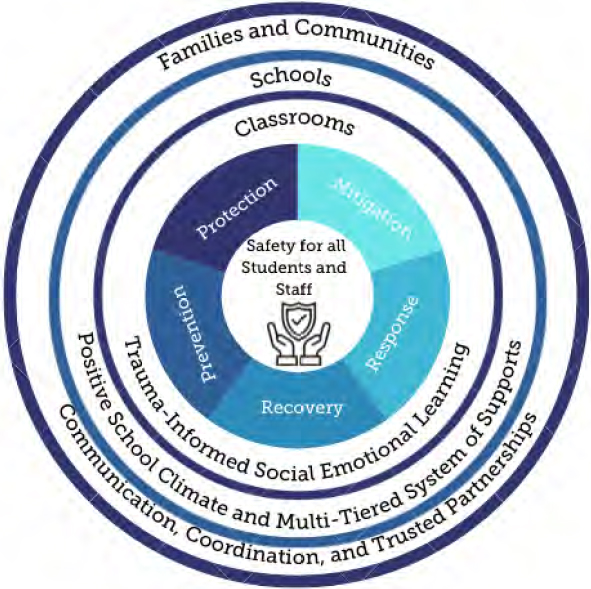
The committee’s framework centers the safety of all students and staff; it is supported by the essential components of emergency preparedness and school safety: prevention, protection, mitigation, response, and recovery. The framework uses a comprehensive approach that aims to balance preparedness for immediate threats with ongoing strategies for preventing violence. A narrow focus on school active shooter drills alone risks overlooking opportunities for prevention. By considering the mental, emotional, and behavioral health needs of students and staff as well as the specific needs and context of a school community, schools can adopt practices that create an environment that both responds to potential threats and aims to reduce their likelihood. The committee views trauma-informed, developmentally appropriate approaches as essential to integrating
school active shooter drills into a broader vision of school safety that supports mental, emotional, and behavioral well-being. When these drills are embedded within clear communication, supportive relationships, and a safe and supportive school environment, they can reinforce a sense of safety and agency rather than provoke fear or distress. In this way, preparedness becomes part of a psychologically safe environment, strengthening both emergency readiness and everyday well-being for students and staff.
As described by the Readiness and Emergency Management for Schools technical assistance center, emergency planning in schools starts with prevention—the efforts schools take to address safety and security as well as promote a positive school climate (ED, 2013). Protection can include school safety policies and trainings, including training staff on school active shooter drills. Mitigation efforts minimize loss of life by lessening the impact of an emergency through practicing emergency response and drills. Response occurs to stabilize an emergency once it happens and to reestablish a safe school environment. Finally, recovery restores the school environment by supporting the academic, social, mental, emotional, and physical well-being of everyone in the school community.
School classrooms provide an important context for students to learn and thrive. Ideally, students receive support from both classroom peers and teachers; healthy classrooms are embedded within schools and school systems that can boost mental, emotional, and behavioral well-being, such as self-efficacy and coping skills (Fen-wick-Smith et al., 2018). Connectedness to peers and healthy relationships with other students are associated with beneficial mental, emotional, and behavioral health outcomes (Foster et al., 2017; Oldfield et al., 2016; Widnall et al., 2022). Furthermore, healthy schools exist in relationship with students’ families and within wider communities. Caregivers’ support is vital for development and promotes children’s resilience to adverse health outcomes (Gee & Cohodes, 2023; Ungar, 2004; World Health Organization, 2004).
Ecological models of child development (see, e.g., Figure 1-1) encourage consideration of the balance of risk and protective factors that can impact children’s responses to school active shooter drills.
At the individual level, children’s experiences with school active shooter drills will be affected by personal characteristics such as age, cognitive and socioemotional development, physical and mental health, and history of traumatic stress. Furthermore, children’s responses to school active shooter drills are shaped by relationships with peers, teachers, and families, as well as their parents’ and teachers’ experiences with drills. Classroom and school contexts—including overall organizational structures and systems, and relationships with peers, teachers, and administrators—play a fundamental role. As will be discussed in Chapter 2, healthy schools offer a stable, nurturing, and trustworthy setting in which to learn how to engage in safety procedures.
Children’s responses to drills can also be affected by their broader social context beyond the school setting. For example, children in communities that have experienced high levels of trauma may respond differently from those who reside in safer communities. Positive school and neighborhood climates can be important sources of resilience for students and staff in relation to school active shooter drills and other school security measures.
ORGANIZATION OF THE REPORT
This report is organized in three parts:
Part I (Chapters 1 and 2) provides background and context for understanding the purpose and impact of active shooter drills and other school safety and security measures. Chapter 2 describes variations in implementation of school active shooter drills, state-level requirements for these drills, personnel who participate, and procedures leading up to and following a drill.
Part II (Chapters 3 and 4) focuses on the design and effects of school active shooter drills and other school safety and security measures on mental, emotional, and behavioral health outcomes. These chapters summarize available research on the impacts of these measures on students and staff, and also consider differential impacts that may exist based on such factors as age, race/ethnicity,
home language, and disability status. Chapter 3 focuses specifically on mental, emotional, and behavioral health outcomes for students and staff attributable to active shooter drills. Chapter 4 presents a discussion of these outcomes as they relate to other school safety and security measures in K–12 settings. The committee highlights the strengths and limitations of the available evidence, areas of consensus and uncertainty, and opportunities for future research.
Part III (Chapters 5–7) focuses on the challenges of mitigating the mental, emotional, and behavioral health impacts of school active shooter drills and other school safety and security measures; it also sets forth an agenda for much-needed research. Specifically, Chapters 5 and 6 apply the findings described in Parts I and II to the design and implementation of developmentally appropriate and trauma-informed school active shooter drills and to school safety and preparedness planning more broadly. Chapter 5 reviews current research on developmental science and trauma and on the relationship between the environment and the individual; it also describes the risk and protective factors that might be considered in implementing protective measures, including active shooter drills. Chapter 6 describes the supports, programs, and expertise needed to implement, monitor, and evaluate best practices in protecting children from harmful events or exposures. It includes a discussion of components and features of active shooter drills and other school security measures that can minimize potential adverse effects on the mental, emotional, and behavioral health of students and staff. Chapter 6 also identifies best practices that can be implemented before, during, and after drills; the implications for school climate and culture; and the importance of implementation context in building resiliency and achieving effective implementation. Finally, Chapter 7 outlines a future research agenda by identifying existing research gaps, summarizing methodological considerations for future research, and describing important data needs.
REFERENCES
Astor, R. A., & Benbenishty, R. (2018). Bullying, school violence, and climate in evolving contexts: Culture, organization, and time. Oxford University Press. https://doi.org/10.1093/oso/780190663049.001.0001
Berk, L. E. (2022). Development through the lifespan. Sage Publications. https://books.google.com/books?id=pj4uzwEACAAJ
Blair, J. P., Nichols, T., Burns, D., & Curnutt, J. R. (2013). Active shooter events and response. CRC Press.
Borum, R., Cornell, D. G., Modzeleski, W., & Jimerson, S. R. (2010). What can be done about school shootings? A review of the evidence. Educational Researcher, 39(1), 27–37.
Bradshaw, C. P., Cohen, J., Espelage, D. L., & Nation, M. (2021). Addressing school safety through comprehensive school climate approaches. School Psychology Review, 50(2–3), 221–236. https://doi.org/10.1080/2372966X.2021.1926321
Centers for Disease Control and Prevention. (2022). Firearm deaths grow, disparities widen. U.S. Department of Health and Human Services. https://www.cdc.gov/vitalsigns/firearm-deaths/index.html
Coleman, S. (2018). Safe Kids Inc.: H.E.R.O. Curriculum: Grades K–8—Efficacy findings in prominent afterschool program, public school district, and private school—Pilot study report. https://static1squarespace.com/static/6570f71970ad2a50a4b8df60/t/65f1c82ba46c35510367d8af/1710344246172/Pilot+Study+White+Paper+K-8.pdf
———. (2020). Safe Kids Inc.: H.E.R.O. Curriculum: Grades 9–12—Efficacy findings in public school district and charter high school—Pilot study report. https://safekidsinc.ai/wp-content/uploads/2021/02/High-School-Pilot-Study.pdf
Cornell, D. G. (2017). School violence: Fears versus facts. Routledge.
Cornell, D. G., Mayer, M. J., & Sulkowski, M. L. (2020). History and future of school safety research. School Psychology Review, 50(2-3), 143–157. https://doi.org/10.1080/2372966X.2020.1857212
Cox, J. W., Rich, S., Trevory, L., Muyskens, J., & Ulmanu, M. (2025). School shootings database. https://www.washingtonpost.com/education/interactive/school-shootings-database/
Dickson, M. J., & Vargo, K. K. (2017). Training kindergarten students lockdown drill procedures using behavioral skills training. Journal of Applied Behavior Analysis, 50(2), 407–412. https://doi.org/10.1002/jaba.369
Donovan, D. J. (2023). Active shooter drills in schools: Are we helping or hurting our kids? Clinical Pediatrics, 63(4), 441–443. https://doi.org/10.1177/00099228231180707
Doss, K., & Shepherd, C. (2015). Active shooter: Preparing for and responding to a growing threat. Butterworth-Heinemann.
Ebsary, N. J. (2018). Biometric monitoring using facial recognition, data collection, and storage: Safety and privacy perceptions of high school students. Journal of Computer Science & Systems Biology, 11(6), 313–318. http://doi.org/10.4172/jcsb.1000291
Executive Office of the President. (2024). Combating emerging firearms threats and improving school-based active-shooter drills (Executive order 14127). Federal Register 89(191). https://www.federalregister.gov/documents/2024/10/02/2024-22938/combating-emerging-firearms-threats-and-improvingschool-based-active-shooter-drills
Federal Bureau of Investigation (FBI). (n.d.). FBI active shooter safety resources. https://www.fbi.gov/how-we-can-help-you/active-shooter-safety-resources.
Federal Emergency Management Agency. (2020, March). Active shooter attacks: Security awareness for soft targets and crowded places [PDF]. FEMA. https://www.fema.gov/sites/default/files/2020-03/fema_faith-communities_activeshooter.pdf
Fenwick-Smith, A., Dahlberg, E. E., & Thompson, S. C. (2018). Systematic review of resilience-enhancing, universal, primary school-based mental health promotion programs. BMC Psychology, 6(1), 30. https://doi.org/10.1186/s40359-018-0242-3
Flannery, D. J., Fox, J. A., Wallace, L., Mulvey, E., & Modzeleski, W. (2021). Guns, school shooters, and school safety: What we know and directions for change. School Psychology Review, 50(2–3), 237–253. https://doi.org/10.1080/2372966X.2020.1846458
Fortin, J. (2022, May 25). What does “active shooter” mean? The New York Times. https://www.nytimes.com/article/active-shooter-what-is-it.html
Foster, C., Horwitz, A., Thomas, A., Opperman, K., Gipson, P., Burnside, A., Stone, D., & King, C. (2017). Connectedness to family, school, peers, and community in socially vulnerable adolescents. Children and Youth Services Review, 81, 321-331. https://doi.org/10.1016/j.childyouth.2017.08.011
Gee, D. G., & Cohodes, E. M. (2023). Leveraging the developmental neuroscience of caregiving to promote resilience among youth exposed to adversity. Development and Psychopathology, 35(5), 2168–2185. https://doi.org/10.1017/s0954579423001128
Gerlinger, J., & Schleifer, C. (2021). School characteristics associated with active shooter drill implementation. Analyses of Social Issues and Public Policy, 21(1), 917–940. https://doi.org/10.1111/asap.12251
Gottfredson, D. C. (2001). Schools and delinquency. Cambridge University Press.
Harding, S., Morris, R., Gunnell, D., Ford, T., Hollingworth, W., Tilling, K. Evans, R., Bell, S., Grey, J., Brockman, R., Campbell, R., Araya, R., Murphy, S., & Kidger, J. (2019). Is teachers’ mental health and wellbeing associated with students’ mental health and wellbeing? Journal of Affective Disorders, 242, 180–187. https://doi.org/10.1016/j.jad.2018.08.080
Holloway, K., Cahill, G., Tieu, T., & Njoroge, W. (2023). Reviewing the literature on the impact of gun violence on early childhood development. Current Psychiatry Reports, 1– 9. https://doi.org/10.1007/s11920-023-01428-6
The “I Love U Guys” Foundation. (n.d.). Home. https://iloveuguys.org
———. (2022). The Standard Response Protocol. https://iloveuguys.org/The-Standard-Response-Protocol.html
Institute of Medicine (IOM). (1994). Reducing risks for mental disorders: Frontiers for preventive intervention research. National Academy Press.
King, S., & Bracy, N. L. (2019). School security in the post-Columbine era: Trends, consequences, and future directions. Journal of Contemporary Criminal Justice, 35(3), 274–295. https://doi.org/10.1177/1043986219840188
Kingston, B., Mattson, S. A., Dymnicki, A., Spier, E., Fitzgerald, M., Shipman, K., Goodrum, S., Woodward, W., Witt, J., Hill, K. G., & Elliott, D. (2018). Building schools’ readiness to implement a comprehensive approach to school safety. Clinical Child and Family Psychology Review, 21(4), 433–449. https://doi.org/10.1007/s10567-018-0264-7
Kupchik, A. (2010). Homeroom security: School discipline in an age of fear (Vol. 6). NYU Press.
———. (2016). The real school safety problem: The long-term consequences of harsh school punishment. University of California Press.
Lee, J., & Schute, V. (2010). Personal and social-contextual factors in K–12 academic performance: An integrative perspective on student learning. Educational Psychologist, 45(3), 185–202. https://doi.org/10.1080/00461520.2010.493471
Leibbrand, C., Hill, H., Rowhani-Rahbar, A., & Rivara, F. (2020). Invisible wounds: Community exposure to gun homicides and adolescents’ mental health and behavioral outcomes. SSM—Population Health, 12. https://doi.org/10.1016/j.ssmph.2020.100689
Lopez, B. (2024, January 19). Texas’ new school safety law mostly addresses the Justice Department’s advice. But funding fixes is still an issue. The Texas Tribune. https://www.texastribune.org/2024/01/19/texas-school-safety-uvalde-doj-report/
Malloy, G. D. P. (2015). Final report of the Sandy Hook advisory commission. Sandy Hook Advisory Commission.
Martaindale, M. H., & Blair, J. P. (2019). The evolution of active shooter response training protocols since Columbine: Lessons from the Advanced Law Enforcement Rapid Response Training Center. Journal of Contemporary Criminal Justice, 35(3), 342–356. https://doi.org/10.1177/1043986219840237
Mayer, M. J., & Furlong, M. J. (2010). How safe are our schools? Educational Researcher, 39(1), 16–26. http://www.jstor.org/stable/27764550
McLean, L., Abry, T., Taylor, M., & Connor, C. M. (2018). Associations among teachers’ depressive symptoms and students’ classroom instructional experiences in third grade. Journal of School Psychology, 69, 154–168. https://doi.org/10.1016/j.jsp.2018.05.002
Miotto, M. B., & Cogan, R. (2023). Empowered or traumatized? A call for evidence-informed armed-assailant drills in U.S. schools. The New England Journal of Medicine, 389(1), 6–8. https://doi.org/10.1056/NEJMp2301804
Mitchell, K., Jones, L., Turner, H., Beseler, C., Hamby, S., & Wade, R. (2019). Understanding the impact of seeing gun violence and hearing gunshots in public places: Findings from the youth firearm risk and safety study. Journal of Interpersonal Violence, 36, 8835–8851. https://doi.org/10.1177/0886260519853393
Morris, M. (2016). Pushout: The criminalization of Black girls in schools. The New Press.
Muschert, G., Henry, S., & Bracy, N. L. (Eds.). (2013). Responding to school violence: Confronting the Columbine effect. Lynne Rienner Publishers.
National Academies of Sciences, Engineering, and Medicine (NASEM). (2019a). Fostering healthy mental, emotional, and behavioral development in children and youth: A national agenda. The National Academies Press. https://doi.org/10.17226/25201
———. (2019b). The promise of adolescence: Realizing opportunity for all youth. The National Academies Press. https://doi.org/10.17226/25388
———. (2019c). Vibrant and healthy kids: Aligning science, practice, and policy to advance health equity. The National Academies Press. https://doi.org/10.17226/25466
National Association of School Psychologists (NASP), National Association of School Resource Officers (NASRO), & Safe and Sound Schools. (2021). Best practice considerations for armed assailant drills in schools. https://www.nasponline.org/assets/Documents/Research%20and%20Policy/Advocacy%20Resources/Armed-Assailant-Guide-Revised-SEPT-2021.pdf
National Association of School Resource Officers (NASRO). (n.d.). Frequently asked questions. https://www.nasro.org/faq/
National Center on Safe Supportive Learning Environments. (2022). State report on the implementation of the Gun-Free Schools Act: U.S. states and other jurisdictions 2019–20 school year. U.S. Department of Education. https://safesupportivelearning.ed.gov/sites/default/files/StateRtImplGFSA-2019-20-508_2022.03.07.pdf
National Institute of Education (NIE). (1978). Violent schools-safe schools: the safe school study report to the Congress: Executive summary (Vol. 1). https://www.ojp.gov/pdffiles1/Digitization/45988NCJRS.pdf
National Research Council (NRC). (2003). Deadly lessons: Understanding lethal school violence. National Academies Press. https://doi.org/10.17226/10370
National Research Council (NRC) and Institute of Medicine (IOM). (2009). Preventing mental, emotional, and behavioral disorders among young people: Progress and possibilities. The National Academies Press. https://doi.org/10.17226/12480
Navigate360 (Age Appropriate Guidelines for ALICE Training® at Any Age). (2023, April 7). Age appropriate guidelines for ALICE training at any age [PDF]. Navigate360. https://info.navigate360.com/hubfs/ALICE%20Content%20PDFs/Guides/ALICE-K12-EB-040723-Age%20Appropriate%20Guidelines.pdf
Nickerson, A., Randa, R., Jimerson, S., & Guerra, N. (2021). Safe places to learn: Advances in school safety research and practice. School Psychology Review, 50, 158–171. https://doi.org/10.1080/2372966X.2021.1871948
Noguera, P. A., & Syeed, E. (2020). City schools and the American dream 2: The enduring promise of public education (2nd Ed.). Multicultural Education.
Oldfield, J., Humphrey, N., & Hebron, J. (2016). The role of parental and peer attachment relationships and school connectedness in predicting adolescent mental health outcomes. Child and Adolescent Mental Health, 21(1), 21–29. https://doi.org/10.1111/CAMH.12108
O’Regan, S. V. (2019, December 13). The company behind America’s scariest school shooter drills. The Trace. https://www.thetrace.org/2019/12/alice-active-shooter-training-school-safety/
Peguero, A. A., & Bondy, J. M. (2021). Immigration and school safety. Routledge.
Rajan, S. (2024). The impacts of firearm violence exposure on youth in the US: Building the evidence and the solutions. Youth & Society, 56(8), 1391–1395. https://doi.org/10.1177/0044118X241285222
Rajan, S., Reeping, P. M., Ladhani, Z., Vasudevan, L. M., & Branas, C. C. (2022). Gun violence in K-12 schools in the United States: Moving towards a preventive (versus reactive) framework. Preventive Medicine, 165, 107280. https://doi.org/10.1016/j.ypmed.2022.107280
Rios, V. M. (2011). Punished: Policing the lives of Black and Latino boys. NYU Press.
———. (2020). Human targets: Schools, police, and the criminalization of Latino youth. University of Chicago Press.
Ruzek, E. A., Hafen, C. A., Allen, J. P., Gregory, A., Mikami, A. Y., & Pianta, R. C. (2016). How teacher emotional support motivates students: The mediating roles of perceived peer relatedness, autonomy support, and competence. Learning and Instruction, 42, 95–103. https://doi.org/10.1016/j.learninstruc.2016.01.004
Rygg, L. (2015). School shooting simulations: At what point does preparation become more harmful than helpful. Children’s Legal Rights Journal, 35(3), 215.
Safe Kids Inc. (n.d.). The H.E.R.O. Program: Empower PreK 12 Kids [Program overview]. Safe Kids Inc. https://www.safekidsinc.com/hero-program-overview
Schildkraut, J., & Elsass, H. J. (2016). Mass shootings: Media, myths, and realities. Bloomsbury Publishing.
Schildkraut, J., & Nickerson, A. B. (2022). Lockdown drills: Connecting research and best practices for school administrators, teachers, and parents. MIT Press.
Schildkraut, J., Nickerson, A. B., & Ristoff, T. (2020). Locks, lights, out of sight: Assessing students’ perceptions of emergency preparedness across multiple lockdown drills. Journal of School Violence, 19(1), 93–106. https://doi.org/10.1080/15388220.2019.1703720
Schonfeld, D. J., Melzer-Lange, M., Hashikawa, A. N., Gorski, P. A., & Council on Children and Disasters, Council on Injury, Violence, and Poison Prevention, Council on School Health (2020). Participation of children and adolescents in live crisis drills and exercises. Pediatrics, 146(3), e2020015503. https://doi.org/10.1542/peds.2020-015503
Simonetti J. A. (2020). Active shooter safety drills and US students—Should we take a step back? JAMA Pediatrics, 174(11), 1021–1022. https://doi.org/10.1001/jamapediatrics.2020.2592
Skiba, R. J., & Peterson, R. L. (2000). School discipline at a crossroads: From zero tolerance to early response. Exceptional Children, 66(3), 335–346. http://doi.org/10.1177/001440290006600305
Sprague, J. R., & Walker, H. M. (2021). Safe and healthy schools: Practical prevention strategies. Guilford Publications.
Tanner-Smith, E. E., Fisher, B. W., Addington, L. A., & Gardella, J. H. (2018). Adding security, but subtracting safety? Exploring schools’ use of multiple visible security measures. American Journal of Criminal Justice, 43(1), 102–119. https://doi.org/10.1007/s12103-017-9409-3
Turanovic, J. J., Pratt, T. C., Kulig, T. C., & Cullen, F. T. (2022). Confronting school violence: A synthesis of six decades of research. Cambridge University Press.
Ungar, M. (2004). The importance of parents and other caregivers to the resilience of high‐risk adolescents. Family Process, 43(1), 23–41. https://doi.org/10.1111/j.1545-5300.2004.04301004.x
United States Department of Justice (DOJ). (2024). Critical incident review—Active shooter at Robb Elementary School. https://portal.cops.usdoj.gov/resourcecenter/content.ashx/cops-r1141-pub.pdf
U.S. Department of Education (ED). (2013). Guide for developing high-quality school emergency operations plans. https://rems.ed.gov/docs/School_Guide_508C.pdf
U.S. House of Representatives. (2022). House report 117-403. https://www.congress.gov/congressional-report/117th-congress/house-report/403
Villarreal, S., Kim, R., Wagner, E., Somayaji, N., Davis, A., & Crifasi, C. (2024). Gun violence in the United States 2022: Examining the burden among children & teens. Johns Hopkins Center for Gun Violence Solutions. United States of America. https://coilink.org/20.500.12592/2qldvc9
Vossekuil, B., Fein, R. A., Reddy, M., Borum, R., & Modzeleski, W. (2002). The final report and findings of the Safe School Initiative. U.S. Secret Service and ED.
Widnall, E., Winstone, L., Plackett, R., Adams, E., Haworth, C., Mars, B., & Kidger, J. (2022). Impact of school and peer connectedness on adolescent mental health and well-being outcomes during the COVID-19 pandemic: A longitudinal panel survey. International Journal of Environmental Research and Public Health, 19. https://doi.org/10.3390/ijerph19116768
World Health Organization. (2004). The importance of caregiver-child interactions for the survival and health development of young children: A review. https://iris.who.int/bitstream/handle/10665/42878/924159134X.pdf


