Aviation Weather Services: A Call For Federal Leadership and Action (1995)
Chapter: Chapter 1: Introduction
1
Introduction
Adverse weather has a major impact on aviation safety and efficiency.
Aviators and their flying machines have had to cope with adverse weather since the dawn of aviation. A major factor in the Wright brothers' selection of Kitty Hawk, North Carolina, as their test site was the expectation of favorable winds. Nonetheless, on the historic day when they first demonstrated powered flight, a wind gust overturned and damaged their aircraft after its fourth flight.
Today, weather continues to be one of the most important factors affecting aviation safety and efficiency. During 1988–1992, one-fourth of all aircraft accidents and one-third of fatal accidents were related to weather (Salottolo, 1994). In addition, 41 percent of air traffic delay time during 1990 was attributable to weather. These delays accounted for approximately $4.1 billion of direct costs to the airline industry—not including the financial loss and inconvenience suffered by the traveling public (OFCM, 1992). Projected increases in air travel will tend to exacerbate the impact of adverse weather on aviation safety and efficiency.1 Efficiently managing the research, development, acquisition, and operation of aviation weather systems and services is essential to accommodate increased air traffic while continuing to meet public expectations for safety, efficiency, affordability, and convenience.
The skill and experience of pilots involved in U.S. aviation vary widely, as do the capabilities of their aircraft. Thus, the aviation weather system must provide a wide variety of services to accommodate the needs of individual pilots as well as those of the air traffic controllers, airline dispatchers, flight service specialists,2 aviation weather forecasters, and airport managers upon whom they depend.
Assessing the effectiveness of existing aviation weather services and related research is a difficult task. Although many accidents are related to weather, the number and frequency of accidents are an imperfect and incomplete measure of effectiveness for two reasons. First, although many weather-related accidents could be reduced by improving the quality of preflight and en route aviation weather services, weather-related accidents also could be reduced by enhancing training programs to increase the effectiveness of decision making by pilots, controllers, and other users in the face of uncertain or adverse weather conditions. Second, adverse weather can create dangerous situations that, because of pilot skill, luck, or some other circumstance, do not result in aircraft accidents or reportable incidents, and these situations do not appear in accident statistics. Similarly, the efficiency of aviation operations is a product of many diverse factors, and it is difficult to isolate the specific impact of aviation weather services.
An earlier report, Weather for Those Who Fly (NRC, 1994), examined the existing conceptual and technological possibilities for improving aviation weather services, most notably by providing accurate, timely, and relevant information in graphic format to pilots (on the ground and in the air), air traffic controllers, and other users. Finding that "the present-day aviation weather system is obsolete," that report argued that "the needs of aviation for a modern weather information system are manifold and urgent." The report also offered a "vision of an improved weather system [that] includes modernized observation systems, new capabilities in high-resolution atmospheric modeling and prediction, new data bases designed to meet aviation needs, and a new emphasis on presenting weather information in ways that aid effective decision making by pilots, air traffic controllers, and dispatchers.'' Because "there is no single, integrated plan specifying the objec
tives, strategies, schedule, phasing, and budgets" to achieve an improved aviation weather system, the report concluded that "the vision is clear, the commitment to realize it is not." Thus, the report recommended that because "the initiatives for improving weather information services to all sectors of aviation address urgent needs and take advantage of existing technology, they should be pursued with resolve and implemented surely and swiftly."
The report of this committee turns to questions related to how the federal government can meet its responsibilities to provide aviation weather services "surely and swiftly." The report is not concerned with the science and technology of aviation weather information. Rather, it focuses on the roles and missions of the Federal Aviation Administration (FAA), the National Weather Service (NWS), other agencies, and the private sector. Also, the report documents the need for greater federal leadership in aviation weather services and presents a variety of recommendations that could result in significant improvement at little or no additional cost.
Safety Imperatives
The U.S. airspace system is one of the safest in the world. In fact, aviation is the safest means of passenger transportation in United States (DOT, 1990). Nonetheless, as illustrated in Table 1–1, weather-related accidents frequently end in tragedy. During 1988–1992, the annual death toll from aircraft accidents in the United States was 1,016 people, and weather was a cause or factor in one-third of fatal aircraft accidents (Salottolo, 1994). Accordingly, accident prevention is a primary goal of the aviation weather system. This emphasis is reflected in the FAA's strategic plan (FAA, 1994b), which includes two weather-related objectives:
- "Reduce the likelihood of weather-related accidents by improving access and delivery of weather information and by improving technology."
- "Reduce the capacity-impacting consequences of weather phenomena by improved weather forecasts and increased accuracy, resolution, and dissemination of observations on the ground and in the air."
In addition, the 1993 FAA Capital Investment Plan establishes the goal of reducing "the number of accidents attributable to weather by 20 percent by 2000" (FAA, 1993).
Economic Imperatives
The air transportation system serves the business community and general public by providing routine passenger service and delivering mail and other air cargo throughout the United States. The pervasive impact of aviation on the U.S. economy is reflected in the following data:
- U.S. air carriers generate annual revenues of $88 billion per year (FAA, 1995).
- The United States has about one-half of the world's aviation activity. Fourteen of the world's 15 busiest commercial airports are located in the United States (DOT, 1994).
- Passenger-miles flown by U.S. air carriers more than doubled between 1979 and 1994. More than a million people fly in the United States every day. During 1993, U.S. air carriers accumulated 11 million flight hours, served 513 million passengers, moved about 18 billion ton-miles of cargo, and consumed 16 billion gallons of fuel (FAA, 1995).
- During 1993, general and business aviation aircraft, including air taxis and helicopters, accumulated 24
TABLE 1-1 Accident Statistics, 1988–1992 (Source: Salottolo, 1994)a
TABLE 1-2 U.S. Airports with Annual Delays in Excess of 20,000 hours (Source: FAA, 1994a)
|
Atlanta Hartsfield |
Minneapolis-St. Paul |
|
Boston Logan |
New York Laguardia |
|
Charlotte Douglas |
Newark International |
|
Chicago O'Hare |
Orlando McCoy |
|
Dallas-Fort Worth |
Philadelphia International |
|
Denver Stapleton |
Phoenix Sky Harbor |
|
Detroit Metro Wayne |
Pittsburgh International |
|
Honolulu International |
San Francisco International |
|
Houston International |
Seattle-Tacoma |
|
John F. Kennedy International |
St. Louis Lambert |
|
Los Angeles International |
Washington National |
|
Miami International |
|
- million flight hours and consumed 719 million gallons of fuel (FAA, 1995).
- In some areas of the United Sates, including most of Alaska, aviation is the primary means of transportation.
- U.S. commercial, business, and general aviation involves over 185,000 aircraft; 665,000 licensed and student pilots; and 100,000 flight hours per day (FAA, 1995).
Just as aviation is an important element of the U.S. economy, aviation weather services are an important component of the air transportation system, as indicated by the following:
- The accuracy of high-level wind forecasts has a significant impact on fuel consumption. Improved forecasts could reduce the amount of fuel consumed by air carriers by 1–3 percent (NASA, 1982).3 During 1993, this would have saved U.S. carriers up to $300 million.
- Widespread use of cockpit weather display systems would reduce the annual operating costs of a typical domestic airline by $5.9 million (Scanlon, 1993).
- Forecasts of adverse weather at destination airports often require departing aircraft to carry extra fuel so that they can reach alternate airports in case they cannot land at the intended destination. A typical commercial jet aircraft burns approximately 1 percent of the added fuel for every 100 miles it flies. Thus, if 700 pounds of extra fuel are added to a flight of 1,000 miles, about 70 pounds of extra fuel are consumed just to carry the added weight. However, it is not unusual for forecasts to predict adverse weather that is not present when aircraft arrive at their destination. Improved weather forecasts would reduce these "false alarms" and, thereby, reduce the need to carry—and consume—extra fuel.
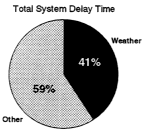
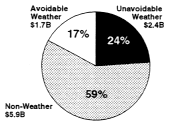
Figure 1-1
Cost of weather-related aviation delays during 1990. (Source: OFCM, 1992)
-
- Adverse weather in the vicinity of airports is the primary cause of aviation system delays as well as a principal cause of air carrier accidents. During 1993, the 23 U.S. airports listed below in Table 1-2 each experienced more than 20,000 hours of aircraft delay. Without increases in system capacity, annual delays at nine additional airports are projected to reach this level by 2003 (FAA, 1994a). Many of these airports operate at or near capacity for several hours each day. As a result, even minor weather events can cause significant delays (Qualley, 1995).
- Figure 1-1 depicts the total estimated cost of avoidable delays associated with weather during 1990. Small increases in airport capacity during adverse weather can significantly reduce the total system delays that result.4 For example, increasing airport capacity by 10 percent during adverse weather may yield a 20–50 percent reduction in total system delays. Likewise, small reductions in the effective duration of adverse weather (e.g., from 3 hours to 2.5 hours), which can be realized by more accurately predicting when the adverse weather will start and end, can reduce total system delays by a substantial amount (20–35 percent) (Evans, 1995).
- Deicing operations at a major facility such as Denver International Airport can cost about $220,000 for a 24-hour snowstorm. Improving the ability to predict and measure snow accumulation and precipitation rates allows airlines to reduce these costs (and the environmental impact posed by deicing fluids) by tailoring their deicing operations to actual conditions (Carmichael, 1995).
Air traffic controllers ensure that aircraft under their control maintain safe separation distances from each other. During adverse weather, airline despatchers and air traffic managers reduce air traffic to prevent overloading airports. Improving aviation weather services makes it possible for these individuals to respond more appropriately to adverse weather, thereby reducing weather-related delays and increasing the capacity and efficiency of the national airspace system. As a result, the quality of aviation weather services has a direct impact on the growth and maintenance of a safe and efficient system of air commerce in the United States.
Organization of this Report
Together with Chapter 1, Chapter 2 lays the foundation for the rest of the report. Chapter 2 (and Appendix D) describes the aviation weather roles and missions of federal agencies as defined by existing legislation, interagency agreements, and Federal Aviation Regulations (FARs). Chapter 2 also briefly discusses aviation weather-related issues associated with proposals to establish an air traffic services corporation to take over some of the functions of the FAA.
Chapter 3 (and Appendices E through G) assesses the effectiveness of currently available aviation weather services and related training programs. Chapter 3 uses these assessments to identify unmet user needs that should be addressed by improving existing systems and fielding new systems. Chapter 4 (and Appendix H) builds upon Chapter 3 by investigating issues associated with the aviation weather research and development program and its ability to provide a knowledge and technology base that will keep pace with future growth in user needs.
Chapter 5 (and Appendix I) is devoted to regional requirements, how they vary from national norms, and how well the national aviation weather system meets regional needs.
Chapters 6 and 7 contain the main message of the report. Chapter 6 (and Appendix J) assesses options for adjusting agency roles and missions in light of the intent of current legislation and the effectiveness of existing national and regional aviation weather services and related research. Chapter 7 describes several near-term activities to initiate the process of improving the ability of the aviation weather system to meet its current and future potential in terms of safety and efficiency.
Appendix A contains a complete list of the committee's findings and recommendations.
References
Carmichael, B. 1995. Personal communication from Bruce Carmichael, National Center for Atmospheric Research/Research Applications Program, to Alan Angleman, August 10, 1995.
DOT (Department of Transportation). 1990. Moving America—New Directions, New Opportunities. Washington, D.C.: DOT.
DOT. 1994. Air Traffic Control Corporation Study—Report of the Executive Oversight Committee to the Department of Transportation. Washington, D.C.: DOT.
Evans, J. 1995. Measuring the Economic Value of Aviation Meteorological Products. Ninth Conference on Applied Climatology and 14th Conference on Weather Analysis and Forecasting, held January 15–20, 1995 in Dallas, Texas. Boston: American Meteorological Society.
FAA (Federal Aviation Administration). 1993. 1993 Federal Aviation Administration Aviation System Capital Investment Plan. Washington, D.C.: FAA.
FAA. 1994a. Aviation Capacity Enhancement Plan. Washington, D.C.: FAA.
FAA. 1994b. FAA Strategic Plan 1994. Washington, D.C.: FAA.
FAA. 1995. FAA Aviation Forecasts. Washington, D.C.: FAA
Lunnon, R., and M. Ahmed. 1993. A study of the savings in time and fuel to aviation through the use of upper-air wind forecasts. Pp. 404–408 in Fifth Conference on Aviation Weather Systems held August 26, 1993, in Vienna, Virginia. Boston: American Meteorological Society.
NASA (National Aeronautics and Space Administration). 1982. Impact of Weather on Aircraft Fuel Savings and Operating Efficiency. Cleveland, Ohio: NASA Lewis Research Center.
NRC (National Research Council). 1994. Weather for Those Who Fly. National Weather Service Modernization Committee, National Research Council. Washington, D.C.: National Academy Press.
OFCM (Office of the Federal Coordinator for Meteorology). 1992. National Aviation Weather Program Plan. Federal Coordinator for Meteorological Services and Supporting Research. Washington, D.C.: OFCM.
Qualley, w. 1995. Commercial airline operational control. Pp. 117–121 in Sixth Conference on Aviation Weather Systems held January 15–20, 1995, in Dallas , Texas. Boston: American Meteorological Society.
Salottolo, G. 1994. Presentation by Greg Salottolo, National Transportation Safety Board, to the National Aviation Weather Services Committee, at the National Academy of Sciences, Washington, D.C., September 1, 1994.
Scanlon, C. 1993. Cockpit weather information needs. Pp. 228–234 in National Aviation Weather Users' Forum held November 30-December 2, 1993, in Reston, Virginia. Washington, D.C.: Federal Aviation Administration.
Tenenbaum, J. 1992. Recent experiment focuses on operational impact of jet stream forecast errors. ICAO Journal. December 1992. 12–13.


