Adviser, Teacher, Role Model, Friend: On Being a Mentor to Students in Science and Engineering (1997)
Chapter: 5 The Mentor as Role Model
5
THE MENTOR AS ROLE MODEL
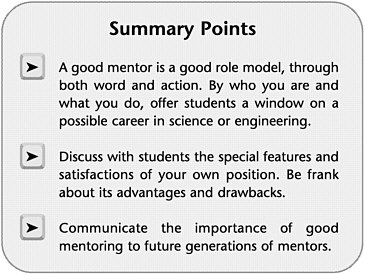
In a good mentoring relationship, you, as the senior partner, can be a role model through both your words and your actions. By who you are, you provide a personal window for the student on a possible future. Your ethical, scientific, and professional behavior all leave a strong impression on students, as does your attitude toward your work.
Communicate your feelings about your professional career. Share your frustrations as well as your enthusiasms. When something excites you, tell your students why. Communicate the importance of mentoring and your hope that students will some day be mentors themselves.
A student might see or understand only a part of what you do-probably your scientific or engineering activities. Take the time to raise other topics that you are comfortable in discussing with your students. What is a typical day, week, or weekend like for you? What does it feel like to do what you do? You might want to talk about administrative, entrepreneurial, or civic activities; family obligations or the
A Geneticist-Molecular Biologist Who Became a Patent Lawyer
"Even when I was a scientist [at Northeastern Ohio Universities College of Medicine], I spent a lot of time with other people teaching and doing genetic counseling. I liked the interpersonal aspects of my work as well as the science. Patent practice lets me use them both." Dr. Seide became an attorney in the New York firm of Brumbaugh, Graves, Donohue & Raymond. In her specialty of intellectual-property law, she spends much of her time in litigation and counseling: Does a new biotechnology process or product merit a patent? Can a client expect good protection for the life of the patent? To answer such questions, she must understand the cutting-edge research that her clients are doing. She could not do this without her expertise in-and love for-science. Dr. Seide feels that it was important to focus on science for its own sake while working toward her PhD. Still, she encourages students to understand that "if you want to do science from another perspective, more avenues are open to you. I have found how exciting it is to learn from people in other disciplines and to look at science from other perspectives." |
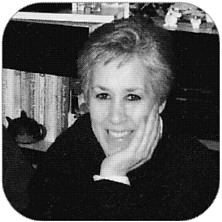 Rochelle Karen Seide, who was educated as a biologist, now enjoys a rewarding career as a patent attorney specializing in biotechnology. After beginning her studies in bacteriology and earning a PhD in human genetics, she completed her schooling with a law degree. This seemingly radical career change, she says, came naturally enough as an extension of her inborn people skills.
challenge of a dual-career partnership; and your goal of balancing the professional and personal aspects of life.
The sum of all those activities-of all your actions as a mentor-is what students take with them after graduation. The image of you as a person will last longer than your words or professional achievements. The power and value of the image will depend on the efforts you have made in building honesty, trust, and good communication throughout your mentoring relationship.