The Future Role of Pesticides in US Agriculture (2000)
Chapter: Front Matter
2101 Constitution Avenue, N.W.Washington, D.C.20418
NOTICE: The project that is the subject of this report was approved by the Governing Board of the National Research Council, whose members are drawn from the councils of the National Academy of Sciences, the National Academy of Engineering, and the Institute of Medicine. The members of the committee responsible for the report were chosen for their special competences and with regard for appropriate balance.
This report has been prepared with funds provided by the US Department of Agriculture under grant number, 59-0700-5-119, Environmental Protection Agency under contract number 6W-1187-NANX, and the National Research Council. Any opinions, findings, conclusions, or recommendations expressed in this publication are those of the author(s) and do not necessarily reflect the views of the organizations or agencies that provided support for the project.
Library of Congress Cataloging-in-Publication Data
The future role of pesticides in US agriculture / Committee on the Future Role of Pesticides in US Agriculture, Board on Agriculture and Natural Resources and Board on Environmental Studies and Toxicology, Commission on Life Sciences.
p. cm.
Includes bibliographical references (p. ).
ISBN 0-309-06526-7 (case bound)
1. Pesticides--United States. I. National Research Council (U.S.). Committee on the Future Role of Pesticides in US Agriculture. II. National Research Council (U.S.). Board on Environmental Studies and Toxicology. III. Title.
SB950.2.A1 F88 2000
632'.95'0973--dc21
00-011245
Additional copies of this report are available from
National Academy Press, 2101 Constitution Avenue, N.W., Lockbox 285, Washington, D.C. 20055; (800) 624-6242 or (202) 334-3313 (in the Washington metropolitan area); Internet, http://www.nap.edu
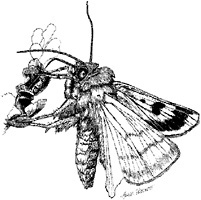 | The illustration to the left, a corn earworm moth, Heliothis zea, was created by Alice Prickett of Urbana, Illinois, and was adapted for the image on the cover of this book. |
Printed in the United States of America
Copyright 2000 by the National Academy of Sciences. All rights reserved.
THE NATIONAL ACADEMIES
National Academy of Sciences
National Academy of Engineering
Institute of Medicine
National Research Council
The National Academy of Sciences is a private, nonprofit, self-perpetuating society of distinguished scholars engaged in scientific and engineering research, dedicated to the furtherance of science and technology and to their use for the general welfare. Upon the authority of the charter granted to it by the Congress in 1863, the Academy has a mandate that requires it to advise the federal government on scientific and technical matters. Dr. Bruce M. Alberts is president of the National Academy of Sciences.
The National Academy of Engineering was established in 1964, under the charter of the National Academy of Sciences, as a parallel organization of outstanding engineers. It is autonomous in its administration and in the selection of its members, sharing with the National Academy of Sciences the responsibility for advising the federal government. The National Academy of Engineering also sponsors engineering programs aimed at meeting national needs, encourages education and research, and recognizes the superior achievements of engineers. Dr. William A. Wulf is president of the National Academy of Engineering.
The Institute of Medicine was established in 1970 by the National Academy of Sciences to secure the services of eminent members of appropriate professions in the examination of policy matters pertaining to the health of the public. The Institute acts under the responsibility given to the National Academy of Sciences by its congressional charter to be an adviser to the federal government and, upon its own initiative, to identify issues of medical care, research, and education. Dr. Kenneth I. Shine is president of the Institute of Medicine.
The National Research Council was organized by the National Academy of Sciences in 1916 to associate the broad community of science and technology with the Academy's purposes of furthering knowledge and advising the federal government. Functioning in accordance with general policies determined by the Academy, the Council has become the principal operating agency of both the National Academy of Sciences and the National Academy of Engineering in providing services to the government, the public, and the scientific and engineering communities. The Council is administered jointly by both Academies and the Institute of Medicine. Dr. Bruce M. Alberts and Dr. William A. Wulf are chairman and vice chairman, respectively, of the National Research Council.
COMMITTEE ON THE FUTURE ROLE OF PESTICIDES IN US AGRICULTURE
MAYBERENBAUM,Chair,
Department of Entomology, University of Illinois, Urbana, Illinois
MARKBRUSSEAU,
Department Soil, Water, and Environmental Science, University of Arizona, Tucson, Arizona
JOSEPHDIPIETRO,
College of Veterinary Medicine, University of Florida, Gainesville, Florida
ROBERTGOODMAN,
Department of Plant Pathology, University of Wisconsin, Madison, Wisconsin
FREDGOULD,
Department of Entomology, North Carolina State University, Raleigh, North Carolina
JEFFREYGUNSOLUS,
Department of Agronomy and Plant Genetics, University of Minnesota, St. Paul, Minnesota
BRUCEHAMMOCK,
Department of Entomology, University of California, Davis, California
ROLFHARTUNG,
Environmental Toxicology, University of Michigan, Ann Arbor, Michigan (Retired)
PAMELAMARRONE,
AgraQuest, Inc., Davis, California
BRUCEMAXWELL,
Department of Plant, Soil, and Environmental Sciences, Montana State University, Bozeman, Montana
KENNETHRAFFA,
Department of Entomology, University of Wisconsin, Madison, Wisconsin
JOHNRYALS,
Paradigm Genetics, Inc., Cary, North Carolina
DALESHANER,
American Cyanamid, Princeton, New Jersey
*JAMESSEIBER,
Center for Environmental Sciences and Engineering and Department of Environmental Resource Sciences, University of Nevada, Reno, Nevada
DAVIDZILBERMAN,
Department of Agricultural and Resource Economics, University of California, Berkeley, California
Consultant
ERIKLICHTENBERG,
Department of Agricultural and Resource Economics, University of Maryland, College Park, Maryland
Staff
Kim Waddell, Project Director
Mary Jane Letaw, Project Director (through September 11, 1999)
Heather Christiansen, Research Associate
Karen Imhof, Project Assistant
*Resigned December, 1998 after changing affiliation to USDA-ARS |
BOARD ON AGRICULTURE AND NATURAL RESOURCES
HARLEYW. MOON,Chair,
Iowa State University
DAVIDH. BAKER,
University of Illinois
*SANDRAS. BATIE
Department of Agricultural Economics Michigan State University East Lansing, Michigan
MAYR. BERENBAUM,
University of Illinois
*ANTHONYS. EARL
Quarles & Brady Law Firm, Madison, Wisconsin
*ESSEXE. FINNEY,JR.
Agricultural Research Service, US Department of Agriculture, Mitchellville, Maryland (retired)
CORNELIAB. FLORA,
Iowa State University
ROBERTT. FRALEY,
Monsanto Company, St. Louis, Missouri
ROBERTB. FRIDLEY,
University of California
W. R. (REG) GOMES,
University of California
PERRYR. HAGENSTEIN,
Institute for Forest Analysis, Planning, and Policy, Wayland, Massachusetts
GEORGER. HALLBERG,
The Cadmus Group, Inc., Waltham, Massachusetts
*RICHARDR. HARWOOD
Crop and Soil Sciences Department, Michigan State University, East Lansing, Michigan
*T. KENTKIRKChair,
Department of Bacteriology, University of Wisconsin, Madison, Wisconsin
CALESTOUSJUMA,
Harvard University
GILBERTA. LEVEILLE,
McNeil Consumer Healthcare, Denville, New Jersey
WHITNEYMACMILLAN,
Cargill, Inc., Minneapolis, Minnesota (retired)
WILLIAML. OGREN,
US Department of Agriculture (retired)
NANCYJ. RACHMAN,
International Life Science Institute, Washington, D.C.
G. EDWARDSCHUH,
University of Minnesota
JOHNW. SUTTIE,
University of Wisconsin
THOMASN. URBAN,
Pioneer Hi-Bred International, Inc., Des Moines, Iowa
ROBERTP. WILSON,
Mississippi State University
JAMESJ. ZUICHES,
Washington State University
Staff
Warren Muir, Executive Director
Myron F. Uman, Acting Executive Director (through May 1999)
David L. Meeker, Director (since March 2000)
Charlotte Kirk Baer, Associate Director
Shirley Thatcher, Administrative Assistant
*Through December 1999 |
BOARD ON ENVIRONMENTAL STUDIES AND TOXICOLOGY
GORDONORIANS,Chair,
University of Washington, Seattle, Washington
DONALDMATTISON,Vice Chair,
March of Dimes, White Plains, New York
DAVIDALLEN,
University of Texas, Austin, Texas
INGRIDC. BURKE,
Colorado State University, Fort Collins, Colorado
WILLIAML. CHAMEIDES,
Georgia Institute of Technology, Atlanta, Georgia
JOHNDOULL,
University of Kansas Medical Center, Kansas City, Kansas
CHRISTOPHERB. FIELD,
Carnegie Institute of Washington, Stanford, California
JOHNGERHART,
University of California, Berkeley, California
J. PAULGILMAN,
Celera Genomics, Rockville, Maryland
BRUCED. HAMMOCK,
University of California, Davis, California
MARKHARWELL,
University of Miami, Miami, Florida
ROGENEHENDERSON,
Lovelace Respiratory Research Institute, Albuquerque, New Mexico
CAROLHENRY,
Chemical Manufacturers Association, Arlington, Virginia
BARBARAHULKA,
University of North Carolina, Chapel Hill, North Carolina
JAMESF. KITCHELL,
University of Wisconsin, Madison, Wisconsin
DANIELKREWSKI,
University of Ottawa, Ottawa, Ontario
JAMESA. MACMAHON,
Utah State University, Logan, Utah
MARIOJ. MOLINA,
Massachusetts Institute of Technology, Cambridge, Massachusetts
CHARLESO'MELIA,
Johns Hopkins University, Baltimore, Maryland
WILLEMF. PASSCHIER,
Health Council of the Netherlands
KIRKSMITH,
University of California, Berkeley, California
MARGARETSTRAND,
Oppenheimer Wolff Donnelly & Bayh, LLP, Washington, DC
TERRYF. YOSIE,
Chemical Manufacturers Association, Arlington, Virginia
Senior Staff
James J. Reisa, Director
David J. Policansky, Associate Director and Senior Program Director for Applied Ecology
Carol A. Maczka, Senior Program Director for Toxicology and Risk Assessment
Raymond A. Wassel, Senior Program Director for Environmental Sciences and Engineering
Kulbir Bakshi, Program Director for the Committee on Toxicology
Lee R. Paulson, Program Director for Resource Management
Roberta M. Wedge, Program Director for Risk Analysis
COMMISSION ON LIFE SCIENCES
MICHAELT. CLEGG,Chair,
University of California, Riverside, California
PAULBERG,Vice Chair,
Stanford University, Stanford, California
FREDERICKR. ANDERSON,
Cadwalader, Wickersham and Taft, Washington, D.C.
JOANNABURGER,
Rutgers University, Piscataway, New Jersey
JAMESE. CLEAVER,
University of California, San Francisco, California
DAVIDS. EISENBERG,
University of California, Los Angeles, California
JOHNL. EMMERSON,
Fishers, Indiana
NEALL. FIRST,
University of Wisconsin, Madison, Wisconsin
DAVIDJ. GALAS,
Keck Graduate Institute of Applied Life Science, Claremont, California
DAVIDV. GOEDDEL,
Tularik, Inc., South San Francisco, California
ARTUROGOMEZ-POMPA,
University of California, Riverside, California
COREYS. GOODMAN,
University of California, Berkeley, California
JONW. GORDON,
Mount Sinai School of Medicine, New York, New York
DAVIDG. HOEL,
Medical University of South Carolina, Charleston, South Carolina
BARBARAS. HULKA,
University of North Carolina, Chapel Hill, North Carolina
CYNTHIAJ. KENYON,
University of California, San Francisco, California
BRUCER. LEVIN,
Emory University, Atlanta, Georgia
DAVIDM. LIVINGSTON,
Dana-Farber Cancer Institute, Boston, Massachusetts
DONALDR. MATTISON,
March of Dimes, White Plains, New York
ELLIOTM. MEYEROWITZ,
California Institute of Technology, Pasadena, California
ROBERTT. PAINE,
University of Washington, Seattle, Washington
RONALDR. SEDEROFF,
North Carolina State University, Raleigh, North Carolina
ROBERTR. SOKAL,
State University of New York, Stony Brook, New York
CHARLESF. STEVENS,
The Salk Institute for Biological Studies, La Jolla, California
SHIRLEYM. TILGHMAN,
Princeton University, Princeton, New Jersey
RAYMONDL. WHITE,
University of Utah, Salt Lake City, Utah
Staff
Warren R. Muir, Executive Director
Jacqueline K. Prince, Financial Officer
Barbara B. Smith, Administrative Associate
Laura T. Holliday, Senior Program Assistant
Preface
Predicting the future would appear to be an inherently unscientific process; there are few opportunities for constructing falsifiable hypotheses and testing them, short of waiting until the future actually becomes the present. Nonetheless, scientists are often called on to engage in the exercise; the ability to construct and project different futures can allow scientists to guide society in achieving a particular fate that it deems desirable. Relevant information gathered about the past and the present can be used as a basis for choosing intelligently among possible futures.
In January 1998, the National Research Council convened a committee of experts representing a broad range of disciplines to make an effort to predict the future of pesticide use in American agriculture. The effort was far from the first made by the National Research Council to evaluate aspects of pesticide use; the subject has been the focus of National Research Council attention for close to 5 decades, dating back to the earliest days of widespread adoption of synthetic organic pesticides (Appendix A). The format of evaluation has varied—some publications resulted from conferences or symposia and others, were the product of committee deliberations after extended study. Conclusions have also varied, sometimes dramatically. That they have varied is not surprising, given that, over the course of 5 decades technologies have changed, society's goals and values have changed, and even the biology of pest species has changed. In most cases, the publications have had a measurable impact and have influenced attitudes toward pesticides or pesticide use.
It is our hope that this report will influence attitudes and policies.
One prediction that can be made with some confidence, however, is that, irrespective of the impact of our committee's study and report, it will likely not be the last study commissioned by the National Research Council on the subject of pesticides. Whether there will be 5 more decades of debate or far fewer, depends on dimensions of society, technology, and biology that are impossible to predict even with the best analytical tools available today.
May R. Berenbaum
Chair
Committee on the Future Role of Pesticides in US Agriculture
Acknowledgments
The committee was greatly assisted by many individuals and groups that generously shared facts and expertise during the information-gathering phase of this study. In particular, we thank the people who participated in the three public workshops held across the country to provide the committee with input on a wide variety of subjects:
MICHAEL ALAVANJA, Agricultural Health Study, National Cancer Institute
KATE AULTMAN, National Institute of Allergy and Infectious Diseases
JOE BODDIFORD, Georgia Peanut Commission, Sylvania, Georgia
BARRY BRENNAN, US Department of Agriculture, Cooperative State Research, Education, and Extension Service, Pesticide Applicator Training
JENNY BROOME, University of California Davis, Sustainable Agriculture Research and Education Program and Biological Integrated Farming Systems
MARGRIET CASWELL, US Department of Agriculture, Economic Research Service
RAY CARRUTHERS, US Department of Agriculture, Agricultural Research Service
PETER CAULKINS, US Environmental Protection Agency, Office of Pesticide Policy
FORREST CHUMLEY, Dupont Agricultural Products
RON CISNEY, Olocco Ag Services, Santa Maria, California
HAROLD COBLE, US Department of Agriculture, Cooperative State Research, Education, and Extension Service
JIM CRANNY, US Apple Association
RUPA DAS, California Department of Health Services, Berkeley, California
ERNIE DELFOSSE, US Department of Agriculture, Agricultural Research Service
HELENE DILLARD, New York State Agricultural Experiment Station
LARRY ELWORTH, Gettysburg, Pennsylvania
ROBERT EPSTEIN, US Department of Agriculture, Agricultural Marketing Service, Science and Technology Pesticide Data Program
LEONARD GIANESSI, National Center for Food and Agriculture Policy
BOB GILLIOM, US Geological Survey, Sacramento, California
DICK GUEST, US Department of Agriculture, Cooperative State Research, Education, and Extension Service Interregional-4 Program
JOHN G. HUFTALIN, Grower, Rochelle, Illinois
TOBI JONES, California Department of Pesticide Regulation
WOLFRAM KOELLER, Cornell University, New York State Agricultural Experiment Station, Geneva, New York
SAM LANG, Fairway Green, Raleigh, North Carolina
YOUNG LEE, US Food and Drug Administration, Center for Food Safety and Applied Nutrition
RAY MCALLISTER, American Crop Protection Association
MIKE MCKENRY, University of California Davis, Kearney Agricultural Experiment Station
CHARLES MELLINGER, Glades Crop Care, Jupiter, Florida
MIKE OWEN, Iowa State University, Ames
KATHLEEN MERRIGAN, Henry A. Wallace Institute, Washington, DC
MICHAEL O'MALLEY, University of California Davis, Employee Health Services
ELDON ORTMAN, Purdue University, West Lafayette, Indiana
STEVE PAVICH, Pavich Family Farms, Porterville, California
BOB PETERSON, Dow AgroSciences, Indianapolis, Indiana
DAVID PIMENTEL, Cornell University, Department of Entomology, Ithaca, New York
GEORGE PONDER, Curtice Burns Foods, Montezuma, Georgia
MARY PURCELL, US Department of Agriculture, Cooperative State Research, Education, and Extension Service, National Research Initiative Competitive Grants Program
BOB QUINN, Millenial Farm and Ranch, Big Sandy, Montana
NANCY RAGSDALE, US Department of Agriculture, Agricultural Research Service
SAM RIVES, US Department of Agriculture, National Agricultural Statistics Service
WAYNE SANDERSON, National Institute of Safety and Health, Cincinnati, Ohio
ANN SORENSEN, Center for Agriculture in the Environment, American Farmland Trust, Dekalb, Illinois
TOM SPARKS, Dow AgroSciences, Discovery Research, Indianapolis, Indiana
TONY THOMPSON, Willow Lake Farm, Windom, Minnesota
KEL WIEDER, US Department of Agriculture, Agriculture Cooperative State Research, Education, and Extension Service, National Research Initiative Competitive Grants
MARK WHALON, Pesticide Research Center, Michigan State University, East Lansing, Michigan
DEAN ZULEGER, Hartland Farms, Hancock, Wisconsin
The following are also acknowledged for assisting the National Research Council staff during preparation of the report by providing updated information and statistics: Arnold Aspelin, senior economist, US Environmental Protection Agency Office of Pesticides Programs; Eldon Ball, economist, US Department of Agriculture, Economic Research Service, Resource Economics Division; Jennifer Eppes, author of The Future of Biopesticides, Business Communications Company Inc.; Merritt Padgitt, agricultural conomist, US Department of Agriculture, Economic Research Service; James Parochetti, US Department of Agriculture, Cooperative State Research, Education, and Extension Service; and Patrick Stewart, Department of Political Science, Arkansas State University.
The committee and staff wish to acknowledge with special recognition the contributions of Nancy Ragsdale of the Agricultural Research Service, US Department of Agriculture. Her efforts catalyzed the interest in and subsequent support for this study from both the US Department of Agriculture and the National Research Council. The committee thanks her for unflagging support and patience with this report though its development.
The committee is grateful for the extraordinary efforts of the staff of the National Research Council Board on Agriculture and Natural Resources (BANR) in facilitating all stages of this study. Warren Muir, executive director of the Commission on Life Sciences and of BANR provided oversight and Charlotte Kirk Baer, acting as interim director and associate director of BANR, demonstrated an unremitting commitment to seeing this report through to completion. Mary Jane Letaw provided invaluable assistance as project director in early stages of the study, particularly in organizing the project and in arranging the workshops. Karen L.
Imhof, project assistant, ably provided enthusiastic support through all stages of report preparation and completion, despite many competing demands on her time. Kim Waddell, project director during later stages of the study, is particularly worthy of recognition for his exceptional efforts at shepherding the report through the review process in a timely and consummately professional way. Heather Christiansen, research associate, provided timely updates and improvements to many of the figures and tables throughout the report. The committee is also appreciative of Norman Grossblatt for his editorial refinement of the report.
This report has been reviewed in draft form by individuals chosen for their diverse perspectives and technical expertise, in accordance with procedures approved by the National Research Council Report Review Committee. The purpose of this independent review is to provide candid and critical comments that will assist the institution in making the published report as sound as possible and to ensure that the report meets institutional standards of objectivity, evidence, and responsiveness to the study charge. The review comments and draft manuscript remain confidential to protect the integrity of the deliberative process.
We wish to thank the following individuals for their participation in the review of this report: Sandra O. Archibald, Humphrey Institute of Public Affairs; Daniel Barolo, Jellinek, Schwartz & Connolly, Inc.; Ellis B. V. Cowling, North Carolina State University; William Fry, Cornell University; Maureen Hinkle, National Audubon Society (retired); Robert Hollingworth, Michigan State University; George G. Kennedy, North Carolina State University; William L. Ogren, US Department of Agriculture (retired); Steven Radosevich, Oregon State University; Mark Robson, Environmental and Occupational Health Sciences Institute; Len Saari, DuPont Agricultural Products; Thomas Sparks, DowAgro Sciences; and John Stark, Washington State University.
Although the individuals listed above have provided constructive comments and suggestions, it must be emphasized that responsibility for the final content of this report rests entirely with the author committee and the National Research Council.
TABLES, FIGURES, AND BOXES
Tables
1-1 | EPA Regulatory Actions and Special Review Status of Selected Pesticides Used in Field-Crops Production, 1972–June 1995, | |||
1-2 | USDA Agricultural Research Service Funding of Chemical-Pesticide Research, 1999, | |||
1-3 | National Science Foundation Award Data Relevant to Pesticide Research, | |||
2-1 | Pesticide Use in US Row Crops, Fruits, and Vegetables, | |||
2-2 | Pounds of Pesticide Active Ingredient per Planted Acre in Major US Crops, 1990–1997, | |||
2-3 | Acreage and Amounts of Pesticides Applied to Major US Crops, 1997, | |||
3-1 | Application Technologies with Potential to Reduce Pesticide Risks, | |||
4-1 | Global Chemical Pesticide Market (1997 Sales), | |||
4-2 | US Chemical Pesticide Market by Category (1997 Sales), | |||
4-3 | Global Biopesticide Market (in millions of dollars), | |||
4-4 | Comparison of Technologies Pursued by the Pesticide Industry, | |||
4-5 | Company Pesticide Programs, | |||
4-6 | Sales of Transgenic Crops and Chemical Pesticides, 1995–1997, | |||
4-7 | Reduced-Risk Pesticides Registered with US EPA since 1994, | |||
4-8 | Number of Field Tests of Genetically Engineered Crops Containing Single or Multiple Genes, | |||
4-9 | Number of Papers Published in 1996 that Report on Biologically Active Natural Substances, | |||
5-1 | Pest Management Practices for Major Field Crops in Major Producing States, 1990–1997, | |||
5-2 | Fruit and Vegetable Acreage Treated with Pesticides, Major Producing States, 1992–1997, |
Figures
1-1 | Relationship between FIFRA-Approved Insecticides and FDA NADA-Approved Pesticides Used on Companion Animals and Livestock, |
2-1 | Index of Farm Productivity in the United States, 1948–1996, | |||
2-2 | Total Pesticides Application on Major US Crops, 1964–1997, | |||
2-3 | Real Pesticide Expenditures in the United States, 1979–1997, | |||
2-4 | Registration of Safer Chemicals, | |||
4-1 | Pesticide Sales of Top Ten Agrochemical Companies, 1997, | |||
4-2 | Cost to Develop and Time to Market of Various Products, | |||
4-3 | Agricultural-Environmental Biotechnology Modifications 1987–1998, | |||
5-1 | Equilibrium in Output Market When Supply Shifts as a Result of Technological Change, | |||
5-2 | Equilibrium in Output Market with Change in Product Quality, |
Boxes
1-1 | Biopesticide Categories, | |||
2-1 | Fumigants, | |||
3-1 | International Organic Food Market, | |||
4-1 | Microbial Fungicides, | |||
5-1 | Assessing Integrated Weed Management from Biological Time Constraints and Their Impact on Weed Control and Crop Yield, | |||
6-1 | Working Model for Assessing Integrated Weed-Management Strategies, |


