Clinicians Should Focus on Symptom Evaluation and Continuity of Care Following Jet Fuel Releases in Oahu, Says New Report Examining Health Risks from Potential Exposures
News Release
By Dana Korsen
Last update March 19, 2026
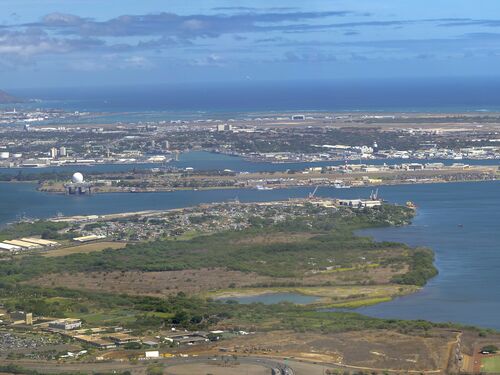
Aerial view of Pearl Harbor and Honolulu, Oahu, Hawaii, USA. From front to back - Pearl City Penninsula, (front right) Middle Loch with remnants of WWII mothball fleet, Ford Island, Joint Base Pearl Harbor-Hickam, Honolulu International Airport with Hickam Field to right, Honolulu, and Diamond Head. Photographed August 9, 2012, by 2018 the mothball fleet was gone.
WASHINGTON — Clinicians caring for individuals who were potentially exposed to drinking water contaminated by jet fuel accidently released on Oahu, Hawaii, in November 2021 should document exposure history, carefully evaluate symptoms, and ensure continuity of primary care as evidence continues to evolve, says a new report from the National Academies of Sciences, Engineering, and Medicine. Diagnostic or screening tests to determine past exposure are not currently available, underscoring the importance of clinical evaluation and ongoing patient-centered care. The report also calls for continued environmental oversight of the drinking water system, research to improve exposure characterization, health research, surveillance of the exposed community, and other efforts to rebuild trust.
As many as 93,000 people were impacted by two accidental releases of kerosene-based aviation fuel, known as JP-5, from the Red Hill Bulk Fuel Storage Facility. The fuel releases, which contaminated the drinking water supply for Joint Base Pearl Harbor-Hickam and the Aliamanu Military Reservation, were the first large-scale contaminations of a public drinking water system with JP-5 — a complex fuel whose components can evaporate into the air, which means residents could be exposed not only by drinking contaminated water but also by breathing JP-5 vapors or through skin contact. Many people in the community have experienced acute health issues, and concerns remain about potential long-term outcomes resulting from the exposure.
After reviewing available scientific evidence, the committee that wrote the report concluded that data are insufficient to determine the risks of specific long-term health outcomes associated with the exposure. Because of this uncertainty and the absence of validated exposure tests, the committee was unable to recommend specific diagnostic tests or exposure-based clinical interventions. However, the committee found limited, suggestive evidence linking jet fuel exposure to short-term respiratory, gastrointestinal, skin, and mental health symptoms.
The committee conducted an extensive review of the scientific evidence on the potential for long-term health risks of exposure to JP-5 and available exposure assessments and models. It also visited Red Hill and the Honolulu Board of Water Supply and engaged extensively with the impacted community through 15 liaisons that included active-duty service members, military families, civilians, and other Oahu residents, in addition to holding a number of virtual and in-person listening sessions.
“Recovery and healing will require compassion and understanding for the individuals and communities who have been affected by the Red Hill fuel leaks — transparency and coordinated response efforts across military and civilian agencies are critical to support this work,” said committee chair Grace M. Lee, chief quality officer and the Christopher G. Dawes Endowed Director of Quality at Stanford Medicine Children’s Health and Lucile Packard Children’s Hospital. “Our committee drew upon core public health functions and Native Hawaiian values to develop our evidence-based recommendations, which are intended to safeguard the health and well-being of exposed individuals in ways that are equitable and responsive to their needs.”
The committee found some evidence of prior drinking water contamination in Oahu, suggesting that low-level exposure before the November 2021 release is possible, with peak exposure most likely occurring between November 20 and December 3, 2021. Actions such as shutting down wells, flushing the distribution systems and household plumbing, and defueling the Red Hill facility likely reduced future exposures and helped protect public health, the report says. However, limitations in sampling methods, reliance on the odor of drinking water to guide health advisories, and the absence of specific biomarkers — molecular clues that help physicians detect or predict health conditions — make it difficult to fully characterize exposures. Experimental evidence suggests contamination levels were plausibly high enough to exceed safety factors for the chemical components of jet fuel.
Guidance for Clinicians
Because no clinical guidance currently exists for long-term health effects of jet fuel exposure, the report recommends that the Defense Health Agency, U.S. Department of Veterans Affairs, and members of the Red Hill community jointly develop guidance, emphasizing the importance of careful symptom documentation and clear communication between clinicians and patients as care evolves.
Improving Exposure Mitigation and Reassurance
Some residents using the formerly contaminated drinking water systems continue to distrust the safety of their drinking water, making exposure mitigation and reassurance a critical component of clinical care and patient counseling, the report says. Relevant partners — including the Defense Department, the U.S. Environmental Protection Agency, and state health and water resource management departments — should collaboratively and transparently ensure the safety of drinking water sources near the Red Hill facility, follow through on recommendations from oversight and accountability reviews, and jointly identify and apply lessons learned from the 2021 fuel releases to improve preparedness in other settings.
Expanding Data Collection and Research
In addition, data collection, analysis, and interpretation — a core component of public health assessments — should go beyond quantifying contaminants to include documenting the full scope of exposure, monitoring symptoms and health outcomes, and ensuring that affected populations are identified and followed over time. The independent Red Hill Registry, facilitated by the University of Hawaii, is a vital assessment activity that is actively enrolling the exposed population and capturing information about their symptoms. DOD should also maintain the Red Hill Defense Occupational and Environmental Health Readiness System Registry and expand it to include anyone who lived or worked at Joint Base Pearl Harbor-Hickam or Aliamanu Military Reservation from May 6, 2021, to March 18, 2022.
The VA and other government agencies should support research to develop and validate biomarkers of petroleum associated with exposure to jet fuel, standardize environmental sampling and chemical analysis methods for petroleum-contaminated drinking water, and characterize petroleum constituents from drinking water sources to points of use, the report says. Longitudinal, community-engaged studies are also needed on the potential health impacts of exposure to petroleum hydrocarbons associated with jet fuels, including epidemiologic studies that carefully measure physical and mental health outcomes, toxicologic studies that replicate realistic human exposure scenarios, and research to investigate short- and long-term health effects of jet fuel exposure.
The study — undertaken by the Committee on the Clinical Follow-Up and Care for Those Impacted by the JP-5 Releases at Red Hill — was sponsored by the U.S. Department of Defense and the U.S. Department of Veterans Affairs. The National Academies of Sciences, Engineering, and Medicine are private, nonprofit institutions that provide independent, objective analysis and advice to the nation to solve complex problems and inform public policy decisions related to science, engineering, and medicine. They operate under an 1863 congressional charter to the National Academy of Sciences, signed by President Lincoln.
Contact:
Dana Korsen, Director of Media Relations
Office of News and Public Information
202-334-2138; email news@nas.edu
Featured Publication
Clinical Follow-up and Care for Those Impacted by the JP-5 Releases at Red Hill
Consensus Study Report
·2026
In 2021, U.S. Navy personnel accidentally caused two releases of kerosene-based aviation fuel (jet propellant 5, or JP-5) from the Red Hill Bulk Fuel Storage Facility on O'ahu, Hawai'i, contaminating the drinking water supply for Joint Base Pearl Harbor-Hickam and the Aliamanu Military Reservation....
View details