Gulf Futures Challenge Awards $20 Million Each to Two Projects Building a Safer, More Resilient Gulf Coast
News Release
By Pete Nelson
Last update April 23, 2026
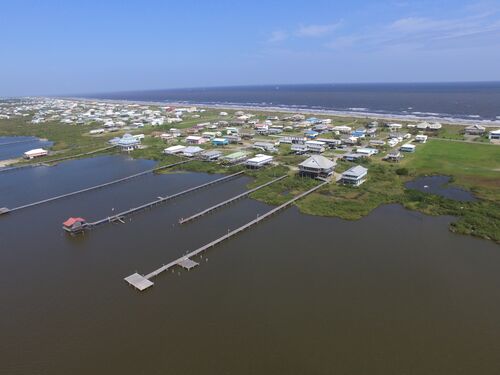
Drone aerial image of houses on a barrier island in Louisiana
WASHINGTON — The National Academies of Sciences, Engineering, and Medicine’s Gulf Research Program has awarded $20 million each to the Louisiana Public Health Institute and the Gulf Offshore Research Institute through the Gulf Futures Challenge, a $50 million initiative to fund projects that apply, translate, or communicate science, engineering, or medical knowledge to produce inclusive, innovative, and transformative solutions to the key challenges facing the Gulf Coast region.
These two awarded projects will strengthen the Gulf Coast by pairing local knowledge with bold scientific innovation to support the region’s people, ecosystems, economy, and shared future
The Louisiana Public Health Institute’s Gulf Hub initiative brings together a powerful, multi-state partnership — State (Louisiana, Mississippi, Alabama, Florida) Primary Care Associations, the Louisiana State University School of Public Health, the University of Miami Miller School of Medicine, Southern University’s School of Social Work, Crescent Care, the Mississippi Public Health Institute, Collective Energy, and 504HealthNet — to transform Community Health Centers into Learning Resilience Hubs, energy-independent, climate adaptive health care facilities that remain operational before, during, and after disruptions and disasters. These hubs will deliver uninterrupted care to more than 500,000 residents across four Gulf states while advancing long-term community and health care resilience.
The Gulf Offshore Research Institute’s Repurposing Petroleum Infrastructure for Sustainable Energy, Food, and Critical Minerals project — in partnership with Harte Research Institute, University of Michigan, Blue Latitudes LLC, University of Southern Mississippi, Louisiana State University, University of Houston, the FerVid Group, Blue Silo Aquaculture LLC, and the Gulf Trust — will research and demonstrate the repurposing of idle offshore oil and gas infrastructure to conserve marine habitat and enable a transition to green hydrogen, open ocean aquaculture, continuous data acquisition, and critical mineral harvesting.
“The Gulf Futures Challenge demonstrates the energy and creativity in the Gulf region,” said Lauren Alexander Augustine, executive director of the Gulf Research Program. “We asked the people of the Gulf for their visions for a brighter future, and they responded with a flood of exciting proposals. The Louisiana Public Health Institute and Gulf Offshore Research Institute’s projects are exemplary in combining fresh ideas with innovative partnerships.”
The Louisiana Public Health Institute and Gulf Offshore Research Institute were selected from 10 finalist projects. Each of the 10 finalist teams received an initial project development grant of $300,000 and received technical assistance to strengthen their proposals. The remaining eight finalists will each receive up to $875,000 in additional project development support.
The projects integrate science with real-world applicability, guided by their visions of what a stronger future for the Gulf could look like. They embody the collaborative spirit of the region, rooted in people-centered and community-driven approaches that honor local knowledge while transforming long‑standing challenges into pathways for future solutions.
“We are delighted by the national acknowledgement of the importance of offshore infrastructure sustaining essential marine habitats, while simultaneously highlighting the potential to advance a thriving and sustainable blue economy supporting coastal communities in the Gulf of America,” said Rob Fondren, co-founder and chairman of the Gulf Offshore Research Institute.
“Community health centers are deeply trusted local health care anchors that communities across the Gulf Coast rely on, especially in times of disruption and disaster,” said Shelina Davis, CEO of the Louisiana Public Health Institute. “Through Gulf Hub, we have the opportunity to equip these centers to remain open, connected, and responsive when care is needed most, while generating and sharing data that strengthens coordination, continuity, and long-term resilience across the region. We are deeply grateful to receive this award and to help advance a vision grounded in community, strengthened by partnership, and focused on lasting impact.”
The Gulf Futures Challenge, which was launched in June 2024, aimed to leverage the inherent talent and knowledge of the people of the Gulf region by supporting ideas and solutions from those who understand it best. The Gulf Research Program created the open competition to spark lasting systems change while delivering immediate protection for the Gulf Coast’s communities and the ecosystems that sustain them. The challenge received 164 compelling proposals from innovators in all five Gulf Coast states — Louisiana, Mississippi, Alabama, Florida, and Texas — and more than 100 reviewers directly evaluated science‑driven ideas that addressed real problems facing their communities.
“The awardees demonstrated how scientific innovation, community knowledge, and creative partnerships can come together to generate real and practical solutions,” said Marcia McNutt, president of the National Academy of Sciences. “These projects are not only technically sound but grounded in the realities of the Gulf region’s people, environments, and economies.”
The Gulf Futures Challenge was managed by Lever for Change, a nonprofit that leverages its networks to help donors find and fund bold solutions to the world’s biggest problems. All 10 finalist proposals have joined Lever for Change’s network, which offers ongoing learning and networking opportunities to expand the impact of their work, raise their visibility, and increase their potential to secure funding.
“The caliber of the proposals we received demonstrates how rigorous science can be translated into practical solutions and real-world resilience,” said Kristen J. Molyneaux, president and co-founder of Lever for Change. “Sustained, strategic investment is what will enable these projects to turn promising science into urgent, community‑level impact across the Gulf Coast. Donors interested in supporting these projects with additional funding can contact Lever for Change to continue advancing this work.”
To learn more about the Gulf Futures Challenge and the awarded projects, visit https://leverforchange.org/open-calls/gulf-futures-challenge/.
Contacts:
Pete Nelson
Director of Communications
Gulf Research Program
PNelson@nas.edu; 202-334-3989
Angie Ngo
Lever for Change