Navigating the Energy Transition in the Gulf of Mexico: Proceedings of a Workshop (2023)
Chapter: Summary
Summary
On December 6 and 7, 2022, the Gulf Offshore Energy Safety Board (GOES) of the Gulf Research Program (GRP) hosted a 2-day in-person workshop in Washington, DC, titled Navigating the Energy Transition in the Gulf of Mexico, to examine the potential future of the energy transition in the Gulf and corresponding challenges and opportunities that plausibly could emerge. The design, facilitation, and analysis of the workshop was supported through a partnership with the Center for Naval Analyses, an independent, nonprofit research and analysis organization dedicated to the safety and security of the nation. The workshop generated a wealth of insights on what is yet to come with the energy transition and ideas on how to leverage opportunities and mitigate negative consequences. Twenty-two individuals—representing diverse perspectives from industry, government, nongovernmental organizations, communities, and academia—participated in the workshop.
WORKSHOP GOAL AND STRUCTURE
GOES’s goal was to sponsor an exploratory workshop that would facilitate participants’ ability not only to identify challenges and opportunities but also to better understand them from the different perspectives of multiple stakeholder groups involved with the energy transition in the Gulf. Participants would then collaboratively identify potential strategies for mitigating, obviating, or overcoming the challenges and for enabling, supporting, and leveraging the opportunities.
To generate valuable discussion toward the workshop’s goal, GOES organized the workshop around a serious game that used the following two mechanisms to help prompt discussions among participants:
- Future scenarios: Two scenario narratives presented alternative future states of the energy transition in the Gulf by the year 2050.
- A map of the Gulf region: Participants interacted with a large printed map of the Gulf region, which was divided into six sections, each placed on a separate table. The map sections served as the “gameboard” for participants to record proposed impacts—both positive and negative—associated with the future scenarios.
Each day of the workshop addressed one of the two scenarios. On Day 1, participants focused on the Path to Net Zero scenario, which assumes that the United States achieves current federal goals of 100 percent clean electricity by 2035 and net-zero emissions by 2050. Discussions on this scenario were broken down into two turns—one focusing on changes from 2022 to 2035 and a second focusing on the subsequent years to 2050.
On Day 2 of the workshop, participants focused on the Steadying the Transition scenario, which presented a future without aggressive, sustained government support for the transition to renewables. This scenario had only one turn, covering changes from 2022 to 2050.
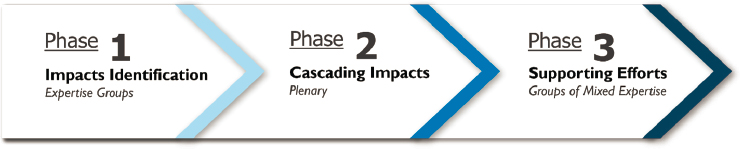
Each turn consisted of three phases (Figure S-1). For Phase 1 (Impacts Identification), participants were assigned to one of four expertise groups—academia/technical, community, governance, or industry—based on their backgrounds. From the perspective of their expertise group, participants identified additional plausible impacts associated with the energy transition described in the scenario. Participants recorded these impacts—both positive and negative—by placing pins on the appropriate map section and documenting additional details about the impact on accompanying notecards. For Phase 2 (Cascading Impacts), each expertise group selected one impact from among those its members generated in Phase 1 and presented it to the other groups in a plenary session. Participants from these groups were then asked to identify additional impacts that could cascade from the impact presented; these were added to the map sections. Finally, for Phase 3 (Supporting Efforts), breakout groups of mixed expertise—composed of representatives from each of the four expertise groups—were each assigned to a different map section. As time permitted, the groups discussed the impacts located on their map section, identifying what actions could be taken to mitigate the negative impacts and enhance the likelihood or benefits of the positive impacts.
Source: CNA.
WORKSHOP OUTPUTS AND KEY TAKEAWAYS
By the end of the workshop, participants generated a geospatial model of impacts associated with the two alternative future scenarios for the energy transition. In total, the workshop participants identified 291 impacts associated with the two scenarios.
Of these impacts, Table S-1 lists the 12 impacts that expertise groups selected to focus on during Phase 2 of gameplay. The color of each entry indicates whether the impact’s author identified the impact as positive (green) or negative (orange) from the perspective of their expertise group. Additional details about each impact, including summaries of the resulting cascading impacts, are provided in the main body of this proceedings.
In addition, the main body of this proceedings lists 54 recurring themes (e.g., workforce, technology) identified from a qualitative analysis of the 291 impacts, as broken down by the game’s three turns and whether the impacts were positive or negative. More broadly, a comparison of the impacts identified for each of the scenarios revealed the following observations.
Uncertainty in government commitment and funding will stymie transition progress, leading to reduced energy diversification and negative consequences for the Gulf region’s energy workforce.
Regardless of the U.S. position, international movement on the energy transition (e.g., regulations and requirements) will force change for industries, such as maritime transportation, that conduct business internationally. Participant reactions to the two scenarios pointed to sharp differences in the United States’ future role—that is, leading the energy transition globally versus reacting to international pressure or even potentially contributing to a collapse of international ambitions for the transition.
An accelerated rate of change (e.g., technological innovation) and implementation of renewable energy sources will present challenges for the workforce and education and retraining efforts to keep pace. Additionally, faster implementation increases concerns about unanticipated or emergent negative consequences—for example, land use for the development and siting of renewables—that could later lead to a slowdown of progress.
Current momentum for and resources associated with the energy transition also present an important opportunity to address long-standing problems such as industrial pollution, environmental justice, and aging infrastructure (e.g., the electric grid).
Environmental justice is a systemic problem in the Gulf region and will remain a challenge even with the transition to renewables. Moreover, environmental justice considerations extend not only to planning and implementing future efforts but also to prioritizing activities in ways that undo historic injustices.
Participants joined in a hotwash session on the second day to reflect on the workshop discussions and share some final thoughts. Table S-2 lists some key takeaways from this session.
| Path to Net Zero (2035) | Path to Net Zero (2050) | Steadying the Transition (2050) | |
|---|---|---|---|
| Academia/Technical | Rapid growth in wind development: By 2035, leaders in the Gulf region recognized that they were lagging in wind development, and policies and actions were implemented to spur truly clean wind development, using materials (e.g., steel) manufactured with zero emissions of criteria and hazardous pollutants, not just zero-carbon emissions. | Building innovation: The Gulf Coast experience with hurricanes led to improvements in building resilience. Climate change and a focus on justice and enabling people to stay in place spurred innovation in the building sector—based on building research—that kept people safe in heat waves, lowered energy demand, and reduced the total amount of energy infrastructure needed. | Training and education: Programs were negatively affected because of decreases in several sources of funding. As a result, the region experienced a loss of talent. In particular, the number of women and people of color in fields relevant to the energy transition decreased. |
| Community | Insurance loss: It became increasingly difficult for municipalities, businesses, and individuals to get insurance and financing, which hindered investments needed to facilitate the transition and accelerated migration challenges throughout the Gulf region. | Income gaps: The decision makers still did not reflect the local communities. Hence, gaps of haves and have-nots remained. | Wildlife impacts: Climate impacts to wildlife and habitats accelerated and negatively affected vulnerable species and ecosystems. Communities reliant on fishing, farming, etc. were left with fewer resources to support themselves. |
| Governance | Pipeline safety: Regulations (and technical standards) for new construction and retrofit of existing pipelines were updated, based on the results of research and development, to optimize safety in transportation and storage of gaseous and supercritical carbon dioxide, gaseous hydrogen, hydrogen blends in natural gas, ammonia, etc. | Renavigation of legacy zones: Legacy groups (military, fishing, oil and gas) operated in certain areas in the Gulf region that are ideal real estate for renewable energy infrastructure. By 2050, the Gulf states and the federal government navigated zoning to optimize energy infrastructure both on- and offshore. | Geothermal energy: Lack of community engagement on the role of geothermal technology resulted in very low adoption of geothermal heat pumps, and the Gulf states’ cost of building cooling was double the national average. |
| Industry | Skilled workers: As oil and gas activity slowed, other offshore industries benefitted from the skills, technology, and “offshore culture” developed in the past 70+ years along the Gulf Coast, accelerating their own industry development. | Resilient infrastructure: The Gulf Coast became a model for resilient infrastructure to overcome challenges from weather and other events (e.g., cyberattacks). | Energy policy volatility: Lack of clear, consistent government policy prevented industry capital investment, which caused waste, inefficiency, unreliable energy, boom/bust cycles, and unsteady employment. |
TABLE S-2 Key Takeaways from the Hotwash Session at the End of the Workshop
| Takeaway | Discussion |
|---|---|
| The challenge of accelerating efforts to meet net-zero goals while avoiding major problems associated with rapid change | As one participant stated, this workshop “underscored how little time we have if we are really going to meet net zero and how behind we are.” However, moving too quickly could lead to negative unintended consequences in the absence of an enterprise risk management framework for the entire Gulf region. |
| Concerns about winners and losers among the five Gulf states (Texas, Louisiana, Mississippi, Alabama, and Florida) | One participant asked what could be done to encourage the Gulf states to bolster one another rather than act as rivals in the energy transition. Tackling the energy transition requires interconnected stakeholder groups that share information transparently. Trying to tackle the energy transition individually risks limiting systems-level impacts. Participants drew inspiration from the Path to Net Zero scenario and discussed different entities (e.g., Gulf Ecosystem Restoration Council, Gulf of Mexico Alliance) that could serve as models for a leadership body to coordinate energy transition efforts among the five Gulf states. |
| The importance of education, especially early education, to the transition | As one participant noted, comprehensive K–12 education centered on renewables, as coordinated across the Gulf states, will lay important groundwork that will change cultural attitudes toward renewables and benefit the future workforce and community engagement. Another noted the need for a forward-thinking approach to preparing the next workforce. |
| Fears about environmental justice communities still getting left behind | One participant commented that strategies surrounding the energy transition fail to address existing problems and will create new ones. Responding to a question about possible exemplars, participants identified a few companies that they saw as at least somewhat successful in treating communities fairly in their energy transition efforts. They also emphasized the importance of learning from global examples, such as European countries further along in the transition. |
| Potential safety issues that could arise with the energy transition | With the potential growth of hydrogen, for example, communities face exposure to risks from the existing network of pipelines, as well as new pipelines, throughout the Gulf and how these pipelines are used, maintained, and monitored moving forward. More broadly, energy transition technologies and operational changes will have significant effects on risk profiles across the Gulf region. |
| The importance of leveraging incentives and regulatory requirements | When asked about the potential role incentives can play in driving change, participants provided several ideas, including incentives to encourage companies to offer apprenticeships and on-the-job training and to expand access to clean energy for disadvantaged communities. Participants also affirmed the need for regulatory requirements in some situations, even as they acknowledged the challenge of enforcing existing regulations. |
As the GRP enters its second decade and focuses on building and implementation activities, the energy transition represents one of the program’s major themes of work. In her opening remarks for the workshop, GRP executive director Lauren Alexander Augustine stated that the GRP hopes to make a difference in how the region is prepared and positioned as the energy transition takes place. As this proceedings shows, Navigating the Energy Transition in the Gulf of Mexico generated a wealth of insights on what is yet to come and ideas on how to leverage opportunities and mitigate negative consequences. It also brought together a diverse group of individuals to begin forming a collaborative community to help identify and tackle the hard problems associated with the energy transition. As such, this workshop served as a fitting kickoff to inform the GRP’s efforts moving forward.
This page intentionally left blank.


