Guide for Truck Parking Information Management Systems (2025)
Chapter: 1 Introduction

CHAPTER 1
Introduction
The safe and efficient movement of freight depends on adequate and strategically located truck parking (FHWA 2022). Federal Hours of Service (HOS) regulations require drivers to take breaks at defined intervals, causing them to search for parking before their allowable drive time expires or while staging for their pickup and delivery slots. This results in lost productivity, higher shipping costs, safety and environmental impacts of circulating trucks, and increased congestion (Federal Motor Carrier Safety Administration 2021 and 2022a). Safety is a primary goal of HOS regulations, and truckers need to rest and sleep regardless of requirements. The Large Truck Crash Causation Study reported that 13 percent of commercial motor vehicle drivers were considered to have been fatigued at the time of their crash (FHWA 2007).
Factors impacting a driver’s ability to park include capacity, accessibility, and availability. Capacity represents the number of authorized spaces to park at physical parking lots (the supply). Accessibility represents the ease of access (often measured by travel time, congestion, and distance) for a driver to reach a parking lot. Availability represents the remainder of truck parking capacity that is not used by other trucks (the demand) and is a highly variable factor that contributes to parking problems. Simply put, truck drivers do not know whether an upcoming truck parking lot will have available spaces for them, and with limited truck parking capacity in the system, it is challenging to predict how many spaces will be available when needed.
State departments of transportation (DOT) have utilized intelligent transportation systems (ITS) for decades to provide motorists with valuable information about traffic conditions ahead, such as congestion, crashes, or inclement weather (Intelligent Transportation Systems Joint Program Office 2020). Additionally, parking availability systems are widely deployed in other applications and settings—specifically, parking garages at airports, shopping malls, and stadiums have been using these systems to inform customers of available parking in crowded facilities.
A fusion of these two precedents created the concept of Truck Parking Information Management Systems (TPIMS), where truck parking infrastructure is equipped with parking monitoring systems that can assess near real-time availability and disseminate that information to truck drivers. By reporting current availability, approaching truck drivers are better able to assess parking availability and make informed decisions about when and where to stop for a break.
Purpose of This Guide
The purpose of the Guide for TPIMS (“Guide”) is to provide truck parking stakeholders with insights and resources for developing and deploying TPIMS where most beneficial. This Guide is a resource for planning processes that address the challenges associated with implementing
and operating an effective program. More specifically, this Guide will describe lifecycle processes associated with the following elements important to TPIMS implementation and operations:
- TPIMS goals and objectives.
- System planning, design, and applications.
- Implementation strategies and considerations.
- Management approaches and models.
While multiple stakeholders can benefit from the information provided herein, the Guide is primarily a resource for state DOTs, other public-sector agencies, and other roadway infrastructure owner-operators (IOO) considering TPIMS implementation. It presents a series of approaches and considerations for relevant agencies to assess as part of a comprehensive planning and management program for TPIMS. Note that the various elements of the TPIMS program lifecycle presented and discussed in this Guide are interdependent. For instance, decisions made in the planning, design, and deployment phases can impact operations and maintenance procedures. As a result, this Guide should be implemented holistically when developing a program rather than focusing on one particular element of interest without regard to other lifecycle elements.
Systems Engineering Development Process
The systems engineering development process is frequently referenced throughout this Guide. As a system of subsystems, TPIMS adheres closely to the development practices associated with building an ITS program or project. In the United States, the FHWA provides systems engineering resources for designing and deploying transportation systems and technologies (FHWA 2024). The systems engineering development process is a structured framework for defining a problem, identifying requirements for the solution, and implementing a system that can be verified and validated to meet user needs. When federal funds are involved, Part 940 of the Code of Federal Regulations (23 CFR § 940) requires that the systems engineering approach be followed. In the ITS community, systems engineering typically follows the steps in what is referred to as the V-diagram, shown in Figure 1.
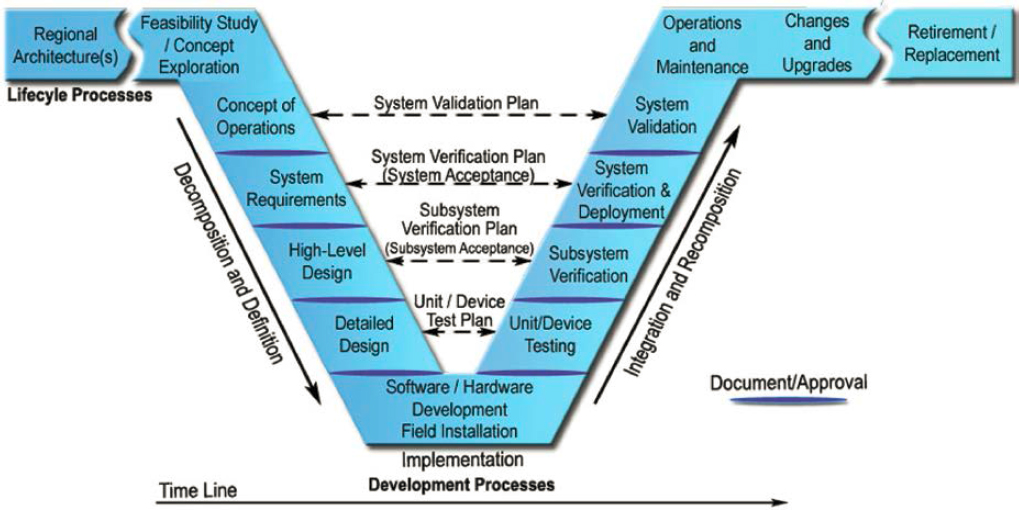
Figure 1. Systems engineering V-diagram.
The systems engineering V-diagram outlines considerations through the lifecycle of TPIMS, ranging from policy, planning, deployment, ongoing operations and maintenance, and eventually retirement. The V-diagram touches on certain key areas that are relevant in subsequent chapters of this Guide. Like many other ITS projects in the United States, the systems engineering process can be a guide to the development of TPIMS projects. For this reason, several chapters of this Guide will reference the overall systems engineering development process, as well as the preparation of specific documentation to guide agency decision-making.
How to Use This Guide
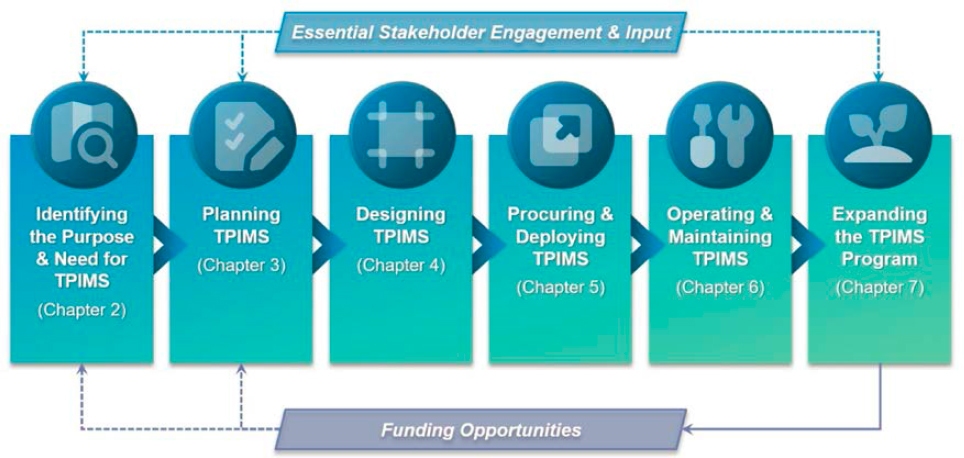
This Guide can be used by agencies as a decision framework for their TPIMS implementation. A decision framework is a set of principles, processes, and practices that proceeds from information and desires to choices that inform actions and outcomes (Lockie and Rockloff 2005). This Guide is framed around a series of key questions specific to TPIMS, applying a framework that utilizes information to guide decision-making and next steps. This process is summarized in Figure 2 with each of the following chapters of this Guide indicated. In answering these questions, agencies identify a problem that TPIMS is intended to address, as well as the system’s goals; the information gathered could be used to assess TPIMS deployment and management options; and engage stakeholders tasked with making decisions and establishing policies.
Agency staff can refer to this Guide as they reach each step in the process but can also “look ahead” to forthcoming steps as a current decision is likely to impact a future one. Furthermore, this Guide serves as a checklist confirming that each step of the TPIMS process has been considered.
This Guide is organized as follows:
- Chapter 1: Introduction. An introduction to TPIMS and this Guide.
- Chapter 2: Identifying the Purpose and Need for TPIMS. Use this chapter to understand the placement and role of TPIMS among a larger transportation program and its feasibility inside that structure. It also includes a brief primer on the trucking industry, its key issues, and business models that relate to truck parking.
- Chapter 3: Planning TPIMS. This chapter covers the planning-level considerations and requirements necessary to meet user needs, which is achieved by assembling Concept of
- Operations (ConOps) and System Requirements documents as part of the systems engineering development process.
- Chapter 4: Designing TPIMS. This chapter helps agencies with preparing plans and procurement documents following the system requirements identified through concept planning and exploration.
- Chapter 5: Procuring and Deploying TPIMS. This chapter guides agencies through procuring and deploying TPIMS, including verification testing to ensure the system meets design specifications and validation processes to confirm that goals and objectives are met.
- Chapter 6: Operating and Maintaining TPIMS. This chapter guides an agency with the decisions necessary for operating and maintaining a TPIMS system. Though this is one of the last steps in the systems engineering process, it is at the part of the lifecycle that is most greatly impacted by prior decisions made in the planning, design, and deployment phases.
- Chapter 7: Expanding the TPIMS Program. This chapter discusses the decisions and next steps involved in the expansion of a TPIMS program, including integration of TPIMS into the planning process, development of scalable designs, and potential funding opportunities.


