Peer Review of the Federal Aviation Administration's Study of the Effects of Passenger Seat Width and Pitch on Airplane Evacuation Performance (2025)
Chapter: 2 Background and Summary of the Civil Aerospace Medical Institute Research Project
2
Background and Summary of the Civil Aerospace Medical Institute Research Project
This chapter is a summary of the Civil Aerospace Medical Institute’s (CAMI’s) 2019–2020 evacuation research project as reported and documented in the report Effects of Airplane Cabin Interiors on Egress I: Assessment of Anthropometrics, Seat Pitch, and Seat Width on Egress.1 References are also made to the video recordings2 that accompanied the report and to CAMI’s documentation of the research project plan as submitted to the Federal Aviation Administration’s (FAA’s) Institutional Review Board (IRB) (see Appendix B). The discussion is intended to be descriptive only, summarizing what the CAMI researchers reported about the project’s objectives, methods, results, conclusions, and limitations, while saving the committee’s critical assessment for Chapters 3 and 4.
The chapter begins with an overview of some practical considerations and findings, as reported by CAMI, from past research on airplane evacuations that influenced several of CAMI’s decisions about the research project’s design and experimental setup. The reasons for the use of traditional measures of seat width and seat pitch, as opposed to other means of determining the seat space available to a passenger, are explained. So too are CAMI’s decisions to restrict eligibility for the study test group, use ramps at the exit doors, limit the number of evacuation trials assigned to each participant, motivate participant performance by using a competitive
___________________
1 Weed, D. B., et al. (2021). Effects of Airplane Cabin Interiors on Egress I: Assessment of Anthropometrics, Seat Pitch, and Seat Width on Egress. https://www.faa.gov/sites/faa.gov/files/2022-04/Effects_of_Airplane_Cabin_Interiors_on_Egress_I.pdf.
compensation scheme, and hire trained flight attendants to assist with the evacuation trials. The discussion then turns to a descriptive summary of the work—the stated objectives, selection of the study sample, and the study design and experimental methods employed for the three distinct (albeit connected) data collection activities. The results reported from the data collected and their analyses are then summarized along with the conclusions reached and study limitations acknowledged in the CAMI report.
SEAT PITCH VERSUS OCCUPIABLE SPACE
Seat pitch is the common term used in reference to the distance separating two passenger seats in successive rows, one seat in front of the other. The distance is typically measured from the same fixed point on each seat, such as the rear fitting where the seat attaches to the floor (see Figure 2-1). However, as the CAMI researchers note in their report, when changes are made to seat pitch and measured in this way, the effects on the occupiable space afforded to a passenger may not be well represented when other changes are also made to the design and dimension of the seats. Indeed, airplane passenger seats have undergone significant physical modifications over the past three decades due to revised safety regulations and changes in the construction technologies and materials used in seats and seat assemblies.3 Resultant changes to leg placement and attachment points and in the design of seat backs, bottoms, and cushions have affected occupiable space, potentially increasing this space even when seat pitch, as traditionally measured, has remained the same or declined.
The CAMI report points out that the United Kingdom Civil Aviation Authority4 has established other metrics for measuring occupiable seat space, such as the distances between the back of the seat and the seat cushion and seat back. If such measures of occupiable space are more informative than seat pitch to define the room available for a passenger to get into a seat and out of it quickly in an emergency, then an emphasis on traditional seat pitch measures when making safety assessments may be misplaced. However, these other metrics are not used in the CAMI research, which focuses on seat pitch and width.
___________________
3 Major changes in seat system designs occurred during the 1990s, following the introduction in 1988 of dynamic force performance standards (i.e., the 16g test in § 25.562) intended to provide increased occupant protection in survivable crashes.
4 United Kingdom Civil Aviation Authority. (2020). CAP 562: Civil Aircraft Airworthiness Information and Procedures, Leaflet 25-90 Minimum Space for Seated Passengers. https://www.caa.co.uk/publication/download/12181.
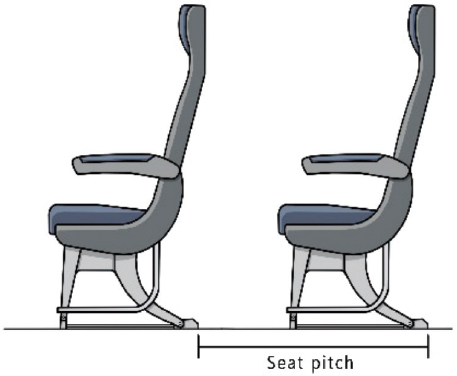
SOURCE: Weed et al. (2021).
https://www.faa.gov/sites/faa.gov/files/2022-04/Effects_of_Airplane_Cabin_Interiors_on_Egress_I.pdf.
INSIGHTS FROM PAST CABIN EVACUATION RESEARCH
To better improve passenger survivability in an emergency, CAMI has been conducting airplane cabin evacuation research since the 1960s. Another key contributor to this body of research has been the Aviation Psychology Department of Cranfield University in the United Kingdom. When designing the 2019–2020 data collection and evacuation trials that are the subject of this review, CAMI made a number of study design decisions that were informed by this past research.
Prior to its 2019–2020 trials, CAMI’s last major evacuation trials were conducted in 2002, using a narrow-body transport airplane simulator with a Type-III overwing emergency exit hatch (see Figure 2-2 for an example).5 A focus of that prior work was on understanding how the configuration of the passageway from the main aisle to the exit, operation and disposal of the hatch, and study test group size, motivation, and demographic and anthropometric characteristics (e.g., sex, age, waist size, and height) may affect evacuation performance. The investigators found that the physical
___________________
5 McLean, G. A., et al. (2002). Access-to-Egress I: Interactive Effects of Factors That Control the Emergency Evacuation of Naïve Passengers Through the Transport Airplane Type-III Overwing Exit. DOT/FAA/AM-02/16. Washington, DC: U.S. Department of Transportation. https://www.faa.gov/sites/faa.gov/files/data_research/research/med_humanfacs/oamtechreports/0216.pdf.
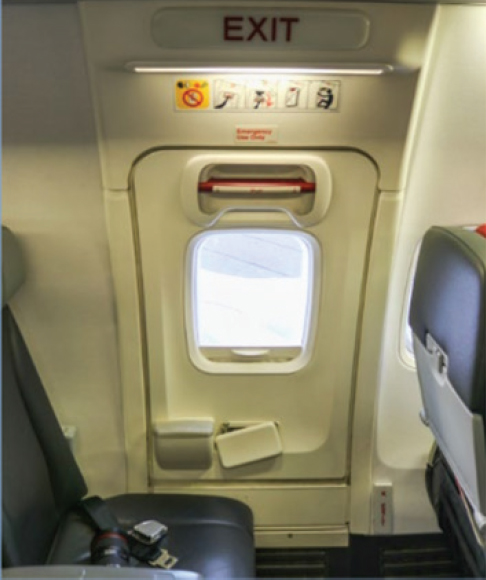
SOURCE: https://www.faa.gov/sites/faa.gov/files/2022-05/PL_115-254_Sec_323_Safety_of_Unoccupied_Exit_Rows.pdf.
characteristics of individuals did produce large differences in evacuation performance through a Type-III exit but concluded that passageway configuration had only minimal effects on evacuation performance.
While conducting those earlier trials, the CAMI investigators, like many previous researchers, had found that repetition leads to learning effects that can affect participant evacuation performance.6 In the earlier Type-III exit trials, variance in individual performance (i.e., evacuation times) tended to plateau after participation in four to six evacuations (i.e., effectively trained). A benefit of learning, therefore, is that variances observed in the evacuation times from a group of trained participants may be more confidently associated with the variables being manipulated in the experiment, such as seat dimensions, as opposed to variance caused by various degrees of participant naiveté. Using trained participants, however, opens the research to criticism about realism, as few airline passengers will ever have
___________________
6 Ibid.
experienced a single evacuation in real life, much less multiple evacuations. The use of a large number of participants to limit the number of trials assigned to each participant has therefore become more common to simulate realism and minimize learning effects.
Past evacuation trials have also shown that the use of inflatable slides at exits contributes to slower evacuations, as many evacuees will hesitate before jumping onto the slide.7 Here again, the introduction of realism by using slides has a disadvantage because participants can suffer a wide variety of injuries due to slow or incorrect dismounting or slide malfunction, including friction burns, cuts, sprains, bruising, and fractures. Because of the risk of injury, designers of evacuation trials are likely to use safer alternatives to slides, including platforms and low-incline ramps. Indeed, because of these and other safety concerns associated with evacuation trials involving human subjects, IRBs responsible for approving research designs for safety and ethical standards may be reluctant to allow slides or participation in trials by people considered at higher risk due to factors such as age, health, disabilities, and other physical limitations.
To add more realism to trials, the use of experienced flight attendants to direct the evacuation has been found to be helpful, indicative of the critical role these personnel play in the evacuation system.8 Evacuation researchers have also taken steps to increase the motivation of trial participants who may not otherwise exhibit the same urgency that is characteristic of passengers evacuating in an actual emergency. Trials that have manipulated participant motivation through means such as offering extra payments for being among the earliest to exit the cabin have maintained a level of performance likely to be observed in evacuations where passengers perceive that there is a potential threat to life. That increased motivation, however, can add to the risk of trial participation, creating another reason for precautions about trial eligibility (i.e., restricting participation by pre-adults and elderly) and experimental setup (i.e., use of ramps).9
___________________
7 McLean, G. A., George, M. H., Funkhouser, G. E., and Chittum, C. B. (1996). Aircraft Evacuations onto Escape Slides and Platforms I: Effects of Passenger Motivation. DOT/FAA/AM-96/18.
8 Muir, H., and Cobbett, A. M. (1995). Influence of Cabin Crew During Emergency Evacuations at Floor Level Exits. CAA Paper 95006:DOT/FAA/AR-95/52.
9 McLean, G. A., George, M. H., Funkhouser, G. E., and Chittum, C. B. (1996). Aircraft Evacuations onto Escape Slides and Platforms I: Effects of Passenger Motivation. DOT/FAA/AM-96/18; Muir, H. C., Marrison, C., and Evans, A. (1989). Aircraft Evacuations: The Effect of Passenger Motivation and Cabin Configuration Adjacent to the Exit. CAA Paper 89019. https://www.caa.co.uk/Documents/Download/10717/859935f7-65e5-4256-bd0c-5243271b52ff/29.
SUMMARY OF 2021 CAMI REPORT
The discussion that follows is entirely descriptive, summarizing the CAMI research project as presented in the 2021 research report (Effects of Airplane Cabin Interiors on Egress I: Assessment of Anthropometrics, Seat Pitch, and Seat Width on Egress) and accompanying documents, including the IRB document (see Appendix B). The report documents the research objectives, study test group selection, data gathering activities (measurements and experiments), results from data analyses, and conclusions reached, and acknowledges limitations. A summary of the reporting on each is provided next.
Stated Objectives
There are two places in the main body of the CAMI report where the research project’s objectives are stated. The first reference, on page 1, reads as follows:
- First objective: “to determine the percentage of the American population for whom ergonomic minimums are being violated at the lowest average seat spacing, and the percentage affected if that spacing was further reduced.”
- Second objective: “to determine what, if any, effect various seat pitch and width configurations have on the speed of a simulated airplane evacuation.”
The second time the objectives (on page 7) appear, they are written differently, as follows:
- First objective: “to determine what percentage of the American population, based on anthropometric measurements, would not be able to sit in transport airplane passenger seats at the currently narrowest and even narrower seat pitch.”
- Second objective: “to determine the effect of seat pitch and seat width on individual egress time.”
In addition, in the IRB proposal (see Appendix B), the objectives are presented as the following two research questions.
- Research Question 1: “What percentage of the population (based on body type) would a smaller seat pitch/width constitute a violation of the ergonomic minimums and a safety risk?”
- Research Queston 2: “Does egress time (DV1:DV2) differ as a function of seat pitch (V1) and seat width (V2)?” (where the dependent variables are individual evacuation time [DV1] and group evacuation time [DV2] and the independent variables are seat pitch [V1] and seat width [V2]).
Finally, a third, ancillary, objective is identified on page 7 of the CAMI report:
- to use these [collected anthropometric data] for ergonomic analyses of current and future seat designs and use in various computer-modeling efforts.
While only noted here, the implications of the differences in wording of the research objectives are discussed more in Chapters 3 and 4 when considering their clarity and coherence and their relationship to the research hypothesis being tested and the study design.
Study Test Group Recruitment
A study sample of 775 individuals was recruited for participation in the research project’s three data collection activities involving anthropometric measurements, seat experiments, and evacuation trials. CAMI contracted with an outside party to recruit participants from the state of Oklahoma. The contractor was tasked with providing a participant group consisting of approximately equal numbers of males and females with no more than 40% in any single age decade (18–30, 31–40, 41–50, and 51–60 years of age). People younger than 18 and older than 60 were supposed to be excluded for participant safety in the evacuation trials. The IRB proposal called for the contractor to screen the participants to ensure that they are in good physical and mental condition and have no other conditions that would endanger themselves or others by their participation in the project.
Apart from these constraints, the recruitment was supposed to yield a randomized study population with demographic and anthropometric characteristics representative of the U.S. population and air travelers generally. In this regard, the CAMI report states (p. 31) that “due to a lack of a database containing similar anthropometric information collected regularly from airline travelers (i.e., the flying public), this study comparison assumes that the general U.S. population well represents the flying public and that such a comparison is appropriate to see if the study population reasonably represents the U.S. flying public.”
Data Collection Measurements and Experiments
The research project consisted of the following three data collection activities, each of which is detailed next:
- anthropometric measurements of individuals
- seat experiments, including questionnaires
- evacuation trials, including questionnaires
Anthropometric Measurements
The anthropometric data collected focused on each participant’s body size and form. Each participant was measured for height, weight, girth, shoulder width (bideltoid breadth), sitting hip width, sitting buttock-to-knee length (BtK), and sitting knee-to-floor length (KtF). These measurements, along with participant demographic data (age, sex), were compared with U.S. population body size measurements from the 2017–2018 National Health and Nutrition Examination Survey (NHANES) conducted by the Centers for Disease Control and Prevention (CDC).
Seat Experiments
The researchers consulted online survey data (seatguru.com) that tracks the dimensions of airplane seats by airline, airplane type, and cabin configuration for the purposes of selecting the seat pitches and widths to be tested.10 Two rows of seats were thus configured with 28-inch and 26-inch seat pitches.11 The former (28 inches and labeled seat number 8) was determined to be the lowest seat pitch in the current airline fleet. The latter (26 inches and labeled seat number 5) was selected to investigate the percentage of the population that would be unable to sit in a seat if the pitch was lower than that currently found in airline service. Seat pitch was measured as the distance between a single point on a reference seat to the same point on the seat in front of and behind the reference seat (see Figure 2-1).
For these experiments that focused on seat pitch, the seat width was set at 17 inches for seats in both rows, which was reported as being the average across the transport airplane fleet, with 16 inches being the lowest in airline service. Seat width was measured as the distance between the armrests’ inner faces over the seat. The seats used were decommissioned
___________________
10 As noted by seatguru.com, how “seat width” is measured can vary between different suppliers and airlines.
11 See Figure 3 on page 10 of Weed, D. B., et al. (2021). Effects of Airplane Cabin Interiors on Egress I: Assessment of Anthropometrics, Seat Pitch, and Seat Width on Egress. https://www.faa.gov/sites/faa.gov/files/2022-04/Effects_of_Airplane_Cabin_Interiors_on_Egress_I.pdf.
older designs (1990s era), having thicker seat cushions than current airline seats that result in less occupiable space for a given seat pitch.
Study participants were observed trying to maneuver to and sit in a middle-of-row seat at each pitch. Because CAMI’s report does not explain how researchers determined when a participant could not sit in a seat, the study committee asked for an explanation and also observed the video footage. The committee was informed that participants were given the basic instruction of “please try to sit” in the seat and asked to lower the armrests if they raised them when attempting to sit. In the case of the seat configured with a 28-inch pitch, a participant observed moving the seat in front or moving the armrests and not being able to lower them would be judged as not being able to sit in the seat. These participants were immediately identified by research staff and handed a blue questionnaire, which was an indicator that they would be excluded from the subsequent evacuation trials involving seats configured with a 28-inch pitch. The blue questionnaire asked participants to rate the difficulty of getting into seat number 8 (at 28-inch pitch) (1 = very difficult, 3 = neutral, 5 = very easy) and to rate the difficulty of getting out of the seat.
When a participant tried to sit in the seat configured at the 26-inch pitch, no similar instructions were given to research assistants to observe and immediately judge whether the participant could sit. Instead, researchers handed each participant a white questionnaire after exiting the row. Both the white and blue questionnaires asked participants whether they could sit in the 26-inch seat (middle row, middle seat). However, the white questionnaire asked participants to rate the difficulty of getting into and out of the 26-inch seat as well as to rate whether they could get out of the seat quickly, while the blue questionnaire asked similar questions about the 28-inch seat pitch. The answers provided by participants to this question were used to determine how many participants could not sit in the seat configured with the 26-inch pitch. This judgment, therefore, was self-reported and not verified by the research staff during the experiment or after the experiments through observation of the video footage.
Both the blue and white questionnaires also asked participants how many flights they have taken in the last 12 months and how experienced they are in flying on passenger airplanes.
Evacuation Trials
The evacuation trials were conducted in a narrow-body cabin simulator, consisting of a single main cabin aisle with 11 seat rows. The seat rows consisted of six seats configured with three seats abreast on either side of the aisle. The seats were equipped with seat belts, and participants were instructed to buckle them prior to the start of the evacuation trial. Two seat
widths (16 and 18 inches) were selected for the trials, presumably because they represented seat widths found in the existing fleet, with 16 inches being the lowest. The likelihood of a narrower seat width being deployed in service was judged to be unlikely by the CAMI researchers. Seat width was manipulated by attaching armrest spacers that prevented the armrests from being raised (see Figure 2-3).
Three seat pitches (28, 32, and 34 inches) were tested. The control seat configuration consisted of seats with a 32-inch pitch. The experimental seat configurations consisted of seats with 34- and 28-inch pitches, varying by trial. The report does not explain why the 26-inch pitch was not tested, but presumably because it is not a dimension found in the fleet and is considered unlikely to be deployed, as a practical matter, based on the results of the seat experiments (the results of which are discussed later in this chapter and considered further in Chapters 3 and 4).
Ramps with handrails were placed at the exit door, which was configured so that the evacuation pathway was the same for all evacuation trials. Participants were required to travel all the way forward and to the right to exit (see Figure 2-4). The exit door was sized to represent Type-I exits, deemed to represent the majority of aircraft doors on narrow-body airplanes.
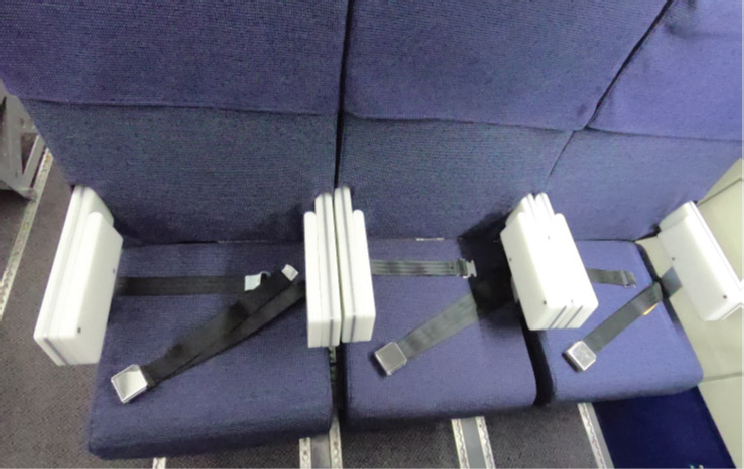
SOURCE: Weed et al. (2021).
https://www.faa.gov/sites/faa.gov/files/2022-04/Effects_of_Airplane_Cabin_Interiors_on_Egress_I.pdf.
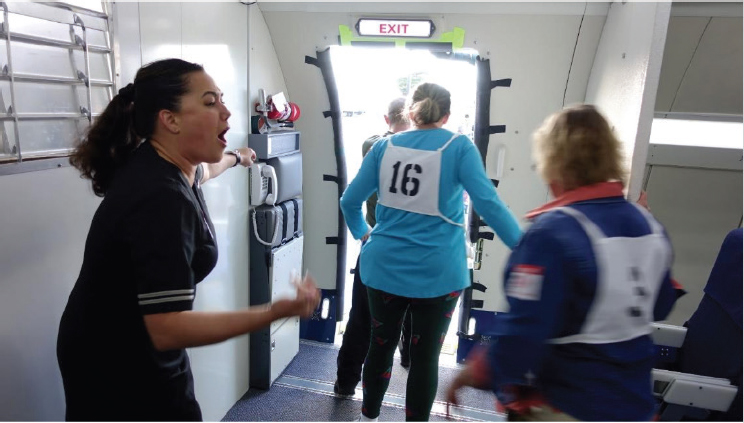
SOURCE: Weed (2022). https://www.fire.tc.faa.gov/2022Conference/session_details.asp?sessionID=3.
Based on a pretest power analysis, it was determined that 12 groups of 60 participants each would be adequate to provide sufficient evacuation data to find an effect. This required 720 participants from the original 775 people recruited for the study test group. It is not clear from the report how the 720 participants were selected for the four groups of 60, except (as noted above) that the decision was made at the outset to exclude anyone from the trials involving the 28-inch seat pitch who was determined to have been unable to sit in the experimental seat having this pitch.
Accordingly, eight groups from the sampled subjects were each assigned to four trials, performed with seat pitch/width pairings of 28/16, 28/18, 32/16, and 32/18. Four groups were each assigned to four trials performed with seat pitch/width pairings of 32/16, 32/18, 34/16, and 34/18. The researchers asserted that a limit of four trials per participant would ensure that participants remained naive to evacuations to better represent the actions of the flying public during an actual aircraft evacuation. Participants were seated so that no participant sat within three rows closest to or farther from the exit more than once in the four trials. There was no attempt to place participants in specific seating locations (i.e., aisle, middle, window seats) based on their demographics, anthropometry, or other additional criteria; hence, in this regard, the seating assignments were randomized.
All participants received a base payment per trial and extra payments based on evacuation performance to enhance motivation. Each trial began with participants being instructed that their evacuation path was “all the
way forward and to the right” and to treat the scenario as if the plane were on fire. Trained flight attendants were positioned to direct the evacuations. Participants were directed to follow the commands of experienced flight attendants and to evacuate as quickly as possible. The evacuations commenced at the sounding of a buzzer.
Video cameras recorded the 48 trials, including the order and timestamp of participants who fully exited the doorway onto the ramp. Group evacuation times were deconstructed into individual evacuation times. Individual evacuation times were derived by analyzing each evacuation video to determine the timestamp for when each participant completely exited the simulator. A participant’s timestamp was subtracted from the timestamp of the preceding participant who had exited the simulator door. In this way, the time interval for a participant to exit was derived, which is the equivalent of a flow rate for the individual participant.
Analyses and Reported Results
Demographics and Anthropometry
Of the 775 recruited participants, slightly more than half (52.5%) were females. The average age of all participants was 35.6 years, with a range of 18 to 64. Four individuals were found to be over the age of 60 due to an oversight in recruiting. The recruiter succeeded in ensuring that no more than 40% were from a single age decade. Participants who were 18–30 years old accounted for the largest percentage (37.8%), while participants 51 and older accounted for the smallest (14%). The number of participants by age range and gender is found in Table 2-1.
TABLE 2-1 Number of Female and Male Participants per Age Group
| Age (Years) | Frequency | Percent | Cumulative Percent | |||
|---|---|---|---|---|---|---|
| Female | Male | Female | Male | Female | Male | |
| 18–30 | 132 | 161 | 32.4 | 43.8 | 32.4 | 43.8 |
| 31–40 | 115 | 98 | 28.3 | 26.6 | 60.7 | 70.4 |
| 41–50 | 92 | 68 | 22.6 | 18.5 | 83.3 | 88.9 |
| 51–60 | 65 | 40 | 16 | 10.9 | 99.3 | 99.7 |
| 61+ | 3 | 1 | 0.7 | 0.3 | 100 | 100 |
| Total | 407 | 368 | 100 | 100 | ||
SOURCE: Data from Tables 3 and 5 in Weed et al. (2021).
https://www.faa.gov/sites/faa.gov/files/2022-04/Effects_of_Airplane_Cabin_Interiors_on_Egress_I.pdf.
The researchers compared the participants’ measurements of height, weight, and girth with those of participants aged 18 to 60 years in CDC’s NHANES data for 2017–2018, specifically comparing the 50th and 95th percentile value for each dataset by sex (see Table 2-2). Except for the 95th percentile female weight, the study participants were reported to be slightly larger than the American public as represented by NHANES survey data. The researchers noted that NHANES survey data indicated, when examined over time, that the average weight and girth of Americans has been increasing over the past several decades, but that other physical dimensions potentially relevant to evacuation ability, including upper leg length and height, have remained mostly unchanged. The researchers noted that there is no database containing similar anthropometric information collected regularly from airline travelers.
Pre-Trial Seat Experiments
Based on the method described above, six of the 775 participants (five male, one female) were determined by research staff to be unable to fit in the seat configured with a 28-inch pitch (seat number 8—last row, middle seat).
With one exception, the participants who were judged to be unable to sit in the seat configured with a 28-inch pitch were in the 95th percentile for BtK. The one exception was a participant who was observed (upon review of the video by CAMI researchers) as being unable to maneuver easily to the seat due to the interaction of weight, girth, and height.
When tested at the 26-inch pitch, 56 participants self-reported in the white questionnaire that they were unable to sit in the seat (seat number 5), which was also configured to a 17-inch width. Another participant did not fill out the questionnaire. Including the six participants who were judged to be unable to sit in the seat having the 28-inch pitch, this would mean that 62 of 774 participants12 (8%) were unable to sit in the seat with a 26-inch pitch. Of the 712 participants who reported that they were able to sit in the seat, 60% reported that getting out of the seat was difficult or very difficult. Nearly 70% of the participants reported that getting out of the seat quickly would be difficult or very difficult.
Evacuation Trials
Of the 720 study test group participants needed for the trials, 718 participated in at least one evacuation and 707 participated in all four. The report notes that due to participant recruitment issues and participants dropping
___________________
12 As noted in the CAMI report, one participant did not complete a questionnaire.
TABLE 2-2 Comparison of Similar NHANES and CAMI Study Anthropometrics by Female and Male with Delta
| Female | |||||||||
| Current CAMI Study | NHANES Data | Delta | |||||||
| Percentiles | Height (cm) | Weight (kg) | Girth (cm) | Height (cm) | Weight (kg) | Girth (cm) | Height (cm) | Weight (kg) | Girth (cm) |
| 50 | 163.6 | 79.9 | 96.9 | 160.8 | 73.2 | 94.6 | 2.8 | 6.7 | 2.3 |
| 95 | 174.66 | 123.86 | 132.1 | 172.59 | 124.8 | 131.24 | 2.07 | –0.94 | 0.86 |
| Male | |||||||||
| Current CAMI Study | NHANES Data | Delta | |||||||
| Percentiles | Height (cm) | Weight (kg) | Girth (cm) | Height (cm) | Weight (kg) | Girth (cm) | Height (cm) | Weight (kg) | Girth (cm) |
| 50 | 176 | 91.35 | 102 | 174.6 | 85.5 | 98.9 | 1.4 | 5.85 | 3.1 |
| 95 | 188.43 | 141.45 | 139 | 187.2 | 132.8 | 132.6 | 1.23 | 8.65 | 6.4 |
NOTE: CAMI = Civil Aerospace Medical Institute; cm = centimeters; kg = kilograms; NHANES = National Health and Nutrition Examination Survey.
SOURCE: Data from Table 15 of Weed et al. (2021).
https://www.faa.gov/sites/faa.gov/files/2022-04/Effects_of_Airplane_Cabin_Interiors_on_Egress_I.pdf.
out, two of the 12 test days had fewer than the requested 60 participants per evacuation group; test day 1 had 54 participants and test day 5 had 58 participants. As noted, five of the six participants who were judged to be unable to sit in the 28-inch seat pitch mock-up were deemed ineligible for the trials, although one was later assigned to the trials involving the larger (32- and 34-inch) seat pitches. The participants who self-reported that they could not sit in the experimental seat with a 26-inch pitch remained eligible for the trials because they all could in the experimental seat configured with a 28-inch pitch. The report does not explain how participants were assigned to seats in the cabin, and which seats were left empty, in those instances when participant numbers fell short of 60.
The data collected from the trials were summarized in descriptive tables and analyzed using multiple regression techniques. The results for group and individual evacuation times and their interactions with seat width and seat pitch were reported as follows:
Group Evacuation Times Group evacuation times (adjusted to account for the fact that one test group included only 54 participants) ranged from 30.63 to 43.77 seconds across the 48 trial runs (see Tables 2-3 and 2-4). The first evacuation was the slowest, and times generally decreased as trail runs increased.
Individual Evacuation Times The approach used to deconstruct group evacuation times into individual evacuation times was to analyze each evacuation video to determine at what timestamp each participant completely exited the simulator. Each participant’s timestamp was then subtracted from the timestamp of the participant immediately preceding them out the simulator door. To be precise, the time interval derived using this method is
TABLE 2-3 Evacuation Times of the First Comparison Group for Test Days 1–8 and Trials 1–32 by Seat Pitch and Seat Width
| Basic Descriptive Statistics | |||
|---|---|---|---|
| Pitch and Width Combination | Min (Fast) | Mean | Max (Slow) |
| 32/18 | 30.63 | 37.06 | 43.77 |
| 32/16 | 32 | 36.34 | 39.42 |
| 28/18 | 33.53 | 37.43 | 43.03 |
| 28/16 | 33.68 | 38.25 | 42.52 |
NOTE: All times are in seconds.
SOURCE: From Table 25 of Weed et al. (2021).
https://www.faa.gov/sites/faa.gov/files/2022-04/Effects_of_Airplane_Cabin_Interiors_on_Egress_I.pdf.
TABLE 2-4 Evacuation Times of the Second Comparison Group for Test Days 9–12 and Trials 33–48 by Seat Pitch and Seat Width
| Basic Descriptive Statistics | |||
|---|---|---|---|
| Pitch and Width Combination | Min (Fast) | Mean | Max (Slow) |
| 32/18 | 32.67 | 35.86 | 38.95 |
| 32/16 | 32.48 | 34.33 | 38.07 |
| 34/18 | 33.65 | 36.1 | 38.38 |
| 34/16 | 30.77 | 33.66 | 36.08 |
NOTE: All times are in seconds.
SOURCE: From Table 26 of Weed et al. (2021).
https://www.faa.gov/sites/faa.gov/files/2022-04/Effects_of_Airplane_Cabin_Interiors_on_Egress_I.pdf.
the inverse of the “flow rate” for an individual participant rather than the individual evacuation time. The times of the first evacuee in each of the 48 trials were removed from the initial individual evacuation times analysis on the suggested grounds that these 48 times were essentially a measure of reaction time and evacuation speed for the first evacuee.
Individual evacuation times were screened for outliers—considered to be those evacuation times that were three standard deviations (three sigma) above or below the average group evacuation time for each combination of seat pitch and seat width. Using these outlier criteria, the researchers removed 34 individual evacuation times that were three sigma greater than the mean, resulting in 2,510 individual evacuation times for final analysis. All 34 of the removed outlier times were slower (ranging from 1.3 to 3.08 seconds) than their respective group averages. The researchers then performed multiple regression analysis on the remaining 2,510 individual evacuation times to assess the relative significance of participant attributes (i.e., demographics and anthropometrics) to the average individual evacuation times for each participant.
The researchers reported that their analysis revealed that participant gender, girth, age, and KtF were significant predictors of average individual evacuation times and should be covariates in any further analyses. The statistical significance of gender, girth, and age was reported to be consistent with previous evacuation research results,13 while the statistical significance
___________________
13 McLean, G. A. (2001). Access-to-Egress: A Meta-analysis of the Factors That Control Emergency Evacuation Through the Transport Airplane Type-III Overwing Exit. Office of Aerospace Medicine Technical Report DOT/FAA/AM-01/02. Washington, DC: U.S. Department of Transportation.
of KtF (which had not been measured in previous studies) was reported to be a new finding.
Individual Evacuation Times: Interaction of Seat Pitch and Seat Width Two 2×2 Repeated-Measures Analysis of Covariance (RM-ANCOVA) were performed by investigators to determine if a significant interaction existed between seat pitch and seat width while accounting for the significant covariates of gender, girth, age, and KtF. Both RM-ANCOVAs were non-significant at the p = .05 level. They reported no significant differences in individual evacuation times due to seat pitch and seat width when accounting for the covariates of gender, girth, age, and KtF.
Individual Evacuation Times: Effect of Seat Pitch Multiple RM-ANCOVAs were performed by the researchers to evaluate the main effect of seat pitch on individual evacuation times while accounting for the previously identified covariates. Four separate ANCOVAs were performed and all four were insignificant at the p = .05 level. They found no significant differences in individual evacuation times due to seat pitch when accounting for the covariates of gender, girth, age, and KtF.
Individual Evacuation Times: Effect of Seat Width Multiple RM-ANCOVAs were performed to evaluate the main effect of seat width on individual evacuation times while accounting for the previously identified covariates. Three additional ANCOVAs were performed, and all three were insignificant at the p = .05 level. They found no significant differences in individual evacuation times due to seat width when accounting for the covariates of gender, girth, age, and KtF.
Conclusions Reached by CAMI Researchers
Representation of Demographics and Anthropometrics of Test Subjects in CAMI Report
As previously noted, the research project assumes that a study sample that is representative of the U.S. population will also be generally representative of the flying public, absent more specific information about the flying public. The CAMI report notes that the anthropometric data gathered indicated that the study population tended to be slightly larger and heavier than the general U.S. population as indicated by NHANES data. The investigators reported that the study test group, therefore, could be considered to move slower than the U.S. population, albeit generally representative of that population.
Minimum Seat Pitch
Because less than 1% of the study test group participants could not sit in the experimental seat configured with a 28-inch seat pitch, the report concludes that this seat dimension should not impede the ability of a large majority of people to fit into seats and fly. Because about 8% of participants were unable to fit in the experimental seat having a 26-inch pitch (including the six who could not sit in the seat having a 28-inch pitch), the researchers concluded that a reduction in seat pitch from 28 inches to this lower pitch could have a detrimental impact on the ability of a larger percentage of the population to sit in the seats and fly.
Significance of Seat Dimensions on Evacuation Times
While the study identified key physical characteristics (age, girth, gender, and KtF) that accounted for significant variation in evacuation times, the investigators reported finding no significant statistical differences in group evacuation time based on seat pitch, seat width, or a combination of the two. The statistical significance in individual evacuation time that was found for sex, girth, and age was characterized as being consistent with previous evacuation research results, while the statistical significance of KtF was characterized as a new finding. The previous evacuation research cited included trials involving Type-III emergency exit hatches that had shown that increased participant girth leads to slower movement and evacuation time of individuals but not to group evacuation speed. The study results were therefore characterized as adding to the body of knowledge of previous airplane evacuation research (including knowledge about the effects of body size on individual evacuation times) but with the findings of no discernable difference in group evacuation times due to seat dimensions.
Because a 28-inch pitch is the narrowest currently in the domestic airplane fleet and only six of the 775 people in the study population could not sit in seats having this pitch, the researchers concluded that the seat pitches tested in this study, which prevail in the fleet, “should provide protection and not impede” evacuation “for 99% of the general U.S. population.” The report further concludes that if ergonomic minimums are maintained (i.e., passengers can sit in the seat), an aircraft’s interior configuration should not have a significant impact on evacuations. The report offers the caveat, however, that if passenger size and shape change enough over time, this may change ergonomic minimums and their compatibility with interior configurations.
Acknowledged Limitations
The report acknowledged that the findings from the study are indicative of only a small (albeit important) number of the many variables that influence real-world airplane evacuations (i.e., there is no structural damage to the aircraft that impeded evacuation, the aircraft is on its landing gear, passengers are not injured in the landing, there is no fire or debris in the cabin). The authors also acknowledged that the study did not consider passenger comfort (or the lack thereof), which may impact a passenger’s sense of well-being during a flight.
This page intentionally left blank.


