Digital Model–Based Project Development and Delivery: A Guide for Quality Management (2025)
Chapter: Appendix F: Sample Quality Artifacts and Checklists
APPENDIX F
Sample Quality Artifacts and Checklists
This appendix provides sample quality artifacts and checklists that agencies can use to develop their preferred forms of quality management records. The samples include exported reports, sample Model Element Tables (METs), and checklists.
Quality Artifact
A bridge review generated from Bentley’s PW365 Design Review, a type of 3D modeling review software, was selected for this appendix as a sample quality artifact. This review was conducted in the review software and all comments, and their resolutions, were exported as a table along with images of the model where those comments were made. Saved views of comments made in the model were also exported to PDF.
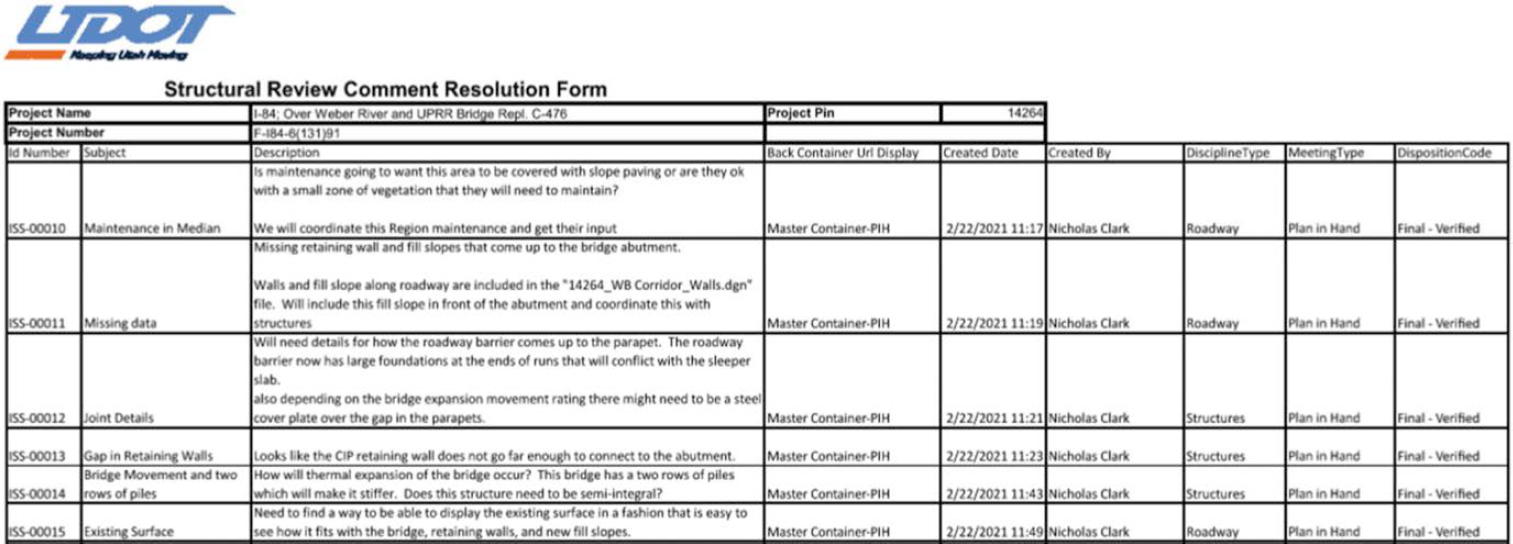
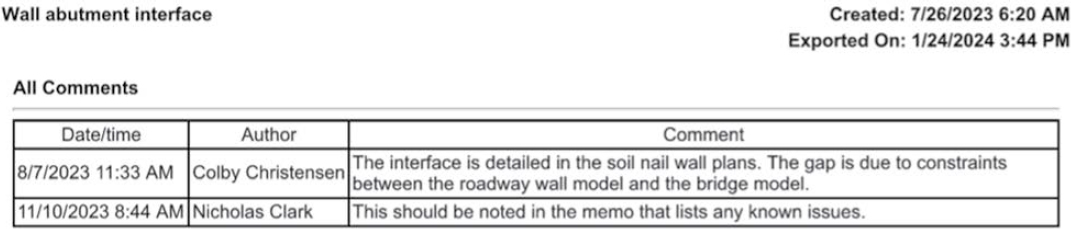
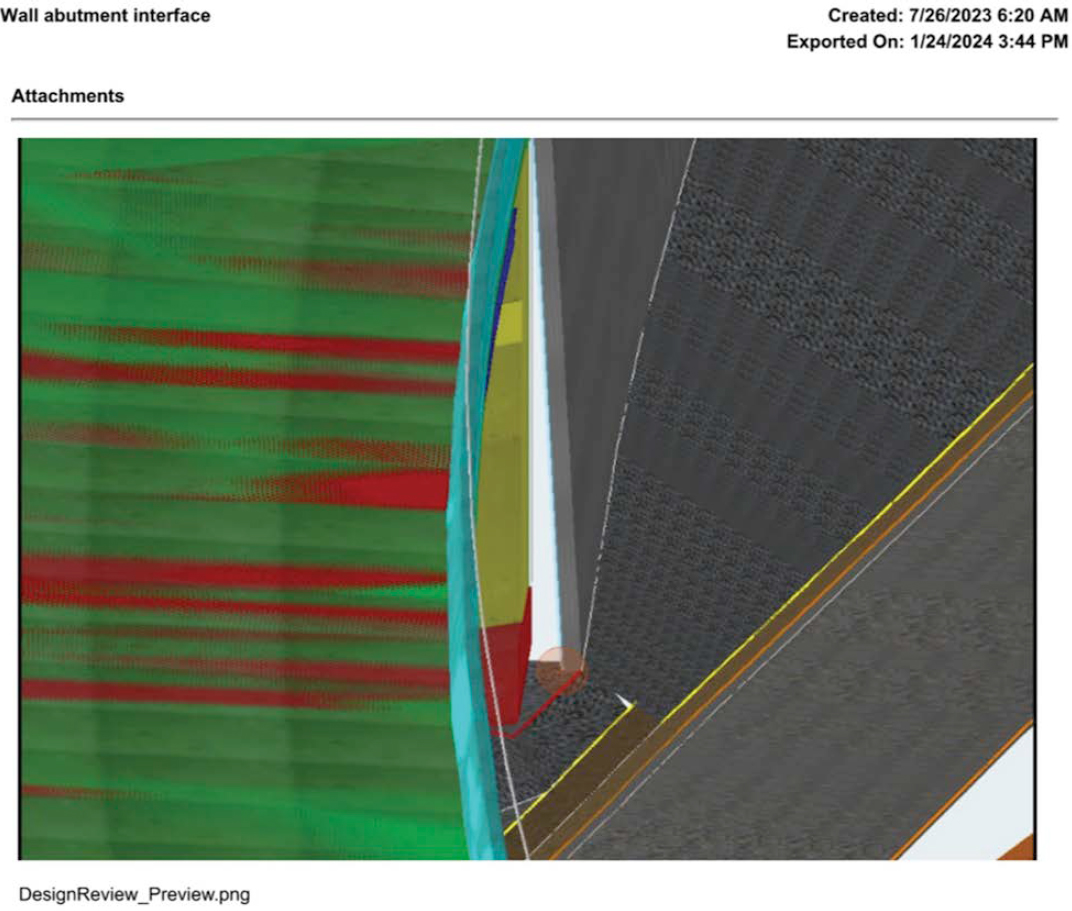
Figure F-1 is an excerpt of the Structural Review Comment Resolution Form, which was exported once the review was completed as a quality artifact of the milestone review. The comment resolution form contains the ID number, comment, model container, comment creation data and author, discipline type, and disposition code. Figure F-2 shows the specific issue of a wall abutment interface and includes a description, reviewer information, and final approval. Figure F-3 shows the comment log with time and date stamps of the review. Figure F-4 shows the bridge model and the area where the comment is attached. This series of figures provides an example of a review software export that can be used as a quality artifact for the review.
MET and Checklists
The sample MET and checklists can be found in Appendix F Addendum: Review Checklist Spreadsheet on the National Academies Press website (nap.nationalacademies.org) by searching for NCHRP Research Report 1153: Digital Model–Based Project Development and Delivery: A Guide for Quality Management. These artifacts and checklists serve as examples and are not comprehensive lists of everything to be reviewed in a model.
METs provide a robust list of elements included in a model. They can serve as a quality artifact when used to verify that the elements listed are included in the model or converted into a checklist. Reviewers can make comments in the MET checklist about each element in the model. The sample MET that was selected for this appendix was adapted from the PennDOT Digital Delivery Model Element Breakdown.
Agencies can compare review components provided in the examples to gain a general understanding of what might be unknown or intimidating concepts for anyone new to reviewing models. This information can augment existing materials or be used to create new review tools, checklists, and documentation. Table F-1 lists the eight example artifacts found in the spreadsheet and explains the key model review concepts that they illustrate.
Source: HDR with permission.

Source: HDR with permission.
Source: HDR with permission.
Source: HDR with permission.
Table F-1. List of sample quality artifacts provided.
| No. | Name | Review Type | Key Review Concepts |
|---|---|---|---|
| 1 | MET - Modeling Standards | Model Element Table (MET); Modeling Standards | A MET can be used as a checklist as it lists out all modeled elements included in the model and their design requirements, such as level of detail (LOD), Level of Information Need (LOIN), and authorized uses. The MET can be modified for each milestone to indicate what LOD and LOIN levels are required for 30%, 60%, 90%, and final deliverables. Agencies can use this as a template to provide reviewers with an ordered method of stepping through and checking off requirements for each element as well as documentation to confirm each element was reviewed. |
| 2 | Corridor - Modeling Standards and Integrity Review | Modeling Standards; Model Integrity | Checklist of considerations when reviewing corridor models, including survey and design standards, model structure, and design criteria specific to the project. |
| 3 | Drainage - Model Integrity Review Checklist | Model Integrity - Drainage | Checklist of example items to be considered when validating the quality of a drainage model, including file structure, model structure, and design constraints. |
| 4 | 3D Engineered Model QC Checklist | Model Integrity - Roadway | Checklist for quality control of 3D road models, created by Florida Department of Transportation. Items to review include geographic coordinate system, completeness, consistency between model and views, verifying surfaces, and checking for clashes/clearances. |
| 5 | Model Element Checklist | Model Integrity | Checklist of items to be considered when checking integrity of model elements to confirm they have been created correctly. |
| 6 | ORD 3D Model Checklist | Clash Detection and Spatial Coordination Review; Model Integrity - Roadway | Checklist for 3D road model elements, created by the Tennessee Department of Transportation. Includes a mix of model integrity and discipline design items. |
| No. | Name | Review Type | Key Review Concepts |
|---|---|---|---|
| 7 | Bridge Design Review Checklist | Model Integrity; Discipline Design - Bridge | Checklist has a starter list of review items on bridge models. This list includes “overview” items on how the bridge comes together as a whole, model structure such as file hierarchy and model attribution, and detecting conflicts and constructability issues throughout build order and phasing. Checklist for a single element, the deck, demonstrates areas of concern when looking at individual bridge elements in a 3D model, such as steel reinforcement and complex details that may or may not be modeled in 3D. |
| 8 | Survey Data Checklist | Survey (Geodetic, Topographic Features, 3D Surfaces) | Checklist that can serve as a starter list for reviewing survey data. Items of note include formatting, verifying digital data, producing quality computer-aided design and drafting files, and reviewing topography and surfaces. |
Abbreviations and acronyms used without definitions in TRB publications:
| A4A | Airlines for America |
| AAAE | American Association of Airport Executives |
| AASHO | American Association of State Highway Officials |
| AASHTO | American Association of State Highway and Transportation Officials |
| ACI–NA | Airports Council International–North America |
| ACRP | Airport Cooperative Research Program |
| ADA | Americans with Disabilities Act |
| APTA | American Public Transportation Association |
| ASCE | American Society of Civil Engineers |
| ASME | American Society of Mechanical Engineers |
| ASTM | American Society for Testing and Materials |
| ATA | American Trucking Associations |
| CTAA | Community Transportation Association of America |
| CTBSSP | Commercial Truck and Bus Safety Synthesis Program |
| DHS | Department of Homeland Security |
| DOE | Department of Energy |
| EPA | Environmental Protection Agency |
| FAA | Federal Aviation Administration |
| FAST | Fixing America’s Surface Transportation Act (2015) |
| FHWA | Federal Highway Administration |
| FMCSA | Federal Motor Carrier Safety Administration |
| FRA | Federal Railroad Administration |
| FTA | Federal Transit Administration |
| GHSA | Governors Highway Safety Association |
| HMCRP | Hazardous Materials Cooperative Research Program |
| IEEE | Institute of Electrical and Electronics Engineers |
| ISTEA | Intermodal Surface Transportation Efficiency Act of 1991 |
| ITE | Institute of Transportation Engineers |
| MAP-21 | Moving Ahead for Progress in the 21st Century Act (2012) |
| NASA | National Aeronautics and Space Administration |
| NASAO | National Association of State Aviation Officials |
| NCFRP | National Cooperative Freight Research Program |
| NCHRP | National Cooperative Highway Research Program |
| NHTSA | National Highway Traffic Safety Administration |
| NTSB | National Transportation Safety Board |
| PHMSA | Pipeline and Hazardous Materials Safety Administration |
| RITA | Research and Innovative Technology Administration |
| SAE | Society of Automotive Engineers |
| SAFETEA-LU | Safe, Accountable, Flexible, Efficient Transportation Equity Act: A Legacy for Users (2005) |
| TCRP | Transit Cooperative Research Program |
| TEA-21 | Transportation Equity Act for the 21st Century (1998) |
| TRB | Transportation Research Board |
| TSA | Transportation Security Administration |
| U.S. DOT | United States Department of Transportation |