Low-Level DC Leakage and Fault Currents in Transit Systems: Developing a Prototype for Detection and Mitigation (2025)
Chapter: 2 Research Approach
CHAPTER 2
Research Approach
The feeder impedance model of the power line in DC transit systems at high frequency contains information about the characteristics and operating conditions of the bus. Real-time tracking of impedance changes can be used for fault detection and health monitoring of the feeder (Pasdar 2014). To continuously monitor the health condition of the DC railway system and detect possible failures, it is necessary to make real-time measurements of the network impedance at the high-frequency range.
The proposed smart sensor network is meant to monitor the health condition of the railway network and to detect, in real time, any type of fault in the bus that may be due to the poor health condition of insulators, conductors, or towers. The smart sensor injects a high-frequency signal into the bus while the injected signal is blocked by other smart sensors at the two ends of the segment to be monitored. Furthermore, due to the blockersʼ simulated isolation, this new circuit is electrically disconnected from the load at high frequencies. The only electrical path is through the distributed capacitance between the third rails and the ground. The impedance of the feeder, at high frequency, is monitored by tracking the injected signal. The difference between the pre-measured and actual impedance provides information about the health of the DC bus feeder.
The University of Akron (UA) conducted research, developed a lab breadboard model, and tested it at the Greater Cleveland Regional Transit Authorityʼs property. The tests showed positive results in detecting low-level faults in DC transit systems (Boler et al. 2020).
This phase of the project is meant to extend this technology to third-rail transit applications. The faults (i.e., current magnitude and location) include those originating from subsurface conductors as well as third-rail contact systems. This augments research accomplished under TCRP Project D-17, “Detecting and Mitigating Low-Level DC Leakage and Fault Currents in Transit Systems,” where field-testing research was limited to transit systems powered by overhead contact wires.
Sensor System
As previously noted, “the main scheme consists of three smart sensors that work together on the desired segment” (Ibrahem et al. 2017). For detecting the network condition during train passing, a fourth sensor can be included to eliminate high-frequency signals getting into the train.
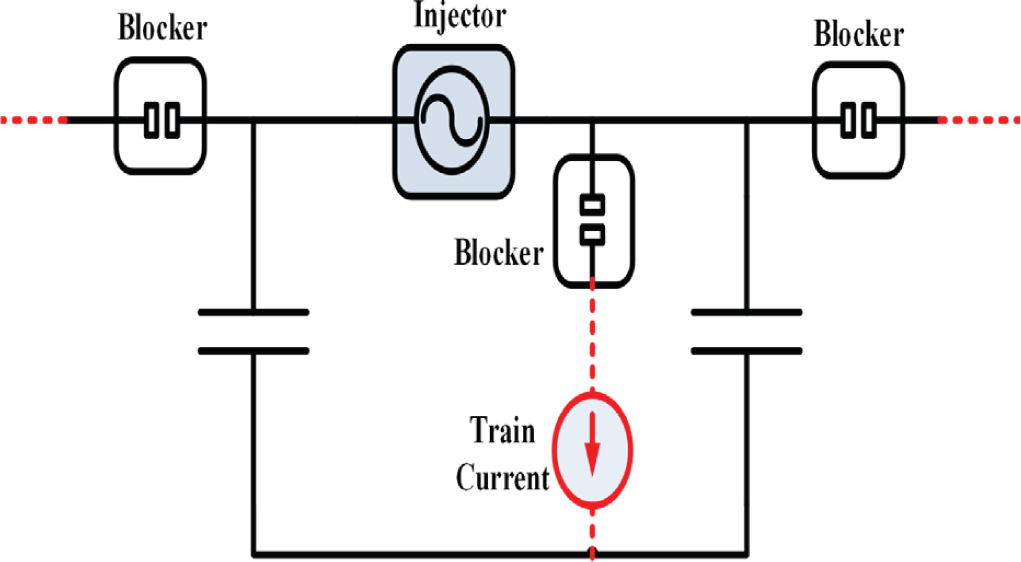
Each smart sensor can work either as an injector or as a blocker. . . . The smart sensor injects a high-frequency signal into the DC bus, while the blockers on the train and at each end of the segment keep the injected signal from propagating into undesired paths and beyond the segment. This gives rise to a new high-frequency electrical circuit. Further, due to the blockerʼs simulated isolation, this new circuit is electrically disconnected from the load. The only electrical path is through the distributed capacitance between the [third rail] and the ground, as shown in [Figure 2]. Deviations of this high-frequency system from the baseline impedance provide information about the health condition of the DC bus feeder. (Ibrahem et al. 2017)
Source: Ibrahem et al. (2017).
Long Description.
The diagram shows a smart sensor network that consists of a central injector connected to a line flanked by two blockers. The smart sensor injector sends a high-frequency signal into the line, while the blocker sensors on the train and at each end of the segment keep the injected signal from propagating into undesired paths and beyond the segment. A dotted line labeled 'Train Current' flows downward through the middle of the blocked segment, with an additional blocker on that path. Capacitors are connected to ground at two points, between the blockers and the injector.
The blocker has the same hardware structure as that of the injector sensor, and so the two can be used interchangeably.
The blocker senses the current on the line at the point where it is applied and uses closed-loop feedback to inject an opposing signal, which attenuates the current. As the blocker attenuates the current, the transmission line beyond the location of the blocker appears as a high impedance path. Thus, the sensorʼs measurement is restricted solely to the overhead line without the dominating influence of loading. (Ibrahem et al. 2017)
The steps in the execution of the project can be summarized as follows:
- Collect data germane to low-level fault currents in third-rail transit systems.
- Analyze the causes of low-level faults and the reasons they are not detected by existing technology in third-rail transit systems.
- Develop a modeling and simulation platform for third-rail DC transit power systems.
- Develop a prototype monitoring and control system for low-level fault detection for a third-rail DC transit system.
- Test the effectiveness of the device under actual transit conditions at an existing heavy rail property.
- Provide the transit industry with a prototype design for further development into production units by the private sector.

