Review of the SBIR and STTR Programs at the Department of Defense (2026)
Chapter: 6 The STTR Program and DOD
6
The STTR Program and DOD
The Department of Defense’s (DOD’s) Small Business Technology Transfer (STTR) program was established in 1992 with the aim of fostering innovation by facilitating collaboration between small businesses and research institutions. By leveraging the agility of small enterprises and the research capabilities of research institutions such as universities and federal laboratories, the STTR program is aimed at meeting DOD’s mission-critical needs through technological advances. This chapter explores the unique characteristics of DOD’s STTR program, examining its rationale, funding landscape, competitiveness, and obstacles, and concludes by synthesizing some key findings and recommendations.
STTR’S DISTINCTIVE RATIONALE AND STRUCTURE
The STTR program was established to address specific needs not fully met by the existing Small Business Innovation Research (SBIR) program. While both programs aim to stimulate technological innovation and enhance the role of small businesses in federal research and development (R&D), the STTR program is uniquely designed to foster formal collaborations between small businesses and research institutions, such as universities and federal laboratories.
The rationale for a separate STTR program lies in its potential ability to bridge the gap between fundamental research, often conducted within universities and federal laboratories, and practical application. While small and young businesses often possess agility and entrepreneurial drive, they may lack access to the specialized research facilities and expertise within universities, nonprofit research institutions, and Federally Funded Research and Development Centers (FFRDCs). Because it requires collaboration between small businesses and these research institutions, the STTR program has the potential to leverage those institutions’ capabilities and tools. This collaborative approach may be particularly valuable for DOD, which faces increasingly complex technological challenges and is particularly focused on realizing its mission.
The distinct rationale of the STTR program is reflected in its unique structural requirements, setting it apart from the SBIR program. Central to the STTR program is the mandatory collaboration between a small business and a U.S.-based research institution. This formal partnership is not merely encouraged but is a condition of eligibility, ensuring that both entities are actively involved in the R&D process. The small business must perform at least 40 percent of the R&D activities, while its research institution partner is required to carry out a minimum of 30 percent. The remaining 30 percent can be allocated flexibly based on the project’s specific needs.1 This structure ensures a significant commitment from both parties and promotes a balanced partnership in which the strengths of each can be effectively utilized. The partners must also establish a cooperative research agreement that outlines the terms of collaboration, including intellectual property rights, proprietary information, and commercialization plans. The SBIR program, on the other hand, permits but does not require collaboration agreements, and a certain percentage of the overall effort must be undertaken by the small business awardee, thereby capping the amount that can be undertaken by a research partner: in the case of Phase I SBIR awards at least two-thirds of the overall effort must be undertaken by the small business awardee, and for Phase II that figure drops to one-half (SBA, 2023).
THE STTR FUNDING LANDSCAPE
To assess the effectiveness and impact of DOD’s STTR program, it is useful to begin with an overview of STTR awards, including the funding rates for Phase I and Phase II applications, the distribution of awards across different services/components and states, and other characteristics.
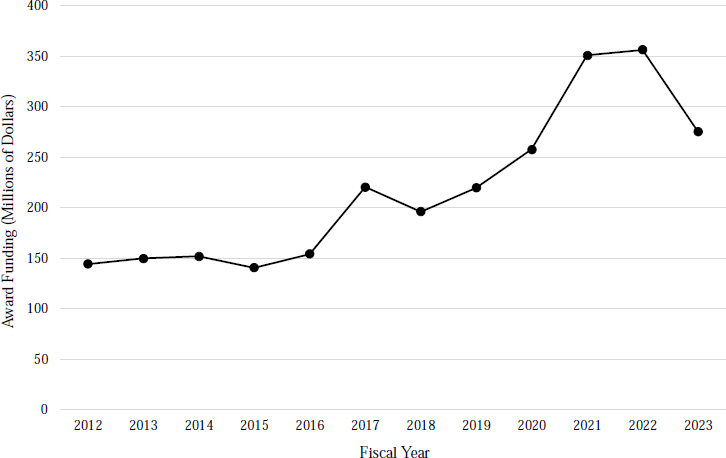
Figure 6-1 shows DOD’s expenditures on the STTR program and how they have evolved over time. The past decade has seen significant growth in the overall inflation-adjusted level of funding through the program, reflecting three interrelated developments. First, with the 2011 SBIR/STTR reauthorization, the statutory level of funding for STTR was gradually increased (from 0.3 percent to 0.45 percent of extramural R&D funding). Second, starting in 2017, there was a sizeable increase in the size of DOD’s extramural research expenditures, which led to an increase in the level of STTR expenditures. There was a further increase in this trajectory with the onset of the COVID-19 pandemic, with significant increases in overall federal research funding.
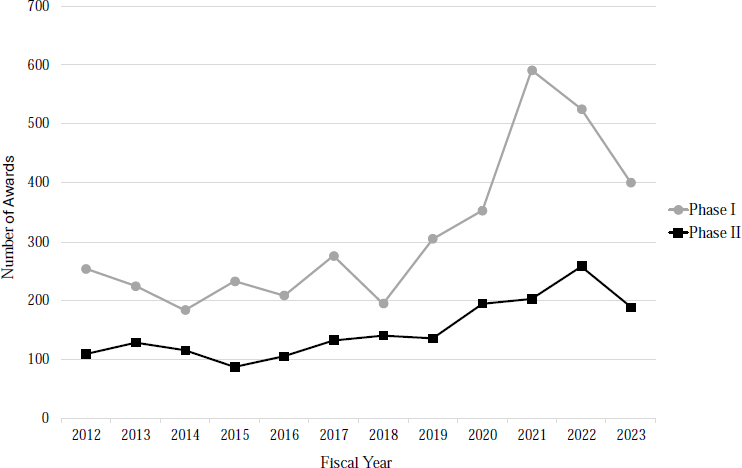
Despite this increase in expenditures, there has been a more muted (and recent) decrease in the number of actual awards (Figure 6-2). From fiscal year (FY) 2012 through 2019, the number of Phase I and Phase II STTR awards
___________________
1 The U.S. Small Business Administration’s 2023 SBIR/STTR Policy Directive indicates that “an agency can measure this research or analytical effort using the total award dollars or labor hours, and must explain to the small business in the solicitation how it will be measured” (SBA, 2023, p. 34). The DOD STTR 25.D Annual Program Broad Agency Announcement indicated that “the percentage of work is measured by both direct and indirect costs” (DOD, 2025b, p. 2).
NOTE: All values adjusted for inflation with 2023 as base year (https://www.bls.gov/data/inflation_calculator.htm).
SOURCE: Committee calculations based on the U.S. Small Business Association’s SBIR/STTR Awards database (SBIR.gov).
supported by DOD each remained at a roughly similar level, as illustrated in Figure 6-2. In other words, the overall number of awards remained (roughly) constant over this period, reflecting increased average award sizes from $299,000 to $415,000 in FY2019. In the most recent period (FY2019–2022), however, there was a sizeable increase in the number of awards, concentrated in Phase I awards.
Awardee Characteristics
An analysis of DOD’s STTR program over the period FY2012–2023 reveals notable trends in the characteristics of participating firms. The STTR program exhibits a relatively low fraction of first-time awardees and a high fraction of multiple-award recipients. Only 13.4 percent of STTR recipients were first-time awardees. Conversely, 32.2 percent of DOD’s Phase I STTR awardees received 15 or more Phase I SBIR or STTR awards from any federal agency within a 5-year period, a common characterization of multiple-award recipients, seen in previous scholarship (NASEM, 2020). The committee also calculated proportions of STTR awards made to higher-volume participants using the congressional performance benchmark of 51+ Phase I awards within 5 years from any federal agency, which are defined as “experienced firms” in the 2022 reauthorization of the SBIR/STTR programs (see the extended discussion in
NOTE: All values adjusted for inflation with 2023 as base year (https://www.bls.gov/data/inflation_calculator.htm).
SOURCE: Committee calculations based on the Small Business Administration’s SBIR/STTR Awards database (SBIR.gov).
Chapter 9).2 Using this measure, only 11.9 percent of DOD STTR awards went to experienced firms during fiscal years 2012–2023 (see Table 6-1).
The relatively low proportion of awards going to firms new to the program suggests that new firms may face greater barriers to entry compared with experienced firms. For instance, established firms may be more adept at navigating the program’s requirements. As noted, multiple-award recipients include those receiving multiple awards from DOD and those securing awards from multiple federal agencies. The prevalence of such firms indicates a concentration of awards among a subset of businesses with prior experience and success within federal R&D programs, possibly suggesting that academics in highly ranked universities may be selective in choosing the small firms with which they want to work as partners.
Further examination by DOD service/component, as detailed in Table 6-2, shows that this trend is particularly pronounced within the Navy, Army, and Missile Defense Agency (MDA), which have an even lower fraction of first-time awardees and a higher fraction of multiple-award recipients compared with the
___________________
2 U.S. Congress, SBIR and STTR Extension Act of 2022, P.L. 117-183 (September 30, 2022). See Section 8, “Increased Minimum Performance Standards for Experienced Firms.”
| Federal Agency | Percentage of First-Time Awardees | Percentage of Phase I STTR Awards to Firms | |||
|---|---|---|---|---|---|
| With 15+ Phase I SBIR/STTR Awards from Any Federal Agency | With 15+ Phase I SBIR/STTR Awards from DOD | With 51+ Phase I SBIR/STTR Awards from Any Federal Agency | With 51+ Phase I SBIR/STTR Awards from DOD | ||
| Department of Defense | 13.4 | 32.2 | 24.5 | 11.9 | 7.2 |
| Department of Energy | 22.7 | 17.0 | 3.4 | 4.6 | 1.4 |
| Department of Health and Human Services | 45.4 | 3.3 | 0.3 | 0.4 | 0.0 |
| National Aeronautics and Space Administration | 13.6 | 35.5 | 12.9 | 13.3 | 1.9 |
| National Science Foundation | 71.1 | 0.7 | 0.1 | 0.1 | 0.0 |
| Average | 33.2 | 17.7 | 8.2 | 6.1 | 2.1 |
NOTE: Experience is first calculated as the proportion of awards (Phase I STTR only) from an agency to firms that have accumulated at least 15 other Phase I SBIR or STTR awards from any federal agency in the previous 0–5 years. The committee also calculated figures using the 51+ Phase I award threshold for “experienced firms” per the provisions of the SBIR and STTR Extension Act of 2022 (P.L. 117-183) and as outlined by the Small Business Administration (SBA). See “Performance Benchmark Requirements” at https://www.sbir.gov/performance-benchmarks. For comparison, the table includes two columns with measures that restrict these underlying definitions to include only DOD SBIR/STTR awards.
SOURCE: Committee calculations based on SBA’s SBIR/STTR Awards database (SBIR.gov).
TABLE 6-2 STTR Awardee Characteristics Across Top Five DOD Divisions (Fiscal Years 2012–2023)
| Service/Component | Percentage of First-Time Awardees | Percentage of Phase I STTR Awards to Firms | |||
|---|---|---|---|---|---|
| With 15+ Phase I SBIR/STTR Awards from Any Federal Agency | With 15+ Phase I SBIR/STTR Awards from DOD | With 51+ Phase I SBIR/STTR Awards from Any Federal Agency | With 51+ Phase I SBIR/STTR Awards from DOD | ||
| Air Force | 17.5 | 24.0 | 17.6 | 7.2 | 4.2 |
| Army | 11.9 | 36.4 | 26.9 | 18.2 | 11.9 |
| Defense Advanced Research Projects Agency | 17.6 | 29.4 | 22.9 | 12.4 | 7.2 |
| Missile Defense Agency | 6.6 | 43.7 | 35.4 | 16.6 | 12.7 |
| Navy | 7.0 | 40.6 | 32.3 | 14.6 | 9.0 |
| Average | 12.1 | 34.8 | 27.0 | 13.8 | 9.0 |
NOTE: Experience is first calculated as the proportion of awards (Phase I STTR only) from an agency to firms that have accumulated at least 15 other Phase I SBIR or STTR awards from any federal agency in the previous 0–5 years. The committee also calculated figures using the 51+ Phase I award threshold per the provisions of the SBIR and STTR Extension Act of 2022 (P.L. 117-183). For comparison, the table includes two columns with measures that restrict these underlying definitions to include only DOD SBIR/STTR awards.
SOURCE: Committee calculations based on the Small Business Administration’s SBIR/STTR Awards database (SBIR.gov).
overall STTR program averages. In contrast, data on the Air Force and the Defense Advanced Research Projects Agency (DARPA) reveal relatively higher participation from first-time awardees and a lower proportion of multiple-award recipients.
This variance is especially significant given that the period of analysis includes the Air Force’s introduction of the open topics solicitation program, which offers many small Phase I awards.3 This initiative was designed in part to expand the small (or nontraditional) business base.4 The data suggest that the open topics program was effective in increasing the engagement of first-time awardees within the Air Force’s STTR program.
Geographic Distribution of Awards
An analysis of the geographic distribution of DOD STTR awards reveals significant variations in award intensity across various states. As illustrated in Figure 6-3, the relative intensity of STTR awards per capita is particularly high in
![Geographic distribution of DOD STTR awards per million capita (fiscal years [FY] 2012–2023)](https://www.nationalacademies.org/index.php/read/29329/assets/images/img-161.jpg)
SOURCE: Committee calculations based on the Small Business Administration’s SBIR/STTR Awards database (SBIR.gov).
___________________
3 STTR and SBIR open topics Phase I awards were originally offered for a shorter period of time (up to 3 months) and a maximum dollar value of $50,000. Currently, STTR Phase I open topics awards are for up to $110,000 (while SBIR Phase I open topic awards are for up to $75,000) for a 3-month period of performance.
4 15 U.S.C., Section 638(ww)(1)(B).
Massachusetts, Colorado, New Mexico, Alabama, New Hampshire, Virgina, Maryland, and Delaware. When one examines just Phase I awards (see Figure 6-4), these states are joined by Ohio. The location of DOD research laboratories and facilities may impact levels of STTR activity in those states or regions. Finally, looking just at Phase II STTR awards (see Figure 6-5), a pronounced concentration of awards is seen in Massachusetts, Virginia, and New Mexico. This higher concentration may reflect the presence of robust support systems, infrastructure, and resources necessary to advance projects to more complex development stages.
Table 6-3 presents STTR versus SBIR funding by state. Overall, STTR funding constitutes about 12.7 percent of the combined SBIR/STTR funding within the states. This ratio holds true for states such as California, Massachusetts, and Colorado, among others, suggesting a balanced engagement with both programs. Notably, certain Midwestern states with large, research-intensive public university systems—including Wisconsin, Illinois, and Ohio—exhibit a relative strength in STTR funding compared with SBIR funding. This pattern may be attributable to the strong collaborative relationships between small businesses and universities in these states, leveraging academic research capabilities to drive innovation through the STTR program. The geographic patterns observed
![Geographic distribution of DOD Phase I STTR awards per million capita (fiscal years [FY] 2012–2023)](https://www.nationalacademies.org/index.php/read/29329/assets/images/img-162.jpg)
SOURCE: Committee calculations based on the Small Business Administration’s SBIR/STTR Awards database (SBIR.gov).
![Geographic distribution of DOD Phase II STTR awards per million capita (fiscal years [FY] 2012–2023)](https://www.nationalacademies.org/index.php/read/29329/assets/images/img-163.jpg)
SOURCE: Committee calculations based on the Small Business Administration’s SBIR/STTR Awards database (SBIR.gov).
highlight the significant role played by DOD facilities and research institutions in the distribution of STTR awards. States that host major DOD laboratories and have universities with robust research programs tend to secure a higher number of awards, particularly at the more competitive Phase II level. This suggests that proximity to DOD resources and the presence of strong academic–industry partnerships are influential factors in the success of STTR initiatives.
Leading STTR Partner Institutions
Table 6-4 shows the top research institutions participating as firm partners in the STTR program. Many of the nation’s leading universities are actively engaged in collaborations with small businesses to advance defense-related technologies. Institutions such as the Massachusetts Institute of Technology, The Ohio State University, The Pennsylvania State University, Purdue University, and the Georgia Institute of Technology rank highly in terms of both funding amounts received and the number of STTR contracts awarded. Their significant involvement highlights the importance of academic expertise and resources in driving innovation within DOD. Institutions such as North Carolina State University (#3) and the University of Central Florida (#14, not
TABLE 6-3 Total DOD SBIR/STTR Program Funding, by State (Fiscal Years 2012–2023)
| State | Total SBIR Funding | Total STTR Funding | STTR Percentage of Total |
|---|---|---|---|
| Alabama | 539,686,119 | 97,306,784 | 15.3 |
| Alaska | 3,653,350 | 1,444,174 | 28.3 |
| Arizona | 320,350,958 | 58,009,929 | 15.3 |
| Arkansas | 21,658,125 | 4,871,818 | 18.4 |
| California | 3,803,759,090 | 441,183,181 | 10.4 |
| Colorado | 872,271,979 | 109,845,687 | 11.2 |
| Connecticut | 167,846,158 | 19,545,992 | 10.4 |
| Delaware | 76,651,429 | 18,654,476 | 19.6 |
| Florida | 645,574,117 | 81,662,469 | 11.2 |
| Georgia | 233,227,704 | 32,627,931 | 12.3 |
| Hawaii | 197,158,749 | 17,289,846 | 8.1 |
| Idaho | 31,750,813 | 4,158,256 | 11.6 |
| Illinois | 237,710,591 | 72,119,853 | 23.3 |
| Indiana | 142,182,184 | 24,905,708 | 14.9 |
| Iowa | 16,122,626 | 2,528,028 | 13.6 |
| Kansas | 34,258,138 | 11,381,774 | 24.9 |
| Kentucky | 32,668,168 | 16,214,651 | 33.2 |
| Louisiana | 75,841,671 | 5,553,798 | 6.8 |
| Maine | 21,738,892 | 514,270 | 2.3 |
| Maryland | 811,023,321 | 136,422,260 | 14.4 |
| Massachusetts | 2,144,618,237 | 303,433,417 | 12.4 |
| Michigan | 371,314,850 | 61,815,518 | 14.3 |
| Minnesota | 136,727,268 | 14,990,500 | 9.9 |
| Mississippi | 11,138,080 | 0.0 | |
| Missouri | 67,798,870 | 10,932,380 | 13.9 |
| Montana | 39,710,671 | 7,506,769 | 15.9 |
| Nebraska | 26,118,868 | 3,020,741 | 10.4 |
| Nevada | 45,117,759 | 9,741,571 | 17.8 |
| New Hampshire | 296,531,299 | 35,383,144 | 10.7 |
| New Jersey | 369,315,900 | 47,076,647 | 11.3 |
| New Mexico | 250,519,511 | 54,835,752 | 18.0 |
| New York | 652,211,410 | 113,930,138 | 14.9 |
| North Carolina | 329,105,648 | 52,577,445 | 13.8 |
| North Dakota | 1,526,124 | 1,073,214 | 41.3 |
| Not Found | 861,872,858 | 158,293,755 | 15.5 |
| Ohio | 47,564,447 | 13,347,672 | 21.9 |
| Oklahoma | 134,153,754 | 18,176,674 | 11.9 |
| Oregon | 794,586,511 | 72,517,884 | 8.4 |
| Pennsylvania | 77,873,455 | 7,823,612 | 9.1 |
| Rhode Island | 42,969,669 | 5,661,795 | 11.6 |
| South Carolina | 14,859,974 | 6,498,166 | 30.4 |
| South Dakota | 87,212,668 | 17,269,771 | 16.5 |
| Tennessee | 837,270,105 | 145,952,008 | 14.8 |
| Texas | 230,441,826 | 26,731,793 | 10.4 |
| Utah | 38,207,934 | 4,986,500 | 11.5 |
| Virginia | 1,605,364,238 | 197,129,039 | 10.9 |
| Vermont | 188,578,746 | 33,182,977 | 15.0 |
| Washington | 80,425,018 | 6,104,338 | 7.1 |
| West Virginia | 31,348,420 | 5,318,187 | 14.5 |
| Wisconsin | 42,783,592 | 19,268,693 | 31.1 |
| Wyoming | 30,314,579 | 2,998,159 | 9.0 |
| Total | 15,925,252,117 | 2,318,099,457 | 12.7 |
NOTE: All values adjusted for inflation with 2023 as base year (https://www.bls.gov/data/inflation_calculator.htm).
SOURCE: Committee calculations based on the Small Business Administration’s SBIR/STTR Awards database (SBIR.gov).
TABLE 6-4 Top DOD STTR Research Institution Partners (Fiscal Years 2012–2023)
| Institution | Number of STTR Awards | Total STTR Funding (Dollars) |
|---|---|---|
| Purdue University | 103 | 47,725,376 |
| The Ohio State University | 114 | 47,536,274 |
| North Carolina State University | 92 | 47,299,123 |
| Southwest Research Institute | 58 | 35,131,684 |
| Georgia Institute of Technology | 69 | 33,169,748 |
| University of Maryland | 64 | 33,112,349 |
| Massachusetts Institute of Technology | 69 | 31,674,482 |
| University of Arizona | 47 | 31,156,951 |
| Sandia National Laboratories | 54 | 30,796,209 |
| University of Michigan | 56 | 29,512,895 |
NOTE: All values adjusted for inflation with 2023 as base year (https://www.bls.gov/data/inflation_calculator.htm).
SOURCE: Committee calculations based on the Small Business Administration’s SBIR/STTR Awards database (SBIR.gov).
shown) also feature prominently, indicating that partnerships are not limited to the most prestigious universities but include a diverse range of institutions with specialized expertise or strong industry ties.
Notably, some top-tier universities renowned for their engineering and science programs, such as the University of California, Berkeley and the University of Illinois Urbana-Champaign are conspicuously absent from the list of leading STTR participants. This absence may stem from various factors, including an institutional focus on fundamental over applied research, differing collaboration policies, or lower levels of engagement with the STTR program. It suggests that while institutional prestige is significant, the effectiveness of the STTR program depends more on the strength and productivity of the collaborations between small businesses and research partners.
STTR Awards to Minority-Serving Institutions (MSIs)
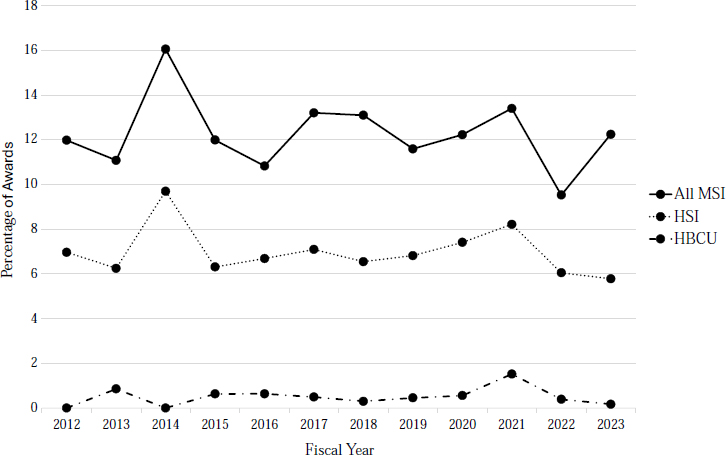
The committee’s statement of task5 includes examining the STTR program’s effectiveness in fostering research collaborations and identifying potential barriers, particularly for institutions serving minority populations. Table 6-5 illustrates MSI participation in the STTR program, and Figure 6-6 further breaks down trends in MSI STTR activity at DOD over the period FY2012–2023. The data reveal both challenges and opportunities for improvement.
| Institution | Number of STTR Awards | Total STTR Funding (Dollars) |
|---|---|---|
| University of Arizona | 47 | 31,156,951 |
| University of Central Florida | 50 | 25,406,904 |
| George Mason University | 38 | 15,836,623 |
| The University of Texas at Austin | 33 | 15,243,675 |
| University of California, San Diego | 28 | 14,541,934 |
| Colorado State University | 24 | 11,593,570 |
| University of California, Santa Barbara | 17 | 9,194,638 |
| University of Houston | 17 | 6,732,505 |
| University of North Texas | 13 | 5,198,622 |
| Florida International University | 15 | 2,064,287 |
NOTE: All values adjusted for inflation with 2023 as base year (https://www.bls.gov/data/inflation_calculator.htm). Minority-serving institutions drawn from Rutgers University’s 2024 published list based on Department of Education data (https://cmsi.gse.rutgers.edu/msi-directory).
SOURCE: Committee calculations based on the Small Business Administration’s SBIR/STTR Awards database (SBIR.gov).
___________________
5 The committee’s Statement of Task can be found in Chapter 1.
NOTE: All values adjusted for inflation with 2023 as base year (https://www.bls.gov/data/inflation_calculator.htm); MSIs drawn from Rutgers University 2024 published list based on Department of Education data, including subgroup analysis for historically Black colleges and universities (HBCUs) and Hispanic-serving institutions (HSIs) (https://cmsi.gse.rutgers.edu/msi-directory).
SOURCE: Committee calculations based on the Small Business Administration’s SBIR/STTR Awards database (SBIR.gov).
While some MSIs have achieved notable success in establishing STTR partnerships—with institutions such as the University of Central Florida (50 awards, $25.4 million) and George Mason University (38 awards, $15.8 million) establishing a substantial number of these partnerships—the overall trends shown in Figure 6-5 suggest persistent barriers to broader participation. The fact that MSI participation has declined from its 2014 peak of about 16 percent to recent levels of around 12 percent, dropping to just under 10 percent in FY2022, indicates challenges in creating and sustaining these collaborative relationships.
Moreover, the consistent underrepresentation of historically Black colleges and universities (HBCUs), with participation remaining below 2 percent throughout the study period, suggests significant structural barriers to creating these collaborations. While Hispanic-serving institutions (HSIs) have maintained higher participation rates (generally 2–6 percent of total awards), their representation still lags significantly behind that of non-MSI institutions.
Several potential barriers to collaboration emerge from this analysis. First, the concentration of awards among a small number of established research institutions suggests that institutional experience and infrastructure play a crucial
role in STTR success. The gap between top performers such as The Ohio State University (114 awards) and even the most successful MSIs indicates potential barriers to developing this institutional capacity. Second, the persistent disparity between HSI and HBCU participation rates suggests that different MSIs may face distinct challenges in establishing small business partnerships. This variance merits further investigation to understand the specific obstacles facing different types of institutions. Finally, the recent decline in overall MSI participation, particularly the sharp drop in FY2022, raises concern about whether current program structures adequately support sustained collaboration with MSIs.
These observations point to several potential mechanisms that could encourage such collaborations. The success of certain MSIs in establishing significant STTR portfolios suggests that targeted support for developing institutional capacity and partnership networks could help broaden participation. Additionally, the varying patterns of participation among different types of MSIs indicate that customized approaches may be needed to address the specific challenges facing different institutional categories.
The data strongly suggest that fostering broader collaboration, particularly with MSIs, will require focused attention to reducing barriers and developing supportive mechanisms. The current patterns of participation indicate that while the STTR program has created some successful partnerships with MSIs, significant work remains to stimulate broad-based research collaboration.
STTR, Federal R&D, and Technology Transfer
The committee analyzed funding patterns for research institutions to assess the STTR program’s effectiveness at transferring technology and capabilities developed through federal funding. Data from the National Science Foundation’s (NSF’s) National Center for Science and Engineering Statistics on institutional funding for federal R&D across all agencies, and DOD in particular, reveal a positive relationship between overall R&D expenditures and STTR participation that has significant implications for technology transfer outcomes.
A striking observation emerges when one compares institutions’ overall DOD R&D funding with their STTR participation. While Johns Hopkins University led significantly in DOD’s R&D expenditures ($8 billion) in FY2023, its STTR engagement was relatively modest ($1.7 million). Conversely, The Ohio State University, ranked 36th in DOD R&D funding ($47.4 million), showed the highest STTR expenditures ($9.5 million) among all institutions. This disparity suggests that high levels of DOD funding do not automatically translate into effective technology transfer through the STTR program.
The data also reveal potential challenges in the program’s technology transfer mission. Some major research universities with substantial DOD funding show limited STTR engagement. There is significant variation in STTR participation among institutions with similar levels of DOD funding, indicating the potential impact of institutional factors beyond research capacity. Indeed, the concentration of participation as partners among certain institutions suggests that effective technology transfer mechanisms may not be widely distributed across
the research institution landscape. These patterns suggest that while the STTR program has created effective pathways for technology transfer at certain institutions, its effectiveness varies significantly across the research institution landscape. The data indicate that technology transfer through STTR may depend more on institutional expertise in commercial translation and small business partnerships and the incentive structure within individual universities rather than on overall DOD research funding levels.
CHALLENGES TO STTR EFFECTIVENESS
The STTR program uniquely requires small businesses to collaborate with universities or federal laboratories, with at least 30 percent of the work being conducted by the research institution and 40 percent by the small business. This structure leverages the advanced research capabilities of academia and the agility of small businesses, fostering the development of cutting-edge technologies in such areas as quantum computing and advanced materials. However, this requirement also introduces complexities, such as the need for up-front negotiation of intellectual property agreements and potential misalignment between academic research objectives and DOD operational needs. These factors can impede the efficient transition of technologies to practical use within DOD, potentially leading to longer development timelines compared with the SBIR program. Other issues, discussed below, impact the potential effectiveness of the program.
Funding levels: The levels of Phase I and Phase II STTR funding have not kept pace with inflation, and the program, and its resulting collaborations, may benefit from additional flexibility in appropriate funding sizes, for both Phase I and Phase II projects. There may be cases in which smaller Phase I award sizes may be appropriate and other cases in which the optimum Phase II award size may be significantly larger than the current threshold. In areas such as artificial intelligence (AI), data science, and machine learning, the current salaries range from $150,000/year to $300,000/year (Sternlicht, 2025).6 Given that as little as 30 percent of the Phase I and Phase II award funding goes to a research partner, the actual amounts available to universities are not commensurate with the level of effort needed from professors and their graduate students or postdocs to participate in an STTR project. The stipends of graduate students in engineering are typically in the range of $40,000–$50,000/year,7 and postdoc salaries in the range of $75,000–$90,000/year (Sainburg, 2023). Given the low levels of funding, a typical STTR effort has a senior company employee or university faculty member serving as the principal investigator, with someone more junior doing most of the work. This being the case, STTR projects can often serve as a training ground for young employees.
___________________
6 See also https://aipaygrad.es.
7 See http://phdstipends.com.
Attracting more first-time awardees: As noted previously, the Navy, Army, and MDA exhibit particularly low fractions of first-time awardees and higher concentrations of multiple-award recipients. In contrast, the Air Force and DARPA have higher participation rates from first-time awardees. The Air Force’s implementation of the open topics program, which simplifies the application process, appears to have effectively increased engagement from new firms, which suggests that specific initiatives and solicitation strategies can reduce barriers to program entry. This observation is particularly important with respect to attracting junior researchers working in cutting-edge technical areas such as AI and quantum. The STTR program provides a distinctive and critical pipeline to encourage more junior researchers to continue work (e.g., during a thesis or postdoc) while also engaging with the defense innovation system.
Data sensitivity: More and more STTR projects may need a controlled unclassified information (CUI) clause. Many universities view this provision as an impediment, given that a significant number of graduate students in science and engineering are international students, who cannot access CUI information. As these students are well trained in AI, data science, and machine learning, if CUI provisions are enforced, the small companies will be unable to attract them, and they may eventually join large companies such as Meta, Google, or Apple.8
DOD bureaucracy: Many small business owners double as their company’s contract officers. STTR contract negotiations involve such issues as intellectual property rights, publication of results, and technology transfer between companies and universities. Issues such as getting paid on time and any gap in funding between Phase I and Phase II could discourage small businesses.
FINDINGS AND RECOMMENDATIONS
Finding 6-1: The STTR program requirement to collaborate with a research institution is both a significant strength and a source of challenges.
Finding 6-2: The participation rate of first-time firms in DOD’s STTR program is low, indicating potential barriers to entry.
Finding 6-3: DOD STTR awardees are geographically concentrated in states with major DOD research facilities and strong academic–industry partnerships, potentially limiting nationwide contributions to innovation.
Recommendation 6-1: Department of Defense Small Business Technology Transfer (STTR) program managers should prioritize and experiment with new means of targeted outreach and support for new firms and those from historically underutilized parts of the country in order to enrich the innovation ecosystem.
___________________
8 For a discussion of CUI and the challenges it poses for some researchers, see NASEM, 2022.
Recommendation 6-2: Department of Defense Small Business Technology Transfer (STTR) program managers should streamline collaboration requirements and provide support for negotiating intellectual property agreements to reduce complexities and expedite technology transitions.
This page intentionally left blank.


